
What was advertised in a revolutionary American newspaper 250 years ago this week?
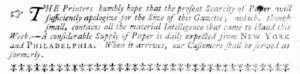
“This Gazette … though small, contains all the material Intelligence that came to Hand this Week.”
The June 1, 1776, edition of John Dixon and William Hunter’s Virginia Gazette looked different than previous issues and opened with an explanation from the printers. That newspaper usually consisted of four pages of three columns each with a large masthead at the top of the first page. In addition to the title, date, names of the printers, and issue number, the usual masthead declared that the newspaper contained “THE FRESHEST ADVICES, BOTH FOREIGN AND DOMESTIC.” Another line in the masthead proclaimed, “IN CIVITATE LIBERA LINGUAM MENTEMQUE LIBERAS ESSE DESERE” or “In a free state, there should be freedom of speech and thought.” For a final layer, an advertisement for subscriptions, paid notices, and job printing ran across the bottom of the masthead. An image depicting the arms of the monarch, similar to the one previously used by Alexander Purdie in the masthead of his Virginia Gazette, appeared in the center of Dixon and Hunter’s standard masthead.
The latest edition of their newspaper, however, consisted of four pages with two columns per page on a smaller sheet. Rather than a masthead with five layers of text serving different purposes, a streamlined masthead gave the title on one line and the date, number, city, and names of the printers on the second line. No image appeared in that masthead. Subscribers could not help but notice that Dixon and Hunter’s Virginia Gazette had a new size and format. Anticipating what kinds of reactions that might cause, the printers opened with a notice to readers: “THE Printers humbly hope that the present Scarcity of paper will sufficiently apologize for the Size of this Gazette.” They tried to mollify their customers, asserting that the June 1 edition, “though small, contains all the material Intelligence that came to Hand this Week.” They did not, however, make any sort of acknowledgment that some advertisements may have been omitted for lack of space. “A considerable Supply of Paper is daily expected from NEW YORK and PHILADELPHIA,” the printers explained before ending with a promise. “When it arrives, our Customers shall be served as formerly.” It was not the first time during the Revolutionary War that colonizers in Virginia did not have access to as much news and advertising in the public prints as they had come to expect. In January 1776, for instance, John Pinkney, the printer of another Virginia Gazette, ran an advertisement in Dixon and Hunter’s newspaper to explain that he missed an issue due to “a Disappointment in receiving Paper from the Northward.” Dixon and Hunter faced the same challenge. The following week they still did not have a new supply of paper, but they doubled the number of smaller pages to eight to serve their readers and their advertisers.