
Who was the subject of an advertisement in a revolutionary American newspaper 250 years ago today?
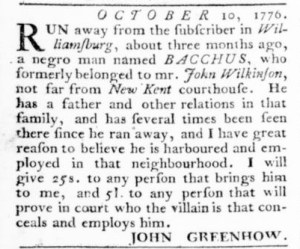
Like many other enslavers seeking to recover their human property, John Greenhow placed a newspaper advertisement that described the enslaved man who liberated himself by running away from him and offered a reward for his capture and return. In this instance, Greenhow inserted an advertisement about Bacchus in the October 18, 1776, edition of Alexander Purdie’s Virginia Gazette. By that time, Bacchus had eluded Greenhow for three months.
Greenhow suspected that Bacchus had help. He explained that the enslaved man “formerly belonged to mr. John Wilkinson, not far from New Kent courthouse.” He reported that Bacchus headed that direction because he “has a father and other relations in that family, and has several times been seen there since he ran away.” Furthermore, Greenhow had “great reason to believe he is harboured and employed in that neighbourhood.” He did not mention whether Bacchus had any notable skills, yet Greenhow seemed certain that the formerly enslaved man managed to find work in the vicinity. He was so confident that was the case that he offered a reward “to any person that will prove in court who the villain is that conceals and employs him.” If Greenhow was correct, that meant that Bacchus received help not only from his “father and other relations” and other Black people but also from a white employer who did not ask too many questions about his background or who might even have been sympathetic to his situation.
Although Greenhow did not write the advertisement with the intention of creating a truncated biography of Bacchus, the notice revealed choices that the Black man made during the Revolutionary War. Among the many disruptions caused by the war, enslaved men and women had the option of making their way to British forces in hopes of earning their freedom. Both men and women could provide services in camp, while men could also fight. In November 1775, John Murray, the Earl of Dunmore and the last royal governor of Virginia, issued a proclamation that offered freedom to enslaved people “appertaining to rebels” (or enslaved by patriots) who were “willing to bear arms” and “join[ed] his Majesty’s troops.” Some advertisements indicated that enslaved men and women who liberated themselves were likely making their way to the British. Yet Bacchus did not make that choice; at least, Greenhow did not think that he did. Instead, Bacchus chose to reunite with his father and other members of his family. He called on bonds with family and friends and forged some sort of agreement with an employer to keep him hidden from Greenhow. Still in danger of discovery, Bacchus was in a better position than if he did not have allies who aided him in seeking freedom.