February 13

What was advertised in a colonial American newspaper 250 years ago this week?

Boston-Gazette (February 7, 1774).

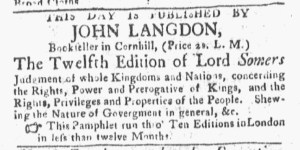
“This Pamphlet run thro’ Ten Editions in London in less than twelve Months.”

American printers and booksellers marketed and sold a variety of political pamphlets and treatises during the imperial crisis that led to thirteen colonies declaring independence from Great Britain.  In addition to hawking items printed in London and imported to the colonies, some of those printers and booksellers also published American editions, as was the case with The Judgment of Whole Kingdoms and Nations, Concerning the Rights, Privileges and Properties of the People.  Three American editions appeared in 1773 and 1774, one in Philadelphia, one in Boston, and one in Newport, Rhode Island.

Several rare book dealers, including Bauman Rare Books, offer overviews of the publication history, contents, and significance of The Judgment of Whole Kingdoms and Nations.  Originally published as Vox Populi, Vox Dei in London in 1709, the pamphlet “examines principles of limited monarchy and the right of resistance to tyranny,” drawing on “historical precedents and reiterat[ing] opposition to absolute monarchy during the time of England’s Glorious Revolution.”  Colonial printers and booksellers both answered the demand for this sort of political philosophy and helped to stoke opposition to king and Parliament by publishing and disseminating this pamphlet and other tracts and treatises.  The Judgment of Whole Kingdoms and Nations “contains the seed of what would become the American Bill of Rights – reprinting the English Bill of Rights – and was read by many of the Founding Fathers, including John Adams and Thomas Jefferson, who owned the Philadelphia 1773 edition.”

Adams may have acquired his copy after reading the advertisement that John Langdon placed in the February 7, 1774, edition of the Boston-Gazette, a newspaper that took an especially vocal stance in support of the Sons of Liberty and the rights of Americans.  Langdon, a bookseller, published the book, engaging the services of Isaiah Thomas as printer.  To incite demand, Langdon informed prospective customers that “This Pamphlet run thro’ Ten Editions in London in less than twelve Months.”  How could anyone interested in politics in the colonies miss out on what was such a popular and influential work in the capital of the empire?  Readers of the Boston-Gazette had to decide for themselves how much to trust Langdon’s assertion about the rapid sales of the pamphlet in London.

That report, however, may have contributed to colonizers overestimating how much the general public on the other side of the Atlantic supported them in their disputes with George III and Parliament.  In Misinformation Nation: Foreign News and the Politics of Truth in Revolutionary America, Jordan E. Taylor argues that American newspapers selectively published reports from London, creating narratives of recent events that matched the ideologies of the printers.  Langdon’s note at the end of his advertisement for a political pamphlet used to support the American cause may have buttressed the narrative that Benjamin Edes and John Gill advanced in the news items and editorials they published elsewhere in the Boston-Gazette.  Declaring that The Judgment of Whole Kingdoms and Nations sold so rapidly in London suggested widespread support for the principles it contained as well as applying them to the American colonies.

February 7

GUEST CURATOR:  Kolbe Bell

What was advertised in a colonial American newspaper 250 years ago today?

Massachusetts Gazette and Boston Post-Boy (February 7, 1774).

“Embellished with a (Quarto) View of the Town of Boston … neatly engraved on Copper.”

The Royal American Magazine was a popular magazine during a run cut short due to the fighting of the American Revolution.  It was first published in 1774 by Isaiah Thomas, a renowned printer who ran the Massachusetts Spy, a newspaper, since 1770.  The Royal American Magazine lasted from January 1774 to early spring of 1775.  Not many successful magazines were started in America before the American Revolution.  Frank Luther Mott states that there were only fifteen magazines published in America before the Royal American started, most of them lasting a year or less.[1]  Isaiah Thomas’s advertisement campaign for the Royal American, however, helped to make it one of the most successful American magazines prior to independence.

The Royal American Magazine was known for having many more engravings than other American magazines at the time; engravings are visual images inserted into a written work, and were made by carefully carving a reverse image onto a copper plate, coating it with ink, and then transferring the image to paper in a printing press.  The engravings representing a “View of the Town of Boston, and a Representation of a Thunder Storm,” as mentioned in this advertisement, enticed more people to subscribe to the magazine.  According to Mott, “its distinctive feature was a little series of engravings by Paul Revere.”[2]  The fact that the advertisement does not include the name of Paul Revere as the engraver for the magazine shows that Paul Revere’s fame increased after the American Revolution.  Despite the Royal American Magazine containing so many engravings and other content, it did not last much longer than a year.  Nevertheless, it was one of the most popular magazines printed in America before the American Revolution.

Visit the “Royal American Magazine Plates,” part of the “Illustrated Inventory of Paul Revere’s Works at the American Antiquarian Society,” to view the engravings and learn more about them.

**********

ADDITIONAL COMMENTARY:  Carl Robert Keyes

Later than he intended (and later than he had advertised), Isaiah Thomas published the first issue of the Royal American Magazine in early February 1774.  The Adverts 250 Project has tracked Thomas’s extensive advertising campaign over many months in 1773 and 1774, including his announcements that he would publish the first issue in January 1774 and an explanation that a ship running aground delayed delivery of the types for the magazine to Boston.  On Thursday, February 3, he inserted a brief notice in his own newspaper, the Massachusetts Spy, pledging that “MONDAY next will be published … NUMBER I. of The Royal AMERICAN MAGAZINE.”  Just as he would do four days later in the advertisement Kolbe examines today, he promoted copperplate engravings of a “View of the Town of Boston, and a Representation of a Thunder Storm.”  Subscribers could leave the engravings intact or, as many likely did, remove them to display in their homes, shops, or offices.

Boston-Gazette (February 7, 1774).

Thomas had aggressively advertised in other newspapers, including several published in Boston.  He once again did so when he finally took the magazine to press.  In addition to the version that ran in the Massachusetts Gazette and Boston Post-Boy on February 7, featured above, he placed a shorter notice in the Boston-Gazette on the same day.  Extending only three lines, it declared, “THIS DAY PUBLISHED, (by I. THOMAS,) Number I. of The Royal American MAGAZINE.”  Perhaps he submitted copy that included the blurb about the copperplate engravings to the printing office only to have the compositors edit it for length to fit on the page with the rest of the news and advertising in that issue.  Whatever the case, Thomas fulfilled the promise he made in the Massachusetts Spy on February 3.  He did indeed publish the Royal American Magazine on the following Monday.  He followed up with much more extensive advertisements in the Massachusetts Spy and the Massachusetts Gazette and Boston Weekly News-Letter on February 10, announcing his success and encouraging more readers to subscribe.

**********

[1] Frank Luther Mott, A History of American Magazines, 1741-1850 (Cambridge: Harvard University Press, 1939), 787-788.

[2] Mott, History of American Magazines, 26.

January 30

What was advertised in a colonial American newspaper 250 years ago this week?

Boston-Gazette (January 24, 1774).

Our Advertising Customers, are desired for the future to send their Advertisements by Saturday Sunset.”

Benjamin Edes and John Gill, printers of the Boston-Gazette, exercised their prerogative as proprietors of the newspaper to place some notices about its operation at the top of the first column on the first page of the January 24, 1774, edition.  Doing so, they hoped, increased the likelihood that the customers they addressed would see them and take note.  To that end, they enclosed their first notice within a decorative border.  The printers declared, “ALL Persons indebted for this Paper, whose Accounts have been above 12 Months standing, are requested to make immediate Payment.”  Printers often extended credit to subscribers.  Some of them remained delinquent for years.

In another notice, Edes and Gill instructed that “Our Advertising Customers, are desired for the future to send their Advertisements by Saturday Sunset.”  Rather than a decorative border, a manicule and italic font called attention to this notice.  Edes and Gill published the Boston-Gazette on Mondays, but ordinances in colonial Boston prohibited working on Sundays.  Sunset occurred at 4:52 in the afternoon on the day the printers published this announcement.  Though that time has been standardized for modern time zones, it was early enough in the day that those laboring in the printing office could set type and finish printing the newspaper in the evening.  John Adams suggests that Edes and Gill may not have always abided the prohibition on working on Sundays.  On Sunday, September 3, 1769, he wrote in his diary that he attended a “Charity Lecture” and then “Spent the Remainder of the Evening and supped with Mr. Otis, in Company with Mr. Adams, Mr. Wm. Davis, and Mr. Jno. Gill.  The Evening spent in preparing for the Next Days Newspaper – a curios Employment.  Cooking up Paragraphs, Articles, Occurences, &c. – Working the political Engine!”  Things were in motion at Edes and Gill’s printing office on Sundays, at least sometimes!  Yet in the early 1770s some colonizers even complained about work undertaken on Saturday evenings.  Announcing that they accepted advertisements until sunset on Saturdays may have been Edes and Gill’s way of indicating that they completed most of their work by that time while also holding firm that they could labor into the evening if they wished.  Although they would not have used the phrase, it gave them plausible deniability about any intentions of working on Sundays.

In a third notice, the printers teased an item that would appear in the next edition.  They acknowledged that they “receiv’d THE REMEMB’RANCER … intended for this Day’s Paper,” yet chose to delay publication for a week.  The piece “publickly reveals very marvellous Practices of his Excellency, at the last Session of the General Assembly.”  Edes and Gill chose to hold off on embarrassing the governor, Thomas Hutchinson, “till next Week, when the Members of both Houses will be more generally in Town.”  The printers may have hoped that the anticipation would yield more sales for the next issue of the Boston-Gazette, though their primary goal seemed to be that as many people as possible, especially those who served in the assembly, would read the piece when issues circulated the following week.  It appeared as the first item on the first page of the January 31 edition.

Rather than opening the January 24 edition with news, editorials, or advertisements submitted by customers, Edes and Gill instead tended to the business of operating their newspaper first and then published other content.  They called on delinquent subscribers to settle accounts, directed advertisers when to submit their notices, and previewed a juicy letter that would appear in the next issue, giving their own notices a prominent place on the page.

January 24

What was advertised in a colonial American newspaper 250 years ago today?

Boston-Gazette (January 24, 1774).

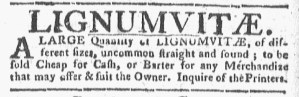
“A LARGE Quantity of LIGNUMVITAE.”

In selecting this advertisement, I collaborated with Kendra Apicella, a student in my Revolutionary America class in Fall 2023.  Kendra spotted the notice when she undertook her responsibilities as guest curator for the Slavery Adverts 250 Project.  She was not with familiar with lignum vitae.  Neither was I.  That provided an opportunity for student and professor to learn together as we looked for more information about this commodity that appeared in the pages of the January 24, 1774, edition of the Boston-Gazette.  Lignum vitae, we discovered, referred to a tree indigenous to the Caribbean as well as wood and resin obtained from the tree and medicines derived from the resin.

Lignum vitae translates from Latin as “wood of life,” a name given to the tree because of its medicinal qualities.  The advertisement in the Boston-Gazette did not seem to market “A LARGE Quantity of LIGNUMVITAE” as a remedy.  Instead, the “different sizes, uncommon straight and sound,” suggests pieces of wood intended for furniture and decorative items.  On behalf of the St. John Historical Society, Eleanor Gibney provides a history of the commodification of the tree in the early modern period in “Lignum vitae: Beauty, Strength, and the Fallibility of Medicine.”  She explains that lignum vitae “is among the hardest and heaviest of all commercial woods.”  Furthermore, “[w]hat makes lignum vitae wood so valuable is not the density alone, but the combination with the oily resin that permeates the wood, lubricating and making it almost indestructible.”

Gibney also notes that a Moravian missionary, C.G.A. Oldendorp, recorded some thoughts about lignum vitae during his time in the Virgin Islands.  In 1767, he described the wood as “difficult to work with, both on account of its hardness and its crooked growth.”  That hardness meant durability.  Iron would rust away more quickly than building timbers made of lignum vitae would rot, he asserted.  Oldendorp further described the wood as “expensive” and “exported to Europe in considerable quantities.”  It also found its way to British colonies in North America.  The anonymous seller who advertised in the Boston-Gazette acknowledged the wood’s reputation for “crooked growth” when describing the pieces available as “uncommon straight and sound.”  The advertiser also banked on widespread familiarity with the wood’s “hardness” and durability, not considering it necessary to elaborate on those qualities.

Eighteenth-century readers, immersed in the language of consumer culture of the era, recognized “LIGNUMVITAE” when they saw it advertised among the notices in the Boston-Gazette, yet many modern readers do not have any immediate associations with the tree, its appearance and other qualities, and the various uses of the wood.  I often tell my students that colonizers spoke their own language, no matter how much it looks like English to us, and that we have to translate the words that they wrote and published.  Sometimes that is because the meanings of words have shifted over time or words commonly used in the eighteenth century are no longer part of everyday speech.  In this instance, like so many others involving consumer culture (including all the different kinds of textiles listed in countless advertisements!), a once-popular commodity no longer has the demand it did in the early modern era.  Kendra and I both learned more about commerce and consumption in the Atlantic World thanks to our curiosity about this advertisement for lignum vitae.

January 3

What was advertised in a colonial American newspaper 250 years ago today?

Boston-Gazette (January 3, 1774).

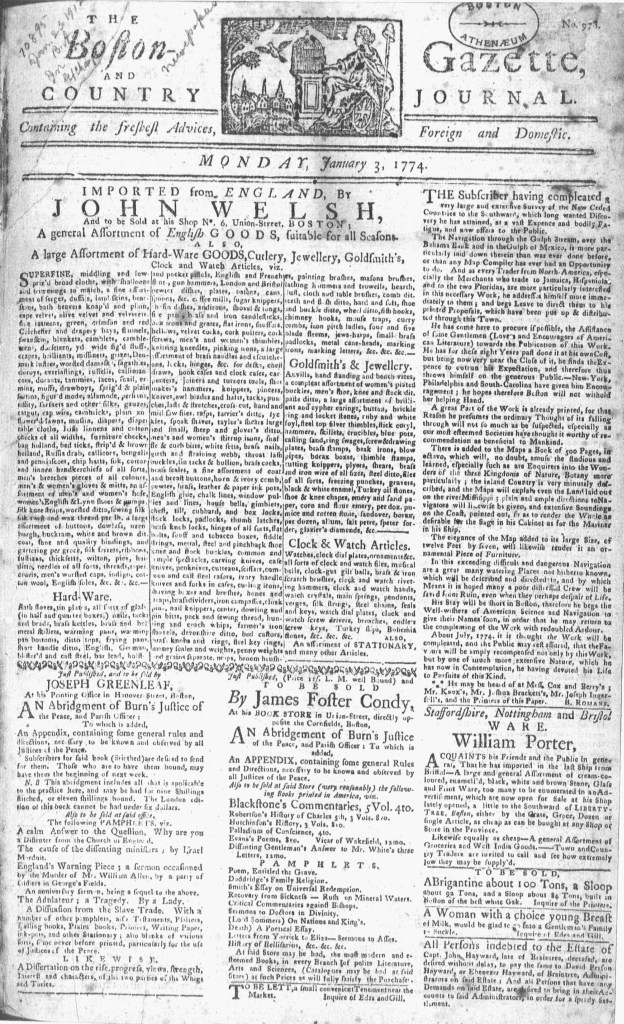
“A large Assortment of Hard-Ware GOODS, Cutlery, Jewellery, Goldsmith’s, Clock and Watch Articles.”

Readers almost certainly noticed John Welsh’s advertisement in the January 3, 1774, edition of the Boston-Gazette.  The shopkeeper announced that he imported and sold “A general Assortment of English GOODS, suitable for all Seasons” and “A large Assortment of Hard-Ware GOODS, Cutlery, Jewellery, Goldsmith’s, Clock and Watch Articles.”  To demonstrate the selection he offered to consumers, Welsh published an extensive list of his inventory.

The length of that list alone distinguished Welsh’s advertisement from others that ran in that issue of the newspaper.  More significantly, the format and placement made his notice notable.  Rather than extending in one column and continuing in the next, the advertisement spanned two of the regular columns, an unusual format in the Boston-Gazette or any other colonial newspaper.  Within the space occupied by the advertisement, the list of goods was divided into three columns with lines, but no space, separating them.  While that made the dense text more difficult to navigate, Welsh did provide some guidance with a series of headers.  The “English GOODS,” mostly textiles and accessories, that appeared first did not have a header, but “Hard-Ware,” “Goldsmith’s & Jewellery,” and “Clock & Watch Articles” each had headers that directed readers to items of interest.

The advertisement’s position on the page also enhanced its visibility.  It ran in the upper left corner on the first page, right below the masthead, making it the first item that readers saw when they perused the first issue of the Boston-Gazettepublished in 1774.  Even if readers who knew that the latest news often appeared on the second and third pages rather than the front page immediately flipped past the first page, they likely noticed Welsh’s advertisement as they skimmed to make sure they did not miss any news that might have appeared on the front page.  After all, the organization did vary from week to week depending on the amount of “intelligence” and advertisements submitted to the printing office.  Welsh’s advertisement dominated the first page, as it would have done on any page.  The unusual format underscored the wide selection of merchandise that he made available to customers.

Boston-Gazette (January 3, 1774).

December 27

What was advertised in a colonial American newspaper 250years ago today?

Boston Evening-Post (December 27, 1773).

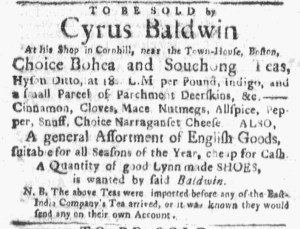
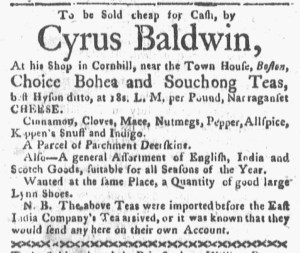
“The above Teas were imported before any of the East-India Company’s Tea arrive, or it was known they would send any on their own Account.”

Cyrus Baldwin advertised “Choice Bohea and Souchong Tea” in the December 20, 1773, edition of the Boston Evening-Post, the first issue published following the protest now known as the Boston Tea Party.  In an effort to convince both prospective customers and the general public that he traded in good faith, he appended a nota bene to assert that his teas “were imported before any of the East-India Company’s Tea arrive, or it was known they would send any on their own Account.”  Three days later, he ran a similar advertisement in the Massachusetts Spy.  That notice included new merchandise, but it still listed “CHOICE Bohea and Souchong Teas” and concluded with the same nota bene.  As the politics of tea became a main topic of discussion, in town meetings, in the press, in everyday conversation, did not decide to discontinue his advertisements presenting tea for sale at his shop in Boston.

Boston-Gazette (December 27, 1773).

On December 27, Baldwin once again advertised in the Boston Evening-Post, replacing his advertisement from the previous issue with the one from the Massachusetts Spy.  In addition, that advertisement, complete with the nota bene, also ran in the Boston-Gazette on December 27.  Over the course of several days, Baldwin inserted it in three of the five newspapers published in Boston at the time.  Notably, neither Isaiah Thomas, the printer of the Massachusetts Spy, nor Benjamin Edes and John Gill, the printers of the Boston-Gazette, rejected the advertisement, though they had earned reputations as the printers who most vociferously advocated for the patriot cause and critiqued Parliament and colonial officials.  Did their willingness to publish the advertisement serve as tacit endorsement of the rationale Baldwin offered to justify selling his tea?  Maybe not.  The printers may have been too busy participating in events as they unfolded after the Boston Tea Party and gathering news from near and far that they did not scrutinize the contents of all the advertisements submitted to their printing offices.  After all, other merchants and shopkeepers continued to advertise tea in the Boston-Gazette and the Massachusetts Spy.  The printers may not have examined each advertisement closely to spot tea among the lists of merchandise.  They might have also been satisfied, at least for the moment, because they knew any tea sold by Baldwin and others had not been acquired via the problematic shipments that ended up in the harbor rather than in shops and stores.

As colonizers, including “Venders of Tea,” debated what to do next following the Boston Tea Party, they did not immediately cease advertising, buying, selling, and drinking tea.  Following strategies that they adopted in response to the Stamp Act and the Townshend Acts, they eventually devised nonimportation and consumption agreements.  Loyalists like Peter Oliver accused patriots, especially women, of cheating on those agreements.  Such indiscretions would have been a continuation of the flexibility toward tea exhibited in newspaper advertisements published in the days immediately after the Boston Tea Party.

December 13

What was advertised in a colonial American newspaper 250 years ago today?

Boston-Gazette (December 13, 1773).

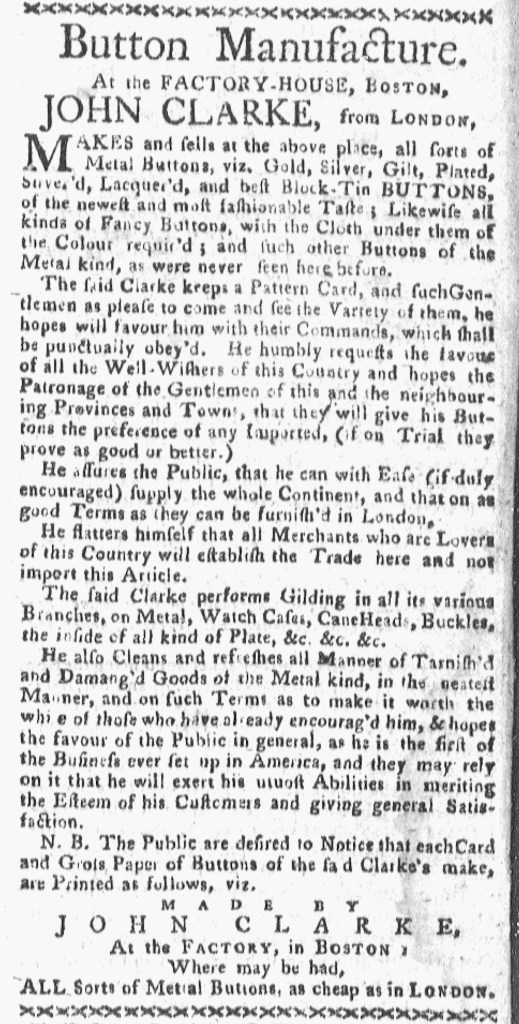
“He flatters himself that all Merchants who are Lovers of this Country will establish the Trade here and not import this Article.”

John Clarke made and sold “all sorts of Metal Buttons” at the “FACTORY-HOUSE” in Boston.  His advertisement in the December 13, 1773, edition of the Boston-Gazette testified to the many ways that he marketed his buttons, both within and beyond newspaper notices.  For instance, Clarke did more than describe his “Gold, Silver, Gilt, Plated, Silver’d, Lacquer’d, and best Block-Tin BUTTONS, of the newest and most fashionable Taste” and “Fancy Buttons with the Cloth under them of the Colour requir’d.”  He also provided samples on “a Pattern Card,” inviting prospective customers to “come and see the Variety of them.”  Clarke hoped that after examining those specimens they would place orders.  He also devised a means of identifying his buttons once they left his manufactory, advising that “each Card and Gross Paper of Buttons of the said Clarke’s make, are printed as follows, viz. MADE BY JOHN CLARKE, At the FACTORY, in Boston: Where may be had, ALL Sorts of Metal Buttons, as cheap as in London.”  His newspaper advertisement reproduced a shorter advertisement that appeared on the packaging of his products.

Clarke also made an appeal to support domestic manufactures, echoing the sentiments that John Keating so often published in advertisements for his “PAPER MANUFACTORY” in New York and others who wished to support local economies rather than importing so many goods from Great Britain.  He presented his buttons to “all the Well-Wishers of this Country and hopes the Patronage of the Gentlemen of this and the neighbouring Provinces and Towns, that they will give his Buttons the preference of any imported.”  Clarke made this appeal as tensions mounted in Boston over the arrival of ships carrying tea that Parliament intended to tax under the new Tea Act.  Within a week, colonizers would board those ships and throw the tea into the harbor.  Clarke likely expected that his message would resonate with readers of theBoston-Gazette, one of the newspapers that most often decried the abuses of Parliament and the colonial officials that attempted to implement its policies.  Those readers (and his prospective customers) included “Merchants who are Lovers of this Country” who had a duty, Clarke asserted, to “establish the Trade here and not import this Article.”  He did not, however, expect merchants, shopkeepers, tailors, and consumers to accept an inferior product as an alternative to the buttons imported from London.  He asked customers to try his buttons, determine “if on Trial they prove as good or better,” and only then place orders for larger quantities “on as good Terms as they can be furnish’d in London.”

At a time when the imperial crisis intensified, Clarke encouraged colonizers to “Buy American” and support his “FACTORY HOUSE” for making buttons, “the first of the Business ever set up in America.”  In addition to his extensive appeal that ran in the Boston-Gazette, the packaging for his buttons included an abbreviated version that promoted his “FACTORY, in BOSTON,” and compared its output, “ALL Sorts of Metal Buttons,” to those imported from London.

September 27

What was advertised in a colonial American newspaper 250 years ago today?

Boston-Gazette (September 27, 1773).

“A PAMPHLET, Intitled, BATES and his HORSES weighed in the Balance.”

Mr. Bates did not receive a universally warm welcome when he performed his feats of horsemanship in Boston in the fall of 1773.  Bates advertised in several newspapers in the city, announcing his presence and informing prospective audiences of his considerable experience performing at courts in Europe.  On September 27, his advertisement for an exhibition scheduled for the next day ran in all three newspapers published in the city that day.  Although it appeared on its own in the Boston Evening-Post, another advertisement concerning Bates ran in the Boston-Gazette and the Massachusetts Gazette and Boston Post-Boy.  That notice offered a brief critique of Bates and promised a more extensive treatment in a pamphlet.  The cheeky compositors conveniently placed the advertisements next to each other in the Boston-Gazette and at the top and bottom of the same column in the Massachusetts Gazette and Boston Post-Boy.

The new notice announced the anticipated publication of a pamphlet, “BATES and his HORSES weighed in the Balance” in a few days.  The pamphlet would demonstrate that “his Exhibitions in Boston are impoverishing, disgraceful to human Nature, and down-right Breaches of the Sixth Commandment.”  The advertisement concluded with an admonition, “Oh be a Man,” from Edward Young’s The Complaint: Or, Night-Thoughts on Life, Death, and Immortality.  The line from the poem may have been intended to mock Bates and demean the sense of masculinity that defined him and supposedly made it possible for him alone to perform “a Variety of manly Exercises” never before seen in Boston.  Alternately, it may have condemned the pride that he exhibited, both in person and in newspaper advertisements and handbills.  For his part, Bates may have welcomed the additional attention for his act instead of experiencing embarrassment over the attack in the public prints and the imminent publication of the pamphlet.

Whatever Bates’s reaction might have been, the pamphlet may not have gone to press.  The advertisement stated that it “will be Printed, and Sold at the Printing-Office in Hanover-Street.”  Joseph Greenleaf ran that printing office.  The pamphlet is not among his known imprints, nor among those produced by other printers in Boston.  If Greenleaf or another printer did print “Bates and His Horses,” the pamphlet proved even more ephemeral than the handbills that the performer distributed in the city.  On the other hand, whoever wished to critique Bates may have considered it sufficient to run disparaging newspaper advertisements without investing additional time, money, and resources into the endeavor.  Bates did not remain in Boston much longer.  Before long, he took his act to Newport, Rhode Island.  At least one colonizer there did not welcome his arrival, according to manuscript additions to a newspaper advertisement that the Adverts 250 Project will feature in the coming weeks.

August 23

What was advertised in a colonial American newspaper 250 years ago today?

Boston-Gazette (August 23, 1773).

“It would greatly oblige us, if our advertising Customers would send their Advertisements Saturday Afternoon.”

Colonial printers only occasionally addressed the business of advertising in their newspapers.  Some did solicit advertisements in the colophon at the bottom of the final page, though they did not always specify rates or offer additional instructions.  In the colophon for the Massachusetts Gazette and Boston Post-Boy, for instance, Nathaniel Mills and John Hicks stated that “Subscriptions, Advertisements, and Letters of Intelligence for this Paper are taken in” at their printing office.  John Holt did provide more information in the colophon for the New-York Journal, noting that “Advertisements of no more Length than Breadth are inserted for Five Shillings, four Weeks, and One Shilling for each Week after, and larger Advertisements in the same Proportion.”  A few printers also promoted other forms of advertising.  Isaiah Thomas, for example, informed readers that he printed “Small HAND-BILLS at an Hour’s Notice” in the colophon for the Massachusetts Spy.  The printer of the Wöchentliche Pennsylvanische Staatsbote highlighted a particular service in the masthead of that newspaper: “All ADVERTISEMENTS to be inserted in this Paper, or printed single by HENRY MILLER, Publisher hereof, are by him translated gratis.”

Most printers, in contrast, did not regularly publish information about advertising in their newspapers.  Among those that did, few presented the sorts of specifics that Holt, Thomas, and Miller did in their colophons.  That makes the note that Benjamin Edes and John Gill, printers of the Boston-Gazette, inserted at the bottom of the third page of the August 23, 1773, edition all the more noteworthy.  “It would greatly oblige us,” they pleaded, “if our advertising Customers would send their Advertisements Saturday Afternoon.”  The printers presumably meant “no later than Saturday Afternoon.”  They distributed their weekly newspaper on Mondays.  That meant that production of the first and last pages, printed on the same side of a broadsheet, took place near the end of the week and production of the second and third pages, on the other side of the broadsheet, just prior to distribution.  Edes and Gill and others who worked in their printing office needed time to set type for the latest news and new advertisements, manually operate the press, and hang the newspapers for the ink to dry before folding and delivering them to subscribers.  If advertisers wanted their notices to appear in the Boston-Gazette on Monday then they needed to submit them to the printing office in a timely fashion.  Edes and Gill advised that meant Saturday afternoon.  To increase the likelihood that advertisers would take note of such instructions, they inserted this notice as a single line in the margin at the bottom of the page, a line that ran across all three columns of that page. That notice guided advertisers while also testifying to what the printers considered best practices in the business of advertising in their colonial newspaper.

June 20

What was advertised in a colonial American newspaper 250 years ago this week?

Supplement to the Boston-Gazette (June 14, 1773).

“UMBRILLOES.”

Isaac Greenwood may not have believed that imitation was the sincerest form of flattery when John Cutler decided to run advertisements adorned with a woodcut that closely replicated the image of genteel woman shaded by an umbrella that he had included in many of his advertisements for the past couple of years.  Greenwood first used the image in May 1771 and continued incorporating it into his newspaper notices in 1772 and 1773.  In the summer of 1773, he launched a new advertising campaign that featured the woodcut and the headline “NOT IMPORTED” to underscore that he made the “UMBRILLOES” he sold while simultaneously encouraging consumers to support domestic manufactures by choosing them over imported alternatives.

Boston Evening-Post (June 14, 1773).

Cutler also made “Umbrilloes of all sorts for Ladies and Gentlemen … in the best Manner.”  In addition, he “mended and covered” old umbrellas.  As Greenwood’s latest advertisement with the image of the woman and umbrella appeared in supplement that accompanied the June 14 edition of the Boston-Gazette, Cutler debuted his strikingly similar woodcut in an advertisement in the Boston Evening-Post on the same day.  He then took the rather extraordinary step of having the woodcut transferred to the printing offices of the Massachusetts Gazette and Boston Weekly News-Letter in time to run in the June 17 edition.  Such transfers continued for the next several weeks as Cutler increased the exposure for the image by inserting it in more than one newspaper.

Massachusetts Gazette and Boston Weekly News-Letter (June 17, 1773).

Some prospective customers may have considered the woman depicted in Cutler’s advertisements more elegant than the one in Greenwood’s notices.  Both wore necklaces.  In the original image, the necklace hugged the woman’s chin, making it difficult to distinguish, while in the imitation the necklace hung lower on the woman’s neck and featured a pendant that enhanced it.  The original image offered a view of the woman’s decolletage, while the imitation placed greater emphasis on embroidery and other adornments.  The hairstyles differed as well.  The woman in the original image wore a high roll, but some viewers may have mistaken it for a turban.  In the imitation, the woman had her hair pile high upon her head, but the image suggested elaborate curls and even a tendril that hung below her right ear to frame her face.

In several ways, Cutler’s new image was superior to the familiar one that Greenwood had circulated for more than two years.  Cutler could have chosen another image to represent his business in the public prints.  After all, he advised prospective customers that he made umbrellas “at the Golden Cock, in Marlborough Street.”  Some advertisers experimented with branding and logos in the late eighteenth century, consistently associating an image with their shops and their goods.  Greenwood may not have been very happy that Cutler devised an image that so closely resembled the one that already represented his business.