October 30

What was advertised in a revolutionary American newspaper 250 years ago today?

Boston-Gazette (October 30, 1775).

“He pays cash for all kinds of homespun cloths.”

Enoch Brown, a shopkeeper, had a history of promoting domestic manufactures (or goods made in the colonies) as alternative to items imported from Britain.  In the spring of 1768, for instance, he ran an advertisement alerting “those Persons who are desirous of Promoting our Own Manufactures … That he takes in all Sorts of Country-made Cloths at his Store on Boston Neck.”  In the wake of learning about duties levied on certain imported goods in the Townshend Revenue Act, many colonizers set about organizing nonimportation agreements.  They simultaneously embraced goods produced locally as a means of supporting the colonial economy and correcting a trade imbalance with Britain.  Several years later, Brown ran another advertisement with similar themes in January 1775.  Bearing the headline “American Manufacture,” that notice emphasized that the variety of textiles Brown stocked “were manufactured in this Province, and are equal in quality to any, and superior to most imported from England, and much cheaper than can be produced from any part of Europe.”

Although Brown had been at the same location for years, he departed Boston for Watertown following the battles at Lexington and Concord.  That presented challenges for both Brown and his customers, so “for greater Conveniency” he once again moved, this time to “Little-Cambridge” in the fall of 1775.  When he opened his shop, he advertised a “Variety of Winter Goods” for the coming season as well as “sagathees, duroys, camblets,” and other textiles “of American manufacture, which he sells extreme cheap.”  Customers could acquire any of those for low prices, despite the disruptions taking place as the siege of Boston continued.  Committed to giving consumers choices that matched their political principles, Brown sought new merchandise made locally.  In a nota bene at the end of his advertisement, he declared that he “pays cash for all kinds of homespun cloths.”  In so doing, he filled the role of intermediary between producers and consumers, giving both the opportunity to support the American cause.  After all, the Continental Association devised by the First Continental Congress did not merely instruct consumers to cease purchasing imported goods but also called on colonizers to “encourage Frugality, Economy, and Industry; and promote Agriculture, Arts, and the Manufactures of this Country.”  As a shopkeeper who bought and sold homespun cloth, Brown did his part.
October 27

What was advertised in a revolutionary American newspaper 250 years ago today?

Connecticut Gazette (October 27, 1775).

“AN AMERICAN EDITION.”

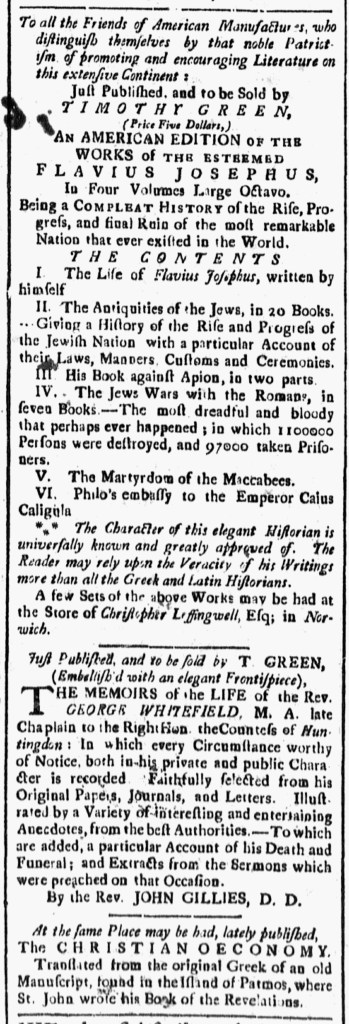
Calls to “Buy American” during the imperial crisis and the Revolutionary War extended to advertisements for books.  In the October 27, 1775, edition of the Connecticut Gazette, Timothy Green, the printer, promoted three works published in the colonies and available at his printing office in New London.  He addressed the advertisement to “all the Friends of American Manufactures, who distinguish themselves by that noble Patriotism of promoting and encouraging Literature on this extensive Continent.”

Those books included the “MEMOIRS of the LIFE of the Rev. GEORGE WHITEFIELD,” one of the most famous ministers of the era.  When he died in Newburyport, Massachusetts, on September 30, 1770, news spread throughout the colonies as widely and as quickly as news about the Boston Massacre earlier that year.  John Gillies compiled the memoir from Whitefield’s “Original Papers, Journals, and Letters” and added “a particular Account of his Death and Funeral; and Extracts from the Sermons which were preached on that Occasion.”  They originally appeared in a London edition published in 1772, but Green most likely sold an American edition printed by Robert Hodge and Frederick Shober in New York in 1774.

For another of the books, The Works of Flavius Josephus in four volumes, Green triumphantly proclaimed that it was an “AMERICAN EDITION.”  Earlier in the eighteenth century, American printers sometimes put a London imprint on the title page of books they printed in the colonies, believing that customers preferred imported works.  Mitch Fraas, curator at the Kislak Center for Special Collections, Rare Books, and Manuscripts at the University of Pennsylvania, notes the prevalence of “books printed in America … bearing the false imprint of European cities.”  That seems to have been the case with two 1773 editions of The Works of Flavius Josephus with a New York imprint yet “Probably printed in Glasgow,” according to the entries in the American Antiquarian Society’s catalog.  Yet colonizers had access to an authentic American edition … and Hodge and Shober had been involved in the production, just as they had printed an edition of The Christian Oeconomy, the final book in Green’s advertisement, in 1773.

Rather than looking to London to provide them with books, some printers and booksellers embraced American editions and encouraged prospective customers to do the same.  Green framed doing so as the patriotic duty of “Friends of American Manufactures” who supported the American cause and participated in the Continental Association, a nonimportation agreement enacted throughout the colonies in response to the Coercive Acts.  Readers could do their part to defend American liberties through the choices they made in the marketplace, including purchasing an “AMERICAN EDITION” when they went to the bookstore.

October 23

What was advertised in a revolutionary American newspaper 250 years ago today?

New-York Gazette and Weekly Mercury (October 23, 1775).

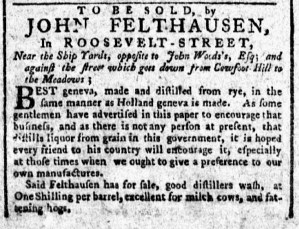
“BEST geneva, made and distilled from rye.”

When John Felthausen wanted the public to know about the “BEST geneva [or genever], made and distilled from rye,” that he produced, he placed an advertisement in the October 23, 1775, edition of the New-York Gazette and Weekly Mercury.  He declared that he distilled his spirits “in the same manner as Holland geneva is made,” assuring prospective customers of the quality and taste.  To entice readers to purchase his genever, Felthausen reported that “some gentlemen have advertised in this paper to encourage that business” because “there is not any person at present, that distills liquor from grain in this government” or colony.  In answer to colonizers who expressed a desire for someone to take responsibility for distilling genever and other spirits in New York, Felthausen suggested that they had a responsibility to support his business now that he accepted their charge to launch such an enterprise.

Yet Felthausen did not address solely those who had written of their desire to see genever produced locally.  Instead, he proclaimed that he “hoped every friend to his country” would buy his genever, “especially at those times when we ought to give a preference to our own manufactures.”  The distiller made a “Buy American” argument, confident that prospective customers knew all about the Continental Association, a nonimportation agreement devised by the First Continental Congress in response to the Coercive Acts.  The Continental Association also called on colonizers to promote “Agriculture, Arts, and the Manufactures of this Country” as alternatives to imported goods.  Throughout the colonies, supporters of the American cause mobilized around the choices that they made in the marketplace.  Many became even more determined to so after the battles at Lexington and Concord.  Entrepreneurs like Felthausen encouraged consumers to practice politics when they made purchases, presenting their decisions as civic duties for “every friend to his country.”

October 8

What was advertised in a revolutionary American newspaper 250 years ago this week?

Providence Gazette (October 7, 1775).

“He presumes every Friend to America, both in Town and Country, will encourage him occasionally.”

When Cornelius Cooper, a “BRUSH-MAKER, from Philadelphia,” relocated to Providence, he ran an advertisement in the October 7, 1775, edition of the Providence Gazette to introduce himself to his new neighbors and prospective customers.  The newcomer announced that he “makes and sells, Wholesale and Retail, Sweeping, Hearth, Cloaths, Shoe and Buckle Brushes, and every other Article in the Brush Way.”

Realizing that he was unknown to the residents of Providence, Cooper realized that he might increase sales by giving them sound reasons to purchase his brushes, either to use themselves or to stock in their shops to sell to others.  “As our own Fabrications, of every Kind, hold forth their Utility, in a most conspicuous Manner,” the brushmaker declared, “he presumes every Friend to America, both in Town and Country, will encourage him occasionally.”  Cooper did not need to rehearse current events for readers to understand his meaning.  They knew that the siege of Boston continued, following the battles at Lexington and Concord in April and the Battle of Bunker Hill in June.  They also knew that the Continental Association, a nonimportation agreement devised by the First Continental Congress, went into effect on December 1, 1774, in response to the Coercive Acts.  Colonizers sought to use commerce, especially their choices about consumption, as political leverage to convince Parliament to repeal the Boston Port Bill, the Massachusetts Government Act, and other legislation.  The Continental Association also called on colonizers to encourage domestic manufactures or the production of goods in the colonies as replacements or substitutes for imported ones.  Cooper did his part in making brushes.  Now “every Friend to America” needed to do their part by supporting his enterprise.

Making purchases was not the only way they could do so.  In a nota bene, Cooper requested “that People will be careful to save their Hogs Bristles, for which he will give a good Price in Cash.”  Consuming goods made in the colonies was important, but colonizers could also participate in the production of those goods by collecting materials, delivering them to Cooper, and earning some cash for their efforts.  The brushmaker also noted that he sought an apprentice, “a discreet, active Lad, about 14 Years of Age.”  He would pass along knowledge of his trade and make help the next generation contribute to the local economy.  Readers understood the inspiration and political ramifications without Cooper going into detail in his advertisement.  He presented them with a patriotic obligation and encouraged them to do their civic duty in the marketplace.

August 22

What was advertised in a revolutionary American newspaper 250 years ago today?

Dunlap’s Maryland Gazette (August 22, 1775).

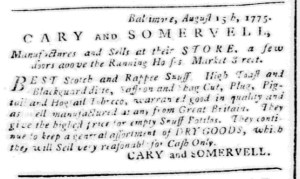
BEST Scotch and Rappee Snuff … warranted good in quality and as well manufactured as any from Great Britain.”

The partnership of Cary and Somervell stocked and sold “a general Assortment of DRY GOODS” at their store in Baltimore in the summer of 1775, but that was not their primary reason for running an advertisement in the August 22 edition of Dunlap’s Maryland Gazette.  Instead, they wished to advise the public that their firm “Manufactures and Sells … BEST Scotch and Rappee Snuff, High Toast and Blackguard [snuff], Saffron and Shag Cut, Plug, Pigtail and Hogtail Tobacco.”  Cary and Somervell offered tobacco users an array of choices of familiar products.  They also paid “the highest price for empty Snuff Bottles,” encouraging prospective customers to offset the cost of their purchases by trading in bottles that they no longer needed.

In promoting the tobacco products that they made in Baltimore, Cary and Somervell published promises about their wares: “warranted good in quality and as well manufactured as any from Great Britain.”  That was a familiar aspect of “Buy American” advertisements prior to the American Revolution, yet it had greater resonance once the Continental Association went into effect on December 1, 1774, and, especially, following the battles at Lexington and Concord on April 19, 1775.  The Continental Association, a nonimportation agreement devised by the First Continental Congress in response to the Coercive Acts, called for “encourag[ing] Frugality, Economy, and Industry; and promot[ing] Agriculture, Arts, and the Manufactures of this Country” as alternatives to imported goods.  Thus, the nonimportation agreement also outlined the responsibilities of both producers and consumers in the colonies.  Such civic duties gained even greater urgency in the wake of battles fought in Massachusetts.

Even without taking current events into consideration, Cary and Somervell issued a familiar challenge when they asserted that their tobacco products were as “good in quality and as well manufactured as any from Great Britain.”  How would consumers know unless they tested Cary and Somervell’s snuff and tobacco for themselves?  The partners used a bold assertion to entice prospective customers to sample their products and become the final arbiters of whether they, the consumers, agreed with the claims made in the newspaper advertisement.

July 31

What was advertised in a revolutionary American newspaper 250 years ago today?

Dunlap’s Pennsylvania Packet (July 31, 1775).

“… that we may not now, nor hereafter, have any occasion to import from our ministerial enemies in Great-Britain.”

Charles Maise, a “MUSTARD and CHOCOLATE MAKER” in Philadelphia, took to the pages of Dunlap’s Pennsylvania Packet to promote his business at the end of July 1775.  First, he needed supplies, offering “Forty shillings per bushel for any quantity of good clean Mustard-seed.”  Yet Maise wanted readers to think bigger about his business and their role as both suppliers and consumers given the imperial crisis experienced in the colonies over the last decade.  He expressed his hope that “farmers and others will use their best endeavours to encourage this valuable manufactory, by cultivating and improving the growth of so valuable an article, that we may not now, nor hereafter, have any occasion to import from our ministerial enemies in Great-Britain.”  Such sentiments certainly resonated with the Continental Association, a nonimportant agreement devised by the First Continental Congress in the fall of 1774 in response to the Coercive Acts. The eight article called on colonizers “in our several Stations,” including mustard and chocolate makers, to “encourage Frugality, Economy, and Industry; and promote Agriculture, Arts, and the Manufactures of this Country.”

Producers had a part to play in making available alternatives to imported goods, but the Continental Association did not depend on their efforts alone.  Consumers also had to make choices aligned with their political principles.  That meant purchasing “domestic manufactures,” goods produced in the colonies.  Maise stood ready to partner with consumers in pursuing their common cause.  In a nota bene, he announced that he “stands in the market on market days, opposite the London Coffee-house.”  Customers could find him there.  He extended “thanks to his former customers,” stating that he “hopes for a continuance of their favours, and doubts not but to merit their esteem.”  Of course, Maise also intended for his advertisement to reach new customers and wanted them to join existing customers in supporting both his business and the American cause by purchasing mustard produced locally from mustard seeds grown in the colonies.  Mustard gained political significance when taking into consideration “our ministerial enemies in Great-Britain,” especially in the wake of recent news of hostilities commencing at Lexington and Concord, the siege of Boston, and the Battle of Bunker Hill.

July 21

What was advertised in a revolutionary American newspaper 250 years ago today?

Pennsylvania Evening Post (July 21, 1775).

“He hopes to meet with due encouragement, especially as it is the first of its kind attempted in America.”

John Melchior Naff, a “MANUFACTORER of WIRE,” used an advertisement in the July 21, 1775, edition of the Pennsylvania Evening Post to inform “the public in general, and his friends in particular,” about the business he planned to establish in Philadelphia.  He declared that he “proposes to manufacture and sell all kinds of WIRE, BRASS and IRON, and draw it to any size, fit for any use whatsoever.”  He also stated that he “can make all kinds of COMMON PINS, HAIR PINS, COTTON CARDS, and HOOKS and EYES, as good and as cheap as can be imported from Europe.”

Although Naff did not invoke the Continental Association, a nonimportation agreement in protest of the Coercive Acts that had been in effect since the previous December, he almost certainly expected that readers would take it into consideration when they perused his advertisement.  In addition to boycotting goods imported from Britain, the Continental Association called for consumers and producers alike to encourage “domestic manufactures.”  Naff answered that call with pins and other items of the same quality and low prices as imported ones.  He made an investment in the enterprise, reporting that he “hath, at his own expence, already furnished himself with the proper tools and implements to carry on the said business.”  The entrepreneur felt he deserved “due encouragement” from consumers, “especially as it is the first of its kind attempted in America.”  That claim echoed the one that Richard Lightfoot recently made about his “PIN MANUFACTORY” in New York, asserting that “he is the first that ever attempted” to produce several kinds of wirework “on this continent.”  Similarly, Ryves and Fletcher, paper stainers in Philadelphia, advertised that “they are the first who have ever attempted” to make paper hangings (or wallpaper) “on this continent.”

A few months before Naff, Lightfoot, and Ryes and Fletcher ran their advertisements, the imperial crisis boiled over.  Word about the battles at Lexington and Concord and the siege of Boston spread quickly.  More recently, colonizers learned about the Battle of Bunker Hill.  As they prepared for the possibility of more military encounters, perhaps even in or near their own towns, they also continued to use the marketplace as a venue to engage in resistance.  When Naff requested “due encouragement” for establishing a new industry in America, he reminded prospective customers of their duty to fight against Parliament in the decisions they made about the goods they purchased.

July 18

What was advertised in a revolutionary American newspaper 250 years ago today?

Pennsylvania Evening Post (July 18, 1775).

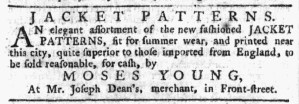
“JACKET PATTERNS … printed near this city, quite superior to those imported from England.”

Public discourse about the American Revolution resonated not only in the news and editorials that appeared in newspapers but also in the advertisements that ran in them.  In the July 18, 1775, edition of the Pennsylvania Journal, for instance, John Dean, a bookbinder, once again advertised the Philadelphia edition of A Self Defensive War Lawful, a sermon recently “preached at Lancaster, before Captain Ross’s company of militia” by John Carmichael.  The updated version of this advertisement indicated that four local printers and booksellers now stocked the sermon.  It also listed prices for single copies, a dozen, or a hundred, suggesting that Dean anticipated that retailers would purchase copies to sell or other customers would buy the sermon to distribute in their communities.

The advertisement immediately above the one for the sermon was also tied to the events of the American Revolution.  Moses Young announced that he sold “JACKET PATTERNS.”  He had an “elegant assortment of the new fashioned JACKET PATTERNS, fit for summer wear, and printed near this city.”  Young did not have to invoke the Continental Association, a nonimportation agreement devised by the First Continental Congress in response to the Coercive Acts, for readers to understand the implications of his assertion that the patterns were produced near Philadelphia.  In addition to prohibiting imported goods, the Continental Association called on colonizers to “encourage Frugality, Economy, and Industry; and promote Agriculture, Arts, and the Manufactures of this Country.”  Moses Young did just that … and he gave consumers a chance to do their part.  They could keep up with current trends and they could do so without sacrificing quality.  After all, Young described the patterns as both “new fashioned” and “quite superior to those imported from England.”  In addition, he sold them for a “reasonable” price.  As the siege of Boston continued in Massachusetts and the Second Continental Congress continued meeting in Philadelphia, Young’s marketing presented an opportunity for consumers to offer their support for the American cause through one of the decisions they made in the marketplace.

July 16

What was advertised in a revolutionary American newspaper 250 years ago this week?

New-York Gazette and Weekly Mercury (July 10, 1775).

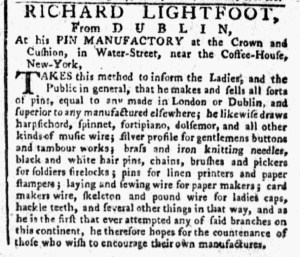
“He therefore hopes for the countenance of those who wish to encourage their own manufactures.”

In the summer of 1775, Richard Lightfoot placed a newspaper advertisement to promote his “PIN MANUFACTORY at the Crown and Cushion” in New York.  In addition to “all sorts of pins,” he also produced a variety of other wirework, including “harpsichord, spinnet, fortepiano, dolsemor, and all other kinds of music wire,” “brass and iron knitting needles,” “pins for linen printers and paper stampers,” and “laying and sewing wire for paper makers.”

Lightfoot addressed “the Ladies,” who presumably constituted a significant portion of his customers, yet also directed his advertisement to “the Public in general.”  After all, he had an interest in the entire community knowing about the work undertaken at his “PIN MANUFACTORY” and his contributions to the American cause through his participation in the marketplace.  Lightfoot proclaimed that “he is the first that ever attempted any of said branches,” the production of the various kinds of wirework, “on this continent.”  He did so at a time that colonizers observed the Continental Association, a nonimportation agreement devised by the First Continental Congress in response to the Coercive Acts.  That pact called for encouraging “Industry” and “the Manufactures of this Country” as alternatives to imported goods.  Under those circumstances, Lightfoot hoped “for the countenance of those who wish to encourage their own manufactures.”  That meant that “the Public in general” should support his enterprise by recommending it to “the Ladies” who purchased and used the pins and other items he made.

When they did so, they could depend on the quality of those products.  Lightfoot asserted that his pins were “equal to any made in London or Dublin, and superior to any manufactured elsewhere.”  He was qualified to make that claim, indicating that he was “From DUBLIN” and likely learned and practiced his trade there before migrating to New York.  Claiming that authority, Lightfoot assured prospective customers that they did not sacrifice quality when they applied their political principles to their decisions about which pins to purchase.  It did not matter that the Continental Association prohibited buying imported pins because Lightfoot made and sold pins that were just as good as (or even better than) pins produced elsewhere!

July 11

What was advertised in a revolutionary American newspaper 250 years ago today?

Dunlap’s Maryland Gazette (July 11, 1774).

“It is hoped that all who wish to see the Manufactures of Great-Britain established in America will encourage this work.”

Robert Moore, a “Cabinet maker in Baltimore Town,” advertised paper hangings (or wallpaper) and “MOCK INDIA PICTURES” to decorate domestic interiors in a notice in Dunlap’s Maryland Gazette in July 1775.  He did not claim that he produced the paper hangings and pictures, only that he sold them.  The cabinetmaker likely aimed to diversity the revenue streams for his workshop.

Yet earning his livelihood was not Moore’s only purpose in hawking those items or promoting them in the public prints.  He also aimed to advance the American cause, doing his part in the commercial realm as readers in Maryland continued to receive news about military encounters, especially the battles at Lexington and Concord, the siege of Boston, and the Battle of Bunker Hill, and the Second Continental Congress and provincial congresses throughout the colonies coordinated responses as the imperial crisis became a war.  Both entrepreneurs and consumers had been using commerce as a means of resistance before the fighting commenced; Moore intended to continue following that strategy.  The Continental Association that the First Continental Congress devised in response to the Coercive Acts, called for boycotting imported goods and encouraging the production and consumption of alternatives made in the colonies.

Moore echoed that ideology in his advertisement.  He proclaimed that he paper hangings and pictures were “all entire the Manufacture of this Country.”  Perhaps he stocked paper hangings produced by Ryves and Fletcher at their “NEW AMERICAN MANUFACTORY” in Philadelphia and advertised in Dunlap’s Pennsylvania Packet.  Whatever the source, Moore emphasized that their quality (“great Perfection”) and price (“lower rates”) rivaled those imported from England.  Consumers did not have to make sacrifices to when they chose to put their political principles into action in the marketplace.  Furthermore, Moore asserted that consumers had a civic responsibility to purchase goods produced in the colonies: “It is hoped that all who wish to see the Manufactures of Great-Britain established in America will encourage this work.”  Even after the fighting commenced in New England, colonizers attempted to continue exerting pressure on Parliament through the choices they made as retailers and consumers.