June 19

What was advertised in a revolutionary American newspaper 250 years ago today?
Postscript to Dunlap’s Pennsylvania Packet (June 19, 1775).

“A NEW AMERICAN MANUFACTORY.”

As summer arrived in 1775, Ryves and Fletcher took to the pages of Dunlap’s Pennsylvania Packet to inform the public that they established a “NEW AMERICAN MANUFACTORY” where they made and sold “all kinds of PAPER HANGINGS” (better known as wallpaper today).  The eighth article of the Continental Association, the nonimportation pact devised by the First Continental Congress in the fall of 1774, called for “promot[ing] Agriculture, Arts, and the Manufactures of this Country” as alternatives to imported goods.  That charge had even greater urgency following once colonizers heard about the battles at Lexington and Concord and the ensuing siege of Boston.  When Ryves and Fletcher ran their advertisement two days after the Battle of Bunker Hill, word of that engagement had not yet arrived in Philadelphia.  When it appeared again in July, readers had even more information about momentous events in Massachusetts that likely shaped how they reacted to Ryes and Fletcher marketing paper hangings made in America.

The “PAPER STAINERS,” as Ryves and Fletcher described themselves, asserted that they “are the first who have attempted that manufacture on this continent.”  Perhaps they were not aware that Plunket Fleeson made, advertised, and sold “AMERICAN PAPER HANGINGS” in Philadelphia in 1769, though they may have conveniently overlooked that enterprise in their efforts to promote their own.  Ryves and Fletcher made significant investment in procuring both workers and materials, noting in particular that their undertaking “consumes a large quantity of the paper of this country.”  In return for their dedication to the patriot cause, they “are therefore induced to hope for the countenance and protection of all well wishers to the infant manufacturers of America.”  They did their duty as producers, but that was not enough; consumers now had an obligation to purchase the paper hangings that Ryves and Fletcher made.  The paper stainers launched a “Buy American” campaign at the beginning of the Revolutionary War.  As part of their marketing efforts, they emphasized quality, extolling the “neatness of patterns and elegance of colour,” and price, pledging that “they will sell on much more reasonable terms than any paper can be disposed of which is imported into America.”  Ryves and Fletcher were among the first to produce and market paper hangings made in America, helping establish a new industry during the era of the American Revolution.

**********

I provide a brief case study of patriotic advertisements for paper hangings in Carl Robert Keyes, “A Revolution in Advertising: ‘Buy American’ Campaigns in the Late Eighteenth Century,” in Creating Advertising Culture:  Beginnings to the 1930s, vol. 1, We Are What We Sell:  How Advertising Shapes American Life … And Always Has, eds. Danielle Coombs and Bob Batchelor (New York:  Praeger, 2013), 1-25.

February 5

What was advertised in a colonial American newspaper 250 years ago this week?

Massachusetts Spy (February 2, 1775).

“BUTTONS. MADE and sold … at the Manufactory-house, Boston.”

John Clarke’s advertisement for buttons that he “MADE and sold … at the Manufactory-house” in Boston was one of several in the February 2, 1775, edition of the Massachusetts Spy that hawked goods produced in the colonies.  He advertised at a time that the harbor had been closed and blockaded for more than eight months because of the Boston Port Act, one of several measures that Parliament enacted in response to the Boston Tea Party.  The other Coercive Acts included the Massachusetts Government Act, the Administration of Justice Act, and the Quartering Act.  In turn, the colonies refused to import British goods, having previously pursued that strategy in response to the Stamp Act in 1765 and the duties imposed on certain goods in the Townshend Acts in the late 1760s.  The Continental Association, devised by the First Continental Congress, went into effect on December 1, 1774.  In addition to prohibiting imports, it called on colonizers to encourage “domestic manufactures” or goods produced in the colonies.

Clarke not only made buttons in Boston, he made “two sorts of new fashioned buttons.”  One was a “plain flat Button, with a corded edge round it, either gilt or plated.  The other bore an inscription, “UNION AND LIBERTY IN ALL AMERICA,” that made a statement.  Consumers could express political sentiments and sartorial sensibilities simultaneously.  (Similarly, the Adverts 250 Project previously examined another newspaper notice that included “glass buttons having the word liberty printed in them.”)  Clarke’s “Liberty button,” well worth the investment, cost just a little more than the “plain flat Button,” at twenty shillings per dozen compared to eighteen shillings per dozen.  Clarke also gave “good allowance to shopkeepers to sell again.”  In other words, he offered discounts to retailers who purchased his buttons and presented them to their customers.  After all, shopkeepers had their own part to play in promoting American products to consumers and supplying them with alternatives to goods imported from Britain.  When it came to buttons, what better way to do that than with the inscribed “Liberty button” made in Boston?

February 2

GUEST CURATOR:  Ella Holtman

What was advertised in a colonial American newspaper 250 years ago today?

Massachusetts Spy (February 2, 1775).

“AMERICAN CAKE-INK.”

This advertisement is extremely interesting because we do not use the term or commonly understand what cake ink is today. As author Harry Schenawolf explains in his Revolutionary War Journal, the Nortons’ cake ink was most likely dried iron gall ink. With a dash of water, the powder became liquid and ready to use with a quill. Iron gall ink is made from a mixture of iron sulfate, oak galls, and tree gum, ensuring it to be long-lasting, adherent, and dark.

Samuel Norton produced his own dried iron gall cake ink. Anna Norton sold it in Boston. They offered their product to any patriotic supporter of America. In the advertisement, the Nortons also reminded the public that their cake ink went for “the same rates as the British Cake-Ink is sold at in London.” They offered an American product for the same prices charged in Britain, obeying a nonimportation agreement. This alludes to the growing tension between the American colonies and Britain’s perceived unjust control in February 1775.

When the Revolutionary War started a couple of months later, American soldiers went to fight, bringing few belongings and facing long travels. Officers and soldiers easily transported and utilized cake ink. They wrote home to loved ones and shared news. Purchasing and using cake ink, like that made and sold by the Nortons, aided in communication during the era of the American Revolution.

**********

ADDITIONAL COMMENTARY:  Carl Robert Keyes

As Ella notes, the Nortons advertised their cake ink at an important moment.  The Boston Port Act closed the city’s harbor on June 1, 1774, severely hampering commerce.  In response, the colonies enacted the Continental Association, a nonimportation agreement, on December 1.  In addition to boycotting imported goods, the Continental Association called on colonizers to “encourage Frugality, Economy, and Industry; and promote Agriculture, Arts, and the Manufactures of this Country.”

The Nortons did just that when they marketed “AMERICAN CAKE-INK” to “all true friends to America.”  They did so at a time when other advertisers also advanced “Buy American” messages or otherwise indicated their compliance with the Continental Association.  Consider some of the advertisements that ran alongside the Nortons’ notice in the February 2, 1775, edition of the Massachusetts Spy.  Henry Christian Geyer advertised printing ink that he “manufactured … at his Shop near Liberty Tree” in Boston’s South End.  A nota bene indicated that the Massachusetts Spy “has been printed with Ink made by said Geyer, for two months past.”  A similar nota bene appeared in his advertisement in the Massachusetts Gazette and Boston Post-Boy.  Enoch Brown’s notice sporting the headline “American Manufacture” ran once again, offering textiles produced in Massachusetts and glassware “manufactured at Philadelphia” as alternatives to imported goods.  Philip Freeman inserted an advertisement for gloves that had been running for six months, lamenting the “threatening” times and asking consumers to “encourage our own Manufactures” by purchasing the gloves that he made.  In a relatively new advertisement, John Clarke hawked the buttons that he produced “at the Manufactory-house, Boston,” each inscribed, “UNION AND LIBERTY IN ALL AMERICA.” Another advertisement notices announced the sale of “SUNDRY Goods … imported in the Brigantine Venus … from London” conducted under the supervision of the local Committee of Inspection according to the provisions of the tenth article of the “American Congress Association.”

The short advertisement for “AMERICAN CAKE-INK” that Ella selected for today’s entry played its part in disseminating messages about leveraging decisions about consumption to achieve political ends, especially when considered in concert with several other advertisements in the same issue of the Massachusetts Gazette.  Consumers, these notices reminded readers, participated in politics when they chose which items purchase.

January 29

What was advertised in a colonial American newspaper 250 years ago this week?

Massachusetts Spy (January 26, 1775).

“American Manufacture.”

An advertisement in the January 26, 1775, edition of the Massachusetts Spy informed readers of “SUNDRY Goods, Wares and Merchandize Imported in the Brigantine Venus … from London” that would be “SOLD agreeable to The American Congress Association.”  That nonimportation agreement included provisions for selling goods imported between December 1, 1774, and February 1, 1775, yet it also called for encouraging “domestic manufactures” as alternatives to items acquired from Britain.

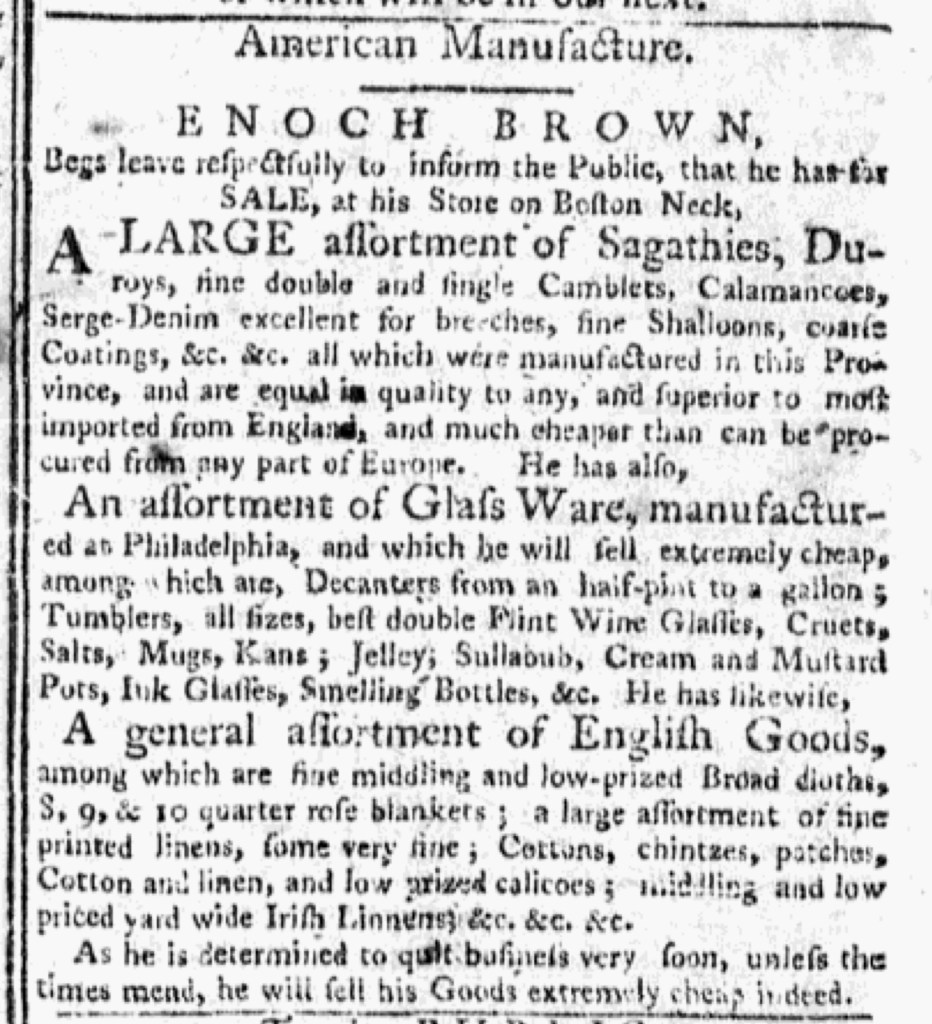
Enoch Brown emphasized such wares in his own advertisement in that same issue of the Massachusetts Spy.  The headline proclaimed, “American Manufacture.”  Brown reported that he stocked several kinds of textiles, a “LARGE assortment of Sagathies, Duroys, … Camblets, Calamancoes, Serge-Denim, [and] Shalloons … all which were manufactured in this Province.”  Like many other retailers who encouraged consumers to “Buy American” during the imperial crisis, Brown emphasized that his customers would not have to make sacrifices when it came to price or quality for the sake of abiding by their political principles.  These textiles, he insisted, “are equal in quality to any, and superior to most imported from England.”  In addition, customers could purchase them “much cheaper than can be procured from any part of Europe.”

Yet that was not the extent of Brown’s wares produced in the colonies.  He also stocked an “assortment of Glass Ware, manufactured at Philadelphia.”  Perhaps he stocked some of the “AMERICAN GLASS” advertised by John Elliott and Company in the Pennsylvania Journal just as the Continental Association went into effect at the beginning of December 1774.  Brown listed a variety of items, including decanters, wine glasses, and mustard pots, underscoring that “he will sell extremely cheap.”

Only after detailing products made in the colonies did Brown also mention a “general assortment of English Goods,” naming several textiles, such as “fine printed linens,” not included among those “manufactured in this Province.”  He likely attempted to liquidate inventory that had been on his shelves before the nonimportation agreement commenced, intending to “quite business very soon, unless the times mend.”  To that end, he vowed to “sell his Goods extremely cheap indeed.”  In the process, he gave priority to “American Manufacture” in his advertisement, directing readers to options that would allow them to be responsible consumers who did their part in support of the Continental Association and the American cause.

December 12

What was advertised in a colonial American newspaper 250 years ago today?

New-York Gazette and Weekly Mercury (December 12, 1774).

“He will meet with due encouragement … by every real friend to American manufactures.”

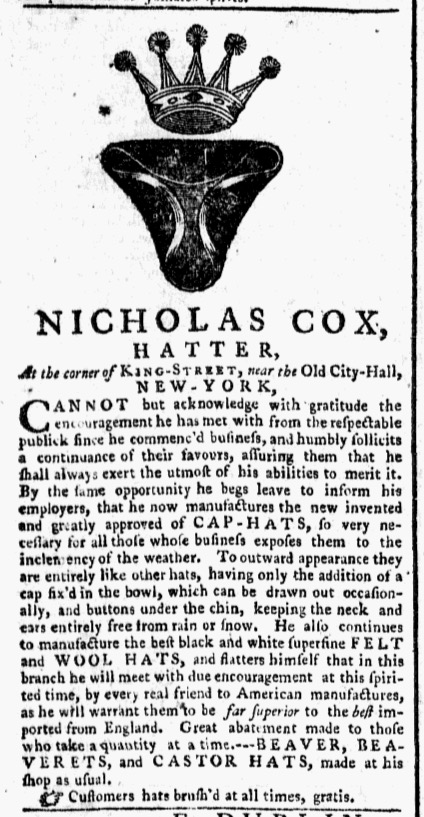
Nicholas Cox, a hatter, made several appeals to consumers in his advertisement in the December 12, 1774, edition of the New-York Gazette and Weekly Mercury.  He commenced with a standard expression of gratitude for “the encouragement he had met with from the respectable publick since he commenc’d business.”  Many purveyors of goods and services did so in their advertisements, signaling to readers that other consumers already considered them worthy of their business.  It was a familiar means of bolstering an advertiser’s reputation.

The hatter also incorporated commentary specific to his trade, proclaiming that he “manufactures the new invented and greatly approved of CAP-HATS.”  For those unaware of this innovation, eh explained that by “outward appearance they are entirely like other hats, having only the addition of a cap fix’d in the bowl, which can be drawn out occasionally.”  In such instances, it “buttons under the chin, keeping the neck and ears entirely free from rain or snow.”  Cox marketed this new style, a very practical element, as “so very necessary for all those whose business exposes them to the inclemency of the weather.”  According to Kate Haulman, colonizers debated whether they should carry umbrellas, “stylistic spoils of empire hailing from India,” in the 1760s and 1770s.  “Some regarded umbrellas as ridiculous and frivolous,” she notes, “serving no purpose that a good hat could not supply.”[1]  Cox produced and sold such hats for men of business who sought to eschew the effeminacy and luxury associated with umbrellas.

His next appeal made an even more explicitly political argument to prospective customers.  He made “the best black and white superfine FELT and WOOL HATS,” like the tricorne hat depicted in the woodcut that adorned his advertisement.  Cox asserted that patriotic consumers had a duty to support his business when they made choices about where to acquire their hats.  He expressed confidence that he “will meet with due encouragement at this spirited time, by every real friend to American manufactures.”  The Continental Association, a boycott of British goods adopted in response to the Coercive Acts, had recently gone into effect.  Cox offered an alternative to colonizers who desired to acquire hats yet wished to remain patriotically correct, either according to their own principles or at least to avoid the ire of others who observed the purchases they made.  Furthermore, his customers did not have sacrifice quality for principles.  The hatter pledged that “he will warrant [his hats] to be far superior to the best imported from England.” That being the case, the crown that appeared above the tricorne hat at the top of his advertisement may have testified to the superior quality of his hats, a general sense of pride in being part of the British Empire, or reverence for the monarch whom many colonizers still hoped would intervene on their behalf in their altercation with Parliament.

In addition to those appeals, Cox included two more common marketing strategies.  He promised a “[g]reat abatement … to those who take a quantity at a time.”  In other words, he gave discounts for buying multiple hats, both for consumers and for retailers who intended to sell them in their own shops.  He also provided a free ancillary service: “Customers hats brush’d at all times, gratis.”  Cox saw to the care and maintenance of the hats he made and sold long after the time of purchase.  He cultivated relationships with customers by encouraging them to return to his shop for assistance in keeping their hats in good order.  Overall, Cox resorted to a variety of familiar and specific appeals when advertising his hats, distinguishing him from competitors who did not put as much effort into marketing their wares.

**********

[1] Kate Haulman, “Fashion and the Culture Wars of Revolutionary Philadelphia,” William and Mary Quarterly, 3rd ser., 62, no 4 (October 2005): 632.

December 7

What was advertised in a colonial American newspaper 250 years ago today?

Pennsylvania Journal (December 7, 1774).

“White and Green Glass Ware; Such as are usually imported from Great-Britain.”

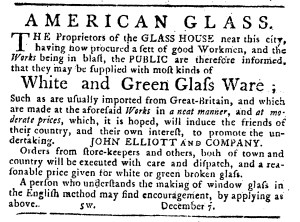
A headline in capital letters and a large font proclaimed, “AMERICAN GLASS.”  In a secondary headline composed of font of the same size, John Elliott and Company promoted “White and Green Glass Ware” that they produced ay their “GLASS HOUSE” near Philadelphia.  That advertisement happened to appear in the December 7, 1774, edition of the Pennsylvania Journal, the first issue published since the Continental Association went into effect on December 1.  Throughout the colonies, retailers and consumers adopted that boycott of goods imported from Britain, some enthusiastically and some under pressure.  They hoped that measure would help convince Parliament to repeal the Coercive Acts passed in retaliation for the Boston Tea Party.

Ever since the boycotts inspired by the Stamp Act nearly a decade earlier, supporters of the American cause emphasized the importance of “domestic manufactures” or goods produced in the colonies.  Such products offered an alternative to imported wares while also bolstering local economies and creating jobs.  The Continental Association had the potential to disrupt consumption practice, but it also presented opportunities for American entrepreneurs, including Elliott and Company.

In their advertisement, the proprietors of the Glass House reported that they had “procured a sett of good Workmen” and the glassworks were “in blast.”  That meant that the public “may be supplied with most kinds of White and Green Glass Ware; Such as are usually imported from Great-Britain.”  Prospective customers did not need to worry about the quality or cost of this alternative.  Elliott and Company offered assurances that they produced glassware “in a neat manner, and at moderate prices.”  In their appeal to “the PUBLIC,” Elliott and Company did not address consumers alone.  They also hoped to entice retailers, noting that “Orders from store-keepers and others, both of town and country will be executed with care and dispatch.”  They hoped these various appeals would “induce the friends of their country, and their own interest, to promote the undertaking.”  It was a win-win-win situation for the protest against Parliament, for customers, and for Elliott and Company.

November 7

What was advertised in a colonial American newspaper 250 years ago today?

Newport Mercury (November 7, 1774).

“American SNUFF … equal to any imported from Great-Britain.”

George Lawton and Robert Lawton hoped that their marketing strategy would help them to edge out the competition when they advertised “American SNUFF” in the November 7, 1774, edition of the Newport Mercury.  They explained that the product they sold was “MANUFACTURED in Pennsylvania, and esteemed there equal to any imported from Great-Britain.”  Apparently, it was not yet familiar to consumers in Rhode Island, but the Lawtons hoped that the enthusiasm for the snuff in another colony would convince local customers to give it a try.  Furthermore, they suggested that patriotic consumers had a duty to select this “American SNUFF” and support domestic manufactures over imported alternatives.  “[I]t is hoped,” the Lawtons declared, “that the public spirit of this colony will not be wanting to promote the use of this article, if on trial it should be found to merit it.”  They allowed for some wiggle room, leaving it to consumers to assess the quality of the snuff for themselves, yet proposed that those who did consider it “equal to any imported from Great Britain” should shift their allegiance to the product from the colonies.

Elsewhere on the same page, John Bell a shopkeeper who frequently advertised in the Newport Mercury, hawked “ENGLISH and INDIA GOODS” that he sold “as cheap as can be bought in any shop in AMERICA.”  Following a catalog of some of his inventory, he concluded with a separate entry for “Best Tilloch’s snuff, just imported from Glasgow.”  That city was well known for the quality of the tobacco products made there and then shipped to consumers on both sides of the Atlantic.  Bell expected that customers in Newport recognized “Tilloch’s snuff” as a familiar brand, not an unreasonable supposition considering that other entrepreneurs also advertised that product.  Bell’s effort to market imported snuff did not have the same visual appeal as the advertisement placed by the Lawtons.  Their notice featured “American SNUFF” as a headline in a larger font, calling attention to both the product and the argument about the political principles associated with it at a time that many colonizers advocated for boycotts of British goods as a means of resisting the Coercive Acts passed by Parliament earlier in the year.  They seemingly considered this strategy effective, resorting to it once again after using it several months earlier.

August 18

What was advertised in a colonial American newspaper 250 years ago today?

Massachusetts Gazette and Boston Weekly News-Letter (August 11, 1774).

“Render this Country an essential Service, by establishing a Manufacture necessary to its Prosperity.”

Abraham Cornish had been in business and advertising long enough by the late summer of 1774 that he expected colonizers to be familiar with his brand of “CORNISH’s New-England Cod-Fish HOOKS.”  He deployed the name of his product as a headline for his advertisement in the August 18 edition of the Massachusetts Gazette and Boston Weekly News-Letter.  Still, for those who needed a refresher or a bit more encouragement to purchase his fishhooks, he provided more information about why those from “his Manufactory” were superior to others.  That they were made in America was central to his marketing efforts.

The savvy entrepreneur had recently moved from “the North-End of Boston, to the Upper Part of Charlestown,” where he continued to make fishhooks “warranted of the best Quality.”  He called on “all concerned in the Fishery” to “favor him with their Custom, as they will thereby promote their own private Interest, and render this Country an essential Service, by establishing a Manufacture necessary to its Prosperity.”  It was a win-win-win situation for “the American Fishery,” the manufacturer, and all colonizers at a time that the political crisis intensified due to the imposition of the Coercive Acts in retaliation for the Boston Tea Party.  Those whose livelihood depended on fishing could acquire equipment “found much Superior to any imported, Cornish could maintain or even expand his business, and the colonies would benefit from “domestic manufactures” that both supported a local industry and directly contributed to the local economy.  Ever since the boycotts inspired by the Stamp Act nearly a decade earlier, many colonizers had advocated for producing more “domestic manufactures” as a means of reducing their reliance on imported goods.  Doing so also served as political leverage in the struggles with Parliament.  Such plans placed obligations on both artisans and tradespeople to produce goods and consumers to purchase those goods instead of imported items.  Like many other producers of “domestic manufactures,” Cornish assured prospective customers that they did not have to sacrifice quality, decalaring that his fishhooks were “made of the best Wire only” and “better shap’d to take Fish.”  He proclaimed that they were “universally approv’d,” having gone into even greater detail in a previous advertisement about how “Fishermen who made Trial of his Hooks … found them … superior to those imported from England.”  Cornish devised a “Buy American” campaign before the colonies declared independence.

January 15

What was advertised in a colonial American newspaper 250 years ago today?

Providence Gazette (January 15, 1774).

“Clothiers Press-Papers … much superior to any imported from Europe.”

John Waterman sought a clothier, “well experienced in all Parts of the Business,” to work at “the new and most compleat Works in the Colony” of Rhode Island, recently established at “the Paper-Mills in Providence.”  According to the advertisement he placed in the January 15, 1774, edition of the Providence Gazette, candidates for the position would have “good Encouragement” if they could produce recommendations for their “Diligence, Steadiness, Activity and Integrity.”  Waterman instructed “Any Person with the above Qualifications” to apply at the clothier works at the paper mill.

In addition to seeking an employee, Waterman used his advertisement for another purpose.  He inserted a nota bene under his signature, advising the public that he sold “Clothier Press-Papers made by said WATERMAN, as good as any manufactured in America, and much superior to any imported from Europe.”  He had deployed the same marketing strategy the previous summer, declaring that his “Clothier Press-Papers” were “equal to any made in America, and far superior to any imported from Europe.”  In that advertisement, Waterman listed local agents in Providence, East Greenwich, and Newport, who also sold his product.

Throughout the imperial crisis, many advertisers made “buy American” appeals to consumers.  They did so more frequently when relations with Parliament became more strained, but even in times of relative calm some still asserted that colonizers should purchase “domestic manufactures” instead of imported goods.  Waterman did not make an explicitly political argument to readers of the Providence Gazette, though they certainly understood the context in which he proclaimed his “Clothiers Press-Papers” were “much superior to any imported from Europe.”  Along with the politics, Waterman and others aimed to convince American consumers that they did not have to accept inferior products when they bought goods produced in the colonies.  Waterman emphasized quality in his advertisement, likely trusting that readers would reach their own conclusions about other advantages of supporting his enterprise rather than purchasing similar items imported from Europe.

December 13

What was advertised in a colonial American newspaper 250 years ago today?

Boston-Gazette (December 13, 1773).

“He flatters himself that all Merchants who are Lovers of this Country will establish the Trade here and not import this Article.”

John Clarke made and sold “all sorts of Metal Buttons” at the “FACTORY-HOUSE” in Boston.  His advertisement in the December 13, 1773, edition of the Boston-Gazette testified to the many ways that he marketed his buttons, both within and beyond newspaper notices.  For instance, Clarke did more than describe his “Gold, Silver, Gilt, Plated, Silver’d, Lacquer’d, and best Block-Tin BUTTONS, of the newest and most fashionable Taste” and “Fancy Buttons with the Cloth under them of the Colour requir’d.”  He also provided samples on “a Pattern Card,” inviting prospective customers to “come and see the Variety of them.”  Clarke hoped that after examining those specimens they would place orders.  He also devised a means of identifying his buttons once they left his manufactory, advising that “each Card and Gross Paper of Buttons of the said Clarke’s make, are printed as follows, viz. MADE BY JOHN CLARKE, At the FACTORY, in Boston: Where may be had, ALL Sorts of Metal Buttons, as cheap as in London.”  His newspaper advertisement reproduced a shorter advertisement that appeared on the packaging of his products.

Clarke also made an appeal to support domestic manufactures, echoing the sentiments that John Keating so often published in advertisements for his “PAPER MANUFACTORY” in New York and others who wished to support local economies rather than importing so many goods from Great Britain.  He presented his buttons to “all the Well-Wishers of this Country and hopes the Patronage of the Gentlemen of this and the neighbouring Provinces and Towns, that they will give his Buttons the preference of any imported.”  Clarke made this appeal as tensions mounted in Boston over the arrival of ships carrying tea that Parliament intended to tax under the new Tea Act.  Within a week, colonizers would board those ships and throw the tea into the harbor.  Clarke likely expected that his message would resonate with readers of theBoston-Gazette, one of the newspapers that most often decried the abuses of Parliament and the colonial officials that attempted to implement its policies.  Those readers (and his prospective customers) included “Merchants who are Lovers of this Country” who had a duty, Clarke asserted, to “establish the Trade here and not import this Article.”  He did not, however, expect merchants, shopkeepers, tailors, and consumers to accept an inferior product as an alternative to the buttons imported from London.  He asked customers to try his buttons, determine “if on Trial they prove as good or better,” and only then place orders for larger quantities “on as good Terms as they can be furnish’d in London.”

At a time when the imperial crisis intensified, Clarke encouraged colonizers to “Buy American” and support his “FACTORY HOUSE” for making buttons, “the first of the Business ever set up in America.”  In addition to his extensive appeal that ran in the Boston-Gazette, the packaging for his buttons included an abbreviated version that promoted his “FACTORY, in BOSTON,” and compared its output, “ALL Sorts of Metal Buttons,” to those imported from London.