What was advertised in a colonial newspaper 250 years ago today?
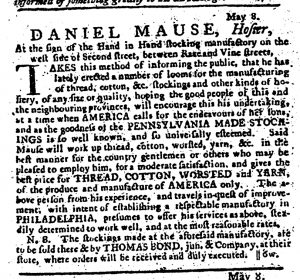
Pennsylvania Journal (May 17, 1766).
Hosier Daniel Mause made assertive claims about the value of purchasing stockings produced domestically. Note from the date of the advertisement (May 8) that Mause and other colonists certainly knew that the Stamp Act had been repealed; this advertisement was not a holdover reprinted from weeks or months earlier. That Mause considered it necessary or persuasive to insert an advertisement that so stridently promoted “the produce and manufacture of AMERICA only” suggests that even though the Stamp Act crisis was over the rift between the colonies and Britain had not closed completely. Mause eyed the parent country with suspicion and knew that others did as well.
It might be tempting to argue that Mause was merely being opportunistic and making whatever appeal was necessary in an attempt to increase business. Such an explanation by itself, however, remains unconvincing. Even if Mause did not firmly embrace the political ideas he pronounced in this advertisement, he certainly expected that they would resonate with readers. Mause’s politics and desire to make a living and earn a profit were not necessarily mutually exclusive. In addition, this advertisement depicts the anxieties other colonists felt and the solutions they embraced.
To help concerned consumers know where they could purchase his “PENNSYLVANIA MADE STOCKINGS” Mause informed them that they were available at “the sign of the Hand in Hand stocking manufactory” as well the store operated by “THOMAS BOND, jun. & Company.” In effect, he designated an approved vendor of his merchandise.
What was advertised in a colonial newspaper 250 years ago today?
Pennsylvania Gazette (May 15, 1766).
“To be sold by MARY HARVEY, … a well chosen and neat Assortment of Dry and wet Goods.”
Female shopkeepers were disproportionately underrepresented among the advertisements placed in colonial newspapers. Consciously seeking to avoid erasing women from the commercial landscape as producers, suppliers, and retailers – not solely as consumers on the other side of exchanges – I take notice every time I spot an advertisement placed by a woman when I am making selections about which to feature here.
It would be unfair, however, to assume that I chose Mary Harvey’s advertisement solely based on her sex. It reveals so much more about early American marketing and consumer culture than “just” demonstrating that women played varied roles (though I contend that is significant in its own right). When I first began studying eighteenth-century advertising I expected to identify distinct methods or appeals made by men and women, but Mary Harvey’s advertisement, like so many others placed by women, demonstrates that male and female advertisers relied on similar appeals. In this advertisement, Harvey promised low prices. By providing an extensive list of her wares she also engaged potential customers to think of the range of choices that will allow them to make selections according to their own tastes.
Harvey also concludes with a political appeal that mirrored those frequently made by male advertisers: “as she has made it her Study to promote Home-made Manufactures, she hopes for the Countenance of her old Friends, and all those who are Lovers of their Country.” Although not allowed to participate in the formal mechanisms of politics due to her sex, Harvey joined many others in imbuing consumer choices with political ramifications. Through her advertising, Mary Harvey gained a voice in public discourse about the Stamp Act, the Declaratory Act, and the relationship between Parliament and the colonies.
What was advertised in a colonial newspaper 250 years ago this week?
New-York Gazette (May 12, 1766).
“The whole are made from Patterns of the newest Fashion.”
Last week I argued that when Stephen Hardy introduced himself as “TAYLOR from LONDON” that he suggested to potential customers that they could depend on him to outfit them in the latest fashions from the cosmopolitan center of the British Empire. Joseph Beck, “STAYMAKER, from LONDON,” deployed the same strategy, though he did so much more explicitly. Rather than expect readers to make the connection on their own, he stated that the stays (eighteenth-century undergarments similar to corsets) he made were of a fashion “now preferred by Ladies of the first Distinction in London.”
An ocean separated Beck and other New Yorkers from London, but the staymaker assured potential customers that all of his wares were “made from Patterns of the newest Fashion.” This was possible because he remained in contact with others who pursued his occupation in the empire’s largest city: the patterns were “constantly sent him by some of the most eminent Staymakers in London.” Beck had connections. Those connections gave him access to the latest fashions and, in turn, gave cachet to the stays he made and sold.
After establishing that his stays were quite fashionable, Beck made an interesting pivot. He combined a “Buy American” appeal with his promises of London cosmopolitanism. Not only did he sell his stays at a lower price than those imported from England, since they were “made in this City, and the Stuff mostly of the Product of America, it’s hoped the Ladies will give the Preference on that Account.”
American colonists did not smoothly break away from Britain, politically, economically, or culturally. Beck’s advertisement transmitted competing messages about the economic independence of the colonies while shoring up British identity and fashion.
What was advertised in a colonial newspaper 250 years ago today?
Pennsylvania Journal (May 8, 1766).
“ANCHORS manufactured in America.”
“I have for some time carried on the business here.”
Daniel Offley and Charles Wharton were competitors when it came to selling anchors in Philadelphia. Both of these advertisements appeared in the May 8, 1766, issue of the Pennsylvania Journal, but the dates affixed to each suggest the course of conversations that took place, certainly in the public prints but possibly face-to-face with potential customers as well. Wharton’s advertisement had been running since late March, but Offley’s appeared for the first time in the May 8 issue. (Guest curator Maia Campbell previously featured the same advertisement from Wharton, which also appeared in the Pennsylvania Gazette.)
Pennsylvania Journal (May 8, 1766).
Wharton incorporated two powerful appeals into his short advertisement. He pledged to sell anchors “at a half penny per lb. cheaper than any other person can or will sell at in this city.” Considering that anchors weighed hundreds or even thousands of pounds, this presented significant savings. Wharton also announced that he his anchors were “manufactured in America.” Like a good number of other merchants, retailers, and artisans in the mid 1760s, he embarked on the first “Buy American” campaign in response to the Stamp Act. (Keep in mind that in March, when the advertisement first appeared, the colonists were not yet aware that the Stamp Act had been repealed – just two days before the date on the advertisement.)
Wharton, a wealthy merchant from a prominent family, sold anchors, but Offley, a smith, “MADE and SOLD” anchors as a significant part of his livelihood. His advertisement suggests that he found it difficult to compete with the well-connected Wharton (though he never named his competitor), but he offered extensive explanations and justifications in order to convince potential customers to purchase his anchors even though they cost more.
Offley stated that he did not have access to the same resources as the manufacturer of anchors “sent to this place” from elsewhere in the colonies. If he could get “shanks, made out of the loop directly from the pig-iron at the forges” he could afford to sell his anchors at the lower price. However, Offley asserted that he made anchors of a higher quality, emphasizing “the care I always take to have them made well.” He also stated that he had “for some time carried on the business here” and practiced it “to the greatest perfection that it has been brought to here.” In addition, he promised that “one of my anchors of four hundred weight, will hold as much as one of the others of five hundred.” In other words, he sold a superior product that made it unnecessary to buy heavier anchors, thus more than covering the half penny per pound discount offered by his competitor.
In addition, Offley repaired anchors, a service not offered by Wharton. He doubled down on his skills as an artisan when he threatened that he would not “mend nor repair any of those that is advertised American made.” Offley warned that if potential customers bought their anchors from Wharton that he had no intention of making repairs at some later time. Instead, he would turn them away.
Wharton advanced a “Buy American” appeal that likely resonated with many readers, but Offley thought about production and commerce on an even more local scale. He had established himself as a smith in Philadelphia, as had others. He did not appreciate a merchant like Wharton infringing on business that he felt should go to local artisans, no matter if Wharton sold products “manufactured in America.” Offley pleaded that “if this branch of manufactory be taken away from this place, it may be a long time before it may be regained.” This would be a loss for “the number of hands that may be employed in it.” In addition, Offley was interested in “keeping the cash in our own province, circulating amongst the laborious part of mankind.”
That final sentence suggests that status played a role in these competing advertisements. Wharton and Offley both saw value in products “manufactured in America,” but the merchant and the artisan ultimately had different goals. Offley suggested that Wharton sought merely to line his own pockets, but purchasing anchors made locally by “the laborious part of mankind” would serve the greater good.
What was advertised in a colonial newspaper 250 years ago this week?
Newport Mercury (March 17, 1766).
“The Encouragement of Manufactures in our own Country is of the greatest Advantage.”
Jonathan Wilson did not sell just any “Packing Paper by the Ream.” His paper was “the Manufacture of this Colony.” As colonists continued to oppose the Stamp Act (as of yet unaware that the king would give royal assent to its repeal the day after this advertisement was published, though it would take several more weeks for word to cross the Atlantic), many advertisers imbued the goods they sold with patriotic value. After all, the success of boycotts and nonimportation agreements depended in part on colonists finding alternate means to supply themselves with goods that previously came from Britain.
In case the initial appeal was too subtle to resonate with some readers, Wilson inserted a final sentence about the value of purchasing domestically produced goods: “As the Encouragement of Manufactures in our Country is of the greatest Advantage, the Paper Mill in this Colony, for which Rags are now wanted, will doubtless be chearfully encouraged by the Public.” In so doing, Wilson not only promoted the paper he sold; he also encouraged consumers to considering buying any sort of “Manufactures” originating in the colonies. He mobilized a “Buy American” message for his own goods, but recommended that consumers should “chearfully encourage” similar endeavors.
Advertisements like this one supplemented public debates about the connections between politics and consumer behaviors that over time forced early Americans to clarify their positions on the relationship between Great Britain and the colonies.
What was advertised in a colonial newspaper 250 years ago this week?
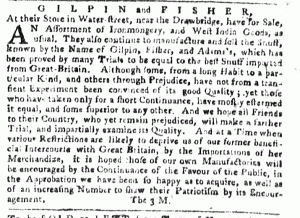
Pennsylvania Gazette (January 30, 1766)
“Which has been proved by many Trials to be equal to the best snuff imported from Great-Britain.”
Advertisements for goods, such as the one depicted above, were commonplace in colonial newspapers. Advertising snuff, also known as sniffing tobacco, would not have been a shocking advertisement for the time as tobacco was a popular product. What is striking about the notice is what the tobacco was compared to: tobacco imported from Great Britain.
I also find it interesting that Gilpin and Fisher would make a comparison to tobacco from Great Britain at a time when several of the colonies were prone to unrest. Britain had just passed the Stamp Act tax in 1765; some British products were currently being boycotted. Perhaps since the people of the colonies still considered themselves British citizens, they would have wanted to be loyal to British products. On the other hand, the advertisement would give colonists a sense of security in local products since the colonists had been so used to British goods.
**********
ADDITIONAL COMMENTARY: Carl Robert Keyes
I was excited when Maia chose this advertisement, for a variety of reasons. She did not know that I had already selected an advertisement from the Massachusetts Gazette for yesterday that was also shaped by the Stamp Act, making this a wonderful transition into her responsibilities as guest curator for this week. I also appreciated the appeal to locally produced good, which Maia highlights in the quotation she selected from this advertisement: “Which has been proved by many Trials to be equal to the best snuff imported from Great-Britain.”
When I have featured advertisements that make similar appeals, I have emphasized their political valence and their rhetoric of resistance. Maia offers a perspective that I have not given as much attention: assuring colonists that domestic products were as good as any imported from Great Britain was not just an assurance of quality. This was also a means of offering reassurance to potential customers who faced an increasingly disorienting world of consumption disrupted by transatlantic politics.
Also, in questioning to what extent colonists might have wanted, on some level, to remain loyal to British goods Maia also reminds us that this was indeed a period of resistance – not yet revolution – and colonists continued to embrace their identity as members of the British empire even as they sought redress of grievances within the British system of law and politics.
What was advertised in a colonial newspaper 250 years ago this week?
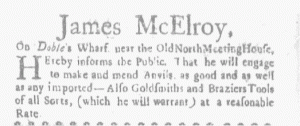
Boston-Gazette (January 13, 1766)
“He will engage to make and mend Anvils, as good and as well as any imported.”
In the 1760s advertisers regularly indicated that they stocked and sold imported goods. Many advertisements deployed formulaic language or structure that included references to the origins of merchandise and explicitly used the word “imported.” Colonial artisans found themselves in competition with shopkeepers who peddled imported wares that were often superior in quality and craftsmanship to what was produced on this side of the Atlantic.
James McElroy seems to have realized that other colonists could be skeptical about such goods. In response, he offered a variation on the first “Buy American” campaigns that emerged during the Stamp Act protests when he assured potential customers that he could “make and mend Anvils, as good and as well as any imported.” In addition, he forged “Goldsmiths and Braziers Tools of all Sorts” and offered a guarantee (“which he will warrant”) of their quality.