December 23

What was advertised in a revolutionary American newspaper 250 years ago today?
Virginia Gazette [Dixon and Hunter] (December 23, 1775).

“A large and exact VIEW of the late BATTLE at CHARLESTOWN.”

Like other printers, John Dixon and William Hunter sold books, pamphlets, almanacs, stationery, and other merchandise to supplement the revenues they generated from newspaper subscriptions, advertisements, and job printing.  They frequently placed advertisements in their newspaper, the Virginia Gazette, to generate demand for those wares.  The December 23, 1775, edition, for instance, included three of their advertisements, one for “SONG BOOKS and SCHOOL BOOKS For SALE at this OFFICE” and another for the “Virginia ALMANACK” for 1776 with calculations “Fitting VIRGINIA, MARYLAND, [and] NORTH CAROLINA” by “the ingenious Mr. DAVID RITTENHOUSE of Philadelphia,” the same mathematician who did the calculations for Father Abraham’s Almanack marketed in Philadelphia and Baltimore.

Their third advertisement promoted memorabilia related to the hostilities that erupted at Lexington and Concord earlier in the year.  “Just come to Hand, and to be SOLD at this PRINTING-OFFICE,” Dixon and Hunter proclaimed, “A large and exact VIEW of the late BATTLE at CHARLESTOWN,” now known as the Battle of Bunker Hill.  The copies they stocked were “Elegantly coloured” and sold for “one Dollar.”  Dixon and Hunter apparently carried a print, “An Exact View,” engraved by Bernard Romans and published by Nicholas Brooks, rather than a striking similar (and perhaps pirated) print, “A Correct View,” that Robert Aitken included in a recent issue of the Pennsylvania Magazine, or American Monthly Museum and sold separately.  Romans and Brooks had advertised widely and designated local agents to accept subscriptions for the print.  Dixon and Hunter also advertised another collaboration between Romans and Brooks, “an accurate MAP of The present SEAT of CIVIL WAR, Taken by an able Draughtsman, who was on the Spot at the late Engagement.”  The map also sold for “one Dollar.”  Previous efforts to market the map included a broadside subscription proposal that listed local agents in various towns, including “Purdie and Dixon, Williamsburgh.”  Romans and Brooks apparently had not consulted with all the printers, booksellers, and other men they named as local agents when they drew up the list or else they would have known that Alexander Purdie and John Dixon had dissolved their partnership in December 1774.  Dixon took on Hunter as his new partner while Purdie set about publishing his own Virginia Gazette.  Those details may have mattered less to Romans and Brooks than their expectation that printers, booksellers, and others with reputations for supporting the American cause would indeed aid them in marketing and selling a map depicting the conflict underway in Massachusetts.  Whether or not Purdie or Dixon and Hunter collected subscriptions, local agents in Williamsburg did eventually sell the print and the map that supplemented newspaper accounts and encouraged feelings of patriotism among the consumers who purchased them.

December 13

What was advertised in a revolutionary American newspaper 250 years ago today?

Connecticut Journal (December 13, 1775).

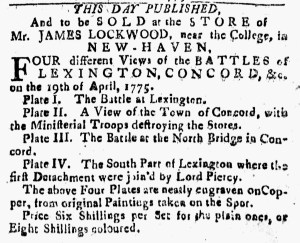
“FOUR different Views of the BATTLES of LEXINGTON, [and] CONCORD.”

The marketing of memorabilia that commemorated events associated with the American Revolution began before the Second Continental Congress declared independence.  Shortly after the Boston Massacre, for instance, Paul Revere, Henry Pelham, and others produced and advertised images depicting the “BLOODY MASSACRE perpetrated in King-Street.”  Revere also marketed a “Copper-Plate PRINT, containing a View of Part of the Town of Boston in New-England, and British Ships of War landing their Troops in the Year 1768.”  As the imperial crisis intensified, Charles Reak and Samuel Okey advertised a print depicting “that truly staunch Patriot, the Hon. SAMUEL ADAMS, of Boston.”  The production of commemorative items accelerated following the battles at Lexington and Concord in April 1775 and the Battle of Bunker Hill in June 1775.

In December 1775, James Lockwood advertised “FOUR different Views of the BATTLES of LEXINGTON, CONCORD, &c. on the 19th of April, 1775.”  He provided a short description of each: “The Battle at Lexington,” “A View of the Town of Concord with the Ministerial Troops destroying the Stores,” “The Battle at the North Bridge in Concord,” and “The South Part of Lexington where the first Detachment were join’d by Lord Percy.”  Lockwood promoted both the quality and accuracy of the prints, noting that the “Four Plates are neatly engraved on Copper, from original Paintings taken on the Spot.”  He almost certainly stocked and sold a series of prints engraved by Amos Doolittle based on paintings by Ralph Earl.  Although Lockwood may have sold the prints separately on request, he promoted them as a package, charging six shillings for as set of “the plain ones” or eight shillings for “coloured” prints.  This collection of prints supplemented news coverage of the battles, helping educate colonizers about recent events, yet many consumers may have desired them as symbols of their patriotism and support of the American cause to display in their homes and offices.  During the first year of the Revolutionary War, the marketing of images that celebrated Americans who defended their towns and their liberties likely encouraged some colonizers to imagine declaring independence rather than merely seeking a redress of grievances.

November 24

What was advertised in a revolutionary American newspaper 250 years ago today?

Thomas’s Massachusetts Spy (November 24, 1775).

“This Almanack contains … a very particular Account of … the Battle of Lexington.”

In the fall of 1775, Isaiah Thomas promoted “The NORTH-AMERICAN’s ALMANACK, For the Year 1776.”  He advertised the handy reference manual in the November 24 edition of his newspaper, Thomas’s Massachusetts Spy, Or, American Oracle of Liberty.  According to the imprint on the title page, the almanac was printed in “MASSACHUSETTS-BAY … by I[SAIAH] THOMAS, in WORCESTER, B[ENJAMIN] EDES,” the printer of the Boston-Gazette, “in WATERTOWN; and S[AMUEL] & E[BENEZER] HALL,” the printers of the New-England Chronicle, “in CAMBRIDGE.”  The advertisement also indicated that each of those printing offices stocked and sold the almanac.

Each of those printers earned reputations for their support of the American cause.  In this instance, their marketing efforts reflected their politics.  The advertisement noted that the almanac included “many interesting and entertaining matters” in addition to “what is necessary and useful,” singling out “a very particular Account of the commencement of Hostilities between Great-Britain and America, and the Battle of Lexington, by the Rev. Wm. Gordon.”  The contents listed on the title page included other items that resonated with current events, including “Description of a Tory and a Whig,” “Directions for preserving the Health of the Soldiers in the Camp,” and “Sir Richard Rum’s advice to the Soldiers, shewing the good effects of Spirituous Liquors when they are used with moderation, and their pernicious effects when they are used to excess, with a cure for Drunkenness.”  Such moral lessons often appeared in almanacs, but it had new significance as the siege of Boston continued.

Thomas and his fellow printers considered the account of the Battle of Lexington “worthy to be preserved by every American,” signaling that their almanac featured more than just “interesting and entertaining matters.”  Readers had a patriotic duty to purchase The North-American’s Almanack and then commemorate the first battle of the Revolutionary War and renew their commitment to defending American liberties each time they consulted the almanac.  The printers sought to disseminate it widely, selling it “by the Thousand, Hundred, Groce, Dozen or single,” intending that retailers purchase in volume for resale.  The price on the title page offered a discount, “6 Coppers Single, and 20 Shillings the Dozen,” and the printers may have negotiated even better deals for those purchasing in even greater quantity.  At the same time that they earned their livelihoods by selling almanacs, they also seized an opportunity to commemorate the Battle of Lexington.  Consumers, they asserted, had a patriotic duty to choose this almanac over any of the alternatives.

November 11

What was advertised in a revolutionary American newspaper 250 years ago today?

Pennsylvania Ledger (November 11, 1775).

“AN ORATION … to Commemorate the Bloody Tragedy … By the Hon. JOHN HANCOCK.”

In addition to printing The Prussian Evolutions for Thomas Hanson in the fall of 1775, John Douglass McDougall published and sold “AN ORATION, Delivered March 6, 1774, at the Request of the Inhabitants of the Town of Boston, to Commemorate the Bloody Tragedy of the fifth of March, 1770.  By the Hon. JOHN HANCOCK, Esquire.”  The bookbinder, bookseller, and stationer had only recently added printer to the occupations he pursued at his shop in Philadelphia.  For his first forays, he focused on works supporting the American cause, either because doing so aligned with his political principles or because he spotted an opportunity to enhance his earnings.  Such motivations were not necessarily mutually exclusive.

In 1771, the residents of Boston marked the first anniversary of the “Bloody Tragedy,” now known as the Boston Massacre, with an oration delivered by James Lovell.  It did not take long for local printers to market copies.  So began an annual tradition.  Each year, a prominent figure delivered an “ORATION” and printers published and marketed those addresses.  Following Lovell, Joseph Warren spoke in 1772, Benjamin Church in 1773, John Hancock in 1774, and Joseph Warren again in 1775, just a few months before being killed in action at the Battle of Bunker Hill.  The annual oration became a ritual in Boston, as did the marketing of copies of the latest address in Boston’s newspapers each spring.  Printers outside of Boston, however, did not publish local editions, nor did booksellers outside of New England advertise copies they acquired from Boston.  The “Bloody Tragedy” and the trials of the soldiers involved had certainly been reported far and wide in newspapers throughout the colonies, but the subsequent commemorations did not receive as much notice, at least not in terms advertisements encouraging consumers beyond New England to purchase their own copies of the most recent oration.

That made McDougall’s new edition of Hancock’s oration from 1774 an innovation in the local market.  Why did he opt to publish Hancock’s address rather than the one more recently delivered by Warren?  As president of the Second Continental Congress, Hancock achieved recognition throughout the colonies, whereas Warren, even though he had died for the American cause, may have been considered a figure associated primarily with Massachusetts and thus not having the same appeal in Philadelphia, where the Second Continental Congress met and McDougall printed and advertised Hancock’s oration.  Whatever the reason, the publication and marketing of Hancock’s oration in Pennsylvania testified to a transition taking place throughout the colonies in the wake of the Coercive Acts and the battles at Lexington and Concord.  More colonizers began to think of themselves as sharing a common cause rather than having interests aligned with their own province.  They began to think of themselves as an imagined community of Americans despite the local and regional differences that distinguished each colony from the others.

November 1

What was advertised in a revolutionary American newspaper 250 years ago today?

Pennsylvania Journal (November 1, 1775).

“A NEAT Mezzotinto print of the Hon. JOHN HANCOCK.”

“A large and exact VIEW of the late BATTLE at CHARLESTOWN.”

“An accurate map of the present seat of CIVIL WAR.”

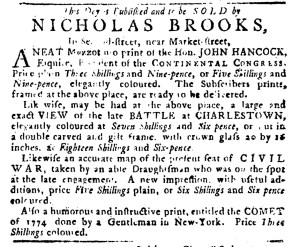
Nicholas Brooks produced and marketed items that commemorated the American Revolution before the colonies declared independence.  In an advertisement in the November 1, 1775, edition of the Pennsylvania Journal, for instance, he packaged together three prints previously advertised separately, each of them related to imperial crisis that had boiled over into a war.  For this notice, Brooks presented them as a collection of prints for consumers who wished to demonstrate their support for the American cause by purchasing and displaying one or more of them.

Brooks announced that a “NEAT Mezzotinto print of the Hon JOHN HANCOCK, Esquire, President of the CONTINENTAL CONGRESS,” that had previously been proposed in other advertisements had been published and was now for sale at his shop on Second Street in Philadelphia.  The subscribers who had reserved copies in advance could pick up their framed copies or arrange for delivery.  Others who had not placed advanced orders could acquire the print for three shillings and nine pence or pay two extra shillings for one “elegantly coloured.”

“Likewise, may be had at the above place,” Brooks reported, “a large and exact VIEW of the late BATTLE at CHARLESTOWN,” depicting what has become known as the Battle of Bunker Hill.  This print competed with an imitation bearing a similar title, “a neat and correct VIEW of the late BATTLE at CHARLESTOWN,” that Robert Aitken inserted in the Pennsylvania Magazine and sold separately.  Brooks, who had long experience selling framed prints, offered choices for his “exact VIEW.”  Customers could opt for an “elegantly coloured” version for seven shillings and six pence” or have it “put in a double carved and gilt frame, with glass 20 by 16 inches,” for eighteen shillings and six pence.  The eleven shillings for the frame, half again the cost of the print, indicated that Brooks anticipated that customers would display the “exact VIEW” proudly in their homes or offices.

He also promoted “an accurate map of the present seat of CIVIL WAR, taken by an able Draughtsman,” Bernard Romans, “who was on the spot of the late engagement.”  Brooks revised copy from earlier advertisements: “The draught was taken by the most skillful draughtsman in all America, and who was on the spot at the engagements of Lexington and Bunker’s Hill.”  The map showed a portion of New England that included Boston, Salem, Providence, and Worcester.   This print, he declared, was a “new impression, with useful additions,” though he did not specify how it differed from the one he previously marketed and sold.  As with the others, customers had a choice of a plain version for five shillings or a “coloured” one for six shillings and six pence.

Brooks added one more item, “a humorous and instructive print, entitled the COMET of 1774, done by a Gentleman in New-York.”  Did this print offer some sort of satirical commentary on current events?  Or was it unrelated to the prints of Hancock, the Battle of Bunker Hill, and the “CIVIL WAR” in New England?  Whatever the additional print depicted, Brooks made the prints that commemorated the American Revolution the focus of his advertisement, gathering together three items previously promoted individually.  In so doing, he not only offered each print to customers as separate purchases but also suggested that they could consider them part of a collection.  Consumers who really wanted to demonstrate their patriotism could easily acquire all three at his shop.

October 4

What was advertised in a revolutionary American newspaper 250 years ago today?

Pennsylvania Journal (October 4, 1775).

“A NEAT MEZZOTINTO PRINT of the HON. JOHN HANCOKC, ESQ; PRESIDENT of the CONTINENTAL CONGRESS.”

On October 4, 1775, Nicholas Brooks took to the pages of the Pennsylvania Journal to announce that he “JUST PUBLISHED … An Exact VIEW of the Late BATTLE at CHARLESTOWN,” now known as the Battle of Bunker Hill.  Brooks had previously distributed subscription proposals for the project that he pursued in collaboration with Bernard Romans.  Brooks and Romans had recently worked together on a map of Boston that depicted the siege of the city following the battles at Lexington and Concord.  Brooks described the new print now ready for purchase as a “Large Elegant PIECE, beautifully Coloured, and much superior to any pirated copy now offered or offering to the public.” Apparently, Brooks had not worked with Robert Aitken in making a version to accompany the Pennsylvania Magazine.  It was not the first time that one colonizer pirated the work of another when producing items that commemorated the imperial crisis that eventually became a war for independence.  Paul Revere had done the same with Henry Pelham’s image of the Boston Massacre, advertising his copy in Boston’s newspapers before Pelham marketed the original.

Despite his frustration with the situation, Brooks must have considered prints commemorating the people and events related to the current crisis viable business ventures.  Immediately below his advertisement for “An Exact View of the Late BATTLE at CHARLESTOWN,” he inserted another advertisement, that one proclaiming, “It is PROPOSED to PRINT, in about ten days, A NEAT MEZZOTINTO PRINT of the HON. JOHN HANCOKC, ESQ; PRESIDENT of the CONTINENTAL CONGRESS.”  Brooks collected subscribers’ names and reserved copies of the print for them at his shop on Second Street in Philadelphia.  Interested parties could also visit the London Coffee House, a popular spot for socializing, conducting business, and talking politics.  Brooks’s advertisement did not give details about what to do at the London Coffee House.  Subscribers may have given their names to an employee who recorded them on a list or they may have signed their own names (and indicated the number of copies they wished to purchase) on a subscription proposal posted alongside other advertisements.  They very well may have perused the names of other patriots who ordered the print as they committed to acquiring their own copy.  Brooks hoped that they would also purchase “Frames and Glasses” to display the prints from his shop, just as he marketed a “Double Carv’d and Gilt Frame … with Crown Glass” for the print depicting the battle.  Brooks certainly wanted commemorative items to become fashionable items that consumers believed that they not only wanted but needed as the imperial crisis intensified.

September 28

What was advertised in a revolutionary American newspaper 250 years ago today?

New-York Journal (September 28, 1775).

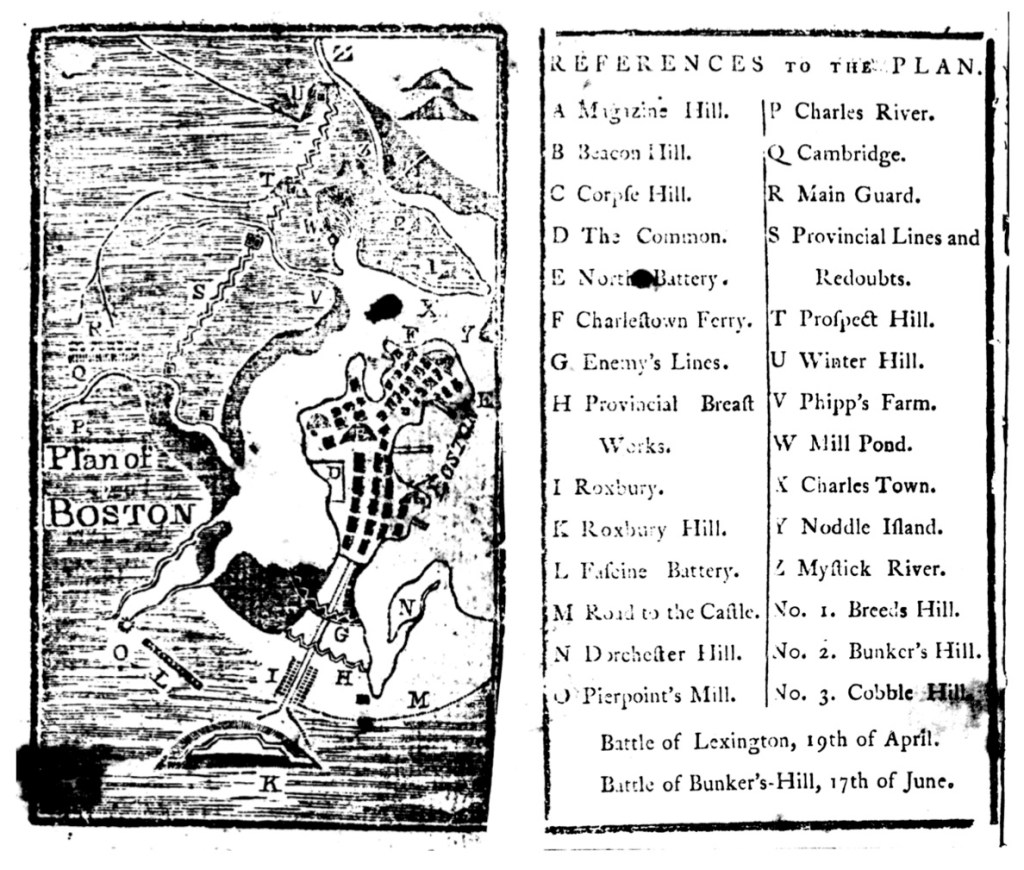
“The Words of Command used in the Manual Exercise, and an accurate Plan of Boston.”

Almost simultaneously with Hugh Gaine announcing in the New-York Gazette and Weekly Mercury that he had “Just PUBLISHED … HUTCHIN’s Improv’d; BEING AN ALMANACK … For the Year of our LORD 1776,” Frederick Shober and Samuel Loudon inserted an advertisement in the New-York Journal to alert the public that they had “Just published … The NEW-YORK and COUNTRY ALMANACK, For the Year of our Lord 1776.”  It included “all the necessary Articles usual in an Almanac, with the Addition of many curious Anecdotes, Receipts [or Recipes], [and] poetical Pieces.”  Unlike Gaine, Shober and Loudon did not provide an extensive list of the contents.  As printer of the New-York Gazette and Weekly Mercury, Gaine had access to as much space as he wished to devote to promoting an almanac he published.  Shober and Loudon, on the other hand, paid to run their advertisement in the New-York Journal.

The partners did, however, specify two items that they wanted prospective customers to know they would find in the New-York and Country Almanack: “the Words of Command used in the Manual Exercise, and an accurate Plan of Boston with the different Situations of the Provincials, and the Ministerial Armies.”  Both reflected current events.  The “REFERENCES TO THE PLAN” (or legend for the map of Boston) in the almanac highlighted the “Battle of Lexington, 19th of April,” and the “Battle of Bunker’s-Hill, 17th of June.”  For readers beyond Massachusetts who did not directly experience those battles, that helped solidify in their minds the dates that they occurred.  By the time that Shober and Loudon took their almanac to press, maps of Boston had circulated widely in the July issue of the Pennsylvania Magazine (and Loudon had been among the booksellers to advertise them).  Nicholas Brooks and Bernard Romans also collaborated on a map that they likely distributed by the end of summer.  Those may have served as models for the “Plan of Boston” that Sober and Loudon commissioned for their almanac.  Gaine also directed attention to the “beautiful Plan of Boston, and the Provincial Camp” in his almanac.  The “whole Process of making SALT PETRE, recommended by the Hon. the Continental Congress” and a “Method of making Gun-Powder” accompanied their map.  In Shober and Loudon’s almanac, the “Words of Command,” taken from the widely published Manual Exercise, supplemented the map.  In both cases, the events of the Revolutionary War inspired the contents of the almanacs and became selling points in marketing them.

“Plan of Boston” [left] and “References to the Plan” [right], in The New-York and Country Almanack for the Year of Our Lord 1776 (New York: Shober and Loudon, 1775). Courtesy American Antiquarian Society.

September 27

What was advertised in a revolutionary American newspaper 250 years ago today?

Pennsylvania Journal (September 27, 1775).

 “AMERICANS VIRTUALLY Represented IN ENGLAND: (A SATYRICAL PRINT.)”

As the imperial crisis intensified and hostilities commenced in Massachusetts in the spring of 1775, American colonizers had supporters in London.  In addition, some artists, engravers, and printers, whatever their own politics may have been, hoped to generate revenue by creating and publishing political cartoons that lambasted the British ministry for the abuses it perpetrated in the colonies.  Some of those prints found their way to eager audiences on the other side of the Atlantic.  In the fall of 1775, William Woodhouse, a bookseller and bookbinder, John Norman, an architect engraver building his reputation, and Robert Bell, the renowned bookseller and publisher, advertised a “SATYRICAL PRINT” that “LATELY ARRIVED FROM LONDON.”

The trio promoted “The MINISTERIAL ROBBERS; or, AMERICANS VIRTUALLY Represented IN ENGLAND,” echoing one of the complaints that colonizers made about being taxed by Parliament without having actual representatives serve in Parliament.  Based on the description of the print in the advertisement, Woodhouse, Norman, and Bell stocked “Virtual Representation, 1775” or a variation of it.  According to the newspaper notice, the image depicted a “View of the present measures carrying on against America, in which are exhibited, A French Nobleman,– A Popish Priest,– Lord Bute,– Lord North,– An American Farmer,– [and] Britannia.”  For each character, “their sentiments, expressed from their own mouths,” appeared as well.

Lord Bute, the former prime minister who inaugurated the plan of regulating American commerce to pay debts incurred during the Seven Years War, appeared at the center of the image, aiming a blunderbuss at two American farmers.  For his “sentiments,” he proclaimed, “Deliver your Property.”  Lord North, the current prime minister, stood next to Bute, pointing at one of the farmers and exclaiming, “I Give you that man’s money for my use.”  In turn, the first farmer stoutly declared, “I will not be Robbed.”  The second expressed solidarity: “I shall be wounded with you.”

The advertisement indicated that the print also showed a “view of the popish town of Quebec unmolested, and the Protestant town of Boston in flames; by order of the English ministry.”  Those parts of the political cartoon unfavorably compared the Quebec Act to the Coercive Acts (including the Boston Port Act and the Massachusetts Government Act), all passed by Parliament in 1774.  The Quebec Act angered colonizers because it extended certain rights to Catholics in territory gained from the French at the end of the Seven Years War.  In the print, the town of Quebec sat high atop its bluff, the flag of Great Britain prominently unfurled, in the upper left with the “French Nobleman” and “Popish Priest” in the foreground.  The legend labeled it as “The French Roman Catholick Town of Quebeck.”  The anti-Catholicism was palpable; the kneeling priest exclaiming “Te Deum” in Latin and holding a cross in one hand and a gallows in the other, playing on Protestant fears of the dangers they faced from their “Popish” enemies.

While Quebec appeared “unmolested” and even favored by Bute, North, and their allies in Parliament, the “English Protestant Town of Boston” appeared in the distance behind the American farmers in the upper right.  The town was indeed on fire, a reference to the battles fought in the vicinity as well as a metaphor for the way Parliament treated the town to punish residents for the Boston Tea Party.  As the advertisement indicated, Britannia, the personification of the empire, made an appearance in the print.  She wore a blindfold and exclaimed, “I am Blinded.”  She looked to be in motion, one foot at the edge of “The Pit Prepared for Others” and her next step surely causing her to fall into it.  There seemed to be no saving Britannia as Bute and North harassed the American farmers and their French and Catholic “Accomplices” watched with satisfaction.

The description of the “SATYRICAL PRINT” in the Pennsylvania Journal merely previewed the levels of meaning contained within the image, yet in likely piqued the curiosity of colonizers who supported the American cause and worried about their own liberties as events continued to unfold in Boston.  Such a powerful piece of propaganda supplemented newspaper reports, maps of the Battle of Bunker Hill, and political treatises circulating in the fall of 1775.

“Virtual Representation, 1775” (London, 1775). Courtesy Boston Public Library.

September 20

What was advertised in a revolutionary American newspaper 250 years ago today?

Pennsylvania Gazette (September 20, 1775).

“A neat and correct VIEW of the late BATTLE at CHARLESTOWN, not inferior to any hithero proposed.”

After appearing in the Pennsylvania Ledger on September 16, 1775, the subscription proposal for “An exact VIEW of the late Battle at Charlestown,” now known as the Battle of Bunker Hill, ran in the Pennsylvania Gazette four days later.  It featured nearly identical copy, including a list of local agents, among them several printers in Philadelphia, who collected the names of subscribers in that city and other towns from New York to Virginia.  The notice named Nicholas Brooks as the “printer of said view,” but did not mention that he collaborated with Bernard Romans, the cartographer and engraver.  An addition at the bottom of the advertisement, “Frames and Glass may be had at the abovesaid N. Brooks’s,” suggested that Brooks managed the marketing of the proposed print.

Immediately below that advertisement, Robert Aitken announced, “NOW engraving for the Pennsylvania Magazine, or American Monthly Museum, a neat and correct VIEW of the late BATTLE at CHARLESTOWN, not inferior to any hitherto proposed.”  Aitken, who was not among the printers listed as local agents for the Brooks and Romans print, promoted a competing print!  This one, however, “shall be printed in a size proper for the Magazine.”  The two prints looked strikingly similar, not unlike the competing prints of the Boston Massacre produced by Henry Pelham and Paul Revere in 1770, though one was larger than the other.  Aitken’s print measured 18 x 26 cm (approximately 7 x 10 inches), the right size to tuck it inside the magazine for delivery to subscribers.  Brooks and Romans’s print measured 31.5 x 42.2 cm (approximately 12.5 x 16.5 inches) on a 40.6 x 50.5 cm sheet (approximately 16 x 20 inches), perhaps making it a better candidate to frame and display.

Robert Aitken (engraver and publisher), “A Correct View of the Late Battle at Charlestown” (1775). Courtesy Library of Congress.

Subscribers to the Pennsylvania Magazine received the print as a premium.  Nonsubscribers could purchase the issue for “One Shilling and Sixpence, on account of the great expence of the engraving.”  On other occasions, including the September 16, 1775, edition of the Pennsylvania Ledger, Aitken advertised the price as one shilling per issue.  He now informed “those Gentlemen who incline to purchase this View of the Battle may be furnished with it at the moderate price of Sixpence.”  In effect, he did not give readers who purchased a single issue of the magazine any sort of discount, perhaps hoping to encourage them to subscribe to receive the print as a gift.  Whatever the case, Aitken’s print was slightly more expensive than the five shillings that Brooks and Romans charged for their uncolored print.

Nicholas Brooks (publisher) and Bernard Romans (engraver), “An Exact View of the Late Battle at Charlestown” (1775). Courtesy Massachusetts Historical Society.

Given the similarity of the prints, did Aitken pirate his “VIEW of the late BATTLE at CHARLESTOWN” from Brooks and Romans?  That had been the case with Revere issuing a print based on a drawing by Pelham before the artist managed to publish his own.  Or did Aitken collaborate with Brooks and Romans?  It was not the first time that an image that accompanied his magazine resembled one of their projects.  The July 1775 issue of the Pennsylvania Magazine featured a map, “A New and Correct Plan of the Town of Boston, and Provincial Camp.”  Aitken marketed it at the same time that Brooks and Romans published a map of eastern Massachusetts and northern Rhode Island that featured an inset showing a “Plan of BOSTON and its ENVIRONS 1775.”  The two did not resemble each other as much as the “VIEW” that each advertised.  Whether they collaborated or competed, Aitken and Brooks and Romans all aimed to disseminate a commemorative item that simultaneously kept buyers better informed and inspired them to support the American cause.

September 16

What was advertised in a revolutionary American newspaper 250 years ago today?

Pennsylvania Ledger (September 16, 1775).

“It is proposed to PRINT An Exact VIEW of the late BATTLE at CHARLESTOWN.”

Bernard Romans, a cartographer, apparently met with sufficient success in marketing and publishing his “MAP, FROM BOSTON TO WORCESTER, PROVIDENCE AND SALEM” in the summer of 1775 that he launched a similar project as fall arrived.  He placed a subscription proposal for a print depicting “An Exact VIEW of the late BATTLE at CHARLESTOWN,” known today as the Battle of Bunker Hill, in the September 16, 1775, edition of the Pennsylvania Ledger.  The proposal stated that it “shall be printed on a good crown imperial paper” at a price of five shillings, “plain,” or seven shilling and six pence, “coloured.”

In promoting the print, Romans summarized the battle, though most readers likely already knew the details.  “[A]n advanced party of Seven hundred PROVINCIALS,” the cartographer narrated, “stood an attack made by Eleven Regiments and a Train of Artillery, of the Ministerial forces, and after an engagement of two hours retreated to their main body at Cambridge, leaving Eleven Hundred of the Regulars killed and wounded on the field.”  Even though the British prevailed, it was such a costly victory in terms of casualties that officers that British General Henry Clinton wrote in his diary, “A dear bought victory, another such would have ruined us.”  The Americans had reason to feel proud despite retreating.  Romans hoped to capitalize on that even as he aimed to publish a print that helped colonizers far from Boston visualize the battle.  The print included “a view of Gen. [Israel] Putnam,” an American officer, “a part of Boston, Charlestown in flames, Breed’s hill, Provincial breast-work, a broken Officer, and the Somerset man of war and a frigate firing upon Charlestown.”

As had been the case with his map, Romans collaborated with Nicholas Brooks, a shopkeeper and “Printer of said View” as well as local agents in several cities and towns from New York to Virginia.  The subscription proposal indicated that the print would be ready “to be delivered to the subscribers in about ten days,” not nearly enough time to disseminate the proposal and collect the names of subscribers before making the first impressions.  In both instances, Romans likely felt confident that consumers would be so interested in purchasing items that commemorated the newest chapter in the struggle against Britain that the demand for the map and the print would justify the expense of producing initial copies as well as prompt him to issue even more as local agents submitted their lists of subscribers.