September 28

What was advertised in a colonial American newspaper 250 years ago today?

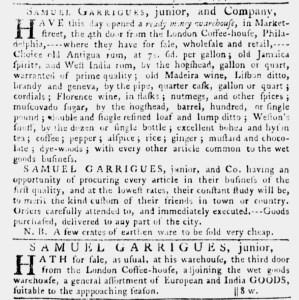
Pennsylvania Gazette (September 28, 1774).

“Goods purchased, delivered to any part of the city.”

As fall arrived in 1774, Samuel Garrigues, Jr., placed a brief advertisement in the Pennsylvania Gazette to remind readers that he sold a variety of imported goods “as usual at his warehouses, the third door from the London Coffee-house” in Philadelphia.  He supplemented that notice with a longer advertisement informing the public that he and his partners, doing business as Samuel Garrigues, Jr., and Company, just opened a “wet goods warehouse” right next door at “the 4th door from the London Coffee-house.”  There they stocked “Choice old Antigua rum,” “old Jamaica spirits, and West India rum,” “old Madeira wine,” “brandy and geneva,” as well as sugar, spices, snuff, coffee, chocolate, and “every other article common to the wet goods business.”  The inventory curiously included “excellent bohea and hyson tea” despite the controversy associated with that commodity.

In addition to listing the merchandise, Garrigues and Company sought to entice prospective customers by explaining that they had “an opportunity of procuring every article in their business of the first quality, and at the lowest prices,” suggesting that they would pass along the savings while also assuring consumers that they did not need to be wary of such bargains meaning inferior goods.  They pledged to make it their “constant study … to merit the kind custom of their friends in town or country” by “carefully attend[ing] to orders” and “immediately execut[ing]” them.  The partnership promised superior customer service.  They also offered a valuable service, delivering purchases “to any part of the city,” whether just a gallon or quart or an entire hogshead or pipe.  They hoped that ancillary service, provided gratis, would sway customers to shop with them to take advantage of both the convenience and the cost.  Eighteenth-century entrepreneurs sometimes experimented with free services as marketing strategies to convince consumers to choose them over their competitors.  For Garrigues and Company, doing so was one aspect of their “constant study” in serving their customers.

August 2

What was advertised in a colonial American newspaper 250 years ago today?

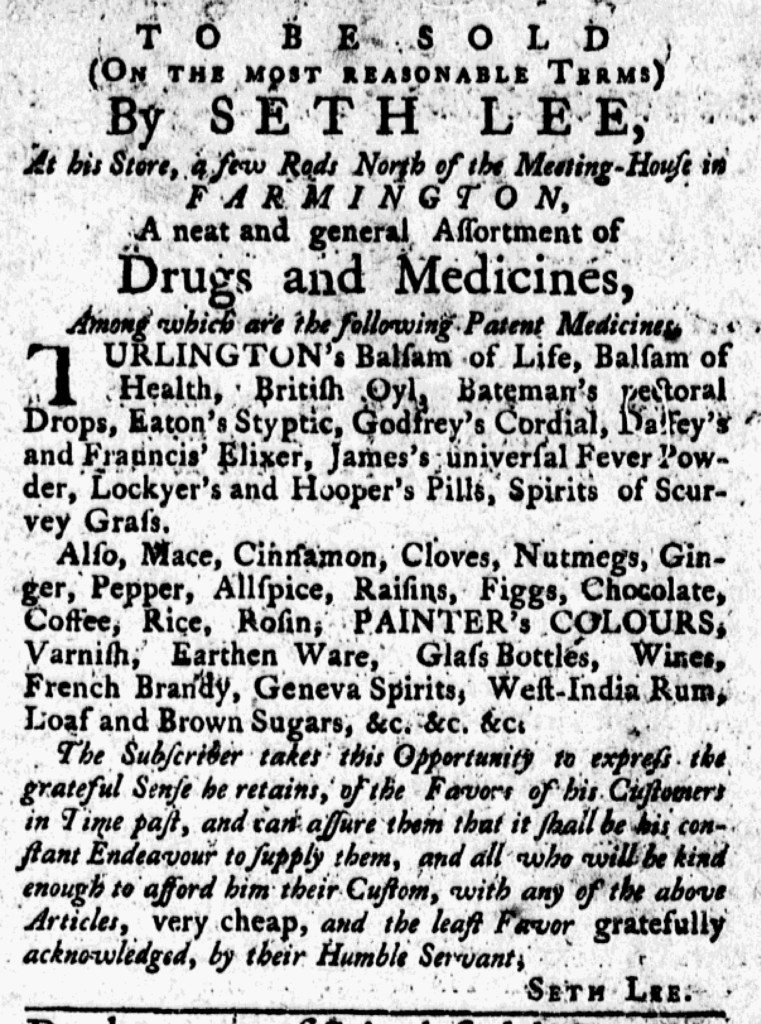
Connecticut Courant (August 2, 1774).

Opportunity to express the grateful Sense he retains, of the Favors of his Customers in Time past.”

In the summer of 1774, Seth Lee of Farmington ran an advertisement for a “neat and general Assortment of Drugs and Medicines” in the Connecticut Courant.  He advised prospective customers that he sold his wares “ON THE MOST REASONABLE TERMS,” hoping that the promise of bargains would entice them to shop at his store.  His merchandise included a variety of patent medicines, each of them so familiar that Lee merely listed a dozen of them without indicating which symptoms they alleviated or maladies they supposedly cured.  He also called attention to alcohol, groceries, paint, and other items that supplemented his inventory.  Lee peddled two popular beverages, coffee and chocolate, but did not mention tea, an increasingly problematic commodity following the Boston Tea Party the previous December and the Coercive Acts passed by Parliament in response.  Elsewhere in the August 2 edition, Amos Wadsworth and Fenn Wadsworth continued hawking “BOHEA TEA, (not infected with a duty),” while Samuel Wescote advertised “good TEA” without further explanation.

Rather than wade into consumer politics, Lee appended a note to his former customers and prospective new customers.  He declared that he wished “to express the grateful Sense he retains, of the Favors of his Customers in Time past.”  In addition to demonstrating his appreciation for their business, such sentiments also testified to his experience providing satisfactory service, an implicit appeal to new customers as Lee attempted to buttress his reputation.  As he continued, Lee included prospective customers in the invitation he extended to readers to shop at his store.  He addressed “all who will be kind enough to afford him their Custom,” pledging that “it shall be his constant Endeavour to supply them … with any of the above Articles, very cheap.”  Furthermore, they would receive exemplary customer service, with “the least Favorgratefully acknowledged.”  Lee highlighted prices at the beginning and end of his advertisement, but he did not make those “REASONABLE TERMS” the focus of his notice.  Instead, he emphasized the relationships he cultivated with customers in the past and would endeavor to continue providing as “their Humble Servant.”  Lee listed goods to attract attention, then sought to hold it by wooing readers with his devotion to customer service.

June 1

What was advertised in a colonial American newspaper 250 years ago today?

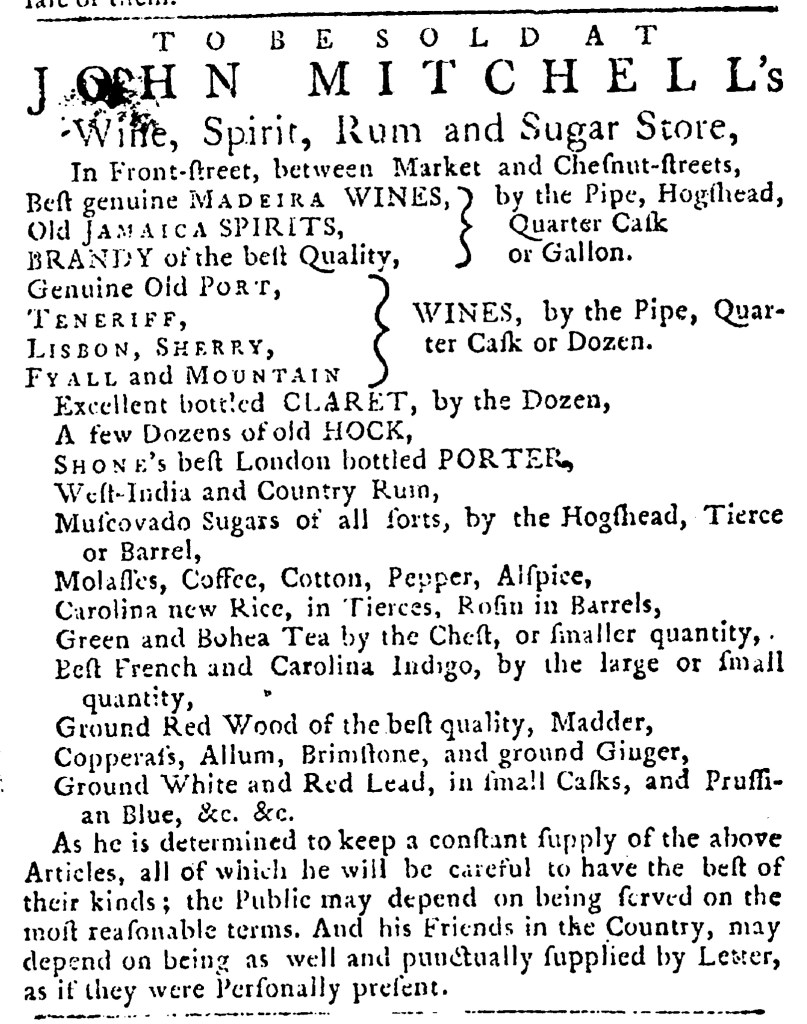
Pennsylvania Journal (June 1, 1774).

“Wine, Spirit, Rum and Sugar Store.”

John Mitchell ran the “Wine, Spirit, Rum and Sugar Store” on Front Street in Philadelphia in the 1770s.  Thomas Batt’s “WINE and SPIRIT STORE” was among his competitors for customers in the bustling urban port and its hinterlands.  To attract the attention of prospective customers, Mitchell provided an extensive list of his inventory in his advertisement in the June 1, 1774, edition of the Pennsylvania Journal.  He sold “Best genuine MADEIRA WINES, Old JAMAICA SPIRITS, [and] BRANDY of the best Quality, by the Pipe, Hogshead, Quarte Cask or Gallon.”  Similarly, his patrons could purchase several kinds of wine, including “Genuine OLD PORT, [and] TENRIFF, LISBON, SHERRY, FYALL and MOUNTAIN” wines, “by the Pipe, Quarter Cask or Dozen.  Like Batt, he offered a choice among quantities.  “Excellent bottled CLARET,” “SHONE’S best London PORTER,” and “West-India and Country Rum” rounded out his selection of alcohol.  Mitchell also stocked groceries, including sugar, molasses, coffee, rice, and the increasingly problematic “Green and Bohea Tea.”

Beyond such a selection, Mitchell also aimed to convince readers that he made shopping at his store convenient.  He advised “Friends in the Country” that they “may depend on being as well and punctually supplied by Letter, as if they were Personally present.”  In other words, Mitchell did not give preference or better treatment to customers who visited his store; instead, he cultivated relationships with customers in towns and villages outside of Philadelphia by providing the same level of service, including filling orders as quickly as possible, so they felt comfortable continuing to buy from him rather than turn to his competitors.  That also meant maintaining “a constant supply” of the merchandise listed in his advertisement so customers did not have to wait on his supply chain after placing their orders.  Mitchell combined these appeals with promises of superior quality and fair prices, declaring that he “will be careful to have the best of their kinds” and that “the Public may depend on being served on the most reasonable terms.”  Although the list of his wares accounted for most of the space in his advertisement, Mitchell deployed a variety of other marketing strategies to entice customers to shop at the “Wine, Spirit, Rum and Sugar Store.”

January 1

What was advertised in a colonial American newspaper 250 years ago today?

New-Hampshire Gazette (January 1, 1773).

“GOODS … as cheap for Cash as at any Shop in Boston.”

Samuel Flagg, a shopkeeper in Salem, complained about “so many flashy Advertisements” that ran in the Essex Gazette in his own notice in that newspaper and others published in New England as 1772 came to an end.  In contrast, the advertisement that Caruth and Nash, who kept shop “at Mr. Abbot’s Tavern, on Kingston Plains,” was not flashy at all.  In the first issue of the New-Hampshire Gazette for 1773, the partners published an advertisement to inform prospective customers that the “JUST IMPORTED, AND … SOLD … A Large and general Assortment of Scotch and English GOODS.”  The way that their name appeared as a headline in all capital letters was the most flashy aspect of Caruth and Nash’s notice.

Yet Flagg had not commented on typography and graphic design alone.  He was even more dismissive of the “Story” that merchants and shopkeepers told consumers in their attempts to incite demand and generate revenue.  Caruth and Nash did not tell a story anywhere near as elaborate as those that Flagg found so absurd and cloying, but that did not mean that their notice lacked any of the marketing strategies in use at the time.  The partners were more reserved in how they presented those appeals to the public.

For instance, they did not go into great detail about their low prices or, especially, what kinds of relationships they cultivated with manufacturers and merchants in England that allowed them to offer great bargains to their customers.  They did, however, pledge that they sold their wares “Wholesale and Retail, as cheap for Cash as at any Shop in Boston.”  Their prices, they assured prospective customers in rural New Hampshire, were competitive with those in the largest urban center in New England.  Caruth and Nash also adopted another strategy that annoyed Flaff, commenting on their customer service.  “Those who are pleased to favour them with their Custom,” the partners advised, “may depend on the best Usage, and the smallest Favour gratefully acknowledged.”  Flagg was not impressed with merchants and shopkeepers who insincerely professed that they “held [themselves] obliged to the good People” for merely looking at their merchandise “without buying.”  Caruth and Nash, on the other hand, incorporated a brief version of that appeal into their newspaper advertisement.

Caruth and Nash’s advertisement was not flashy by the standards of the period, but that did not mean that it lacked marketing appeals intended to sway prospective customers.  They hardly published a mere announcement in the New-Hampshire Gazette.  Instead, their notice included appeals to price and customer service that they believed would help convince readers to purchase from them rather than their competitors.

November 23

What was advertised in a colonial American newspaper 250 years ago today?

Boston-Gazette (November 23, 1772).

“A General Supply of the most modern BOOKS.”

Like many modern booksellers, James Foster Condy sold books and more at his store on Union Street in Boston in the early 1770s.  In a lengthy advertisement that ran in the November 23, 1772, edition of the Boston-Gazette, he highlighted several aspects of his business, promoting his merchandise, his prices, and his customer service.

Condy began with an announcement about a new publication, “A POEM, Entitled, the GRAVE. By Robert Blair.”  That volume also included “An ELEGY written in a Country Church-Yard. By Mr. Gray.”  In addition to listing the price, just one shilling, Condy appealed to colonizers who considered themselves refined consumers of literature, assuring them that the “Pamphlet will fully recommend itself, to the best Judges and Lovers of Poetry.”  The bookseller had a particular interest in this pamphlet, having made arrangements with a local printer to produce a new edition.

The portion of Condy’s advertisement that hawked the poems could have stood on its own as a separate notice, but the bookseller determined that it served as a good introduction to an overview of his wares.  In addition to the poetry, printed in Boston, he also stocked a “General Supply of the most modern BOOKS” imported from London.  Rather than list any titles, Condy highlighted various genres, including “Law, Physick, History, Divinity, and every Branch of polite Literature” as well as bibles and other devotional materials.  He even had “Books for the Amusement and Instruction of Children.”

The bookseller also carried an assortment of stationery and writing supplies.  That portion of his advertisement occupied almost as much space as the portion about the poetry and more than the portion about other books.  Condy listed everything from “Writing Paper of every Sort” and “Account Books of every Size and Quality” to “various Sorts of Penknives” and “Quills,” to “Glass Ink Potts” and “red and black Sealing Wax.”  In yet another section of the advertisement, he called attention to other kinds of merchandise, some of it related to the books and stationery he sold.  Condy stocked “reading Glasses” and “Glasses for near-sighted Persons” as well as “Diagonal Machines for viewing of Prints” and “a Convex Glass for drawing Landscapes.”

The bookseller concluded with a pitch that extended beyond his merchandise.  He proclaimed that he offered the lowest prices that consumers would encounter not only in the city but anywhere in the colonies, asserting that “All those Persons who please to purchase at said Store, may depend on buying as cheap as at any Store in BOSTON or AMERICA.”  He was so confident in that claim that he declared its veracity “without Exception.”  In addition, his customers would be “used” or treated “in such a Manner as will leave no Room for Complaint, but give entire Satisfaction.”  In other words, Condy considered customer service an important aspect of his business.

With all of the books, stationery, writing supplies, glasses, and other merchandise, the inventory at Condy’s bookstore looked much the same to consumers in eighteenth-century America as modern bookstores appear to customers who browse an array of goods.  Condy did not rely on a single revenue stream.  Instead, he marketed and sold a variety of wares, using price and customer service to further entice prospective clients.

November 22

What was advertised in a colonial American newspaper 250 years ago this week?

Maryland Gazette (November 19, 1772).

“They are well acquainted with the newest Fashions.”

When they settled in Annapolis, Jane Nelson and Anne Nelson took out an advertisement in the Maryland Gazette to introduce themselves to the community and encourage “Ladies … to favour them with their Commands” or orders for “all Kind of Milliners and Mantua-makers Work.”  As newcomers to the colony, they could not rely on their reputations to market their services.  Instead, they emphasized their connections to London, the cosmopolitan center of the empire, and their knowledge of current styles there.

In the deadline for their advertisement, the Nelsons proclaimed that they “Just arrived from LONDON.”  Artisans, tailors, milliners, and others often trumpeted that they were “from London” in their advertisements, sometimes long after they crossed the Atlantic.  The Nelsons made it clear that they only recently made that journey.  Accordingly, prospective clients could trust that they were indeed “well acquainted with the newest Fashions” and capable of making hats, cloaks, and other garments “in the most elegant and fashionable manner.”  Having recently come from London, the Nelsons could also provide guidance about “Ladies fashionable dress and undress Caps” and other items.

The Nelsons also aimed to convince prospective clients that they offered exemplary customer service.  They asserted that “Ladies … may depend on having their Work neatly done, and with the utmost Dispatch.”  If given a chance, the Nelsons assured those ladies that “they will not be disappointed in their Endeavours to please, as it shall be their constant Study and greatest Ambition.”  In addition to serving clients who visited them in Annapolis, the Nelsons also took “Orders from the Country,” pledging to punctually complete them.

These “Milliners and Mantua-makers” deployed a two-pronged approach to marketing their services upon arriving in Annapolis.  They promoted their connections to London, underscoring their familiarity with the latest tastes there, while simultaneously vowing to meet and exceed the expectations of their clients in terms of customer service.  The Nelsons hoped that combination of appeals would entice the ladies of Annapolis to engage their services.

October 18

What was advertised in a colonial American newspaper 250 years ago this week?

Massachusetts Spy (October 15, 1772).

“The least favours gratefully acknowledged.”

John Langdon deployed a variety of strategies for marketing his inventory at the “New Book-Store” in Boston in the fall of 1772.  Like many other retailers, he emphasized the choices that he provided for consumers.  In an advertisement in the October 15 edition of the Massachusetts Spy, the bookseller informed prospective customers that he recently imported a “LARGE and Grand Assortment of BOOKS in all Arts and Sciences.”  Those new titles supplemented those he already had in stock.  He confidently proclaimed that he now offered “as large a collection as is to be found at any Store in America.”  His selection supposedly rivaled what consumers would encounter in shops in urban ports like Charleston, New York, and Philadelphia as well as in the shops operated by local competitors.  Langdon intended for that bold claim to double as an invitation for prospective customers to browse in his shop and discover titles of interest among his extensive inventory for themselves.

In addition, thew bookseller made appeals to price and customer service.  He explained that he planned to depart for England in the spring.  As a result, he wished to sell his inventory over the course of the next several months.  To do so, he set low prices.  Langdon pledged that “every Gentleman who may please to favour him with their custom may depend on purchasing at a little more than the sterling cost and charges.”  In other words, he did not mark up the prices exorbitantly but instead sought to make only a small profit on each book he sold.  Langdon concluded his advertisement with a note that the “least favours [are] gratefully acknowledged.”  He appreciated any business, no matter how large or small the transaction.  Even though he had such a large inventory, no purchase … and no customer … was insignificant. Langdon intended to cultivate relationships with everyone who entered his shop.

Langdon’s advertisement for the New Book-Store was no mere announcement that he sold books.  Instead, he crafted a notice that incorporated multiple marketing strategies.  He emphasized the size of his inventory, his motivation for setting low prices, and the importance of every customer in his effort to encourage consumers to acquire books from him.

October 4

What was advertised in a colonial American newspaper 250 years ago this week?

New-York Journal (October 1, 1772).

“The surest Means to acquire a speedy Sale … is to make them of full Quality, at a moderate Charge, and good Attendance.”

Richard Deane, “DISTILLER, from “LONG-ISLAND,” considered experience one of the best markers of quality for the spirits that he sold in New York.  He stocked “a Quantity of neat Brandy, Geneva, Spirits of Wine, and Cordials of different Sorts” as well as “the very best Quality” shrub and New York rum.  In an advertisement in the October 1, 1772, edition of the New-York Journal, he attempted to leverage a precursor to name recognition or brand recognition, stating that the “good Quality of said DEANE’s Brandy, Geneva, and Cordials, has for several Years past been well experienced” by satisfied customers.  In turn, he redoubled his efforts “to excel in that particular Branch of Business” to further enhance his distillery’s reputation.

Deane elaborated on his business philosophy in a note that concluded his advertisement, confiding that he was “fully convinced by long Experience, that the surest Means to acquire a speedy Sale of the above Articles, is to make them of full Quality, at a moderate Charge, and good Attendance, which, with every other Endeavour to give Satisfaction, will be the constant Study, of the Public’s very obliged humble Servant.”  A manicule drew attention to the distiller’s promise to combine high quality, reasonable prices, and excellent customer service.  In many ways, Deane’s marketing strategy anticipated those deployed by breweries and distilleries today.  Many modern companies link their beers and spirits to traditions that date back to previous centuries, invoking a heritage their founders passed down through generations.  They invoke “long Experience” to encourage consumers to feel as though they participate in customs of significance when they imbibe beverages from their breweries or distilleries.  That “long Experience” also testifies to quality.  After all, breweries and distilleries would not remain in business so long if generations of customers did not appreciate their beers and spirits.  The philosophy that Dean expounded at the conclusion of his advertisement in the New-York Journal is the type of historical record that modern advertising executives would love to exploit in connection to the products they market.

August 18

What was advertised in a colonial American newspaper 250 years ago today?

Essex Gazette (August 18, 1772).

“His utmost Abilities will be exerted to give Satisfaction to his Customers.”

In August 1772, George Deblois alerted readers of the Essex Gazette that he “has received, in the last Ships from LONDON, and has now for SALE … A Good and general Assortment of Hard-Ware and ENGLISH GOODS” at his shop in Salem.  The merchant boasted that he purchased this merchandise “in England on the best Terms.”  As a result, he “is enabled, and is determined to sell them, by Wholesale and Retail, at the very lowest Advance.”  Deblois hoped to hook “his Customers and others” with lots of choices and low prices.

He did not, however, catalog his inventory in an attempt to demonstrate the many choices he made available to consumers, a popular strategy among eighteenth-century advertisers.  Instead, he suggested that doing so “would be only tedious” because “his Assortment consists of a great Variety.”  Rather than publish a dense list of his wares, he encouraged prospective customers to visit his shop, browse his merchandise, and see for themselves that they would “find almost every Article usually enquired for, and on as low terms as can be purchased in the Province.”  He pledged that “those who please to call and look” at his imported goods would not be disappointed.  Deblois also emphasized customer service in his efforts to encourage colonizers into his shop, declaring that “His utmost Abilities will be exerted to give Satisfaction to his Customers, and to use them in such a Manner as to encourage them to call again, or to recommend any of their Friends.”  In addition, he added a nota bene to underscore that “Constant Attendance will be given, and the Favours of his Customers gratefully acknowledged.”

Many merchants and shopkeepers focused primarily on their merchandise when they advertised in colonial newspapers.  Deblois took a different approach, treating shopping as an experience to be enjoyed by consumers in Salem and nearby towns.  He invited colonizers to browse in his shop, encountering items they wanted or needed on their own instead of finding them in a list in the public prints.  That experience included customer service as well as the “Hard-Ware and ENGLISH GOODS” offered for sale.  Deblois seemed to understand that cultivating relationships with “his Customers and others” who had not yet visited his shop would likely yield subsequent sales over time.  Accordingly, he emphasized more than moving merchandise in his advertisement.

June 6

What was advertised in a colonial American newspaper 250 years ago today?

Providence Gazette (June 6, 1772).

“HE doubts not of giving Satisfaction to such persons as may please him with their Custom.”

Among the various marketing appeals in their newspaper advertisements, merchants and shopkeepers often vowed to provide exemplary customer service.  Several who placed notices in the June 6, 1772, edition of the Providence Gazettedid so.  Edward Thurber, for instance, declared that “Whoever pleases to favour him with their Custom may depend upon the utmost Fidelity, and on having their Business executed with Dispatch.”  An extensive catalog of the “fine Assortment of Grocery, Hard-Ware, and Piece GOODS” for sale at his store “at the Sign of the BRAZEN LION” in the “North End of Providence” comprised most of his advertisement, but he did not intend for that testimonial to consumer choice to eclipse his commitment to customer service.  Gabriel Allen and William Allen also stocked a “compleat Assortment of English, India, and Hard-Ware GOODS” at their shop “on the West Side of the GREAT BRIDGE.”  They enhanced their allusion to so many choices with a promise that “Ladies and Gentlemen that are pleased to favour them with their Custom, may depend on the best Treatment.”

Artisans and others who provided services also incorporated customer service into their marketing efforts.  Benjamin Bagnall, Jr., informed the public that he “Carefully CLEANED and MENDED” clocks and watches at his shop, confidently stating that he “doubts not of giving Satisfaction to such Persons as may please to favour him with their Custom.”  In this case, “giving Satisfaction” had more than one meaning.  It implied that Bagnall extended good customer service to his clients, but it also signaled quality and skill, two appeals that artisans often included in their advertisements.  In addition, convenience was an element of the customer service that Bagnall provided.  He claimed that “Watches have been frequently sent to adjacent Places to repair,” presumably because colonizers believed that artisans in Providence did not possess the same skills as their counterparts in Boston and New York.  Such inconvenience was not necessary, Bagnall contended, since he “will endeavour to convince his Employers that there is no Occasion to send [watches] out of the Town.”  In making that pledge, Bagnall brought together customer service, skill, and quality in a single appeal to prospective customers.