What was advertised in a revolutionary American newspaper 250 years ago today?
New-York Gazette and Weekly Mercury (January 8, 1776).
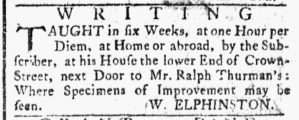
“WRITING TAUGHT in six Weeks … Specimens of Improvement may be seen.”
Among the various advertisements that appeared in the January 8, 1776, edition of the New-York Gazette and Weekly Mercury, W. Elphinston offered his services as a writing tutor. Although writing and reading are skills often taught simultaneously today, that was not always the case in eighteenth-century America. For instance, at “Mrs. TAYLOR’s BOARDING SCHOOL” for “young LADIES” in Philadelphia, all students learned “Reading and the Grammar” along with sewing and embroidery, but they had to pay extra for instruction from a “Writing Master,” a “Drawing Master,” a “Dancing Master,” a “Musick Master,” and other tutors. Some colonizers learned to read without simultaneously learning writing (or arithmetic). Those who made their mark on documents rather than signing their names did not necessarily lack the skill to read those documents, but they did not benefit from instruction in forming the letters that they knew how to read.
Elphinston offered his assistance. He did not teach reading; he assumed that his prospective students already possessed that skill at some level. He expected them to apply what they already knew about reading to learning to write. Elphinston claimed that his pupils would learn to write in just six weeks, provided that they devoted an hour per day to their lessons. In addition to novices, he also helped those with rudimentary ability to improve their writing, yet he did not merely ask prospective students to take his word for it. Instead, he made “Specimens of Improvement” available at the house where he gave lessons. Anyone who considered engaging his services could examine those specimens themselves to see what kind of progress Elphinston’s former students made because of their lessons with the writing tutor. He was not the only writing master to make specimens available to the public. When a “Person from Boston” relocated to Connecticut and advertised that he “will teach in the most elegant and easy Manner, the several Hands now in Practice, both Useful and Ornamental,” he noted that a “Specimen of [his] Performance, in the several hands abovementioned, is left with the Printer … for the Inspection of any Person” who might hire him. Newspaper advertisements attracted attention, but writing tutors believed that samples could seal the deal.
What was advertised in a colonial American newspaper 250 years ago today?
Essex Journal (March 22, 1775).
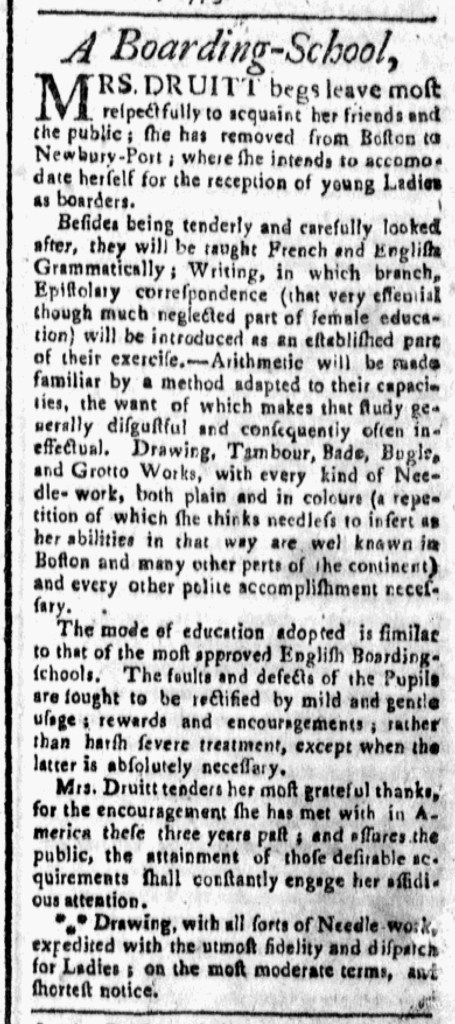
“The mode of education adopted is similar to that of the most approved English Boarding-schools.”
When Eleanor Druitt moved to Newburyport from Boston in the spring of 1775, she placed an advertisement in the local newspaper, the Essex Journal, to announce that she planned to open a boarding school for “young Ladies.” According to her notice, she had been in the colonies for just three years, yet in that time she had established a reputation for educating young women that she hoped would serve her well in her new town. Druitt provided a “mode of education … similar to that of the most approved English Boarding-schools,” offering pupils in Massachusetts the same benefits.
The schoolmistress gave an overview of the curriculum, emphasizing that students would learn “French and English Grammatically” and “Writing, in which branch, Epistolary correspondence (that very essential though much neglected part of female education) will be introduced as an established part of their exercise.” In other words, she taught young women how to write polite letters that would serve them well in maintaining relationships with family and friends in other cities and towns. Her students also learned arithmetic, “made familiar by a method adapted to their capacities, the want of which makes that study generally disgustful and consequently often ineffectual.” Druitt had a much higher estimation of young women’s aptitude for drawing, embroidery, and other kinds of decorative “Needle-work,” asserting that she “thinks needless to insert” a longer description “as her abilities in that way are well known in Boston and many other parts of the continent.” The families of prospective pupils may have seen some of the advertisements she ran in Boston’s newspapers over the past three years since those publications circulated in Newburyport and other towns in Massachusetts and New Hampshire. In general, her curriculum focused on “polite accomplishment[s]” to distinguish the “young Ladies” that she “tenderly and carefully looked after.”
To that end, Druitt declared that the “faults and defects of the pupils [will] be rectified by mild and gentle usage.” That meant “rewards and encouragement; rather than harsh severe treatment.” Parents did not need to worry about the treatment their daughters would receive when boarding with Druitt, though she did state that she would adopt some of those stricter methods as a last resort when “absolutely necessary.” The schoolmistress suggested that she established just the right balance of encouragement and discipline that allowed pupils at her boarding school to thrive. Families had a variety of concerns as the imperial crisis intensified in the spring of 1775, but they need not worry about the “reception” their daughters would experience at Druitt’s boarding school.
What was advertised in a colonial American newspaper 250 years ago today?
Rivington’s New-York Gazetteer (April 7, 1774).
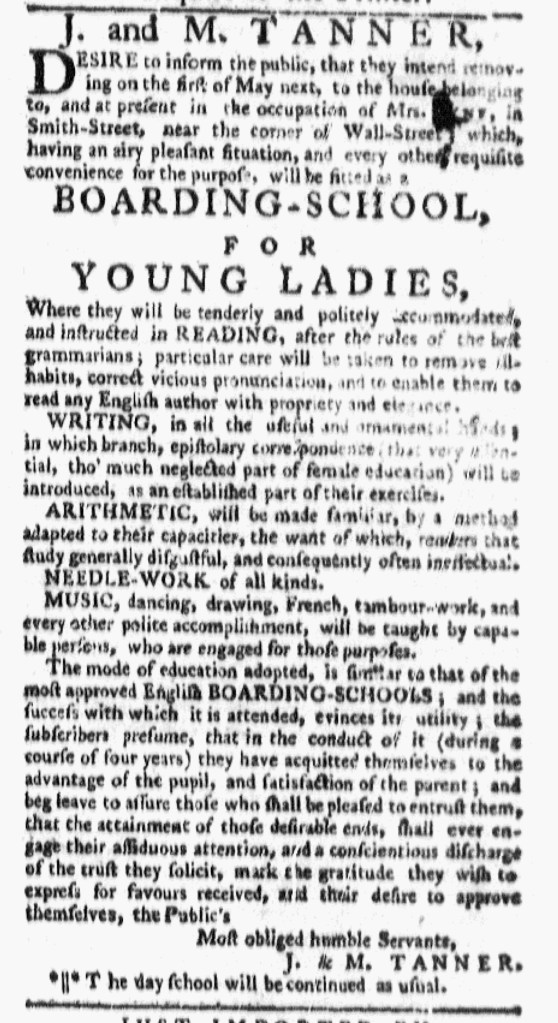
“BOARDING-SCHOOL, FOR YOUNG LADIES.”
J. & M. Tanner’s notice in Rivington’s New-York Gazetteer advertised an opportunity for young women to attend a boarding school “in Smith-Street, near the corner of Wall Street.” At this school, the “YOUNG LADIES” would improve in reading, writing, needlework, music, dancing, and other subjects considered appropriate for them. The Tanners include a comparison of their new school to what a British boarding school had to offer, stating that their curriculum “was similar to that of the most approved English BOARDING-SCHOOLS.” According to Mary Cathcart Borer in Willingly to School: A History of Women’s Education, boarding schools for young ladies popped up in England as early as 1711, with nearly the same curriculum at each.[1] However, arithmetic was a subject that the Tanners’ school in the colonies included that many British schools for girls and young women did not. While still expected to stay in the private sphere, Tanners’ boarding school allowed for young women’s opportunities in arithmetic, which was not always an option for many young women elsewhere. We cannot conclude exactly why the Tanners chose to incorporate arithmetic into their school’s curriculum. However, it indicates that while still using the British model, there were variations of the boarding school systems in the colonies.
The Tanners’ boarding school seems to have been an effort to demonstrate that the colonies could also partake in the same developments that England did, particularly in women’s education and manners. Considering that this advertisement was published in 1774, a year before the first battles of the American Revolution, tensions increasingly inspired colonists to establish self-sufficiency in government and commerce and other aspects of life, such as education, without reliance on Britain. Even as that happened, it is critical to recognize that while the colonies were looking to have their own self-sufficient systems and government, they still included British ideals. Britain was still influential in colonial culture, which was especially shared through ideas of education and what made well-educated and well-mannered young ladies.
**********
ADDITIONAL COMMENTARY: Carl Robert Keyes
Rather than expand on Maria’s interpretation of today’s advertisement, I am reflecting on pedagogy and my experiences integrating the Adverts 250 Project and the Slavery Adverts 250 Project into the courses I teach at Assumption University. Throughout this academic year, including the time that Maria and her peers were enrolled in my Revolutionary America course last fall, faculty and staff have engaged in a series of programs about “awaken[ing] in students a sense of wonder” and how we seek to fulfill the University’s mission. I have learned some valuable lessons along the way, from my colleagues at those events and from my students in the classroom.
Maria and her classmates commence their responsibilities as guest curators by compiling a mini-archive of newspapers published during a particular week in 1774. I provide each of them with a list of extant newspapers that have been digitized and train them in using several databases. Once they have created their mini-archives, each student examines the newspapers for their week to identify all of the advertisements about enslaved people for inclusion in the Slavery Adverts 250 Project and to select an advertisement about consumer goods or services to feature on the Adverts 250 Project. I provide students with hard copies of their newspapers, encouraging them to work back and forth with the digitized ones.
One morning last fall, I arrived in class intending to discuss advertisements about enslaved people and what students learned from that portion of the project. We had a robust discussion, but, to my initial frustration, students did not stick to the topic for the day! Instead of focusing solely on advertisements about enslaved people, they started discussing other kinds of advertisements and asking about other aspects of the newspapers as well. I had a lesson plan, an “agenda” of material that I “needed” to cover that day, and their “off-topic” questions did not facilitate the good order that I had envisioned.
Then I realized that I was witnessing authentic wonder in my classroom, that the conversation taking place was more important than anything I scripted in my mind in advance, and that students were learning more from the experience than by following my outline for that class. I spend so much time working with (digitized) eighteenth-century newspapers that they are as familiar to me as modern media … but having a week’s worth of newspapers published in 1774 in front of them was completely new to my students. The advertisements were new to them, but so were the conventions of eighteenth-century print culture! They immersed themselves in their newspapers, learning as much as they could on their own and then asking questions about life in early America based on what they encountered in those newspapers.
When I finally understood what was happening, I jettisoned my outline so we could have a lengthy conversation about anything my students found interesting or confusing or strange in their newspapers. However unintentional, my first instinct had been to stifle their sense of wonder by attempting to rigidly follow my outline for that class. In the end, we all – professor and students – got so much more out of that class when I learned from my students that I could better facilitate how they learned about the past by giving them opportunities to express their wonder. As the semester progressed, we circled back, repeatedly, to discussing advertisements about enslaved people as my students worked on the Slavery Adverts 250 Project. At the same time, I allowed for more opportunities to “get off track” as we examined a variety of other primary sources. My students learned more and I had a more fulfilling experience as an instructor, energized by the quality of the discussions we had in class on those occasions that my students deviated from what I planned for the day.
**********
[1] Mary Cathcart Borer, Willingly to School: A History of Women’s Education (Cambridge, UK: Lutterworth Press, 1976).
What was advertised in a colonial American newspaper 250 years ago this week?
New-York Journal (October 14, 1773).
“He continues to teach … whatever is requisite to fit the young Students for Admission into any College or University.”
In the fall of 1773, J. Peter Tetard sought students for the boarding school he operated “near King’s Bridge,” about fifteen miles outside of New York. In an advertisement in the October 14 edition of the New-York Journal, he expressed his appreciation for “the encouragement” he received since opening the school over the summer, suggesting both that the enterprise earned the approval of prominent colonizers and that some parents already enrolled their children in the school. Yet he still had space for more students.
To entice parents to send their sons to his boarding school, Tetard made an appeal that continues to resonate today. His curriculum encompassed “whatever is requisite to fit the young Students for Admission into any College or University.” Tetard depicted matriculating at his academy as preparation that would lead to subsequent academic success. To that end, he taught “the French Language in the most expeditious Manner, together with some of the most useful Sciences.” Those included geography, ancient and modern history, logic, and “the learned Languages.” His pupils acquired the ability to engage in “the skilful reading of the Classics.” All of this set Tetard’s students on the path for further study at one of the colleges in the colonies or perhaps even a university in Europe, depending on their status and wealth.
Beyond the curriculum, Tetard emphasized his own role as instructor. He described himself as “Late Minister of the Reformed French Church” in New York. Most colonizers in New York remained deeply suspicious of both the French and Catholicism at the time, making it imperative that Tetard establish his commitment to Protestantism. For parents unfamiliar with his reputation, he stated that his “Character and Capacity are well-known” as a result of residing “with Credit in the City of New-York for upwards of fifteen Years.” Parents of prospective pupils who had concerns about Tetard’s faith or acumen as an instructor could make inquiries of friends and acquaintances who had lived in the city at the same time as the minister-turned-schoolmaster. Tetard pledged that “Gentlemen who will entrust him with the Education of their Children, may depend on their Expectations being properly answered,” in terms of academic instruction, moral formation, and spiritual guidance.
Tetard also commented briefly on the building that housed his boarding school, noting that it “is remarkable for its healthy Situation, commanding one of the finest Prospects” in the colony. In his advertisement, he introduced three elements that remain important in marketing education in the twenty-first century. Tetard emphasized the quality of the faculty, the benefits associated with the facilities, and the preparation necessary to succeed in subsequent endeavors.
What was advertised in a colonial American newspaper 250 years ago today?
Providence Gazette (October 9, 1773).
“FENNING’s much-approved SPELLING-BOOK.”
John Carter, the printer of the Providence Gazette, inserted an advertisement for “FENNING’s much-approved SPELLING-BOOK” in his own newspaper on October 9, 1773. With news items, editorials, and other advertisements, Carter had so much content that he did not provide much detail in the advertisement except to note that he sold copies “Wholesale and Retail” and set prices “Cheaper by the Dozen than any imported” for those who purchased a quantity. The printer also advised that Jacob Richardson sold the spelling books in Newport in case some readers of the Providence Gazette might find it more convenient to make their purchases in that town. Carter kept his advertisement for “WEST’s ALMANACK, For the Year of Our Lord 1774” similarly brief, noting that it “is now in the Press, and will be published seasonably.”
Had Carter inserted a more extensive advertisement, he likely would have generated much of it from the title of the spelling book. Advertisements for books often quoted the lengthy subtitles common for books published in the eighteenth century. In this case, Carter could have promoted the spelling book as a “new and easy guide to the English language” and invoked the author’s credentials as a former schoolmaster in Suffolk and author of The Use of Globes, Practical Arithmetic, Royal English Dictionary, and Young Man’s Book of Knowledge. Both of these books, Fanning’s spelling book and West’s almanac, were so popular and widely known that Carter likely considered it worth announcing that he sold them even if he did not have additional space to promote them in that issue of the Providence Gazette. After all, he and his predecessors who worked with West to publish an almanac each year undertook extensive advertising. Carter’s reprint of Fanning’s spelling book was the “fifteenth edition, with additions,” according to the title page. Prospective customers presumably already knew a lot about both books.
Even though Carter sold Fanning’s spelling book “by the Dozen,” today only one known copy survives in a research library, historical society, or private collection. That copy, held at the American Antiquarian Society in Worcester, Massachusetts, has been damaged, a portion of its title page missing. Carter, Richardson, booksellers, schoolmasters, shopkeepers, and peddlers may have distributed that edition of the spelling book widely in Rhode Island and nearby colonies in the early 1770s, but over time and perhaps through use those copies became as ephemeral as many of the broadsides, pamphlets, handbills, and other items produced on printing presses prior to the American Revolution.
What was advertised in a colonial American newspaper 250 years ago today?
Maryland Journal (September 18, 1773).
“A lecture on the necessity, advantage, beauty, and propriety of a just vocal expression.”
When Mr. Rathell, “formerly of Annapolis, Teacher of the English Language, Writing-master and Accomptant,” opened a school and offered private lessons in Baltimore he introduced himself to prospective students and their families with an advertisement in the Maryland Journal. Much of the lengthy advertisement focused on establishing his experience and credentials. Rathell noted that he “for some time superintended the Academy of the late eminent Mr. Dove, professor of oratory in Philadelphia.” That led to Dove recommended him as a private tutor who earned “the approbation of many respectable families” in the largest city in the colonies. Rathell claimed that he “can produce indubitable proofs” of Dove’s approval of his endeavors as a private tutor. He also promised to strive to continue “to do justice to the recommendation of the celebrated teacher … whose memory is justly revered by the first literary character in America.” If prospective students and their families were not familiar with “the late eminent Mr. Dove,” Rathell implicitly suggested that reflected on them and gave all the more reason that those who wished to rank among the genteel needed to engage his services.
Furthermore, the tutor gained additional experience in Lancaster, Pennsylvania. “To give still greater weight to his credit as a private tutor,” Rathell exclaimed, “he cannot avoid mentioning, with very great respect, that at Lancaster he has been favoured with an attendance on several Ladies eminent for literary accomplishments.” He lauded his former pupils, recognizing “their own happy genius,” while also insisting that their accomplishments “would give consequence to, and establish the reputation of, the most capital teacher at the first court in Europe.” Despite the distance that separated Baltimore from London, Paris, and other centers of cultural and fashion, Rathell asserted that his students received instruction that rivaled that available to monarchs and nobles.
Rathell also used his advertisement to preview a program that he envisioned, one that had the potential to enhance his reputation in Baltimore and attract more students to his school. He proposed “to read, in public, a few pieces from the most eminent English authors.” The elocution of the “Teacher of the English Language” would be on full display for his audience. In addition, he planned “to deliver a lecture on the necessity, advantage, beauty, and propriety of a just vocal expression, wherein the use and elegance of accent, quantity, emphasis, and cadence will be illustrated.” Again, Rathell made an implicit argument to prospective students and their families. It did not matter how expansive their knowledge of literature or how fashionably they dressed if their manner of speaking betrayed them as not truly genteel. Learning to express themselves with “elegance” was an aspect of personal comportment vital to demonstrating status and sophistication. Those who did not master their speech risked being considered imposters when they gathered with the better sort. Like many other tutors, whether they taught elocution or dancing or French, Rathell played on the anxieties and insecurities of prospective students and their families while also trumpeting his experience successfully teaching others skills associated with gentility and social standing.
What was advertised in a colonial American newspaper 250 years ago today?
Providence Gazette (March 20, 1773).
“WANTED immediately, A SCHOOLMASTER.”
Dr. Jonathan Arnold needed an instructor “to take Charge of the School at Whipple Hall, Providence, North End” in March 1773. Even though he wished to hire a schoolmaster immediately because he had “a large Number of Scholars being now ready to enter” the school, Arnold refused to settle for just anyone who could teach reading, writing, and other subjects. Instead, any prospective schoolmaster had to be “temperate and exemplary, in Life and Manners,” in addition to possessing “Ability in his Profession.” In the era of the American Revolution, advertisements seeking schoolmasters as well as those placed by schoolmasters and -mistresses emphasized manners and morals as much as they did classroom instruction.
Arnold underscored that he was serious about screening applicants. In a nota bene, he declared, “It is expected, that whoever applies will produce sufficient Testimonials of his Qualifications as above, from Persons of undoubted Credit and Character.” To make the point even more clear, he added, “None but such need apply.” Arnold demanded references. The “Testimonials” that they provided had to cover all of a prospective schoolmaster’s qualifications, including his skill and experience in the classroom and his morals and demeanor. Furthermore, those giving recommendations had to be beyond reproach themselves.
Although Arnold aimed to hire a suitable instructor as quickly as possible, his advertisement had audiences other than prospective candidates for the position. He indirectly addressed parents and guardians of current and prospective pupils as well as the entire community. Arnold made clear that he did not entrust any of the children and youth under his charge to just any schoolmaster. Parents and the general public could depend on him recruiting instructors who were both effective teachers and good role models. The notice served an immediate purpose, filling an opening at the school, while also fulfilling a secondary purpose of informing the public, especially parents and guardians of the “Scholars,” about the standards maintained at the school.
What was advertised in a colonial American newspaper 250 years ago today?
Pennsylvania Chronicle (January 16, 1773).
“By limiting the number of his pupils … he has a singular advantage.”
Samuel Blair ran a boarding school for boys in Philadelphia in the early 1770s. In an advertisement in the January 16, 1773, edition of the Pennsylvania Chronicle, the schoolmaster announced that he had openings for two pupils and promoted the benefits of learning in such an exclusive setting. He explained that for the “special benefit” of his students, he limited enrollment to only twelve boys. He advertised “whenever a vacancy occurs,” alerting parents who “choose … to have [their sons] instructed in a private family rather than a public school.”
Blair briefly outlined his curriculum, but devoted most of his advertisement to the virtues of a residential setting for a small number of students. The course of study included “the Latin and Greek Languages, Geography, Arithmetic, and all the most useful practical branches of the Mathematics” as well as “the arts of reading, writing, spelling, and speaking English with elegance and propriety.” His school, he suggested, produced genteel young men.
Their comportment, not just the skills they acquired and the subjects they mastered, made them genteel. Blair asserted that “limiting the number of his pupils” allowed him to “devot[e] himself wholly to the care of their education,” including “constant intercourse and conversations with them as members of his family.” That represented a “singular advantage” for his students compared to the attention they received from other schoolmasters. In addition to “bringing [his pupils] on in these studies and exercises with expedition and accuracy … in such a way as shall render them most easy and agreeable to their young and impatient minds,” Blair declared that he instituted a gentle system of discipline that formed young men of character. In the course of spending time with his students in and beyond the classroom, he took responsibility “for correcting and forming their tempers, for inspecting and regulating their general deportment, and for governing them by the milder and more successful means of argument and persuasion.” The schoolmaster did not deploy harsh methods of correction. Instead, he treated his students as members of an extended family.
Blair did not rely on exclusivity alone to generate interest in his boarding school. To attract interest from the parents of prospective pupils, he described the benefits of that exclusivity. His students not only received an education but also an upbringing that transformed them into genteel young men. When they entrusted their sons to his care, parents could depend on them learning a variety of subjects, both practical and refined, under the watchful eye of a schoolmaster who kept order and instilled good manners without resorting to draconian means. Blair believed that his program presented a “singular advantage” for his students … and aimed to convince parents of prospective pupils that was indeed the case.
What was advertised in a colonial American newspaper 250 years ago today?
Providence Gazette (July 11, 1772).
“Attention will be paid to their Learning and Morals.”
James Manning took to the pages of the Providence Gazette to promote his “Latin School” in the summer of 1772. He pursued that venture, he claimed, upon the request of “several Gentlemen … to take and educate their Sons.” His advertisement served as a mechanism to inform those gentlemen “and others disposed to put their Children under my Care” that he offered lessons “in the College Edifice,” the building constructed for Rhode Island College (now Brown University) two years earlier.
Presumably the “several Gentlemen” who encouraged Manning to establish a Latin school already had some familiarity with his qualifications and methods. For others, he offered assurances that he was “a Master duly qualified” and familiar with “the most effectual Methods to obtain a competent Knowledge of Grammar.” He supplemented the Latin curriculum with “spelling, reading, and speaking English with Propriety,” attending to the comportment of his pupils.
Such concerns extended to their morals as well. Manning trumpeted, “I flatter myself, that such Attention will be paid to their Learning and Morals, as will entirely satisfy all who may send their Children.” Throughout the colonies, schoolmasters and -mistresses, especially those who boarded students, posted newspaper advertisements that inextricably linked “Learning and Morals.” In this case, reading Latin and “speaking English with Propriety” accounted for only a portion of the education that Manning’s students received. As markers of gentility, they mattered little if the words and deeds of his charges belied upright morals.
Manning concluded his notice with a brief note that he sold “All Books for the School” in addition to providing instruction and lodging for his scholars. He also had copies of “the classical Authors read in College” for sale “at the Lowest Rate.” In so doing, he likely sought to leverage his location and affiliation with Rhode Island College as an additional reason for gentlemen to send their sons to his Latin school.
What was advertised in a colonial American newspaper 250 years ago today?
Massachusetts Spy (December 19, 1771).
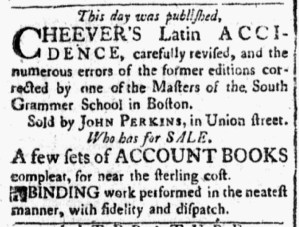
“CHEEVER’S Latin ACCIDENCE, carefully revised.”
Ezekiel Cheever, the author of A Short Introduction to the Latin Tongue, was a Puritan who migrated to New England in 1637. He originally settled in Connecticut before moving to Massachusetts to teach Latin and grammar in the public schools. In 1670 he took the position of Master of the Boston Latin Grammar School which he held until his death in 1708. During his life he was widely loved by his students despite his strict reputation. Under his leadership the school became regarded as one of the best in the colonies and his students included men such as the poet Michael Wigglesworth, Governor Johnathan Belcher, and Judge Samuel Sewall. One year after his death, one of Cheever’s students compiled his teaching notes into a book and published Cheever’s Accidence in 1709. The book was exceedingly popular and became the unofficial standard textbook for teaching Latin grammar in America. In all, twenty-three editions of the book were published, the last of which was published in 1838. While “Latin ACCIDENCE,” as the book was called in this advertisement, was written to teach students Latin, it also taught them the basics of English grammar and helped to formalize definitions that are still taught in schools today.
**********
ADDITIONAL COMMENTARY: Carl Robert Keyes
Colin selected an advertisement for the fifteenth edition of Ezekiel Cheever’s Short Introduction to the Latin Tongue. Two variants of that edition hit the market in 1771. In one, the imprint stated, “Printed and sold by Isaiah Thomas, in Union-Street.” In the other, the imprint declared, “Printed by Isaiah Thomas, for John Perkins, on Union-Street.” According to the catalogers at the American Antiquarian Society, only the imprints differed between the two volumes. Perkins most likely placed the advertisement in the Massachusetts Spy since it advised prospective customers that he sold the textbook, as well as a “few sets of ACCOUNT BOOKS,” but did not mention Thomas.
What prompted Thomas to produce variant imprints for the fifteenth edition? Did Perkins pay to publish only a certain number to carry at his shop, assuming the risk for those copies but not for any others? If so, did he and Thomas agree in advance that the printer would produce additional copies that omitted Perkins’s name from the imprint? Or did production take place in the opposite order? Perhaps Thomas initiated the project, but Perkins recognized an opportunity to profit from a new edition, one with significant improvements. The advertisement did underscore that the volume had been “carefully revised, and the numerous errors of the former editions corrected by one of the Masters of the South Grammer School in Boston.”
Whatever the order of publication of the variants, Perkins turned to Thomas when he set about marketing the book, inserting an advertisement in the newspaper that Thomas published. Did Perkins have to pay for that advertisement? Or was advertising part of a more extensive agreement? Given that Perkins also promoted “BINDING work performed in the neatest manner, with fidelity and dispatch,” the two entrepreneurs, fellow members of the book trades who possessed different skills, may have negotiated several in-kind exchanges that went beyond publishing Cheever’s “Latin ACCIDENCE.”