August 30

What was advertised in a colonial American newspaper 250 years ago this week?

Aug 27 - 8:27:1767 Pennsylvania Gazette Supplement.jpg
Supplement to the Pennsylvania Gazette (August 27, 1767).

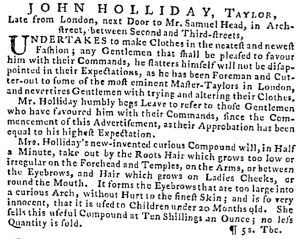
“JOHN HOLLIDAY, TAYLOR … UNDERTAKES to make Clothes in the neatest and newest Fashion.”

John Holliday and his wife ran an advertisement in the Pennsylvania Gazette throughout most of 1767. The Adverts 250 Project previously featured that advertisement, examining how the couple surreptitiously inserted information about “Mrs. Holliday’s new-invented curious Compound” for removing unwanted facial hair at the end of an advertisement that, at a glance, focused primarily on John’s services as a tailor.

The Hollidays’ advertisement demonstrates one strategy female entrepreneurs used to promote their participation in the marketplace without independently publishing newspaper notices, yet the initial portion dedicated to John’s enterprise includes fairly rare commentary on attitudes about the effectiveness of advertising in eighteenth-century America. “Mr. Holliday humbly begs Leave to refer to those Gentlemen who have favoured him with their Commands, since the Commencement of this Advertisement, as their Approbation has been equal to his highest Expectation.” In other words, Holliday acknowledged that business had increased since first placing the advertisement and he attributed that development to his marketing efforts rather than other circumstances. Perhaps Holliday’s advertisement had been successfully because he did not merely announce that he had set up shop. Instead, he listed his qualifications, noting that he had previously been employed as “Foreman and Cutter-out to some of the most eminent Master-Taylors in London.” Such a pedigree likely caught the attention of status-conscious residents of the largest and most cosmopolitan city in the colonies!

Furthermore, Holliday attempted to use his new clients to incite additional demand for his services. Shortly after arriving in Philadelphia from London, he promised that “any Gentlemen that shall be pleased to favour him with their Commands … will not be disappointed” with the garments he made “in the neatest and newest Fashion.” According to this advertisement, several “Gentlemen” indeed “favoured him with their Commands” and thought so highly of the work he completed for them that other potential clients should consider that sufficient testimonial to also engage his services.

August 24

What was advertised in a colonial American newspaper 250 years ago this week?

Aug 24 - 8:23:1766 Providence Gazette
Providence Gazette (August 23, 1766).

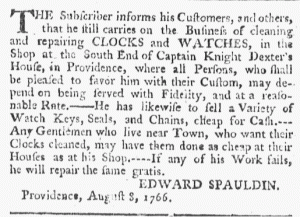
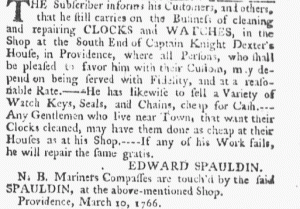
“THE Subscriber … still carries on the Business of cleaning and repairing CLOCKS and WATCHES.”

Publication of the Providence Gazette lapsed for more than a year from May 11, 1765, to August 9, 1765 (with the exception of two “extraordinary issues” on August 24, 1766, and March 12, 1766). The Stamp Act played a role in temporarily suspending the newspaper, but in the revival issue Sarah Goddard and Company indicated that an “inadequate Number of Subscribers” had delayed its return after the hated legislation had been repealed.

When the Providence Gazette once again commenced publication, it included an advertisement from clock- and watchmaker Edward Spauldin, an advertisement that appeared in all four issues published in August 1766. This advertisement had previously appeared in the most recent extraordinary on March 12, 1766. For the August iterations, a nota bene promoting compasses for mariners had been removed and the date listed below Spauldin’s name had been updated. Otherwise, the advertisement was the same, from the text to some rather curious line breaks. It’s possible that the type may not have been reset at all; it may have been sitting in the form for months.

Edward Spauldin made a decision to advertise in the extraordinary issue published nearly half a year earlier. Upon learning that the Providence Gazette would be revived, did he once again decide to place an advertisement in hopes of attracting customers? Or did the Providence Gazette publish his advertisements in order to fulfill a bargain that had been made months earlier? The reappearance of his advertisement can be interpreted in more than one way. It might indicate an enthusiastic advertiser who saw returns from his marketing efforts earlier in the year and hoped to make similar gains once again. Alternately, since the printer had been attempting to revive the newspaper for some time, it might have merely been the continuation of a set number of insertions that had been delayed.

March 12

What was advertised in a colonial newspaper 250 years ago today?

Mar 12 - 3:12:1766 Providence Gazette Extraordinary Supplement
Supplement to A Providence Gazette, Extraordinary (March 12, 1766).

Given the publication history of the Providence Gazette, it is interesting that this advertisement appeared at all.

On March 12, 1766, William Goddard published “A Providence Gazette, Extraordinary.” Note that it was “A Providence Gazette” rather than “The Providence Gazette.” (The most recent issue had featured a masthead proclaiming “Vox Populi, Vox Dei. A PROVIDENCE GAZETTE Extraordinary” nearly seven months earlier on August 24, 1765. Not surprisingly, its contents focused on the then-impending Stamp Act. Regular publication on a weekly schedule had ceased with the issue of May 11, 1765. The newspaper finally resumed weekly publication in August 1766.) The four-page issue included “PROPOSALS for reviving the PROVIDENCE GAZETTE,” assorted news items from throughout the colonies, and testimonials from former and potential customers interested in Goddard resuming publication of the newspaper.

A half dozen or so advertisements appeared in a two-page “SUPPLEMENT to ‘A PROVIDENCE GAZETTE, Extraordinary,’ of Wednesday March 12, 1766.” (Did this supplement accompany the extraordinary issue? Or was it published later? The masthead does not make this clear.)

Edward Spauldin and a handful of other local shopkeepers, artisans, and merchants chose to insert advertisements in a newspaper that was not published on a regular schedule and did not have a slate of subscribers. They may have envisioned that the Extraordinary issue and its SUPPLEMENT would garner a fair amount of attention, allowing them an opportunity to present their goods and services for the consideration of potential customers in the area.

Spauldin’s advertisement was dated “PROVIDENCE, March 10, 1766.” (I checked the previous five issues to confirm that this was a new advertisement rather than one repeated from earlier but with an updated date.) Goddard may have approached him about inserting a commercial notice, but Spauldin ultimately made the decision about advertising in A Providence Gazette. This suggests that he believed in the effectiveness of advertising to incite business in the 1760s. He did not operate his business in an environment of pent-up demand but instead used advertising to create that demand with appeals to price and quality. In addition, he also included a money-back guarantee to get customers through the door: “If any of his Work fails, he will repair the same gratis.”

When “Sarah Goddard, and Company” resumed publication of the Providence Gazette on August 9, 1766, Edward Spaulding placed the same advertisement, except the nota bene had been eliminated and the date was revised to “Providence, August 8, 1766.” Perhaps he attributed new business in March to the original advertisement and decided to give it another try.