October 25

Who was the subject of advertisements in a revolutionary American newspaper 250 years ago today?

Constitutional Gazette (October 25, 1775).

“RUN-AWAY … a Negro man, named MINGO.”

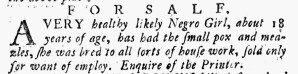
“FOR SALE, A VERY healthy Negro Girl.”

In the fall of 1775, John Anderson joined the ranks of newspaper printers who helped perpetuate slavery by disseminating advertisements about enslaved people in their publications.  In this case, one advertisement concerned “a Negro man, named MINGO,” who liberated himself from Benjamin Hutchinson by escaping from Hutchinson of Southold in Suffolk County on Long Island in early October.  The enslaver described the young man, both his physical features and his clothing, and offered a reward for his capture and return.  Another advertisement offered a “healthy Negro Girl, about 18 years of age,” for sale.  She was capable of “all sorts of house work” and sold “only for want of employ” rather than any deficiency.

Those advertisements first appeared in the October 25 edition of the Constitutional Gazette, a newspaper that commenced publication near the beginning of August.  The new publication initially did not carry advertisements, though Anderson began soliciting them by the end of the month.  Local entrepreneurs who had experience advertising in other newspapers, including goldsmith and jeweller Charles Oliver Bruff and Abraham Delanoy, who pickled lobsters and oysters, soon placed notices in the Constitutional Gazette.  Beyond marketing consumer goods and services, others ran advertisements for a variety of purposes, replicating the kinds of notices found in other newspapers of the period.
Constitutional Gazette (October 25, 1775).

That included advertisements about enslaved people.  Two months after first soliciting advertisements (and less than three months after publishing the inaugural issue), Anderson disseminated Hutchinson’s advertisement about Mingo’s escape from slavery and another notice offering an enslaved young woman for sale.  Like printers from New England to Georgia, he compartmentalized the contents of his newspaper, not devoting much thought to the juxtaposition of news and editorials advocating on behalf of the American cause and advertisements placed for the purpose of perpetuating slavery and the slave trade.

Even as Anderson used his newspaper to advocate for liberty for colonizers who endured the abuses perpetrated by Parliament, he used it to constrain the freedom of Black men, women, and children.  The advertisement about Mingo encouraged readers to engage in surveillance of Black men to determine if any they encountered matched his description.  In addition to publishing advertisements about enslaved people, Anderson also served as a broker.  The advertisement for the young enslaved woman whose name was once known instructed interested parties to “Enquire of the Printer.”  Anderson did more than merely disseminate information.  He actively participated in the sale of the young enslaved woman as one of the services he provided as printer.
June 16

What was advertised in a revolutionary American newspaper 250 years ago today?

Story and Humphreys’s Pennsylvania Mercury (June 16, 1775).

“Enquire of the PRINTERS.”

Printing offices were busy places.  In addition to the master printers, journeymen, apprentices, and others who worked in them, a variety of associates and customers frequently visited to share news and information or to conduct business.  That was almost certainly the case in the printing office operated by Enoch Story and Daniel Humphreys in Norris’s Alley in Philadelphia when the American Revolution began.  The colophon on the final page of their newspaper, Story and Humphreys’s Pennsylvania Mercury, advised that “Subscriptions, … Advertisements, [and] Articles and Letters of Intelligence” were “gratefully received” there.  A constant stream of people likely visited their printing office.

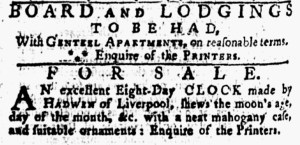
Some of them arrived seeking more information about advertisements that ran in the Pennsylvania Mercury.  In addition to printing and disseminating notices on behalf of advertisers, the printers also served as brokers who provided additional information beyond what appeared in the public prints.  The June 16, 1775, edition, for instance, carried two advertisements that instructed interested parties to “Enquire of the Printers” to learn more.  One gave sparse details about “BOARD AND LODGING TO BE HAD, With GENTEEL APARTMENTS, on reasonable terms.”  Which additional details did Story and Humphreys give to those who did enquire?  Did they merely facilitate an introduction to the advertiser?  Did they have details about price, furnishings, or the schedule for meals?  The advertisement does not reveal how much information they relayed, only that both the printers and the advertiser anticipated that Story and Humphreys would have some involvement beyond publishing the advertisement.

Another advertisement offered for sale an “excellent Eight-Day CLOCK made by HADWEN of Liverpool” that “shews the moon’s age” and the “day of the month” in “a neat mahogany case” with “suitable ornaments.”  Again, the advertisement did not indicate which additional details Story and Humphreys relayed to those who did “Enquire of the Printers,” but it testified to their additional involvement in the transaction after publishing the advertiser’s notice in their newspaper.  Eighteenth-century printers brokered information both in print and in person, the latter an element of the customer service available to advertisers.

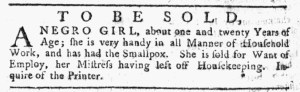
June 6

Who was the subject of an advertisement in a revolutionary American newspaper published 250 years ago today?

Pennsylvania Evening Post (June 6, 1775).

“TO BE SOLD, A NEGRO GIRL…  Inquire of the Printer.”

The June 6, 1775, edition of the Pennsylvania Evening Post carried only two advertisements.  One announced that the Ann from Bristol arrived with a “NUMBER of healthy Men and Women SERVANTS, among whom are Tradesmen, also Sawyers, Footmen, [and] Labourers.”  William and Fisher and Son sold the “Times” of these indentured servants, each of whom willingly made the voyage across the Atlantic.  In exchange for their passage, they agreed to serve for a certain number of years, their “Times,” as specified in their indentures or contracts.

The other advertisement offered a “NEGRO GIRL, about one and twenty Years of Age,” for sale, describing her as “very handy in all Manner of Household Work.”  In addition, she “has had the Smallpox,” which meant that she would not contract the disease again.  As a result, potential buyers could feel more secure in their investment if they bought her.  Furthermore, the advertisement explained that the young woman “is sold for Want of Employ, her Mistress having left off Housekeeping.”  Again, the seller sought to offer reassurances.  The enslaved woman was not sick nor disobedient, just unnecessary.  Rather than free the young woman, her enslaver opted to sell her.  Unlike the servants featured in the other advertisement, she would not gain her freedom in a few years.  She did not have a contract.  She did not serve willingly.

Benjamin Towne, on the other hand, willingly acted as a slave broker in facilitating the transaction.  The advertisement instructed anyone interested in purchasing the enslaved woman to “Inquire of the Printer.”  Towne had been printing the Pennsylvania Evening Post, one of the first tri-weekly newspapers in the colonies, since late January 1775.  This advertisement was the first that offered an enslaved person for sale as well as the first that positioned the printer as a broker.  That it took more than four months does not seem to have been the result of any principles exercised by Towne, though that could have been a factor initially.  Instead, the Pennsylvania Evening Post, printed on a smaller sheet than other newspapers published in Philadelphia, carried fewer advertisements than its competitors.  That seems like the most probable explanation for taking so long to carry an “Inquire of the Printer” advertisement that presented an enslaved person for sale.  Even if Towne had misgivings about such notices when he embarked on publishing the newspaper, the need to generate revenue and remain competitive with Philadelphia’s other newspapers won out.

April 14

Who was the subject of an advertisement in a colonial American newspaper 250 years ago today?

Story and Humphreys’s Pennsylvania Mercury (April 14, 1775).

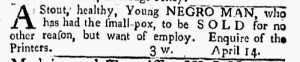
“A Stout, healthy, Young NEGRO MAN … to be SOLD … Enquire of the Printers.”

On April 14, 1775, Enoch Story and Daniel Humphreys published “VOL. I.  NUMB. 2,” the second issue of their new newspaper.  They updated the title in the masthead from The Pennsylvania Mercury; and the Universal Advertiser to Story and Humphreys’s Pennsylvania Mercury, and Universal Advertiser.  The colophon running across the bottom of the final page remained the same, advising readers that they “gratefully received” subscriptions, advertisements, articles, and “Letters of Intelligence” at their printing office in Norris’s Alley in Philadelphia.  Their first issue featured a significant number of advertisements.  The second issue contained even more.  Advertisers were willing to take a chance with this new newspaper, apparently believing that its circulation justified the investment in purchasing space to disseminate their notices.

Among the advertisements that ran for the first time in the second issue of Story and Humphreys’s Pennsylvania Mercury, one offered “A Stout, healthy, Young NEGRO MAN, who has had the small-pox, to be SOLD for no other reason, but want of employ.”  It advised interested parties to “Enquire of the Printers” to learn more.  The notice was dated “April 14” and had a notation, “3 w,” that let the compositor know to include it in three issues.  Last week, Story and Humphreys’s Pennsylvania Mercury made its first appearance in the Adverts 250 Project to examine the advertisements in it (or its second appearance when counting subscription proposals that ran in another newspaper).  Today, the Adverts 250 Project features that newspaper once again because it is making its first appearance in the Slavery Adverts 250 Project.

Yet Story and Humphreys did not merely publish an advertisement that offered an enslaved man for sale.  They published an “Enquire of the Printers” advertisement that made them active participants in the sale.  They may have facilitated an introduction, or they may have negotiated on behalf of the advertiser.  The notice does not reveal the extent of their involvement, but it does indicate that they were involved beyond publishing the advertisement and earning revenue for doing so.  As Jordan E. Taylor documents, American printers acted as slave brokers in thousands of advertisements in newspapers published throughout the colonies and, later, states in the eighteenth century.[1]  Participating in the slave trade was part of the business model for operating a viable newspaper.  Taylor could not identify any printers who refused to run advertisements that offered enslaved people for sale as a matter of principle; the financial incentives were too strong to ignore.  Story and Humphreys very quickly incorporated perpetuating slavery into the practices for their press, both as printers who disseminated advertisements offering enslaved people for sale and as printers who served as slave brokers via “Enquire of the Printers” advertisements.

**********

[1] Jordan E. Taylor, “Enquire of the Printer: Newspaper Advertising and the Moral Economy of the North American Slave Trade, 1704-1807,” Early American Studies: An Interdisciplinary Journal 18, no. 3 (Summer 2020): 287-323.

February 25

Who was the subject of an advertisement in a colonial American newspaper 250 years ago today?

Pennsylvania Ledger (February 25, 1775).

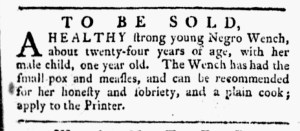
“A HEALTHY strong young Negro [Woman] … with her male child, one year old.”

Five issues.  It took only five issues for an advertisement offering enslaved people for sale to appear in the Pennsylvania Ledger.  James Humphreys, Jr., launched the newspaper on January 28, 1775.  Four weeks later, he printed an advertisement about a “HEALTHY strong young Negro [Woman], about twenty-four years of age,” to be sold “with her male child, one year old.”  The Pennsylvania Ledger was still such a new publication when it carried this advertisement that the proposals and conditions for subscribing appeared as the first item in the first column on the first page.  An advertisement for a political pamphlet ran immediately below the proposals, followed by the advertisement for the enslaved young woman and her child.  Readers encountered them before news reprinted from the Maryland Gazette or any of the other content in that issue.

Humphreys did not merely print and disseminate the advertisement.  He also acted as a broker in the sale.  The notice instructed interested parties to “apply to the Printer.”  What role Humphreys would play when someone did “apply” to him was not apparent in the advertisement.  He may have referred prospective buyers to the advertiser, he may have provided more details about the sale, including price and credit, or he may have been empowered to agree to a sale should a buyer meet the terms specified by the enslaver who offered the woman and child for sale.  Whatever role he played, Humphreys was actively involved in the sale beyond printing the advertisement in his newspaper.

He may have even consulted with the advertiser in composing the advertisement, though it was formulaic enough that an enslaver looking to sell human property likely did not need such assistance.  After all, such “enquire of the printer” advertisements appeared regularly in newspapers published during the era of the American Revolution.  The anonymous advertiser noted that the enslaved woman “has had the small-pox and measles,” a guarantee of her health in the future since she would not contract those diseases again, and “can be well recommended fort her honesty and sobriety.”  In addition, she was a “plain cook.”  Such language was just as common in advertisements for enslaved people as directions to “apply to the Printer” who would act as a broker in the sale.

For more on such advertisements, see Jordan Taylor’s “Enquire of the Printer: The Slave Trade and Early American Newspaper Advertising.”

May 6

Who was the subject of an advertisement in a colonial American newspaper 250 years ago today?

Rivington’s New-York Gazetteer (May 6, 1773).

TO BE SOLD, A Very fine Negro Boy.”

Three issues.  That was how long it took James Rivington to become a broker in the slave trade when he launched Rivington’s New-York Gazetteer or the Connecticut, New-Jersey, Hudson’s-River and Quebec Weekly Advertiser in the spring of 1773.  The Adverts 250 Project has examined some of the advertisements that appeared in the first and second issues of that newspaper.  With the third issue, the Slavery Adverts 250 Project begins chronicling advertisements about enslaved men, women, and children that appeared in Rivington’s New-York Gazetteer.

Rivington, like other colonial printers, generated revenues by publishing and disseminating such advertisements, yet their complicity in perpetuating slavery and the slave trade did not end there.  When they published advertisements that provided descriptions of enslaved people who liberated themselves by running away from their enslavers and offered rewards for their capture and return, colonial printers encouraged and facilitated the widespread surveillance of Black men and women, including by colonizers who did not purport to own enslaved people themselves.  When colonial printers instructed readers to “Enquire of the Printer” for more information about enslaved people for sale, they became brokers in the transactions.

Such was the case with an advertisement in the May 6, 1773, edition of Rivington’s New-York Gazetteer.  In just five short lines, Rivington implicated himself in perpetuating slavery and the slave trade: “TO BE SOLD, A Very fine Negro Boy, about seventeen years old, capable of waiting on a gentleman, and in a family extremly useful, he is strong, well built, and remarkably sober, and well worth £. 100.  Enquire of the Printer.”  In his examination of “Enquire of the Printer” advertisements, Jordan E. Taylor notes, “Printers had several reasons to traffic enslaved people.  Many probably viewed this work as a way of encouraging advertisers.  To refuse to perform this service may have led an advertiser to taker his or her business to competitors.”[1]

Rivington’s competitors certainly did not refuse such business.  On the same day that Rivington’s New-York Gazetteer ran its first “Enquire of the Printer” advertisement, an advertisement describing and offering a reward for Cush, an enslaved man who liberated himself from John Foster of Southampton on Long Island, ran in John Holt’s New-York Journal.  Earlier in the week, Hugh Gaine published three advertisements concerning enslaved people in his New-York Gazette and Weekly Mercury, one seeking a “NEGROE man-servant,” another offering an enslaved woman for sale, and the third describing and offering a reward for Sam, an enslaved man who could speak English and Dutch.  Gaine acted as the broker in the first advertisement, instructing anyone willing to hire out an enslaved “NEGROE man-servant” to learn more “by applying to the printer.”

Still, Rivington made a choice about whether to participate in this aspect of the printing business, just as Nathaniel Mills and John Hicks did when they became proprietors of the Massachusetts Gazette and Boston Post-Boy.  Three days before Rivington published his first advertisement concerning an enslaved person, Mills and Hicks published theirs, joining with other printers in Boston who carried the same notice in their newspapers.  The following week, the fourth issue of Rivington’s New-York Gazetteer carried its first advertisement about an enslaved man, Pompey, who liberated himself.  Rivington had made his editorial decision about what he was willing to publish among the advertisements in his newspaper.  He did not seem to hesitate in doing so.

**********

[1] Jordan E. Taylor, “Enquire of the Printer: Newspaper Advertising and the Moral Economy of the North American Slave Trade, 1704-1807,” Early American Studies 18, no. 3 (Summer 2020): 296.

April 23

Who was the subject of advertisements in colonial American newspapers 250 years ago today?

Connecticut Journal (April 23, 1773).

“TO BE SOLD … A likely Negro Man … Enquire of the Printers.”

TO BE SOLD, A Negro Boy … Enquire of the Printers.”

Timothy Green ran a busy printing office in the early 1770s.  In addition to publishing the New-London Gazette, he sold books, some that he printed but most of them imported.  In the April 23, 1773, edition of his newspaper, Green advertised one of his own imprints, informing readers that “A Faithful HISTORY OF REMARKABLE OCCURRENCES, IN THE Captivity and Deliverances OF Mr. JOHN WILLIAMS, Minister of the Gospel in DEEERFIELD” was “Just Published, and to be Sold.”  Green also did job printing, including broadsides, handbills, and blanks (or forms).  Similarly, Thomas Green and Samuel Green oversaw a bustling printing office where they published the Connecticut Journal and New-Haven Post-Boy.  In the spring of 1773, they distributed subscription proposals for a new edition of “A Discourse on Justification by Faith alone. BY THE REVEREND JONATHAN EDWARDS.”  Those proposals also appeared in the April 23 edition of the New-London Gazette, part of a network of printers and others who cooperated in collecting the names of subscribers who reserved copies.

New-London Gazette (April 23, 1773).

Among their many other responsibilities, all three printers also served as slave brokers.  The same day that they promoted important historical and theological works, they also advised readers to “Enquire of the Printers” to learn more about enslaved people advertised for sale in their newspapers.  In the Connecticut Journal, a brief advertisement announced, “TO BE SOLD, (for no Fault, but for want of Employ,) A likely Negro Man, about 26 Years old, fit for Town or Country. Enquire of the Printers.”  An even shorter, but equally insidious, advertisement in the New-London Gazette stated, “TO BE SOLD, A Negro Boy, about 13 Years old, lately brought into the Country.  Enquire of the Printer.”  In both cases, the advertisers declined to identify themselves, instead instructing interested parties to contact the printers for more information.  In turn, the printers facilitated the sales of enslaved people twice over and generated revenue from the advertisements in the process.  First, they disseminated the notices, undertaking the labor required to print and distribute the advertisements and the rest of the newspapers.  Then, they actively participated in the sale of the “likely Negro Man” and the “Negro Boy, about 13 Years old,” responding to messages they received in the printing office and colonizers who visited to learn more.  As these advertisements demonstrate, printers in New England participated in perpetuating slavery during the era of the American Revolution, alongside their counterparts in Maryland, Virginia, South Carolina, and other colonies with greater numbers of enslaved people.  Such advertisements underwrote the production and dissemination of the news, while those that required readers to “Enquire of the Printers” further enmeshed printers in the slave trade as brokers for sales.

For an extended consideration of such advertisements, see Jordan E. Taylor, “Enquire of the Printer: Newspaper Advertising and the Moral Economy of the North American Slave Trade, 1704-1807,” Early American Studies 18, no. 3 (Summer 2020): 287-323, and the companion website.

March 18

What was advertised in a colonial American newspaper 250 years ago this week?

New-York Gazette and Weekly Mercury (March 16, 1772).

“Enquire of the printer.”

Printing offices were hubs for circulating information in colonial America, but not all of the information that passed through printing offices appeared in print.  Printers obtained and managed far more information than they could publish in newspapers and pamphlets or on broadside and handbills.  In addition, some of their customers gave instructions not to disseminate certain information in print.  As a result, printers received and wrote letters and engaged in conversations with colonizers who visited their printing offices.

Advertisements that appeared in colonial newspapers made clear that printers possessed much more information than fit on the page or that the advertisers wanted made public.  Hugh Gaine, the printer of the New-York Gazette and Weekly Mercury, and printers throughout the colonies regularly published “enquire of the printer” advertisements that instructed readers interested in learning more details to contact the printing office.  In some cases, but not all, the names of the advertisers did not even appear.  Instead, advertisers often entrusted printers with the responsibility of an initial exchange with readers who responded to newspaper notices.

Printers have recently received attention for the role they played in perpetuating the slave trade by serving as brokers for “enquire of the printer” advertisements, but those were not the only instances of printers acting as agents on behalf of advertisers by disseminating additional information that did not appear in print.[1]  Consider some of the advertisements that Gaine published in the March 16, 1772, edition of the New-York Gazette and Weekly Mercury.  One offered for sale the “TAN-YARD belonging to the Estate of Mr. John Robbins … with the Utensils thereunto belonging.”  It advised readers to “apply to Mr. Abraham Mesier … or the Printer hereof” for particulars.  The employment advertisement that ran immediately below it instructed “a young lad” interested in assisting in “taking care of a large store, in a very agreeable part of the country, about 50 miles from this city” to “Enquire of the printer” for more details.  Gaine served as a local agent for an advertiser who resided some distance from New York.  In another advertisement, a local resident who “FOUND the case of a gold watch” let the owner know that they could claim it by “proving their property, and paying the charges of this advertisement, by applying to the printer.”

Gaine managed the flow of information through his printing office at the Bible and Crown in Hanover Square in New York in the 1770s.  He often acted as an agent or broker on behalf of advertisers, supplying additional information that did not appear in newspaper notices to colonizers who heeded the instruction to “enquire of the printer.”  From real estate deals to employment opportunities to lost and found items to enslaved people for sale, printers throughout the colonies often assumed responsibilities beyond printing notices in newspapers.

**********

[1] For printers’ role in perpetuating the slave trade, see Jordan E. Taylor, “Enquire of the Printer:  Newspaper Advertising and the Moral Economy of the North American Slave Trade, 1704-1807,” Early American Studies:  An Interdisciplinary Journal 18, no. 3 (Summer 2020): 287-323.

January 31

Who was the subject of an advertisement in a colonial American newspaper 250 years ago today?

New-Hampshire Gazette (January 31, 1772).

“TO BE SOLD A LIKELY Negro Woman.”

An advertisement in the January 31, 1772, edition of the New-Hampshire Gazette offered a “LIKELY Negro Woman” for sale.  Nothing about the advertisement distinguished it from similar advertisements published in newspapers from New England to Georgia in the era of the American Revolution.  Slavery was so ubiquitous, such a part of everyday life, throughout the colonies that such an advertisement did not look out of place to the readers of the New-Hampshire Gazetteany more than it would have for readers of the Maryland Gazette, the Virginia Gazette, the South-Carolina Gazette, or the Georgia Gazette.  Newspapers published in southern colonies certainly carried more advertisements about enslaved people, but they were not unique to that region.

The advertisement in the New-Hampshire Gazette provided few details about the “LIKELY Negro Woman.”  Instead, it directed interested parties to “Enquire of the Printers.”  Enslavers often adopted this approach in their advertisements, relying on printers to act as brokers in such transactions.  As a result, printers became implicated in the slave trade twice over, first through disseminating such advertisements and then through actively participating in sales of enslaved men, women, and children.  They did not need to be enslavers themselves to play an important role in perpetuating the slave trade.

Yet printers did more than facilitate sales.  They also published advertisements that described enslaved people who liberated themselves by escaping from their enslavers and offered rewards for their capture and return.  Such advertisements contributed to a culture of surveillance of Black people, encouraging readers to carefully scrutinize any Black person they encountered to determine if they matched the descriptions in the newspaper advertisements.

Each advertisement that printers published generated revenues that helped in making their newspapers viable enterprises.  Even as many printers critiqued the abuses perpetrated by Parliament and advocated for independence during the era of the American Revolution, they also published advertisements that perpetuated slavery.  Those advertisements underwrote the dissemination of news and editorials during the imperial crisis that culminated in the American Revolution.  Denied liberty for herself, the “LIKELY Negro Woman” advertised in the New-Hampshire Gazette played a part in the colonies achieving independence and establishing a new nation.

**********

For a more extensive chronicle of newspaper advertisements about enslaved people published during the era of the American Revolution, follow the Slavery Adverts 250 Project.

November 4

Who was the subject of an advertisement in a colonial American newspaper 250 years ago today?

Pennsylvania Packet (November 4, 1771).

“WANTED, A NEGRO BOY … apply to the Printer.”

Two issues.  It took only two issues for John Dunlap, the printer of the Pennsylvania Packet, to become a slave broker.  Dunlap published the inaugural issue of his newspaper on October 28, 1771.  It overflowed with advertising.  So many advertisers submitted notices to the printing office that Dunlap published a two-page supplement and inserted a note that other advertisements arrived too late for publication that week but would appear in the next edition.  Most advertisements in that first issue promoted consumer goods and services.

The following week, however, Dunlap ran another sort of advertisement that regularly appeared in newspapers from New England to Georgia:  a notice in which an unnamed advertiser sought to purchase an enslaved person.  “WANTED,” the advertisement proclaimed, “A NEGRO BOY, from fourteen to twenty years of age, that can be well recommended.”  In running that advertisement, John Dunlap and the Pennsylvania Packet helped to perpetuate slavery and the slave trade.  Yet Dunlap did more than provide space in his newspaper in exchange for advertising fees that made his new publication a viable venture.  The advertisement instructed that “Any person who has such to dispose of, may hear of a Purchaser by applying to the Printer.”  Dunlap brokered the sale by supplying additional information to readers who responded to the advertisement.

That was a common practice throughout the eighteenth century.  In “Enquire of the Printer: Newspaper Advertising and the Moral Economy of the North American Slave Trade, 1704-1807,” Jordan E. Taylor analyzes a “dataset of more than 2,100 unique eighteenth-century North American ‘enquire of the printer’ newspaper slave advertisements appearing from 1704 through 1807.”[1]  Most of those advertisements ran for multiple weeks, making them even more ubiquitous before the eyes of readers and profitable for printers.  Dunlap, then, was not an outlier among printers during the era of the American Revolution.  Instead, he very quickly adopted a widespread practice.  Not exclusively a broker of information, the printer also served as a broker of enslaved men, women, and children.

**********

[1] Jordan E. Taylor, “Enquire of the Printer: Newspaper Advertising and the Moral Economy of the North American Slave Trade, 1704-1807,” Early American Studies: An Interdisciplinary Journal 18, no. 3 (Summer 2020): 290.