August 5

What was advertised in a colonial American newspaper 250 years ago today?

Rivington’s New-York Gazetteer (August 5, 1773).

“It was intirely the Printer’s mistake in advertising last week that Mr. BATES would perform only once more.”

On Thursday, July 22, 1773, Mr. Bates ran an advertisement in the New-York Journal to promote his next performance showcasing feats of horsemanship, informing the public that it would take place on Tuesday, July 27.  In the same notice, he announced that he “proposes, but twice more, before he leaves this City, to exhibit his Performances in Horsemanship.”  He did not indicate the date of his final performance, but the same day he inserted a much shorter advertisement in Rivington’s New-York Gazetteer.  “MR. BATES,” that notice proclaimed, “PROPOSES to perform on Tuesday next, and on Friday the 30th instant, and no more, before he leaves this City.”  The performer placed a longer advertisement, with nearly identical copy to the one in the New-York Journal, in the New-York Gazette and Weekly Mercury on July 26, the day before one of those final performances.  In it, he stated that “Mr. Bates’s stay in town will be very short, as he intends performing only twice.”  In each advertisement, Bates made it clear that he would remain in New York for a limited time only.  Audiences interested in attending his show needed to purchase tickets before it was too late.

The next advertisement that appeared in Rivington’s New-York Gazetteer was consistent with Bates’s marketing over the prior week.  On Thursday, July 29, that notice encouraged readers to attend his final performance in the city: “MR. BATES PROPOSES to perform tomorrow at the usual place, for the last time.”  The New-York Journal did not happen to carry an advertisement from Bates on the day before that final performance.  On Monday, August 2, the New-York Gazette and Weekly Mercury once again ran the advertisement from July 26, with one update.  It now stated, “TO-MORROW, being TUESDAY the 3d August, he will perform on One, Two, Three and Four HORSES, at the Bull’s-Head, in Bowery-Lane.”  Only the date changed, from “27th of July” to “3d August.”  A note at the end still asserted that “Mr. Bates’s stay on town will be very short, as he intends performing only twice.”  On August 5, he once again advertised in the New-York Journal.  The opening paragraph remained the same as what appeared in the previous two issues, but he updated information about his final performance and departure from New York.  “On TUESDAY next, the 10th of August, if the weather permits, if not on the Friday following, which positively will be the last time, as Mr. Bates intends to set out on a tour for Boston the next day,” the advertisement explained, “He will perform on one, two, three and four Horses, at the Bull’s-Head, in the Bowery Lane.”

That same day, August 5, Bates placed a new advertisement in Rivington’s New-York Gazetteer, the publication that announced a week earlier that he would give his final performance on Friday, July 30.  In this notice, Bates stated that he would perform the following Tuesday and allowed for the next Friday as the rain date.  He once again underscored that this was the last chance to attend his who, that audiences had a limited time to witness the spectacle for themselves before he left town.  He underscored that “the public may be assured this will be his last exhibition, and that he will leave this town on his way to Boston, the day after his finishing performance.”  He added that it “was intirely the Printer’s mistake in advertising last week that Mr. BATES would perform only once more.”  Was it?  The advertisement in the July 29 edition of Rivington’s New-York Gazette accurately reflected the dates from the advertisement that appeared in the previous issue as well as the appeals that Bates made in notices in other newspapers.  A savvy marketer like Bates may have intended all along to announce his imminent departure, creating demand for the final shows, and then “extend” his time in New York by a week in order to give two more performances.  Alternately, his plans might have changed and that allowed him to sell tickets for two more shows.

The discrepancy in the advertisements and the supposed “Printer’s mistake” in Rivington’s New-York Gazetteer raises questions about how closely Bates coordinated his marketing efforts with each of the printing offices.  Given the revisions to the advertisements in the New-York Gazette and Weekly Mercury and the New-York Journal, he apparently submitted new instructions.  Did he also send updated information to the other printing office only to have it inadvertently overlooked?  Or did Bates plan for that newspaper to carry the “Printer’s mistake” as a means of creating confusion to amplify the sense of urgency for purchasing tickets that he wanted audiences to experience?  The relief they felt after learning that they had another chance following the “Printer’s mistake” might have convinced some readers to buy tickets for what would actually be Bates’s final performance in New York … but that was not a ploy that the performer could use in more than one newspaper.  Bates carefully managed his marketing efforts while in New York.  He certainly sought to manipulate audiences into attending his shows after announcing they he would soon leave the city.  Was the “Printer’s mistake” an actual mistake or another manipulation intended to incite interest?

July 25

What was advertised in a colonial American newspaper 250 years ago this week?

Rivington’s New-York Gazetteer (July 22, 1773).

“HORSEMANSHIP.”

“MR. BATES PROPOSES to perform on Tuesday next, and on Friday the 30th instant, and no more, before he leaves this City.”  That brief advertisement in the July 22 edition of Rivington’s New-York Gazetteer put readers on notice that only limited opportunities remained to see Bates’s show.  From both his frequent advertisements in New York’s newspapers and the reputation that he cultivated in the city, most readers probably knew that Bates performed feats of horsemanship for the entertainment of his audiences.

New-York Journal (July 22, 1773).

A much longer advertisement in the New-York Journal on the same day deployed the usual headline, “HORSEMANSHIP,” and described him as “The ORIGINAL PERFORMER.”  Bates offered a spectacle of the “MANLY ARTS” that he previously performed for dignitaries that included “the Emperor of Germany, the Empress of Russia, the King of Great-Britain, the French King, the Kings of Prussia, Portugal, Sweden, Denmark, and Poland, and the Prince of Orange.”  Bates confided that he “received the greatest applause” for those performances, “as can be made manifest by the CERTIFICATES from the several courts now in his possession.”  Readers did not have to take his word for it that he presented his feats of horsemanship to monarchs and aristocrats.  For a mere four shillings, colonizers in New York could gain access to the same exhibition enjoyed by royals and nobles, but they had to purchase tickets in advance because “No money will be taken at the Doors, nor Admittance without Tickets.”  Bates welcomed “Ladies and Gentlemen” and provided “proper” seating for their comfort, but requested that “Gentlemen will not suffer any dogs to come with them” for fear of scaring or distracting the horses.

A manicule drew attention to the same appeal that appeared in the other newspaper, though stated differently.  “Mr. Bates proposes, but twice more, before he leaves this City, to exhibit his Performances in Horsemanship,” the equestrian daredevil stated.  That being the case, he intended to sell “the Boards, Scantling, &c. at his riding Inclosure, together with the Benches, Rails, &c.”  Dismantling the venue underscored that audiences had only a limited time to witness Bates performing “on one, two, three and four Horses, at the Bulls-Head, in Bowery-Lane.”  They risked missing a performance that would “excel any Horseman that ever attempted any thing of the kind” if they hesitated and did not buy their tickets as soon as possible.

December 31

What was advertised in a colonial American newspaper 250 years ago today?

South-Carolina Gazette (December 31, 1772).

“Mr. SAUNDERS has been honoured with the greatest Applause,, by all the Nobility that have seen his Great Performances.”

Newspaper advertisements allow for tracing the travels of itinerant performers who entertained colonizers as they moved from town to town in the eighteenth century.  Those same advertisements also provide a glimpse of some of the popular culture options available audiences in early America.  Just in time for the new year, the “New Advertisements” in the December 31, 1772, edition of the South-Carolina Gazette included a notice that “THE CELEBRATED Mr. SAUNDERS Will exhibit his DEXTERITY and GRAND DECEPTION.”

Hyman Saunders, an illusionist, already established a reputation for his “Variety of new, astonishing, and entertaining Performances, by Dexterity of Hand, surpassing every Thing of the Kind that has hitherto been seen, or attempted, on this Side [of] the Atlantic” in New York and Pennsylvania.  Since arriving in the colonies from Europe just over two years earlier, he had moved back and forth between New York and Philadelphia, placing advertisements in the New-York Journal, the New-York Gazette and Weekly Mercury, the Pennsylvania Chronicle, and the Pennsylvania Journal.

To incite interest in his performances, Saunders suggested that colonizers would gain access and enjoy the same entertainments as the better sorts on both sides of the Atlantic.  He trumpeted that he “has been honoured with the greatest Applause, by all the Nobility that have seen his Great Performances in Europe, America, and the West-Indies.”  The illusionist made sure to list prominent colonial officials who had seen his performances, including the governors of Maryland, Pennsylvania, and Virginia.  Audiences who came to his show in “STOTHERD’s Long Room” in Charleston or hired him for “private Performances at their own Houses” would join the ranks of “the Nobility and Gentry in Great-Britain, Ireland, and America, and in particular in the capital Cities.”  Residents of Charleston, one of the largest urban ports in the colonies, wanted their town to rank among those “capital Cities.”  Saunders offered them an opportunity to partake in the same entertainments previously enjoyed by their counterparts in other “capital Cities” in the colonies and throughout the British Empire.

Like other itinerant performers, Saunders resorted to newspaper advertisements to announce his arrival in hopes of inciting interest in his performances.  He gave a preview of the wonders that audiences would witness, noting that he earned “the greatest Applause” from audiences that included “the Nobility and Gentry … in capital Cities.”  Upon purchasing tickets “at ONE DOLLAR each,” colonizers from various backgrounds could experience the same entertainments, but the better sort concerned about the prospects of rubbing elbows with the masses could also schedule private performances that enhanced their own status and Saunders’s acclaim as well.

October 21

What was advertised in a colonial American newspaper 250 years ago today?

Pennsylvania Journal (October 21, 1772).

“MR. SAUNDERS will exhibit his DEXTERITY and GRAND DECEPTION.”

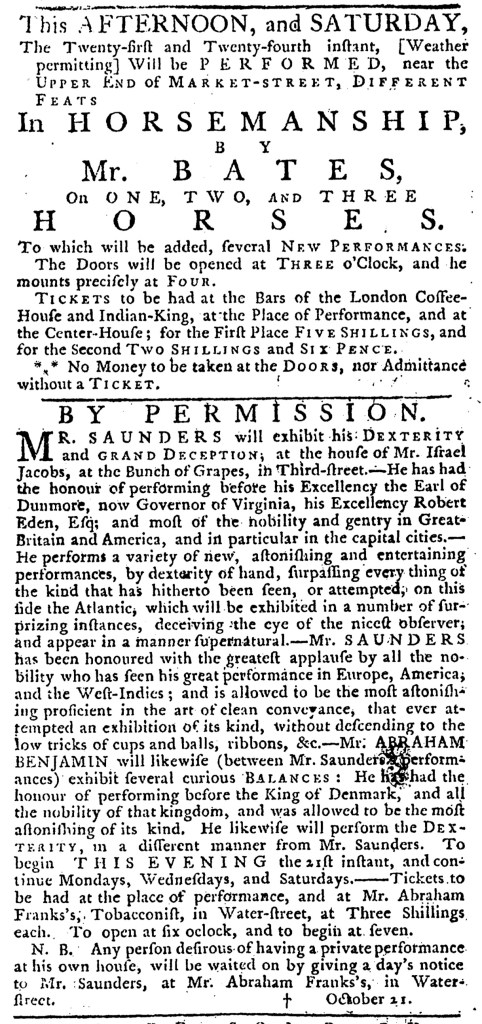
Newspaper advertisements help in revealing some of the entertainments enjoyed by colonizers in the eighteenth century.  For instance, two advertisements in the October 21, 1772, edition of the Pennsylvania Journal promoted upcoming performances and encouraged residents of Philadelphia to purchase tickets.  The first offered feats of “HORSEMANSHIP, BY Mr. BATES,” promising that he did tricks “On ONE, TWO, AND THREE HORSES.”  Bates and his act would have been familiar to regular readers at the time this advertisement appeared, so to entice anyone who had already seen the show to come again he proclaimed that he added “several NEW PERFORMANCES.”  Patrons needed to purchase tickets in advance since “No Money [would] be taken at the DOORS, nor Admittance without a TICKET,” yet they also received a discount for purchasing more than one.  The first ticket cost five shillings and the second only two shillings and six pence.  In other words, Bates advertised a “buy one, get one half off” promotion.

The other advertisement announced that “MR. SAUNDERS will exhibit his DEXTERITY and GRAND DECEPTION … at the Bunch of Grapes.”  Most likely, Hyman Saunders, the illusionist and itinerant performer who previously advertised in newspapers in both New York and Philadelphia, placed this notice.  He boasted that he “had the honour of performing before his Excellency the Earl of Dunmore, now Governor of Virginia … and most of the nobility and gentry in Great-Britain and America, and in particular in the capital cities.”  Saunders described his act as “dexterity by hand, surpassing everything of the kind that has hitherto been seen, or attempted, on this side of the Atlantic,” intending that such hyperbole would motivate readers to come to the show.  As a bonus, they would also see “Mr. ABRAHAM BENJAMIN … exhibit several curious BALANCES,” feats of “DEXTERITY, in a different manner from Mr. Saunders.”  Benjamin previously “had the honour of performing before the King of Denmark, and all the nobility of that kingdom.”  The pedigrees of both performers likely resonated with residents of Philadelphia who aspired to be as cosmopolitan as their counterparts in European cities.  Patrons could purchase tickets in advance at the Bunch of Grapes or “at Mr. Abraham Franks’s, Tobacconist.”  Saunders advised that performances would “continue [on] Mondays, Wednesdays, and Saturdays.”  Colonizers could also hire him for private performances in their own homes, entertaining themselves and guests fortunate enough to receive invitations.

Performers used newspaper advertisements to drum up interest in their performances in early America.  They likely resorted to handbills and broadsides as well, though those kinds of advertisements were more ephemeral.  Itinerant performers depended on publicity to draw audiences to their shows.  Even those who spent some time in town had to resort to promoting their acts to keep audiences coming or coming back for more.

October 16

What was advertised in a colonial American newspaper 250 years ago today?

New-Hampshire Gazette (October 16, 1772).

“The Exhibitions will be perform’d as usual.”

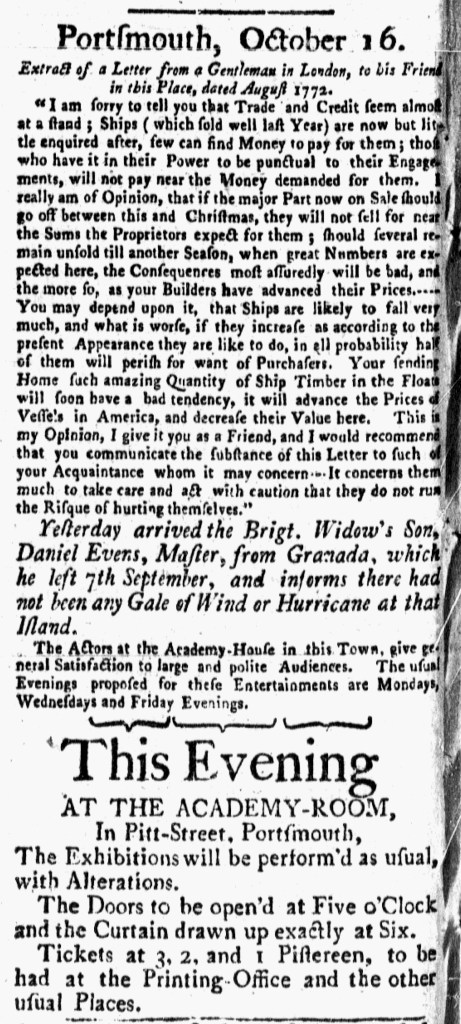
In the summer of 1772, an advertiser who went by “the Exhibitor” and “the Projector” sought to establish a series of performances of “several serious and comic pieces of Oratory” in Portsmouth, New Hampshire.  The Exhibitor proposed a subscription series as a means of determining whether sufficient interest existed to make the project viable, encouraging “those Ladies and Gentlemen who are inclined to favour” the proposal to subscribe quickly because “the Season advance, and he is obliged to go to the Southward in October next.”  Those ladies and gentlemen could purchase subscriptions at the printing office.  In addition, tickets for performances were available “at the Printing Office at Mr. Appleton’s Book-Store, and at Mr. Stavers’s Tavern.”

As was often the case with itinerant performers who advertised that they intended to remain in town for only a limited time, the Exhibitor decided to remain in Portsmouth longer than he originally indicated.  In the middle of October, he placed an advertisement to announce that “This Evening … The Exhibitions will be performed as usual, with Alterations.”  In other words, the show continued, but the Exhibitor varied the content to offer something new to prospective patrons who had recently been in the audience.  Readers could procure tickets “at the Printing-Office and the other usual Places.”

The Exhibitor seemed to get assistance in marketing the performance from Daniel Fowle and Robert Fowle, the printers of the New-Hampshire Gazette.  In the October 16 edition, they concluded the news from Portsmouth with a short blurb that reported, “The Actors at the Academy-House in this Town, give general Satisfaction to large and polite Audiences.  The usual Evenings proposed for this Entertainment are Mondays, Wednesdays and Friday Evenings.”  The Exhibitor’s new notice appeared immediately below that review; news content selected by the editor flowed seamlessly into an advertisement.  The Fowles may have done so as a service to the community if they recognized the benefits of having local productions inspired by “the Entertainments at Sadler’s Well’s,” a renowned theater that had been operating in London since 1683.  In addition, they may have received commissions on the tickets they sold, making the success of the Exhibitor’s venture worth promoting with a short puff piece embedded in the news.

June 19

What was advertised in a colonial American newspaper 250 years ago today?

New-Hampshire Gazette (June 19, 1772).

“A Subscription … for the Amusement of the Public.”

The performance of “several serious and comic Pieces of Oratory, interspers’d with Music and Singing” first advertised in the June 5, 1772, edition of the New-Hampshire Gazette expanded into a series, even though the initial advertisement promoted an event for “This EVENING.”  The following week a similar advertisement appeared, with a few modifications.  It clarified that the performance would “begin at Eight o’Clock” and cautioned “No Person to be admitted without a Ticket.”  That implied that the previous performance had been so popular or had incited so much interest the next performance that colonizers interested in attending needed to secure admission in advance.

The advertisement ran in a third consecutive issue of the New-Hampshire Gazette, though greatly expanded with news that “the Exhibitor” had received such “great Encouragement” that he wished to satisfy “the natural Propensity the Ladies and Gentlemen seem to have [for] Dramatic Entertainments” that he created a subscription series to include “new and surprising Performances never seen in this Country, consisting of Italian Dances, and Pantomimical Interludes in Grotesque Characters, with elegant Scenes and Machinery and every other Decoration.”  The Exhibitor compared the elaborate productions to performances at the famous Sadler’s Wells Theater in London, suggesting that audiences would partake in similar cosmopolitan entertainments in Portsmouth, New Hampshire.

The Exhibitor, who also referred to himself as “the Projector,” listed ticker prices for both subscribers and non-subscribers.  He promised that “Tickets will be transferable,” encouraging colonizers to invest in subscriptions together if they were not interested in attending twelve performances or found the price for the entire series too exorbitant.  He assured readers that “Subscribing is only fixing the same Price,” but purchasing subscriptions had the advantage of making it possible “to put the Design in Execution.”  If the Projector did not receive “a certain Number” of subscriptions then he would not be able to stage the performances; he warned that he “cannot proceed till a sufficient Number is subscribed.”  Anyone interested in the proposed series needed to act quickly, especially since the Projector planned “to go Southward” in October.  He encouraged “Ladies and Gentlemen who are inclined to favour the above Scheme” to “be expeditious in signing.”

Residents of Portsmouth and nearby towns had an opportunity to attend a series of performances at which “no Expence will be spared to have every Decoration the Country can afford,” but only if enough of them purchased subscriptions to support the endeavor.  The advertisement’s decorative border, unique in the New-Hampshire Gazette, suggested that the Exhibitor fulfilled his promise of visual spectacles to amuse his audiences.  The Exhibitor also intended for his descriptions of upcoming acts and comparison to a renowned theater in London to incite interest in a subscription series, even among those who attended previous performances.  Today, theaters and performing arts centers market subscriptions to their patrons, but that method of selling tickets is not a recent innovation.  The practice was already in place in the eighteenth century.

June 7

What was advertised in a colonial American newspaper 250 years ago this week?

New-Hampshires Gazette (June 5, 1772).

“This EVENING … will be Exhibited several serious and comic Pieces of Oratory.”

Newspaper advertisements testify to the entertainment and popular culture enjoyed in the colonies in the eighteenth century.  A notice in the June 5, 1772, edition of the New-Hampshire Gazette informed the public that they could attend “several serious and comic Pieces of Oratory, intersper’d with Music and Singing” at the “new Assembly-Room” in Portsmouth that evening.  The sponsors created a network for distributing tickets.  Those interested in the performance could purchase tickets in advance “at the Printing-Office, at Mr. Appleton’s Book-Store, and at Mr. Stavers’s Tavern.” The sponsors also included a nota bene to address potential concerns about the content of the performance: “the Public may be assured, that nothing will be delivered in the above Exhibition, but what is conducive to, and consistent with Politeness and Morality.”  Neither the “comic Pieces” nor the songs would be ribald or bawdy.

The design of the advertisement increased the chances that readers would take note of it, especially important for an “Exhibition” of oratory and music scheduled for the same day the newspaper that carried the advertisement was published.  The first line operated as a headline, announcing “This EVENING” in a font larger than any in the rest of the notice.  In addition, a decorative border, comprised of printing ornaments, encircled the advertisement, setting it apart from other content.  It was the only item in that issue, whether or news or advertising, that featured a border.  Furthermore, the printers rarely used borders in the New-Hampshire Gazette, making this advertisement even more noteworthy to regular readers.  Its placement on the page also encouraged attention.  It ran in the upper left column, the first item on the third page.  With limited time to sell tickets and attract an audience for the performance, the sponsors depended on both copy and innovative graphic design in their marketing efforts.

December 31

What was advertised in a colonial American newspaper 250 years ago today?

New-York Gazette and Weekly Mercury (December 31, 1770).

“Exhibiting his Art of Dexterity of Hand.”

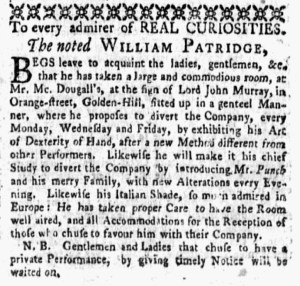
As 1770 came to an end and 1771 began, William Patridge, an itinerant performer, took to the pages of the New-York Gazette and Weekly Mercury to inform residents of the busy urban port that he provided entertainments for “every admirer of REAL CURIOSITIES.”  Patridge rented “a large and commodious room … fitted up in a genteel Manner” for giving performances on Mondays, Wednesdays, and Fridays.

His show consisted of several acts, including “Dexterity of Hand,” “Mr. Punch and his merry Family,” and an “Italian Shade.”  Patridge included additional details about each in his efforts to entice audiences to attend his performances.  He described his “Italian Shade,” mostly likely some sort of illumination, as “so much admired in Europe.”  Audiences on the other side of the Atlantic had been impressed and delighted by this portion of his show, Patridge seemed to suggest, so residents of New York would not want to miss such an acclaimed exhibition.  The portion of the evening devoted to “Mr. Punch and his merry Family” presumably involved a puppet show.  Patridge incorporated “new Alterations every Evening,” making each performance different from any other.  Members of the audience who attended more than one performance would experience something new each time.  When it came to the “Art of Dexterity of Hand,” Patridge declared that he practiced “a new Method different from other Performers.”  Even if readers had seen Hyman Saunders perform when he spent several weeks in New York in November, they supposedly had not seen anything like Patridge’s sleight of hand.

Patridge also saw to the comfort of his audience.  In addition. To selecting a “commodious room … fitted up in a genteel Manner,” he also pledged that he had “taken proper Care to have the Room well aired” for those who saw his show.  He offered “all Accommodations,” though he did not go into greater detail.  He likely expected that residents of the city would already be familiar with “Mr. Mc. Dougall’s” establishment “at the sign of Lord John Murray, in Orange-street, Golden-Hill.”  For those “Gentlemen and Ladies” who did not wish to mix with crowd at one of Patridge’s performances at that location, he also gave private performances in their homes, provided that they gave “timely Notice.”  Patridge hinted at a higher level of refinement and status; rather than attending a performance, those “Gentlemen and Ladies” could have a performer attend on them.

Eighteenth-century newspaper advertisements reveal a variety of entertainments and amusements available to colonial consumers, a range of popular culture options available to them.  Itinerant performers depended on those advertisements to make the public aware when they arrived in town and what kinds of diversions they offered.  Although Patridge did not do so, many also declared that they would be in town for only a short time, attempting to incite greater demand by making their performances scarce commodities.  Still, Patridge did not merely announce his presence in New York.  Instead, he resorted to other kinds of appeals to attract audiences for his shows.

November 1

What was advertised in a colonial American newspaper 250 years ago today?

New-York Journal (November 1, 1770).

“New and astonishing performances in the dexterity of hand.”

Eighteenth-century newspaper advertisements sometimes provide insight into the popular culture and entertainment of the day, including concerts and shows by itinerant performers.  In their advertisements, many performers exhibited their showmanship to prospective audiences as part of their efforts to incite interest and convince them to see their acts in person.  For instance, in an advertisement in the New-York Journal, one illusionist, the “celebrated HYMEN SAUNDERS” who had “Just arrived from EUROPE.” proclaimed that his show included “several new and astonishing performances in the dexterity of hand, different than what has been hitherto attempted, and such as was never seen in this province.”  Saunders expected the novelty of his act to attract the attention of curious colonists.  He further described his performance, whetting the appetite of the public.  “His dexterity of hand, or grand deception,” he trumpeted, “will consist of a variety of entertaining as well as surprising tricks.”  He had so much material to amuse and astound his audiences that “his performance will be divided into acts” with a “concert of music” between the acts.  He promised that the room where he performed would be “illuminated,” allowing spectators good views of his sleight of hand, as well as “well air’d” for their comfort.

Saunders’s advertisement was the first one that appeared after the news in the October 25, 1770, edition of the New-York Journal, likely increasing the likelihood that local audiences would take note of it.  He announced that his first performance would take place on October 29, so by the time the advertisement ran again on November 1 and in subsequent issues, readers had already missed out on being among the first to attend the show.  The performer underscored that his “stay in this city will be but a few weeks,” further warning prospective audiences that they had only a limited time to see his “grand deception” for themselves before he departed for other towns.  In addition to his public performances, Saunders also offered a “private exhibition” to those who hired him at least a day in advance.  Like other itinerant performers, Saunders also relied on word of mouth to promote his act, especially after locals saw his “dexterity of hand” in person, but he did not rely on such reviews alone.  Even after his performances commenced, he continued to run advertisements to promote both the show and his persona, the “celebrated” performer who brought a novel act all the way from Europe to the colonies.

September 16

What was advertised in a colonial American newspaper 250 years ago this week?

New-York Journal (September 13, 1770).

“The best Clubs, and the greatest Entertainments in this City, were at the above Tavern.”

Samuel Fraunces was one of the most illustrious tavernkeepers of his day.  His fame continues into the twenty-first century, due in part to the quality of the services he provided to guests in eighteenth-century America and in part to the continued operation of Fraunces Tavern as a restaurant and museum at the corner of Pearl Street and Broad Street in New York.  Fraunces advertised the various taverns he operated in the late 1760s and early 1770s.  More than a decade later, he hosted George Washington’s farewell to his officers at the conclusion of the Revolutionary War.

Fraunces ran an advertisement in the September 13, 1770, edition of the New-York Journal to announce the opening of his newest venture, the “QUEEN’s-HEAD TAVERN, Near the Exchange.”  He attempted to downplay the necessity of placing an advertisement even as he promoted the various services and amenities available at his tavern.  He emphasized that during his “many Years” of operating a tavern “the best Clubs” met at his establishment and experienced “the greatest Entertainments.”  Given the reputation he had built, Fraunces “flatters himself the Public are so well satisfied of his Ability to serve them, as to render the swelling of an Advertisement useless.”  Its only purpose, he declared, was to “assure his former Friends and the Public in general, that every Endeavour will be used to give them the highest Satisfaction.”

Yet other “swelling” embellished Fraunces’s advertisement as he attempted to attract patrons.  He noted renovations taking place; the tavern was “now fitting up in the most genteel and convenient Manner.”  He also inserted a nota bene to inform prospective customers that he provided take-out and delivery options for those “who live at a convenient Distance.”  Fraunces concluded with a manicule directing attention to a short note explaining that the “House at the Gardens will be duly attended as usual.”  He referred to another venture that he operated simultaneously, Vauxhall Garden, a restaurant, tavern, and pleasure garden named after the popular site in London.

Fraunces had indeed established his reputation as restaurateur and tavernkeeper before opening the Queen’s Head Tavern in the fall of 1770, yet he did not consider his past success sufficient for attracting patrons to his new enterprise.  Instead, he inserted an advertisement to spread the word about his newest venture, amplifying his reputation in the process.