April 5

What advertised in a colonial American newspaper 250 years ago today?

Essex Gazette (April 5, 1774).

To be sold by the Printers hereof, Mr. Hancock’s ORATION, On the Fifth of March.”

Immediately above the record of ships “Entered-In,” “Outward-Bound,” and “Cleared-Out” from the customs house in Boston in the April 5, 1774, edition of the Essex Gazette, Samuel Hall and Ebenezer Hall, the printers, inserted a brief notice, just three lines, alerting readers that they sold “Mr. Hancock’s ORATION, On the Fifth of March.”  The Halls did not need to provide further elaboration for readers to understand the announcement.  For colonizers in New England in the 1770s, the phrase “Fifth of March” conjured images like the phrase “Boston Massacre” evokes today.  They needed no explanation that the advertisement referred to John Hancock delivering the annual address to commemorate the event, to honor those killed when British soldiers from the 29th Regiment under the command of Captain Thomas Preston fired into a crowd of protesters, to condemn quartering troops in colonial cities during times of peace, and to advocate for American liberties.

As had become customary by the fourth anniversary of the Boston Massacre, the town voted to have the oration published and advertisements appeared in newspapers printed in Boston.  Yet they did not appear solely in newspapers in that town.  Other newspapers in New England sometimes carried them as well, none more often that the Essex Gazette, published in nearby Salem.  Samuel Hall had a long history of publishing news and opinion that favored sentiments expressed by Patriots.  On the first anniversary of the Boston Massacre, for instance, he included thick black mourning borders on the first page of his newspaper and published “a solemn and perpetual MEMORIAL Of the Tyranny of the British Administration of Government in the Years 1768, 1769, and 1770,” especially “THE FIFTH OF MARCH, … the Anniversary of Preston’s Massacre–in King-Street–Boston, N. England–1770.”  When Benjamin Edes and John Gill, among the most ardent of Patriots among the printers in Boston, published Hancock’s oration in 1774, the Halls acquired copies to disseminate in Salem and beyond.  In so doing, they participated in the commodification of the Boston Massacre while simultaneously commemorating it and encouraging others to side with the Patriots as relations with Parliament further deteriorated following the Boston Tea Party the previous December.

March 1

What was advertised in a colonial American newspaper 250 years ago today?
Essex Gazette (March 1, 1774).

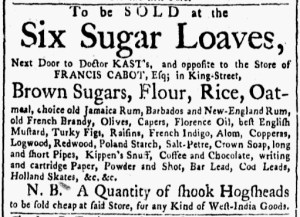
“To be SOLD at the Six Sugar Loaves.”

It was an unusual headline for an advertisement.  The name of the store served as the headline, distinguishing it from the other notices in the March 1, 1774, edition of the Essex Gazette.  In newspapers throughout the colonies, the name of the merchant, shopkeeper, or artisan often appeared as the headline.  Such was the case for advertisements placed by John Appleton, Benjamin Coats, George Deblois, John Prince, and Nathaniel Sparhawk in that issue of the Essex Gazette.  Sometimes the merchandise, product, or service served as the headline, as in Walter P. Bartlett’s notice promoting “Garden Seeds,” Ezekiel Price’s advertisement for “INSURANCE,” and auctioneer W.P. Bartlett’s notice about an upcoming “PUBLIC VENDUE.”

In contrast, an unnamed advertiser advised readers of the Essex Gazette that he or she sold a variety of groceries and other wares “at the Six Sugar Loaves … in King-Street.”  No doubt the name of the shop matched the image on a sign that marked its location.  Other advertisements did not mention shop signs and only a couple made any reference to anything like a shop name.  Price gave his location as “the Insurance-Office” and Appleton stated that his store was located “next Door above the PRINTING-OFFICE.”  In both instances, the name described the primary enterprise undertaken at each business.  The “Six Sugar Loaves” suggested only one of the many commodities sold in that shop.  The inventory in the advertisement led with “Brown Sugars” yet also included “Flour, Rice, Oatmeal,” a variety of spirits, olives, “Turkey Figs, Raisins,” “Coffee and Chocolate,” and even soap, pipes, and “Powder and Shot.”  The sign that gave its name to the store depicted one kind of merchandise sold there.

Appearing in a large font, the “Six Sugar Loaves” may have been as prominently visible on the page of the Essex Gazetteas the sign it represented was on King Street in Salem.  Its inclusion in a newspaper advertisement testifies to the visual landscape of commerce and consumer culture that colonizers encountered as they traversed the streets of port cities on the eve of the American Revolution.  Very few of those signs survive today, but advertisements catalog their extensive use in early America.

February 15

What was advertised in a colonial American newspaper 250 years ago today?

Essex Gazette (February 15, 1774).

“He will sell … at so cheap as Rate as he doubts not will give Satisfaction to every Purchaser.”

George Deblois regularly advertised in the Essex Gazette.  On February 15, 1774, he placed a lengthy notice to promote a “fine Assortment of ENGLISH and HARD-WARE GOODS” that he “just received … from LONDON.”  He asserted that these items were “Suitable for the approaching Season,” encouraging consumers to purchase in advance or at least keep his shop in Salem in mind when they were ready to shop for in the coming weeks and months.  A catalog of his merchandise, divided into two paragraphs, accounted for most of the advertisement.  The first paragraph listed the “ENGLISH” goods, mostly textiles and accessories.  Deblois stocked “Scotch Plaids,” “Devonshire Kersies,” “stampt linen Handkerchiefs,” “a fine assortment of men’s worsted Stockings,” and “Hatter’s Trimmings of all sorts.”  He devoted the other paragraph to housewares and hardware, including the “best of London pewter Dishes,” “hardmetal Tea-Pots,” “steel and iron plate Saws of all sorts and sizes,” and “Brads, Tacks and Nails of all sorts.”

The merchant concluded his advertisement with two common appeals, one about consumer choice and the other about his prices.  The lengthy lists of goods already demonstrated the many choices available to his customers, but he insisted that he also stocked “a great Variety of other Articles, too tedious to enumerate in an Advertisement.”  Readers would have to visit his store to discover what else they might want or need that happened to be on his shelves.  No matter what they selected, his customers could depend on paying low prices.  Deblois declared that “he will sell by Wholesale and Retail … at so cheap a Rate as he doubts not will give Satisfaction to every Purchaser.”  Other advertisers frequently made a nod to low prices.  Elsewhere in the same issue of the Essex Gazette, for instance, John Appleton offered his wares “very cheap.”  Deblois embellished his appeal about prices, hoping to draw the attention of prospective customers and convince them that he offered the best deals.  They would depart his store not only pleased with the goods they acquired but also with a sense of “Satisfaction” about how much they paid.  Deblois encouraged consumers to visit his shop by setting favorable expectations for their shopping experiences.

December 28

What was advertised in a colonial American newspaper 250 years ago today?

Essex Gazette (December 28, 1773).

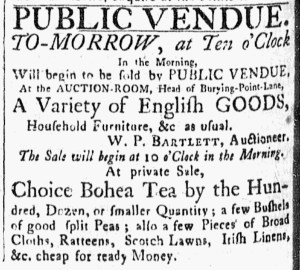
“At private Sale, Choice Bohea Tea.”

Tea, tea, tea.  Everyone was talking about tea after Parliament passed the Tea Act in 1773.  That legislation allowed the East India Company to sell tea directly in colonies without paying export taxes in London.  This reduced the cost of tea for American consumers, but many colonizers resisted because this arrangement included paying duties when the tea was unloaded from the vessels once they arrived in American ports.  If they paid those duties, colonizers would implicitly recognize Parliament’s right to tax them.  They had rejected such assertions when they protested the Townshend Acts and, as a matter of principle, rejected them once again, even when presented with the prospect of buying tea at lower prices.  Many also worried about greater enforcement to prevent smuggling, realizing that they illicit trade also yielded bargain prices.

The talk about tea continued as colonizers anticipated the arrival of ships carrying tea belonging to the East India Company.  The talk about tea continued when three of ships arrived in Boston and residents prevented them from unloading their cargo.  The talk about tea continued after the destruction of that tea during a protest now known as the Boston Tea Party.  The December 28, 1773, edition of the Essex Gazette, for instance, featured plenty of talk about tea.  Two of the three columns on the first page covered the “Proceedings of the PEOPLE, previous to the Destruction of the Tea at Boston.”  The final column followed up with “the following Particulars respecting that HAPPY EVENT, the Destruction of the East-India Company’s ministerial Tea,” reprinted from the December 23 edition of the Massachusetts Gazette and Boston Weekly News-Letter.  At the bottom of that column, a short item with a dateline from “NEWPORT, December 13,” reported that “[b]y a letter from Boston, it seems as though our brethren there had some fears that we should receive the India Company’s detestable Tea; but we think it may be safely affirmed, that it will not be suffered to be sold here.”  Furthermore, there would be consequences “if landed, which is scare possible.”  The article proclaimed that such tea “will be reshipped on board the LIBERTY, and sent to GASPEE, the first favourable wind or weather,” invoking memories of another significant protest, the burning of the Gaspee in June 1772.  Elsewhere in that issue, news articles of varying lengths summarized talk about tea in New York, Philadelphia, and Portsmouth.

Among all that talk about tea, W.P. Bartlett, an auctioneer, advertised “Choice Bohea Tea” available “At private Sale.”  In Salem as in Boston, advertising, selling, buying, and drinking tea did not cease immediately as a rection to the Boston Tea Party.  Tea remained on the market as colonizers continue to debate what to do about tea and how to continue protesting against the Tea Act.

December 14

What was advertised in a colonial American newspaper 250 years ago today?

Essex Gazette (December 14, 1773).

“He is determined to sell so low as to give every Purchaser full Satisfaction.”

Nathaniel Sparhawk emphasized all the choices available to consumers when he advertised a “general Assortment of English and India GOODS” in the December 14, 1773, edition of the Essex Gazette.  To demonstrate some of those choices, he listed some of his merchandise.  His inventory included a “Beautiful assortment [of] superfine, middling and low priced Broad-Cloaths of the most fashionable colours,” “Ribbons of all sorts,” “MEN’s black & cloth colour’d worsted Hose,” “Women’s black, white and cloth-colour’d silk Gloves and Mitts,” “black and white gauze Handkerchiefs,” and “Silk & worsted Knee Garters.”  To further entice prospective customers, Sparhawk pledged to “sell so low as to give every reasonable Purchaser full Satisfaction.”  The shopkeeper intended for the combination of low prices and wide selection to draw customers to his shop in Salem.

In addition to those appeals, Sparhawk used graphic design to attract the attention of readers of the Essex Gazette.  His advertisement was the most visually striking of those that appeared in the December 14 edition.  A border composed of florettes enclosed the entire advertisement, setting it apart from news articles and other advertisements.  It was the only item that featured that sort of adornment on that page or anywhere in the issue.  George Deblois once again published his advertisement promoting a “fine Assortment of ENGLISH and HARD-WARE GOODS.”  It appeared in the column next to Sparhawk’s advertisement.  Both entrepreneurs enumerated many of their goods, but Deblois listed his wares in two dense paragraphs.  Sparhawk, in contrast, opted to divide his advertisement into two columns and list only one or two items on each line.  That likely made it easier for readers to peruse his notice.  In addition to the florettes that surrounded this advertisement, a line of other printing ornaments ran between the two columns, further enhancing its visual appeal.  Sparhawk stocked much of the same merchandise as Deblois and other competitors, but he leveraged graphic design in his advertisement to distinguish his business from the others.

November 30

What was advertised in a colonial American newspaper 250 years ago today?

Essex Gazette (November 30, 1773).

“He will sell by Wholesale and Retail … at so cheap a Rate as he doubts not will give Satisfaction to every Purchaser.”

George Deblois inserted a lengthy advertisement in the November 30, 1773, edition of the Essex Gazette, the sort of advertisement that regularly appeared in newspapers from New England to Georgia.  The merchant announced that he recently imported a “fine Assortment of ENGLISH and HARD-WARE GOODS” and provided a list of some of that merchandise to demonstrate the range of choices customers would encounter at his shop in Salem.  Deblois carried everything from “check’d and stampt linen Handkerchiefs” and “men’s, women’s and boys worsted Gloves” to “a very large assortment of horn and metal coat and breast Buttons” and “brass and iron Candlesticks” to “steel and iron plate Saws of all sorts and sizes” and “Locks, Hinges, Latches, [and] Bolts.”  Even those extensive lists did not exhaust Deblois’s inventory.  He finished one paragraph with “&c. &c.”  Repeating an abbreviation for et cetera suggested that he stocked much more.  A nota bene at the end of the advertisement concluded with “&c. &c. &c.”

Drawing another paragraph to a close, Deblois promoted “a great Variety of other Articles, too tedious to mention in an Advertisement.”  He also appended a note that “he assures his Customers and others, he will sell by Wholesale and Retail … at so cheap a Rate as he doubts not will give Satisfaction to every Purchaser.”  What are the chances that anyone actually noticed those final appeals among the preponderance of prose, most of it cataloging Deblois’s inventory?  Given eighteenth-century practices of intensive reading as well as consumers’ familiarity with standard advertising formats, many readers likely perused those final promises offered by Deblois, at least the first time they saw the advertisement.  Consider that the Essex Gazette, like most other colonial newspapers, was a weekly publication that consisted of four pages.  That limited the amount of content available to readers, increasing the likelihood that many would examine both news and advertisements carefully to glean information about what was happening in places far and near.  In addition, lengthy advertisements listing goods became so common that readers likely learned that even if they did not wish to read every item – all of those “iron Coffee-Mills” and “silk knee Garters” – they should skip to the end of each dense block of text to see if an advertiser inserted anything else, like the appeals Deblois made in this advertisement.  While such advertisements do not look especially attractive to modern eyes accustomed to other forms of marketing, eighteenth-century readers saw them so often that they learned to navigate them to identify the details they considered most important.

October 19

What was advertised in a colonial American newspaper 250 years ago today?

Essex Gazette (October 19, 1773).

“The REPRESENTATIONS of Governor Hutchinson, and others, Contained in certain LETTERS transmitted to England.”

Among the various advertisements in the October 19, 1773, edition of the Essex Gazette, Samuel Hall and Ebenezer Hall, the printers of the newspaper, offered a pamphlet “Just published in Boston” and available at their printing office.  Many readers likely already knew about the contents of the pamphlet, “The REPRESENTATIONS of Governor Hutchinson, and others, Contained in certain LETTERS transmitted to England, and afterwards returned from thence, and laid before the GENERAL ASSEMBLY of the MASSACHUSETTS-BAY, Together with the RESOLVES of the two Houses thereon.”  Acquiring the pamphlet and reading the correspondence for themselves, however, gave colonizers an opportunity to see for themselves exactly what Thomas Hutchinson and others had reported to ministers and members of Parliament in letters that had not been intended for public consumption.  Purchasing and perusing the pamphlet also presented another means of participating in politics.

As Jordan E. Taylor explains in Misinformation Nation: Foreign News and the Politics of Truth ion Revolutionary America, this was not the first instance of printers publishing private letters from colonial officials to associates in London.[1]  In the wake of the arrival of British soldiers in Boston in 1768, Benjamin Edes and John Gill, printers of the Boston-Gazette, published Letters to the Ministry from Governor Bernard, General Gage, and Commodore Hood.  The Halls reprinted the pamphlet and sold it in Salem.  Taylor describes the letters as “quite benign – dull even,” yet a “few passages, nevertheless, aroused indignation,” including “Bernard’s suggestion that the Massachusetts charter be altered to weaken the council and strengthen the office of the governor.”  In addition, letters from customs commissioners recommended “two or three Regiments” to “restore and support Government” in Boston.  From the perspective of the printers and many colonizers, these letters were “hard evidence that a group of officials was conspiring to intentionally exaggerate the disorder in Massachusetts and bring troops into Boston.”

In 1773, the Representations of Governor Hutchison and Others further misrepresented the situation in Massachusetts, at least according to colonizers who advocated for the patriot cause and who recognized a pattern in how the misunderstandings between the colonies and Parliament occurred.  This pamphlet included letters from Thomas Hutchinson, Andrew Oliver, the lieutenant governor, and Charles Paxton, a customs officer.  One passage written by Hutchinson addressed “the abridgment of the colonists’ liberties,” though the governor “claimed that he was predicting, rather than prescribing, that those liberties might eventually be limited.”  Paxton requested “two or three regiments” or else “Boston will be in open rebellion.”  Taylor notes that printers “widely shared the letters in their newspapers,” making them widely accessible and perhaps even generating demand for a volume that collected them together.  The letters gained sufficient interest for the pamphlet to go through ten editions as colonizers examined what Hutchinson and others had written for themselves and constructed their own narrative that the Representations and representations of colonial officials amounted to misrepresentations that caused and exacerbated the imperial crisis.

**********

[1] For a more complete account of Letters to the Ministry and Representations of Governor Hutchinson, see Jordan E. Taylor, Misinformation Nation: Foreign News and the Politics of Truth in Revolutionary America (Baltimore: Johns Hopkins University Press, 2022), 52-54.

August 3

What was advertised in a colonial American newspaper 250 years ago today?

Essex Gazette (August 3, 1773).

“A Variety of News-Papers, will be procured for the Amusement of his respectable Customers.”

Many residents of Salem and nearby towns knew Ephraim Ingalls as a tailor, but he launched a new endeavor in the summer of 1773.  He took to the pages of the Essex Gazette to announce that he “just opened” the “LONDON COFFEE-HOUSE” on Hanover Street, proclaiming that he provided the “best Entertainment usually met with at Coffee-Houses in large mercantile Places.”  In other words, Ingalls’s establishment rivaled its counterparts in Boston, Charleston, New York, Philadelphia, and other major ports.  Prospective patrons could “depend upon being treated and entertained with all possible Respect, in the neatest and genteelest Manner” when they gathered to socialize and drink coffee, tea, and chocolate.

Coffeehouses also served as places for conducting business and discussing politics.  Ingalls extended an invitation to “Merchants, Captains of Vessels, and all other Gentlemen,” declaring that he outfitted the London Coffeehouse with the “best Accommodations for transacting Business.”  That included supplying “English Magazines, and a Variety of News-Papers … for the Amusement of his respectable Customers” as well as for them to consult for the shipping news, entries from customs houses, prices current for commodities in various towns, and other news.  Ingalls almost certainly subscribed to the Essex Gazette as well as a couple of newspapers published in Boston.  He likely acquired copies of the New-Hampshire Gazette, the Providence Gazette, and the Newport Mercury as well as at least one newspaper from New York, another from Philadelphia, and another from Charleston.  Although colonial printers reprinted accounts of current events from newspaper to newspaper, they did not tend to reprint items like marine lists and prices current.  That made a “Variety of Newspapers” as well as access to “Captains of Vessels” who carried news that had not yet made it into the public prints especially attractive to merchants.

The London Coffeehouse in Salem, like coffeehouses in other ports in England and the colonies, also functioned as a library for merchants.  That library set relatively narrow parameters for its collections, especially compared to the variety of books and magazines available at subscription libraries.  Those collections, however, served the needs of the coffeehouse’s clientele … without an additional fee.  Throughout the colonies, proprietors of coffeehouses provided newspapers as a service to entice merchants and others into their establishments.

July 6

What was advertised in a colonial American newspaper 250 years ago today?

Essex Gazette (July 6, 1773).

“Should it be observed that Mr. Watkins’s Advertisement, in the next Page, is not inserted in due Order, it may be imputed to our mistaking his Design in the Copy.”

Benjamin Watkins’s advertisement in the July 6, 1773, editions of the Essex Gazette filled two-thirds of a column.  In it, he listed many of the items included among the “fine Assortment of English and India GOODS” that he sold at his shop in Marblehead, Massachusetts.  Listing one or two items per line, Watkins divided his advertisement into two columns.  Compared to other advertisements that consisted of dense paragraphs that clustered the merchandise together, this format incorporated more white space that made it easier for prospective customers to peruse and spot items of interest.

Essex Gazette (July 6, 1773).

Still, the advertisement may not have appeared exactly as Watkins intended.  The editors considered it necessary to publish a brief notice about it: “Should it be observed that Mr. Watkins’s Advertisement, in the next Page, is not inserted in due Order, it may be imputed to our mistaking his Design in the Copy.”  In general, advertisers usually submitted copy to printing offices and then entrusted the format of their advertisements to compositors.  On occasion, some advertisers made special requests or gave instructions, as seems to have been the case with Jolley Allen and the decorative borders that regularly enclosed his advertisements that ran simultaneously in multiple newspapers in Boston.

On occasion, advertisers submitted copy in the format they desired.  That seems to have been the case with Watkins when he sent his advertisement to the printing office in Salem.  Apparently, Watkins’s message to the printers and notes on the format caused some confusion, prompting the compositors to do their best to follow his directions.  Those efforts fell short.  An updated version of the advertisement appeared in the next issue of the Essex Gazette.  It retained the format of two columns with one item per line, but removed some items and moved others so they appeared in a different order.

What kind of communication occurred between Watkins and the printing office?  Watkins ran a shorter advertisement in the June 22 edition.  It consisted of the introduction to the longer versions as well as a nota bene that explained, “The Particulars to be in next Week’s Paper.”  The printers may have inserted that note because they did not have sufficient space to run Watkins’s entire advertisement in that issue, but that may have also been a strategy to gain more time to decipher whatever the merchants sent to the printing office.  On June 29, the longer advertisement appeared for the first time, in the format that merited the note in the July 6 edition.  Perhaps the printers received a message from a dissatisfied Watkins after they had already printed the page that included the second insertion of his advertisement.  In acknowledgment, they published the note on the last page that went to press and then set about making corrections to achieve a final version that ran in four consecutive issues.

Though speculative, this seems like a reasonable sequence of events based on the various iterations of the advertisements and common practices in printing offices in eighteenth-century America.  It suggests that some advertisers actively provided extensive directions concerning format and design even though most simply submitted copy and left the rest to the compositors.

June 29

What was advertised in a colonial American newspaper 250 years ago today?

Essex Gazette (June 29, 1773).

“Our Customers are very willing their Papers should be read … by any Person who will be so kind as to forward them.”

Newspapers stolen before subscribers read them: the problem dates back to the eighteenth century … and probably even earlier.  It became such an issue in Massachusetts in the summer of 1773 that Samuel Hall and Ebenezer Hall, the printers of the Essex Gazette, inserted a notice addressing the situation.  The printers recognized that many subscribers who lived outside Salem “depend upon receiving their Papers by transient Conveyance” or by indirect means as postriders and others delivered bundles of letters and newspapers to designated locations, such as taverns or shops, with the expectation that members of those communities would then distribute the items to the intended recipients.

The Halls expressed their appreciation to “any Persons for their Favours in forwarding any Bundles to the respective Persons and Places that they are directed to.”  They also acknowledged that their “our Customers are very willing their Papers should be read, after the Bundles are opened, by any Person who will be so kind as to forward them to their Owners in due Season.”  However, all too often that did not happen.  Those who should have felt obliged to see that the newspapers reached the subscribers, especially after they read someone else’s newspaper for free, waited too long to do so or set them aside and forgot about them completely.  That being the case, the printers “earnestly” requested that “those who have heretofore taken up Paper only for their own Perusal, and afterwards thrown them by, or not taken any Care to send them to those who pay for them, would be so kind as not to take up any more.”  Instead, they should “leave them to the Care of those who are more kindly disposed” to see them delivered to the subscribers.

To make the point to those most in the need of reading it, the Halls declared that they “had the Names of some (living in Andover) … who, after having taken up and perused the Papers, and kept them several Days, were at last ashamed to deliver them to the Owners.”  The printers, as well the subscribers, considered this practice “very ungenerous.”  The Halls made a point of advising the culprits that they were aware of who read the newspapers without forwarding them to the subscribers.  They hoped that an intervention that did not involve naming names or directly contacting the perpetrators would be sufficient in altering such behavior.  They did not scold the offenders for reading the newspapers without subscribing.  Indeed, they framed that practice as something printers expected, but they did remind those readers that such generosity did not deserve the “very ungenerous” habit of hoarding and disposing of newspapers instead of forwarding them to the subscribers in a timely manner.  This was one of many challenges that colonial printers encountered in maintaining an infrastructure for disseminating information.