September 16

What was advertised in a colonial American newspaper 250 years ago today?
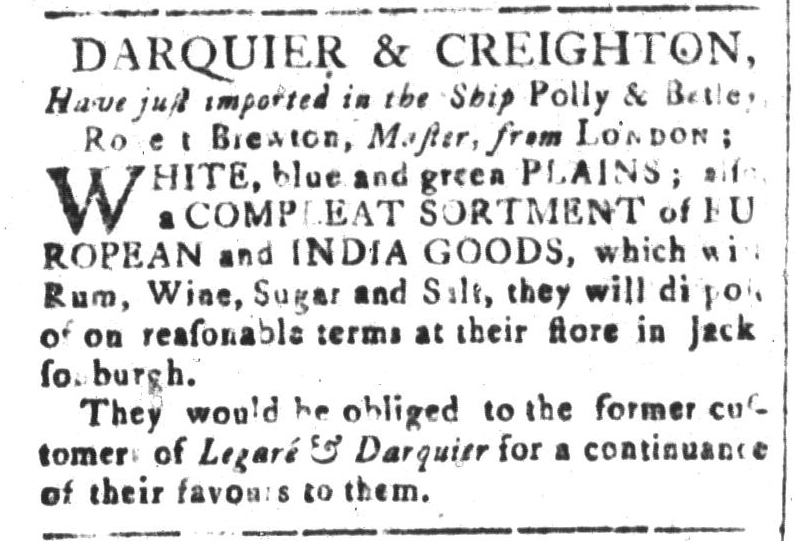
Sep 16 - 9:16:1768 South-Carolina and American General Gazette
South-Carolina and American General Gazette (September 16, 1768).

“They would be obliged to the former customers of Legaré & Darquier for a continuance of their favours to them.”

As summer turned to fall in 1768, the partnership of Darquier and Creighton placed an advertisement in the South-Carolina and American General Gazette to promote the merchandise they stocked at their store in Jacksonburgh on the Edisto River, about thirty miles west of Charleston. The partners probably did not anticipate attracting many customers among the residents of South Carolina’s largest city, but all three newspapers published in the colony at the time were printed in Charleston and served both the thriving port and extensive hinterlands that ranged beyond the colony and into Georgia and North Carolina and beyond. Even though notices from merchants and shopkeepers in Charleston surrounded it, Darquier and Creighton intended their advertisement for prospective customers from Jacksonburgh and its environs.

They also expected that their primary audience would possess a familiarity with local entrepreneurs that readers in Charleston might have lacked. That being the case, they concluded their advertisement with a request: “They would be obliged to the former customers of Legaré & Darquier for a continuance of their favours to them.” In other words, Darquier had formed a new partnership with Creighton after dissolving a partnership with Legaré. Having previously established a customer base, Darquier encouraged the former clientele to transfer their business to the store operated by the new partnership rather than shop elsewhere. The notice also alerted other prospective customers who had never patronized Legaré and Darquier but were familiar with their reputation that one of the partners had launched a new enterprise. The request directed to “former customers” also served to inform readers unfamiliar with Legaré and Darquier that the senior partner in the new endeavor had previous experience serving consumers in the area and felt confident enough about that service to anticipate they would give their business to the new partnership. Darquier and Creighton attempted to leverage the experience and reputation of Legaré and Darquier to establish their own clientele, one drawn from that of the former partnership but open to others as well.

September 8

What was advertised in a colonial American newspaper 250 years ago today?

Sep 8 - 9:8:1768 Massachusetts Gazette Draper
Massachusetts Gazette [Draper] (September 8, 1768).
“WHEREAS many Persons are so unfortunate as to lose their fore Teeth … they may have them replaced with false Ones … by PAUL REVERE.”

Although Paul Revere is primarily remembered as an engraver and silversmith who actively supported the Patriot cause throughout the era of the American Revolution, newspaper advertisements from the period demonstrate that he also tried his hand at dentistry. As summer turned to fall in 1768, Revere placed advertisements in both the Boston Evening-Post and Richard Draper’s Massachusetts Gazette to encourage prospective clients to hire him if they needed false teeth made or adjusted.

Like many others who marketed consumer goods and services in the public prints, Revere stoked anxieties as a means of convincing readers to avail themselves of his services. He proclaimed that “many Persons are so unfortunate as to lose their fore Teeth … to their Detriment, not only in looks, but speaking both in Public and Private.” Revere raised the insecurities that prospective clients likely already felt, but then presented a solution. Colonists who had lost their front teeth “may have them replaced with false Ones, that looks as well as the Natural, and answers the End of Speaking to all intents.” He assured prospective clients that they would no longer need to worry about their appearance or speech once they sought his assistance.

Revere also attempted to generate business from among the clientele of John Baker, an itinerant “Surgeon-Dentist” who had provided his services in Boston before moving along to Newport and New York and other cities. Baker was well known to the residents of Boston and its environs. In an advertisement in the New-York Journal he claimed to have provided his services to “upwards of two thousand persons in the town of Boston.” Even if that was an inflated estimate, it still indicated that Baker had served a significant number of clients there. Revere confirmed that was the case when he used a portion of his advertisement to address those clients. He claimed that he had “learnt the Method of fixing” false teeth that had come loose from Baker during the surgeon-dentist’s time in Boston.

Thanks to the poem by Henry Wadsworth Longfellow, Paul Revere is most famous for his “midnight ride” on the eve of the battles at Lexington and Concord. He also encouraged resistance to the British through his engravings, including “The Bloody Massacre Perpetrated in King Street, Boston.” In addition, Revere is remembered as an artisan who crafted fashionable silver teapots, buckles, and other items. This advertisement shows another facet of Revere’s attempts to earn his livelihood in Boston in the late colonial period, dabbling in dentistry as an extension of practicing his trade as a silversmith.