April 6

What was advertised in a colonial American newspaper 250 years ago today?

Essex Journal (April 6, 1774).

“The business will be carried on as usual by his sons.”

In the spring of 1774, Patrick Tracy of Newburyport, Massachusetts, ran an advertisement in the Essex Journal to request those he owed money to call on him to settle accounts because he had “quitted the business he has been in of late years.”  Only after that did the conscientious entrepreneur also instruct “all who are indebted to him … to make speedy payment, more especially those whose debts have been long standing.”  Tracy made what he owed his priority, signaling how he did business and suggesting to current and prospective customers that they could expect similar treatment from his sons who carried on the business.  Tracy considered that business well enough known that he did not indicate his occupation.

His sons, however, revealed that they “have taken the business lately carried on by their honoured father” and “carry on the distillery as usual” in an advertisement that conveniently appeared immediately below Tracy’s notice in the April 6 edition of the Essex Journal.  Their father deployed more subtle means in attempting to pass along his clientele to his sons, while they instead emphasized their desire for “the continuance of his good customers and the custom of all others.”  The elder Tracy established a reputation during his many years in business.  His sons hoped to benefit from the customer loyalty their father had cultivated, asserting a “mutual advantage” for all involved.

To that end, they also made clear that they put the interests of their customers and associates first.  In addition to operating the distillery “as usual,” they also stocked “an assortment of English Goods, which they will sell by wholesale upon reasonable terms, and so as to afford a profit to the purchaser.”  Though they intended to make money on those transactions, the distillers associated “profit” with their customers who purchased imported goods from them, reversing the usual relationship between sellers and buyers.  Shopkeepers and others who purchased those items to sell retail would acquire them at low enough prices that Jackson, Tracy, and Tracy practically guaranteed that they could in turn offer such bargains that retail customers would purchase their wares.

In their newspaper advertisements, Tracy and his sons carefully choreographed his departure from the family business and their role in continuing its operations.  They sought to maintain and even expand the existing clientele by emphasizing certain principles, including paying what they owed to associates and selling merchandise at such “reasonable terms” that everyone involved benefited from the transactions.

February 28

What was advertised in a colonial American newspaper 250 years ago today?

Boston Evening-Post (February 28, 1774).

“I the Subscriber intend leaving off the Baking Business very soon.”

“The Baking Business will be carried on as usual by the Subscriber.”

Mary Surcomb and William Flagg worked together in placing advertisements in the February 28, 1774, edition of the Boston Evening-Post.  Surcomb took to the pages of that newspaper to advise the public that she “intend[s] leaving off the Baking Business very soon.”  She wished to express her “hearty Thanks to those Gentlemen and Ladies who have favoured me with the Custom since my late Husband’s decease.”  She had not previously advertised her services in any of Boston’s newspapers, though she had placed estate notices in both the Boston-Gazette and the Massachusetts Gazette and Boston Weekly News-Letter following the death of her husband in the fall of 1773.[1]  Those notices indicated that Richard had been a baker as well.  As widows in early America often did, Surcomb continued operating the family business.  In Williamsburg, for instance, Clementina Rind printed the Virginia Gazette after her husband passed away in August 1773, about the same time that Surcomb’s husband died.  For Surcomb, assuming responsibility for the business may have been an extension of her previous responsibilities.  She likely assisted her husband in all kinds of ways, including baking and interacting with customers.

Surcomb appended a nota bene to her advertisement, informing readers that the “Business will be carried on as usual by Mr. William Flagg.  Perhaps Flagg had previously been affiliated with the business as an employee and continued working with the widow.  Whatever his history with the Surcombs, Flagg took over their business and aimed, with Mary’s blessing, to maintain their clientele.  In his own note, he declared that “the Baking Business will be carried on as usual by the Subscriber, who is determined to give universal Satisfaction.”  Rather than the full line that separated other paid notices from each other, a half line demarcated where Surcomb’s portion of the advertisement ended and Flagg’s portion began.  Visually, the format presented a narrative consistent with the copy.  Surcomb and Flagg carefully communicated the transition from one proprietor to the other, including an endorsement from Surcomb for her successor.

**********

[1] See Boston-Gazette (October 25, 1773) and Massachusetts Gazette and Boston Weekly News-Letter (October 7, 1773).

December 8

What was advertised in a colonial American newspaper 250 years ago today?

Pennsylvania Journal (December 8, 1773).

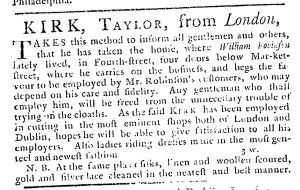
“Any gentlemen who shall employ him, will be freed from the unnecessary trouble of trying on the cloaths.”

Upon arriving in Philadelphia, “KIRK, TAYLOR, from London,” placed an advertisement in the Pennsylvania Journal to introduce himself to prospective clients.  Like so many other artisans who migrated across the Atlantic, Kirk did not have the benefit of his new community’s long familiarity with his work.  Instead, he had to establish his reputation by reporting on his prior experience serving customers in faraway places.  To that end, Kirk proclaimed that he “has been employed in cutting in the most eminent shops of London and Dublin.”  Prospective clients in the largest city in the colonies associated some level of cachet with such connections to even larger and more cosmopolitan cities.  Furthermore, his origins suggested that Kirk had special insight into the latest trends in those places, especially when he declared that he made garments “in the most genteel and newest fashion.”

When he set up shop in Philadelphia, Kirk took the house “where William Robinson lately lived” on Fourth Street.  Not only did he take over that residence, the tailor also hoped to acquire Robinson’s clientele, an efficient means of cultivating relationships in his new city.  The newcomer “begs the favour to be employed by Mr. Robinson’s customers, who may depend on his care and fidelity.”  Earning repeat business, generating word-of-mouth recommendations, and bolstering his reputation depended on attentive service and producing quality work for Robinson’s customers and anyone else who gave him a chance.  Kirk clearly communicated that he was confident in his abilities.  He was such a good tailor, he reported, that “gentlemen who shall employ him, will be freed from the unnecessary trouble of trying on the cloaths,” so precise were his measurements and sewing.  They did not need to tarry in his shop, spending unnecessary time better devoted to their own business or leisure.

Kirk aimed to capture some portion of the market for tailoring services in Philadelphia.  He devised an advertisement that gave prospective clients good reason to give him a chance and then decide for themselves if he merited more orders.  He hoped to gain some of the clients accustomed to visiting a tailoring shop at the same location, but did not entrust his fate to that circumstance alone.  Instead, he advised Robinson’s former customers and other prospective customers that he had experience in the best shops in London and Dublin, knowledge of the latest fashions, and the skills necessary “to give satisfaction to all his employers.”

December 10

What was advertised in a colonial American newspaper 250 years ago today?

Massachusetts Gazette and Boston Post-Boy (December 10, 1770).

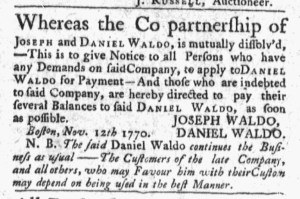
“The Co partnership of JOSEPH and DANIEL WALDO, is mutually dissolv’d.”

When their partnership came to an end in the fall of 1770, Joseph Waldo and Daniel Waldo placed newspaper advertisements “to give Notice to all Persons who have any Demands on said Company, to apply to DANIEL WALDO for Payment.”  They also called on “those who are indebted to said Company” to settle accounts “as soon as possible.”  That portion of the advertisement was fairly standard, replicating many others that appeared in newspapers throughout the colonies.

The nota bene at the end of the advertisement, however, incorporated a marketing strategy not nearly as common in these routine notices.  In this special note, Daniel proclaimed that he “continues the Business as usual.”  He pledged that the “Customers of the late Company, and all others, who may Favour him with their Custom may depend on being used in the best Manner.”  In the course of their partnership, the Waldos had established a clientele and a reputation among consumers in Boston and beyond.  Although the partnership had been “mutually dissolv’d,” Daniel sought to maintain both the clientele and the reputation, inviting existing customers to continue to deal with him and alerting others that the business continued to operate after Joseph’s departure.

That may explain why the advertisement did not include a certain element common to many such notices about partnerships dissolving.  The Waldos did not threaten legal action against those who owed debts, unlike others that made it clear that those who did not settle accounts would find themselves in court.  Doing so would have impaired Daniel’s attempts to continue friendly relationships with a customer base that he hoped to maintain.  After all, he promised continuing and prospective customers that they “may depend on being used in the best Manner.”  Daniel focused on customer service as a means of cultivating his business as it entered a new stage without Joseph as a partner.

May 14

What was advertised in a colonial American newspaper 250 years ago today?

May 14 - 5:14:1770 New-York Gazette and Weekly Mercury
New-York Gazette and Weekly Mercury (May 14, 1770).

“She has had the honour of being employed by several ladies in this city.”

Mary Morcomb did not indicate how recently she had arrived in New York in her advertisement, but it was recently enough that she described herself as a “Mantua-Maker, from London.”  After migrating to the colonies, she hoped to establish a new clientele.  To that end, she informed readers of the New-York Gazette and Weekly Mercury that she made “all sorts of negligees, Brunswick dresses, gowns, and every other sort of lady’s apparel.”  In addition, she extended her skills working with textiles to “cover[ing] UMBRELLOES in the neatest and most fashionable manner.”  Invoking her London origins testified to her access to the latest styles and taste, reassuring prospective customers that she did indeed produce both garments and umbrellas, a new and exotic accessory in the early 1770s, in the “most fashionable manner.”

As a newcomer who could not depend on a reputation established through interacting with clients and acquaintances over time, Morcomb instead attempted to accelerate the process.  She claimed that she already “had the honour of being employed by several ladies in this city.”  Those ladies, Morcomb reported, were satisfied with the garments she made for them and had “declared their approbation of her work.”  This was a secondhand testimonial, delivered by the provider of the goods and services, yet Morcomb hoped it would be sufficient to garner “encouragement from the ladies, in her business.”  She concluded by pledging that if prospective clients put their trust in her that they “May depend upon having their work done with all possible care and dispatch.”

In her effort to attract new customers, Morcomb deployed strategies often used by artisans, especially those in the garment trades, who only recently arrived in the colonies.  Many emphasized their connections to cosmopolitan cities where they had access to the latest fashions and then suggested that this already translated to serving select clients in their new location.  Although unfamiliar to many residents in their communities, Morcomb and other artisans attempted to incite demand by asserting that their services were already in demand.  Prospective customers should be eager to hire them, they proposed, because they had already successfully demonstrated their proficiency at their trades.

February 21

What was advertised in a colonial American newspaper 250 years ago today?

Feb 21 - 2:21:1770 Georgia Gazette
Georgia Gazette (February 21, 1770).

“The Taylor’s Business is carried on in all its branches.”

When Jonathan Remington, a tailor, moved to a new location early in 1770, he placed an advertisement in the Georgia Gazette so prospective clients would know where to find him.  Although he devoted much of the notice to giving directions, he also incorporated, though briefly, several marketing appeals.  “The Taylor’s Business,” he proclaimed, “is carried on in all its branches, in the genteelest manner, and with the utmost dispatch.”  Remington deployed formulaic language, though its familiarity to consumers may have been an asset.  Such brevity may have also allowed the tailor to keep down the costs of advertising while still promoting several aspects of his services.

In that single sentence, he communicated that he possessed a range of skills associated with his trade, declaring that he was qualified to pursue “all its branches.”  Prospective clients need not worry that they might present him with requests too difficult or beyond his experience.  He also made a nod to fashion, asserting that he did his work “in the genteelest manner.”  That appeal also implied the quality of his work.  Prospective customers would not look as though they had visited a second-rate tailor.  They could don his garments and confidently go about their daily interactions with other colonists without fearing that careful observation resulted in damaging judgments.  Remington’s pledge to tend to clients “with the utmost dispatch” testified to the customer service he provided.

Remington also attempted to attract new customers by leveraging his former customers as evidence of his abilities.  He expressed gratitude to “his friends and good customers for their past favours, and hopes for the continuance of them.”  In making that acknowledgment, Remington sought to maintain his current clientele while implicitly extending an invitation to new customers to visit him at his new location.  He reported that his services were already in demand, hoping to incite additional demand among readers of the Georgia Gazette who had not previously employed his services.  He played on consumer psychology that demand, or even the appearance of demand, could create additional demand.

Although not extensive, Remington’s advertisement delivered several marketing appeals intended to make his services attractive to prospective clients.  He relied on standardized language that allowed him to deliver messages grounded in the consumer culture of the period in relatively few words.

February 2

What was advertised in a colonial American newspaper 250 years ago today?

Feb 2 - 2:2:1770 New-Hampshire Gazette
New-Hampshire Gazette (February 2, 1770).

“He still carries on Clock and Watch making as usual.”

Nathaniel Sheaff Griffith, a clock- and watchmaker, was a prolific advertiser who frequently inserted notices in the New-Hampshire Gazette. The frequency of his advertisements may have been occasioned in large part by his rivalry with John Simnet, a competitor who previously practiced the trade in London for several years before migrating to the colonies and setting up shop in the same market as Griffith. Both men advertised and, in a rare occurrence in eighteenth-century newspaper advertisements, departed from merely promoting their own services in favor of denigrating the skill and even the character of the other. They did not explicitly name their rival, but context made the intent of their remarks clear to readers.

Simnet, the newcomer, was the more aggressive. In his first advertisement for 1770, he proclaimed himself the “only perfect Watchmaker ever in this Country,” a bit of boasting that disparaged Griffith as much as it bolstered Simnet. First appearing in the New-Hampshire Gazette on January 12, that brief but provocative notice continued for several weeks. On February 2, Griffith placed a new advertisement, his first of the year. As he had done sometimes, but not always, in the past, Griffith refused to engage with Simnet. Without much fanfare, he sought to inform “his Customers, and others, that he still carries on Clock and Watch making as usual, at his Shop opposite Dr. Langdon’s Meeting House.”

Although he did not spar with Simnet, Griffith did offer appeals intended to resonate with prospective clients. He acknowledged his previous customers and stated that he continued his trade “as usual,” establishing his prior service to local consumers and the stability of his business. Griffith also reported that he had “all Sorts of Materials for said Business,” reassuring readers that he possessed the supplies necessary for his work. Griffith’s advertisement was not as flashy as Simnet’s, but perhaps it did not need to be. Griffith had much deeper roots in the community and may have believed that he did not need to be as strident as Simnet in his advertisements.

July 31

What was advertised in a colonial American newspaper 250 years ago today?

Jul 31 - 7:31:1769 Newport Mercury
Newport Mercury (July 31, 1769).

“The Shoe-making Business is still carried on at her Shop.”

Elizabeth Mumford did not insert herself into the public prints until necessity forced her to do so. When her husband Samuel, a cordwainer, passed away in the summer of 1769, she ran advertisements in the Newport Mercury calling on “her late Husband’s Friends and Customers” to continue to patronize the family business. She referred to the shop on New Lane as “her Shop” and reported that she employed John Remmington, “who has work’d with her late Husband several Years.” Former customers may have been familiar with Remmington already, having interacted with him in the shop in the past. Whether or not they had previously made the acquaintance, Mumford underscored that the “Shoe-making Business” continued without disruption and that customers could “depend on being served with as good Work of every Sort as in her Husband’s Life-time.” Remmington’s presence provided continuity in the production of shoes, but Mumford likely made other contributions, such as waiting on customers and keeping accounts.

Mumford, however, downplayed any role that she had played or continued to play in the family business as partner, supervisor, or assistant. Instead, she presented herself as a widow who happened to own the shop yet otherwise depended on the good will of others. She reported that Remmington continued working at her Shop “for the Benefit of her and her Children,” making her appeal to “her late Husband’s Friends and Customers” all the more poignant. Without husband and provider, the widow and children found themselves in a vulnerable new position. Mumford crafted her advertisement to encourage sympathy and a sense of collective responsibility for her family among friends and patrons. She took what steps she could in engaging Remmington’s continued employment at her shop, but that did not matter if their former customers did not return in the wake of Samuel’s death. In other circumstances, the quality of the shoes produced in the shop on New Lane may have been sufficient promotion in newspaper advertisements, but Mumford did not consider that enough following the death of her husband. She crafted a narrative with greater urgency even as she noted the continuities in the shop. As a widow she enjoyed new financial and legal powers, but she tempered her portrayal of herself as an independent entrepreneur in her efforts to retain her husband’s clientele and “the Continuance of their Favours.”

September 16

What was advertised in a colonial American newspaper 250 years ago today?

Sep 16 - 9:16:1768 South-Carolina and American General Gazette
South-Carolina and American General Gazette (September 16, 1768).

“They would be obliged to the former customers of Legaré & Darquier for a continuance of their favours to them.”

As summer turned to fall in 1768, the partnership of Darquier and Creighton placed an advertisement in the South-Carolina and American General Gazette to promote the merchandise they stocked at their store in Jacksonburgh on the Edisto River, about thirty miles west of Charleston. The partners probably did not anticipate attracting many customers among the residents of South Carolina’s largest city, but all three newspapers published in the colony at the time were printed in Charleston and served both the thriving port and extensive hinterlands that ranged beyond the colony and into Georgia and North Carolina and beyond. Even though notices from merchants and shopkeepers in Charleston surrounded it, Darquier and Creighton intended their advertisement for prospective customers from Jacksonburgh and its environs.

They also expected that their primary audience would possess a familiarity with local entrepreneurs that readers in Charleston might have lacked. That being the case, they concluded their advertisement with a request: “They would be obliged to the former customers of Legaré & Darquier for a continuance of their favours to them.” In other words, Darquier had formed a new partnership with Creighton after dissolving a partnership with Legaré. Having previously established a customer base, Darquier encouraged the former clientele to transfer their business to the store operated by the new partnership rather than shop elsewhere. The notice also alerted other prospective customers who had never patronized Legaré and Darquier but were familiar with their reputation that one of the partners had launched a new enterprise. The request directed to “former customers” also served to inform readers unfamiliar with Legaré and Darquier that the senior partner in the new endeavor had previous experience serving consumers in the area and felt confident enough about that service to anticipate they would give their business to the new partnership. Darquier and Creighton attempted to leverage the experience and reputation of Legaré and Darquier to establish their own clientele, one drawn from that of the former partnership but open to others as well.

September 8

What was advertised in a colonial American newspaper 250 years ago today?

Sep 8 - 9:8:1768 Massachusetts Gazette Draper
Massachusetts Gazette [Draper] (September 8, 1768).
“WHEREAS many Persons are so unfortunate as to lose their fore Teeth … they may have them replaced with false Ones … by PAUL REVERE.”

Although Paul Revere is primarily remembered as an engraver and silversmith who actively supported the Patriot cause throughout the era of the American Revolution, newspaper advertisements from the period demonstrate that he also tried his hand at dentistry. As summer turned to fall in 1768, Revere placed advertisements in both the Boston Evening-Post and Richard Draper’s Massachusetts Gazette to encourage prospective clients to hire him if they needed false teeth made or adjusted.

Like many others who marketed consumer goods and services in the public prints, Revere stoked anxieties as a means of convincing readers to avail themselves of his services. He proclaimed that “many Persons are so unfortunate as to lose their fore Teeth … to their Detriment, not only in looks, but speaking both in Public and Private.” Revere raised the insecurities that prospective clients likely already felt, but then presented a solution. Colonists who had lost their front teeth “may have them replaced with false Ones, that looks as well as the Natural, and answers the End of Speaking to all intents.” He assured prospective clients that they would no longer need to worry about their appearance or speech once they sought his assistance.

Revere also attempted to generate business from among the clientele of John Baker, an itinerant “Surgeon-Dentist” who had provided his services in Boston before moving along to Newport and New York and other cities. Baker was well known to the residents of Boston and its environs. In an advertisement in the New-York Journal he claimed to have provided his services to “upwards of two thousand persons in the town of Boston.” Even if that was an inflated estimate, it still indicated that Baker had served a significant number of clients there. Revere confirmed that was the case when he used a portion of his advertisement to address those clients. He claimed that he had “learnt the Method of fixing” false teeth that had come loose from Baker during the surgeon-dentist’s time in Boston.

Thanks to the poem by Henry Wadsworth Longfellow, Paul Revere is most famous for his “midnight ride” on the eve of the battles at Lexington and Concord. He also encouraged resistance to the British through his engravings, including “The Bloody Massacre Perpetrated in King Street, Boston.” In addition, Revere is remembered as an artisan who crafted fashionable silver teapots, buckles, and other items. This advertisement shows another facet of Revere’s attempts to earn his livelihood in Boston in the late colonial period, dabbling in dentistry as an extension of practicing his trade as a silversmith.