November 18

What was advertised in a colonial American newspaper 250 years ago today?

Nov 18 - 11:18:1767 Georgia Gazette
Georgia Gazette (November 18, 1767).

“Several other articles too tedious to mention.”

Samuel Douglass and Company did not want prospective customers to merely take them at their word that they stocked “A COMPLEAT ASSORTMENT of EUROPEAN and EAST-INDIA GOODS.” To demonstrate their extensive inventory they published a newspaper advertisement that listed hundred of items available at their shop. That advertisement began at the bottom of one column and entirely filled the next, making it rather unique among advertisements in the Georgia Gazette in the 1760s. Other merchants and shopkeepers in Savannah sometimes placed list-style advertisements, but the longest typically extended one-quarter or one-third of a column.

Due to its length, Douglass and Company’s advertisement was one of the most prominent items in the November 18, 1767, edition of the Georgia Gazette. It accounted for slightly more than one of the eight columns of content in the issue, certainly a significant investment for Douglass and Company and a windfall for printer James Johnston. The Georgia Gazette sometimes struggled to attract advertisers, as demonstrated by the generous white space that separated paid notices in other issues, but in this instance shorter advertisements had an even more compact appearance as the result of efforts to make them all fit within the standard four-page issue.

Although an advertisement of such length was rather extraordinary in the Georgia Gazette, it would not necessarily have looked out of place to colonists. Regular readers would have certainly noticed it because it deviated from the advertisements that usually appeared in that newspaper, but newspapers printed in other colonies circulated so widely that readers likely would have encountered similar lengthy advertisements in other publications. Douglass and Company may have figured that if shopkeepers in other colonial ports found the method effective enough that they repeatedly placed notices that filled an entire column that it might be worth trying the same strategy in their local newspaper as a means of distinguishing themselves from their competitors.

In placing this advertisement, Douglass and Company announced to the residents of Savannah and its hinterland that even though they resided in the most recently established colony they still had access to the same variety of consumer goods sold in Boston, Charleston, New York, Philadelphia, and elsewhere throughout the colonies. To underscore that point, they concluded their list by asserting that they also carried “several other articles too tedious to mention.”

November 4

What was advertised in a colonial American newspaper 250 years ago today?

Nov 4 - 11:4:1767 Georgia Gazette
Georgia Gazette (November 4, 1767).

“They … carry on the ART of SURVEYING.”

In the November 4, 1767, edition of the Georgia Gazette, James Anderson and Samuel Savery placed an advertisement “to inform the Publick” that they had formed a partnership and “carr[ied] on the ART of SURVEYING in all its branches.” While Anderson and Savery referred to their work as an art, it was also a technical skill that required both expertise and special equipment. Surveyors needed to understand trigonometry and other mathematics more advanced than most colonists mastered. Given the stakes involved in their work, they also needed to cultivate trust. Anderson and Savery asserted that they drew up plans that were “neatly and accurately done” and did so “with punctuality and dispatch.” They sought to convince potential clients that they were dependable and professional.

Anderson and Savery offered their services to “Gentlemen who desire plans of their islands or estates,” but many other surveyors worked for the colonial government. Their work was essential in transferring land from the crown to the private owners. From the founding of the colony in 1732 until 1752, a Board of Trustees governed Georgia. Throughout most of the period the Trustees designated a public surveyor. On the recommendation of the Lords Commissioners of Trade and Plantations, George II placed the colony under royal authority and established a civil government that consisted of a governor, an assemble, and other necessary offices. This included the surveyor general, an official responsible for administering land grants and public land surveys. According to Ferris W. Cadle, “In time, the duties of this office increased to such an extent that the surveyor general performed very little of the actual surveying, the office having become primarily administrative with the fieldwork left to deputies.”[1]

Anderson and Savery may have worked on behalf of the colonial government at some point in their careers, but in the late 1760s they advertised a different service. They offered to help landholders gain an even better understanding of their property beyond whatever initial surveys had been conducted. Like other surveyors in colonial America, they contributed to imposing order on a frontier.

**********

[1] Ferris W. Cadle, Georgia Land Surveying History and Law (Athens: University of Georgia Press, 1991), 29.

October 28

What was advertised in a colonial American newspaper 250 years ago today?

Oct 28 - 10:28:1767 Georgia Gazette
Advertisements for slaves dominated the final page of the October 28, 1767, edition of the Georgia Gazette.  Twelve advertisements that explicitly mentioned slaves are identified with red.  An additional advertisement, identified with blue, sought an overseer who would have presumably managed enslaved laborers.

“TO BE SOLD, A Likely Young NEGROE WENCH.”

Advertisements about enslaved men, women, and children dominated the notices published in the Georgia Gazette in the 1760s. Of the thirty-six advertisements in the October 28, 1767, edition, twelve concerned slaves. Nine offered slaves for sale or to be “hired out by the Month or Year.” One described a runaway slave and offered a reward to anyone who captured him and delivered him “to the Warden of the Work-house in Savannah.” Another described a fugitive “with an iron on his right leg” who had been detained at the workhouse. One slaveholder announced that “AN OVERSEER is wanted to take charge of about 20 negroes to be employed in the planting of rice.” In addition, four other advertisements offered employment to overseers but did not explicitly mention slaves, yet any overseer “well acquainted with plantation business” most certainly would have expected to manage slaves as part of the job.

In addition to indicating how extensively Georgians incorporated slavery into the commerce and culture of their colony, these advertisements reveal an important aspect of operating a printing business, including publishing the only newspaper in the province, during the decade before the American Revolution. Few colonial newspapers attracted sufficient subscribers to generate profits or even continue publication. Instead, the printers relied on advertising for revenues. Given that one out of three paid notices in the October 28 issue explicitly mentioned slaves and another four sought overseers, James Johnston depended on advertisements concerning the bondage of men, women, and children to fund the publication of the Georgia Gazette. This was neither unique nor extraordinary to this particular issue. The Adverts 250 Project previously examined the high proportion of advertisements about slaves in another issue published four months earlier. Advertisements for slaves regularly dominated the paid notices in the Georgia Gazette.

Yet it was not just Johnston, the printer, who relied on the revenue from these advertisements to continue publishing and distributing the Georgia Gazette. The residents of the colony also depended on advertisements about slaves to bring them other news, foreign and domestic, including the list of taxes to be assessed on various commodities when the Townshend Act went into effect on November 20. That excerpt from “An Act for granting certain Duties in the British Colonies and Plantations in America” was printed on the other side of the page that featured the twelve advertisements for slaves in the October 28 edition. Those advertisements not only contributed to the livelihood of the printer and the continuation of the newspapers, they also made possible the dissemination of news throughout the colony. Advertisements about slaves funded an important civic institution in colonial Georgia.

October 21

Who was the subject of an advertisement in a colonial American newspaper 250 years ago today?

Oct 21 - Georgia Gazette Slavery 11
Georgia Gazette (October 21, 1767).

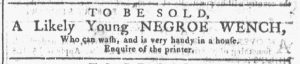
“TO BE SOLD, A Likely Young NEGROE WNECH, Who can wash, and is very handy in a house.”

The October 21, 1767, edition of the Georgia Gazette included thirteen advertisements that involved enslaved men, women, and children in some way. Seven advertisers sought to sell slaves. Two offered rewards for the capture and return of runaway slaves. Another two described suspected runaways that had been captured and requested that their masters claim them. One employment notice outlined the responsibilities of an overseer who would “take charge of about 20 negroes to be employed in planting rice and provisions.” The final advertisement proposed hiring out (or renting out) a “LIKELY NEGROE GIRL,” a good seamstress, by the month or year.

Among these thirteen advertisements, five featured enslaved women and girls. Women may have been largely (but not completely) absent from the advertising pages when it came to operating businesses and promoting their entrepreneurial activities to consumers, but enslaved women and girls appeared in the pages of colonial newspapers regularly. Practically every day in the 1760s at least one newspaper published somewhere in the colonies included at least one advertisement that featured enslaved women or girls, making slavery advertisements perhaps the most voluminous source for examining women’s history printed in colonial newspapers. Although not written from the perspective of enslaved women and girls, they still reveal much about their experiences.

Some reveal more than others. One simply stated: “TO BE SOLD, A VERY FINE, STOUT, YOUNG, and HEALTHY WENCH. For particulars apply to THOMAS HAMILTON.” In addition to the enslaved seamstress who could be hired out, another short advertisement offered a “NEGROE WENCH, Who can wash, and is very handy in a house.” A real estate advertisement for a farm concluded by noting the seller also had “TWO YOUNG NEGROE WENCHES … who are very handy at any kind of house work, and are good sempstresses.” These mentions were brief, but they still aid in understanding and reconstructing the experiences of enslaved women and girls. For instance, these advertisements indicate that enslaved women and girls often engaged in domestic labor rather than working in the fields. Not all of them were drudges within the home but instead developed valuable skills.

Other advertisements told much more elaborate stories about enslaved women and girls, especially advertisements for runaways that often included physical descriptions, described clothing, commented on personality traits, and acknowledged relationships with other slaves. Sometimes they tracked known or suspected movements, speculating on which friends or relatives runaways might approach for aid. No advertisements of that sort appeared in the October 21, 1767, edition of the Georgia Gazette, but they had in the past and they would again. That publication, like most of its counterparts throughout the colonies, frequently ran advertisements about enslaved women and girls, advertisements of various lengths and with assorted purposes. As a result, enslaved women and girls likely appeared in colonial newspapers more often than other women. The attempts to keep them in bondage also yielded a more prominent and extensive record of their experiences in the public prints. Enslaved women could never be out of sight to anyone who read the newspaper, either in the eighteenth century or today.

October 14

What was advertised in a colonial American newspaper 250 years ago today?

Oct 14 - 10:14:1767 Georgia Gazette
Georgia Gazette (October 14, 1767).

“Henry Steerman and Jonathan Remington, TAYLORS and PARTNERS.”

The advertisement placed by Henry Steerman and Jonathan Remington, as well as all of the other advertisements on the same page of the October 14, 1767, edition of the Georgia Gazette, creates a bit of a mystery for modern historian who consult databases of digitized newspapers to conduct their research. These advertisements appeared on the fifth page of that issue.

Why would this be a mystery? Most newspapers published in 1767 followed a standard format: four pages created by printing two pages on each side of a broadsheet and folding it in half. Occasionally printers issued a supplement, either two (using half a broadsheet) or four pages (using an entire additional broadsheet). Usually these supplements had their own masthead that identified them as supplements, though sometimes they were inserted in the center of the newspaper without additional identification. Due to the scarcity of paper, printers carefully filled both sides of any supplement with news items, advertisements, or both, leaving no empty space. If they did not have enough material to issue an even number of pages – four, six, or eight – they inserted notes indicating that news items would be continued in the next issue or advertisements omitted would be in the next.

The Georgia Gazette rarely issued a supplement. The layout sometimes suggested that the printer had difficulty even filling four pages. On such occasions the advertisements featured generous amounts of white space in order to occupy as much space on the page as possible. That Steerman and Remington’s advertisement, along with twenty others, appeared on the fifth page of the Georgia Gazette was out of the ordinary. What was perplexing to this historian, however, was the absence of a sixth page in the database of digitized newspapers. It would have been extraordinary for the printer not to print on both sides of the sheet, yet the sixth page seemed to be missing. Even more curious, the fifth page did not have a masthead that identified it as a supplement. Had Steerman and Remington’s advertisement actually appeared on the fifth page? Or was it on the sixth page and the fifth page, for whatever reason, was missing from the database?

These questions could not be answered merely by examining the digital surrogates. I found definitive confirmation only when I visited the American Antiquarian Society to examine the original issue of the Georgia Gazette that had been photographed and later digitized by Readex. To my surprise, the October 14, 1767, edition of the Georgia Gazette did indeed consist of only five pages. More accurately, it consisted of five printed pages and a blank sixth page, but this was not at all evident from the database. It did not include a photograph of the blank sixth page to provide context and a complete record for researchers.

This points to two lessons when it comes to the creation and use of digital surrogates in historical research. First, digital surrogates should be used in addition to, rather than instead of, original sources. Digital surrogates are valuable resources that have made original documents much more accessible to historians, other scholars, and the general public, but sometimes they hide elements of the past rather than reveal them. They must be consulted with caution and with knowledge of what kinds of questions to also ask about original documents in order not to be misled by digitized ones.

Second, the example of the October 14, 1767, issue of the Georgia Gazette underscores the necessity of content providers, like Readex, consulting with librarians, archivists, historians, and other scholars who are familiar with the original sources and the most likely users of digital surrogates when designing and implementing databases. To a layperson unfamiliar with eighteenth-century newspapers it seemed unnecessary, wasteful, and perhaps even confusing to include a photo of a blank page of a newspaper. To someone who works with eighteenth-century newspapers, both original and digital surrogates, every day, the absence of a blank page in the database actually created confusion that could have been avoided.

Consulting the original issue of the October 14, 1767, edition of the Georgia Gazette cleared up the mystery about its original format, yet another mystery remains, one that will be much harder to solve. Given the scarcity of paper, why did the printer issue an additional halfsheet printed on only one side?

October 7

What was advertised in a colonial American newspaper 250 years ago today?

Oct 7 - 10:7:1767 Georgia Gazette
Georgia Gazette (October 7, 1767).

“He has formerly attempted to get off for the West-Indies.”

In the 1760s the pages of the Georgia Gazette often included far more advertising concerning slaves – slaves for sale, runaway slaves, captured slaves – than advertising for consumer goods and services. These advertisements told the story of enslaved men, women, and children reduced to commodities to be bought and sold, but they also told stories of resistance to that dehumanization and commodification. Runaway advertisements testified to the agency, perseverance, and ingenuity of slaves who seized their freedom when they saw opportunities.

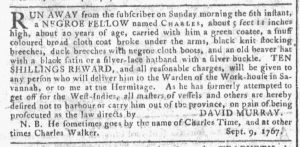
Much to his chagrin, David Murray told the story of one of those bold slaves, “A NEGRO FELLOW named CHARLES.” Although he was a young man, only “about 20 years of age,” Charles had previously attempted to escape from his master. While some slaves ran away with the intention of returning after a brief respite from their bondage, Charles had other plans. He did not seek temporary freedom but instead wished to permanently alter his situation. To that end, he had previously attempted “to get off for the West-Indies.” Murray did not offer any speculation to explain why Charles chose that destination; perhaps the young slave hoped to be reunited with family there. Whatever his reasons, Charles aimed to put considerable distance between himself and Murray, prompting the slaveholder to instruct “all masters of vessels” not to “carry him out of the province.” He also cautioned others “not to harbour” Charles, threatening to prosecute anyone who aided the fugitive.

To evade detection and capture, Charles adopted aliases, sometimes calling himself “Charles Time” and other times “Charles Walker.” Such resourcefulness may have aided in his escape and his ability to remain free for at least the month that had passed since Murray first placed his advertisement.

Between changing his name and making new efforts to escape even after his first attempt had been discovered, Charles demonstrated that he would not be subdued easily. While other advertisements treated enslaved men, women, and children as commodities – such as the “SIX FIELD NEGROES” or the “Young NEGROE WENCH” advertised for sale in the same issue of the Georgia Gazette – Murray’s advertisement about a “NEGROE FELLOW named CHARLES” underscored that slaves did not passively acquiesce to lives of perpetual servitude. Although certainly not Murray’s intent, his advertisement about a runaway slave told a powerful story of one man’s determination to fight to free himself from the injustices he experienced in colonial Georgia.

September 30

What was advertised in a colonial American newspaper 250 years ago today?

Sep 30 - 9:30:1767 Georgia Gazette
Georgia Gazette (September 30, 1767).

“RUN AWAY … a NEGROE FELLOW, named LONDON.”

Hundreds of advertisements for runaway slaves appeared in colonial American newspapers every year throughout the 1760s, documenting one form of resistance to the institution of slavery. From New Hampshire to Georgia, readers would have recognized them as a familiar component of the public prints, published alongside advertisements for consumer goods and assorted legal notices. Many runaway advertisements focused solely on the experiences of particular runaways, but some also told stories about other members of colonial communities.

Grey Elliott inserted such an advertisement in the September 30, 1767, issue of the Georgia Gazette. In it, he reported that London, a “NEGROE FELLOW … well known in and about Savannah” ran away a month earlier. Elliott offered a reward, ten shillings, to whoever captured London and delivered him either to Elliott or “the Warden of the Work house in Savannah.” In addition, he detailed two other awards. Suspecting that London had assistance from accomplices, Elliott announced rewards for anyone “who shall discover him or her by whom the said negroe is harboured.” In other words, he was interested in learning where London was hiding out and who concealed him from his master and colonial authorities. The awards varied: “TWENTY SHILLINGS if a slave” (twice as much as the reward for capturing London) and “FIVE POUNDS … if a white person” (ten times as much as the reward for capturing the runaway). The wording makes it difficult to determine definitively if Elliott meant a slave informant would receive twenty shillings and a white one five pounds or of he meant that the rewards would depend on whether London received aid from a fellow slave or a white accomplice.

Either way, Elliott’s advertisement demonstrates that runaways did not always go it alone when they absconded from their masters. Instead, they benefited from assistance provided by other slaves and, perhaps, sometimes even sympathetic white colonists. Other runaway advertisements provided even more specific information, sometimes noting family relationships that might have drawn runaways to particular places or influenced others to provide aid and comfort. Running away was an act of resistance undertaken by many slaves, but it also had ripple effects. Those who provided assistance to runaways engaged in their own acts of resistance as member of a community allied against the power and authority of slaveholders.

September 23

What was advertised in a colonial American newspaper 250 years ago today?

Sep 23 - 9:23:1767 Cowper and Telfairs in Georgia Gazette
Georgia Gazette (September 23, 1767).

“A LARGE ASSORTMENT OF GOODS.”

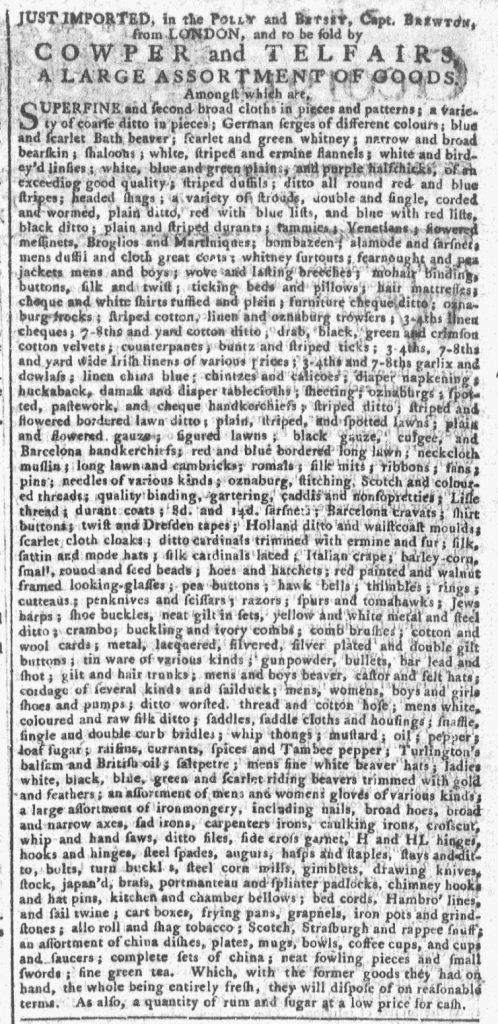
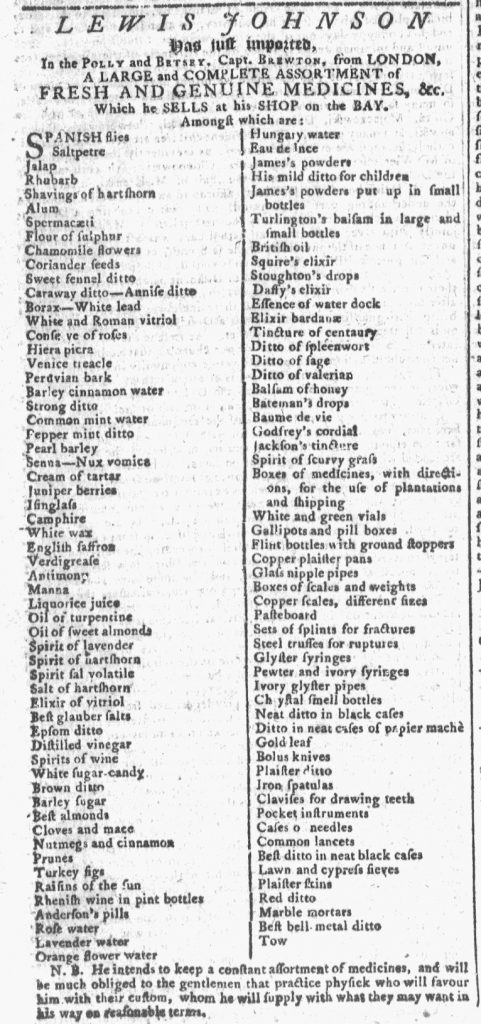
Lewis Johnson inserted an advertisement for his inventory of “A LARGE and COMPLETE ASSORTMENT of FRESH AND GENUINE MEDICINES” in the September 23, 1767, edition of the Georgia Gazette. The partnership of Cowper and Telfairs also placed an advertisement, informing potential customers of the “LARGE ASSORTMENT OF GOODS” they had imported from London. The notices, each listing an elaborate array of items, appeared side by side.

Although Lewis Johnson and Cowper and Telfairs each resorted to the common list-style advertisement to market their wares, the visual aspects of their notices distinguished them from each other. Cowper and Telfairs opted for a dense paragraph that extended two-thirds of the column, enumerating everything from “white, striped and ermine flannels” to “shirt buttons” to “broad and narrow axes” to “complete sets of china.” With some exceptions, they grouped their merchandise together by category (textiles, accouterments and accessories, hardware, and housewares). This made it somewhat easier for potential customers to locate specific items of interest (while also introducing them to others they may not have otherwise considered), even though the merchants did not include any sort of headers to indicate where one type of merchandise ended and another began. This dense list maximized the number of items Cowper and Telfairs presented to the public. While its format may have been somewhat overwhelming or difficult to read, it offered extensive choices to consumers.

Sep 23 - 9:23:1767 Johnson from Georgia Gazette
Georgia Gazette (September 23, 1767).

Johnson’s advertisement, on the other hand, occupied the same amount of space on the page, but did not list nearly as many items. Instead, it divided a single column into two narrower columns, listing only one item per line. This left much more white space on the page, making it easier for readers to navigate through the merchandise. Like Cowper and Telfairs, Johnson introduced his list with the phrase “Amongst which are,” indicating that the advertisement did not include an exhaustive inventory. Both carried additional items at their shops. Given that he carried additional medicines, Johnson made a calculated decision to truncate his list in order to make it easier to read. Compared to the dense format of everything else on the page, the layout of his list likely drew the eyes of colonial readers, increasing the likelihood that they would take note of his advertisement.

Both list-style advertisements had advantages and shortcomings inherent in their appearance on the page. Although eighteenth-century advertisements lack the dynamic graphic design elements of modern marketing efforts, advertisers and printers did experiment with different layouts in their efforts to attract attention and incite demand among potential customers.

September 16

What was advertised in a colonial American newspaper 250 years ago today?

Sep 16 - 9:16:1767 Georgia Gazette
Georgia Gazette (September 16, 1767).

“TWO POOR BOYS … will be taught to read, write, and cast accounts … by the bounty of Gentleman.”

As fall arrived in 1767, schoolmaster John Francklin incorporated philanthropy into his advertising campaign in the Georgia Gazette. Thanks in part to his previous newspaper notices, residents of Savannah and its hinterland may have already been aware that he taught reading, writing, and arithmetic, though in the newest iteration of his advertisement he further elaborated on his methods. That he utilized “a new and most concise method,” however, was not the most significant new information he provided for prospective pupils and their parents.

Francklin offered a scholarship, funded “by the bounty of a Gentleman,” to “TWO POOR BOYS … within the Town of Savannah.” Over the course of a year, these two students would learn “to read, write, and cast accounts.” In addition to tuition, the anonymous benefactor also provided “books, &c.” Presumably “&c.” (the eighteenth-century version of “etc.”) included other school supplies purchased from local booksellers or other shopkeepers, but not room or board. Francklin’s advertisements all suggested that he ran a day school, which may help explain why the recipients of this beneficence had to reside “within the Town of Savannah.”

Although Francklin may not have induced the anonymous gentleman to make this donation, he certainly attempted to extract as much benefit from it as possible. His association with this philanthropic effort would have made his services look even more attractive to the parents of prospective students. In evaluating the schoolmaster, parents would have been as interested in Francklin’s character and the morals imparted in the classroom as in the quality of his instruction. Lest anyone express concern about the influence “POOR BOYS” might have on other students at the school, Francklin specified that they would come from “industrious honest parents,” minimizing the possibility of introducing corrupting factors into interactions among students. The schoolmaster walked a fine line, welcoming recognition of his public spiritedness while simultaneously reassuring current and prospective students and their families that the scholarship students would not cause disruptions. Philanthropy made for a powerful marketing appeal, but Francklin also had to manage it carefully.

September 9

What was advertised in a colonial American newspaper 250 years ago today?

Sep 9 - 9:9:1767 Georgia Gazette
Georgia Gazette (September 9, 1767).

“My apprentice Patrick Nihell will make his escape.”

Throughout the eighteenth century, runaway advertisements were one of the most common types of notices inserted in newspapers. Slaveholders advertised runaway slaves. Masters advertised runaway indentured servants. Husbands advertised runaway wives. Military officers advertised runaway soldiers who had deserted. Masters advertised runaway apprentices. For people in subordinate positions, for people who were often exploited by others, running away from those who exercised power and authority over them was a means of attempting to remedy their situation.

Some of these advertisements appeared more frequently than others. Advertisements for runaway slaves and runaway servants were most common, though their proportion varied from region to region based on how extensively the local economy depended each type of labor. Newspapers in the Chesapeake and Lower South disseminated many advertisements for runaway slaves, but far fewer advertisements for runaway servants. Their counterparts in the Middle Atlantic regularly featured many of both types of advertisements, though careful quantitative analysis would likely reveal that advertisements for runaway servants significantly outnumbered advertisements for runaway slaves in that region. In New England, on the other hand, advertisements for runaway slaves appeared only occasionally and less frequently than advertisements for runaway servants.

Husbands advertised runaway wives throughout the colonies. Not surprisingly, newspapers in the largest urban ports – Boston, Charleston, New York, and Philadelphia – had the highest concentration of such advertisements, corresponding to the size of their populations, yet such notices also appeared in newspapers published in smaller towns. Advertisements for runaway soldiers were the least common, but readers also encountered them in newspapers throughout the colonies.

Finally, advertisements for runaway apprentices ran in newspapers in every region of colonial America, but tended to be most heavily concentrated in those regions that had higher numbers of indentured servants rather than slaves. In running away, abused apprentices sought to escape mistreatment by their masters. In today’s advertisements, Thomas Lee, Jr., updated the standard format for such advertisements. His apprentice, Patrick Nihell, had not run away, but their relationship had apparently deteriorated to the point that Lee suspected Nihell would “make his escape.” In anticipation, Lee preemptively warned “all masters of vessels and others” not to assist Nihell in any way if he did attempt to abscond. He concluded by threatening anyone who colluded with the apprentice “may depend to be prosecuted to the utmost rigour of the law.”