February 3

What was advertised in a colonial American newspaper 250 years ago today?

Feb 3 - 2:3:1768 Image 1 Georgia Gazette
Greyscale jpeg converted from gif. Georgia Gazette (February 3, 1768).

“PROPOSED to be published, a PAMPHLET.”

Digital surrogates have significantly expanded the ability of scholars and the general public to access historical sources. The Adverts 250 Project and the Slavery Adverts 250 Project would not be possible without the databases of digitized eighteenth-century newspapers created by institutions like the American Antiquarian Society and Colonial Williamsburg forming partnerships with companies like Accessible Archives and Readex. Such databases make sources available online as well as portable when downloaded for further reference. This greatly expands the questions we can ask – and answer – about the past.

Feb 3 - 2:3:1768 Image 2 Georgia Gazette
Black-and-white jpeg converted from PDF. Georgia Gazette (February 3, 1768).

Yet we must also be careful consumers of digitized sources: not all digital surrogates are created equal. Consider, for instance, these two digitized versions of the same advertisement from the final page of the February 3, 1768, edition of the Georgia Gazette. Although they contain the same content, they look rather different from each other. The first is much more legible than the second, especially to readers with less experience working with digitized sources.

Why do these two images appear so different? Although I’ve converted both to jpegs, that is not the original format of either when I downloaded them from Readex’s America’s Historical Newspapers. The first image represents what users see on their screen when they examine the newspaper in the database, a greyscale rendition of the page derived from a photograph of the original. It disguises the actual color and texture of the eighteenth-century newspaper, but the visual variations do make it possible for the human eye to distinguish what was printed on the page and what bled through from the other side. I acquired this image by selecting Readex’s option to “Print,” which opened a new page with instructions for printing the entire page of the newspaper (complete with a citation at the top). I then deviated from the procedure intended by Readex by instead dragging a gif image of the entire page to my desktop before cropping the advertisement and converting it into a jpeg (which I have learned through trial and error is the most efficient method for pursuing this project). Had I followed through on the instructions provided by Readex, I could have printed a copy of the greyscale image of the entire page or saved it to my computer as a PDF (which I then could have cropped and converted into a jpeg, achieving the same result but requiring a few extra clicks on my part).

The second image resulted from using a different method to download the page from Readex’s database. America’s Historical Newspapers has a very useful function that allows users to “Download Issue” as a multipage PDF (which can then be cropped and converted into jpegs, as I did to create the second image of today’s advertisement). Rather than working page by page, this saves a great deal of time when it comes to the type of research I do on this project. However, when I select the “Download Issue” function it remediates the newspaper into black-and-white images rather than greyscale. The resulting images are not nearly as legible since it is more difficult to recognize what was printed on the page, what bled through from the other side, and what represents creases, paper texture, or discolorations of the page. Although portable, such images are not as accessible as their greyscale counterparts.

This compromises some of the convenience and functionality of the “Download Issue” option. It saves time, but sometimes at the expense of legibility. When working with black-and-white PDFs of entire issues, sometimes it becomes necessary to return to online database to examine the greyscale image, negating the portability of the PDF.

As digital surrogates proliferate, their users – scholars, students, and the general public – must be aware of their variations. Each digital surrogate remediates an original document. Some result from multiple generations of remediation. In the process, the images have been altered, sometimes to a greater and sometimes to a lesser degree, so users must be wary that they are not viewing a representation exactly as they would experience seeing the original document. They must devise research strategies that allow them to effectively use the digital surrogates that provide greater access to historical sources.

January 27

What was advertised in a colonial American newspaper 250 years ago today?

Jan 27 - 1:27:1768 Georgia Gazette
Georgia Gazette (January 27, 1768).

To be sold … ALL the PERSONAL ESTATE of said BENJAMIN GOLDWIRE.”

Some colonial newspapers seemed to overflow with advertisements places by merchants, shopkeepers, and artisans seeking to sell consumer goods. This was especially true of newspapers published in the largest urban ports, including Boston, Charleston, New York, and Philadelphia. Many newspapers from those cities frequently issued supplements devoted entirely to advertising. Other newspapers, however, featured far fewer advertisements for the wholesale or retail sale of consumer goods. Such was the case for the Georgia Gazette, published in Savannah by James Johnston. Even given the smaller population of the colony, shopkeepers placed relatively few advertisements in the Georgia Gazette. Perhaps the smaller population and fewer shops meant that the proprietors had less need to resort to the public prints rather than worrying about familiarity and word of mouth to promote their businesses.

The January 27, 1768, edition of the Georgia Gazette, for instance, did not include any advertisements placed by shopkeepers. That did not mean, however, that it lacked evidence of participation in the vibrant consumer culture of the eighteenth-century Atlantic world. Several advertisements encouraged colonists to acquire goods at venues other than shops and warehouses in Savannah. Instead of purchasing new items at those locations, consumers could get similar items at bargain rates at estate sales and auctions. In four of the thirty-one advertisements in that issue, executors announced such sales. Each of them included either “Household Furniture” or “HOUSEHOLD GOODS” in addition to slaves and livestock. Unlike advertisements placed by merchants and shopkeepers, these notices did not incorporate any of the most popular marketing strategies, although the appeal to price was implicit when it came to the possibility of low bids at auctions. In the absence of appeals to quality, fashion, or consumer choice, advertisements for estate sales and auctions stimulated the market for secondhand goods, expanding the realm of consumer culture for greater numbers of colonists who may not have had the means to acquire solely new goods from merchants and shopkeepers.

January 13

What was advertised in a colonial American newspaper 250 years ago today?

Jan 13 - 1:13:1768 Georgia Gazette
Georgia Gazette (January 13, 1768).

“PROPOSED to be published, a PAMPHLET.”

James Johnston inserted a subscription notice for “a PAMPHLET … entitled ‘Religious and Moral Observations selected from the Writings of approved Authors’” in the January 13, 1768, edition of the Georgia Gazette. He did not promote a product already available for customers to purchase; instead, like many other eighteenth-century publishers, he presented a proposal in order to gauge public interest in the pamphlet. It would go to press only once a sufficient number of “subscribers” pledged to purchase it.

Publishing by subscription significantly reduced the financial risk. No printer wanted to invest time and materials only to produce a book or pamphlet that never sold enough copies to turn at least a small profit. With that in mind, Johnston instructed that readers “willing to encourage” the proposed pamphlet “may send in their names to the printer of this paper.” As names arrived, he would compile a subscription list (which printers sometimes inserted in proposed publications as a means of acknowledging patrons who supported the project). Johnston did not specify a publication date. Instead, he stated, “The publication will commence as soon as a sufficient number have sent in their names to defray the first expence of publishing.” Although that would not cover all of his costs, the printer considered it enough to indicate that other buyers would eventually step forward to acquire the pamphlet. For initial subscribers “the price of the pamphlet will be two shillings sterling.” Subsequent buyers could expect to pay a higher price. Offering a bargain to those who invested in the project early often helped to stimulate interest.

As part of his effort to promote the pamphlet, Johnston offered a brief description and outline. He estimated that it would be approximately sixty-four pages or “four sheets in 8vo. [octavo].” (This meant that a single sheet was folded in half three times in order to form eight leaves that were one-eight the size of the original sheet. With text printed on both sides of each leaf, this produced sixteen pages per sheet. Four sheets yielded sixty-four pages.) As the title suggested, these sixty-four pages would contain “Religious and Moral Observations” intended to bring together “the opinions and most enforcing arguments of different eminent authors.” The passages would be carefully organized “under proper Heads” and the names of the authors or books included for further reference. The pamphlet would also include “original Notes” intended to “illustrate and enforce the several passages.”

Johnston published the subscription notice to determine interest in the pamphlet, but he also planned to use the pamphlet to assess interest in “a larger publication of the same nature.” He considered the pamphlet a “specimen.” If consumers reacted positively, he would publish a more extensive version. The combination of the initial subscription notice and, eventually, sales of the pamphlet (if the subscription notice proved successful) constituted market research to guide his decisions about printing a substantial volume.

January 6

What was advertised in a colonial American newspaper 250 years ago today?

Jan 6 - 1:6:1768 Georgia Gazette
Georgia Gazette (January 6, 1768).

“An Assortment of Delft Ware.”

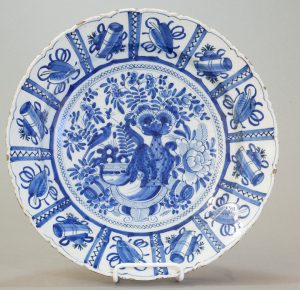
In the January 6, 1768, edition of the Georgia Gazette, William Moore advertised several commodities frequently purchased in bulk, including rum, sugar, and nails. He concluded his list with “an Assortment of Delft Ware,” perhaps for sale directly to consumers or perhaps intended for retailers to stock their shops in Savannah and its hinterland.

Delftware, a type of earthenware with an opaque white glaze enhanced with an overglaze decoration (usually done in blue), came in many designs and patterns. According to Amanda E. Lange, delftware was the most common kind of ceramic imported into the American colonies in the seventeenth and eighteenth centuries. “Produced in a wide variety of forms, ranging from the purely decorative to the decidedly utilitarian, plates, dishes, punch bowls, mugs, tea wares, tiles, apothecary jars, and chamberpots formed the bulk of delftware imported to America.”

Jan 6 - Delftware Plate
Delftware Plate (early 18th century). Courtesy Five Colleges and Historic Deerfield Museum Consortium (AC C.1936.17).

Although delftware derived its name from the town of Delft in the Netherlands, the center for delftware production had shifted to England by the eighteenth century. Whether made in England, the Netherlands, France, or elsewhere, delftware represented a less expensive alternative to fashionable Chinese porcelain.

Moore advertised his “Assortment of Delft Ware” in the final years of its popularity. More durable pottery produced in Staffordshire, England, displaced the fragile delftware in the late eighteenth century. Josiah Wedgwood, Lange notes, “perfected his version of creamware in the 1760. Wedgwood’s effective marketing skills and knowledge of current fashions eventually ruined the market for delftware.” Production in England sharply declined in the 1760s; by the end of the century it ceased.

At the time of Moore’s advertisement, however, delftware remained popular in the English colonies. Selecting among a variety of designs, sometimes imitating Chinese patterns and sometimes depicting European scenes, allowed consumers to assert their own tastes as well as demonstrate their knowledge of the latest fashions. Given the costs of Chinese import porcelain, acquiring delftware served as a substitute for displaying gentility on a budget.

December 30

What was advertised in a colonial American newspaper 250 years ago today?

Dec 30 - 12:30:1767 Georgia Gazette
Georgia Gazette (December 30, 1767).

“GEORGE NORMAN, PERUKE-MAKER and HAIR-DRESSER … has opened a shop.”

When he opened a new shop in Savannah in 1767, George Norman placed an advertisement in the Georgia Gazette to offer his services as a “PERUKE-MAKER and HAIR-DRESSER” to readers in town and throughout the countryside. Although the term “peruke” has fallen into disuse today, colonists knew that it referred to wigs.

In their examination of “Wigmaking in Colonial America,” Thomas K. Bullock and Maurice B. Tonkin, Jr., summarize the activities of Norman and his counterparts in cities and towns throughout the colonies: “The work of the wigmaking craft in Colonial America consisted primarily of three types of activities; making and selling wigs and false hair pieces for men and women, cutting and dressing ladies’ and gentlemen’s hair, and shaving men.”[1] Individual wigmakers engaged in each of these activities to varying extents. Although Norman did not mention shaving in his advertisement, it may have been an ancillary service he provided for male clients who visited his shop.

The presence of Norman’s advertisement in the Georgia Gazette testifies to the growth of Savannah in the second half of the eighteenth century. According to Bullock and Tonkin, the “wig custom … was primarily an urban practice” in colonial America. Although small in comparison to busy urban ports like Boston, Charleston, New York, and Philadelphia, the largest town in Georgia achieved a sufficient “concentration of people and wealth [to create] a society in which the wig was considered a social or economic asset.” Whether they resided in town or country, planters, merchants, and clergy commonly wore wigs, but the practice was not always limited to elites. Bullock and Tonkin indicate that “certain craftsmen, small shopkeepers, and other skilled workers and artisans, whose jobs brought them in contact with the public, found it advantageous to wear wigs.”[2] More than a mere fashion accessory, wearing a wig served as a symbol of respectability in colonial society.

Bullock and Tonkin also comment on the significance of newspaper advertisements in examining the production and sale of wigs in colonial America: “There is a general scarcity of material relating to the practice of the wigmaking craft in America. Newspaper advertisements constitute the bulk of available information, and it is on this we must rely for an insight into the conduct of the craft.”[3] For more on the tools, methods, and processes involved, consult Colonial Williamsburg’s “Wigmaking in Colonial America.”

**********

[1] Thomas K. Bullock and Maurice B. Tonkin, Jr., “Wigmaking in Colonial America,” (Williamsburg, VA: Colonial Williamsburg Foundation Library, 1957), 11.

[2] Bullock and Tonkin, “Wigmaking,” 9.

[3] Bullock and Tonkin, “Wigmaking,” 10.

December 23

What was advertised in a colonial American newspaper 250 years ago today?

Dec 23 - 12:23:1767 Georgia Gazette
Georgia Gazette (December 23, 1767).

“The WHARF and STORES belonging to Capt. Francis Arwen.”

In late December 1767, Van Rensselaer and Peat turned to the Georgia Gazette to advertise “Good West-India and Northward Rum [and] Muscovado Sugar and Pigtail Tobacco; with sundry other Dry Goods,” but that was not the primary purpose of their advertisement. Instead, they promoted a new venture they had just commenced, “having taken the WHARF and STORES belonging to Capt. Francis Arwen.” They offered their services to planters and merchants in Savannah and its hinterland.

Van Rensselaer ad Peat petitioned planters to send rice and other commodities to them for storage before being loaded on ships for transport to other markets for sale. They promised that they had “regular weights and measures” that allowed them to “do justice” in determining the value and volume of goods they received. This benefited planters when it came to charging them for storage and loading commodities onto vessels docked at the wharf, but it also worked in favor of merchants who purchased those commodities. Van Rensselaer and Peat proclaimed that they kept “true and accurate accounts.” Their fair dealing meant that neither planters nor merchants needed to worry that they were being cheated in transactions conducted at Van Rensselaer and Peat’s wharf and stores.

The partners also addressed two other aspects of the services they provided. Savannah competed with the older and larger port at Charleston. Planters might have been tempted to send their rice and other commodities there instead of shipping them via Savannah, anticipating that access to more storehouses meant lower prices. For their part, Van Rensselaer and Peat asserted that they “charg[ed] no more than the Carolina prices” in order to keep their services competitive with those offered by their competitors in the neighboring colony. They also made themselves available to work with planters and merchants at their convenience: “Constant attendance will be given.” This also suggested that watchful eyes safeguarded any commodities deposited for storage, preventing theft.

Many advertisements in colonial newspapers offered goods and services to consumers, but others facilitated the production and distribution of commodities locally and throughout the Atlantic world. The rice and other commodities exported via Van Rensselaer and Peat’s storehouses and wharf were part of large networks of exchange that made possible the consumer revolution of the eighteenth century.

December 16

What was advertised in a colonial American newspaper 250 years ago today?

Dec 16 - 12:16:1767 Georgia Gazette
Georgia Gazette (December 16, 1767).

“The SOUTH-CAROLINA & GEORGIA ALMANACK, FOR THE YEAR OF OUR LORD 1768.”

During the final months of the year colonial newspapers published advertisements for almanacs with increasing frequency. Throughout the fall and into the winter they became a standard feature in newspapers as printers and booksellers first encouraged colonists to acquire their almanacs before the new year commenced and later attempted to sell surplus copies before too much of the new year passed.

In Savannah, James Johnston, Messrs. Clay and Habersham, and Mr. Zubly advertised the “SOUTH-CAROLINA & GEORGIA ALMANACK, FOR THE YEAR OF OUR LORD 1768” in the Georgia Gazette. Like their counterparts who sold almanacs in other colonies, they provided readers with a volume specifically intended for the local market. The calculations were “Fitted for the Latitude of 33 Degrees North,” but that was not the only reference material unique to local conditions. The contents also included “a Tide Table for the Bar and Harbour of Charlestown” as well as “Tables of Roads” to facilitate travel and commerce in the region.

Just as John Holt had done in promoting Freeman’s New-York Almanack in the New-York Journal earlier in the same week, the booksellers in Savannah enticed customers with a preview of the contents, concluding with a poem that introduced readers to the verses they would find in the South-Carolina and Georgia Almanack. Also like Holt, they informed prospective customers that the almanac contained a mixture of useful (“an Interest Table at Eight per cent”) and entertaining (“Remarkable Sayings”) entries, though they did not provide such elaborate detail as their counterpart in New York. A relative lack of competition may have explained the difference: readers in New York could choose among many almanacs printed and advertised there, but colonists in Georgia had far fewer options. Still, the local booksellers apprised customers that the South-Carolina and Georgia Almanack was well worth nine pence because it included so much valuable content “besides what is common in Almanacks,” including “a curious Preface, containing Nostradamus’s Prophecy.” For colonists who had not yet obtained almanacs for the coming year, such hints were intended to pique their interest and convince them to make their purchases. This was an early modern version of the current practice of giving consumers access to the table of contents when advertising books online.

December 9

What was advertised in a colonial American newspaper 250 years ago today?

Dec 9 - 12:9:1767 Georgia Gazette
Georgia Gazette (December 9, 1767).

“A NEAT SECOND HAND CHAIR … hams, gammons, jowls, and bacon.”

Many colonists placed newspaper advertisements for a particular reason. The December 9, 1767, edition of the Georgia Gazette, for instance, included several real estate notices that focused exclusively on the properties for sale. Other advertisements cautioned against runaway slaves or described employment opportunities. Some marketed imported goods to consumers. Mary Hepburn’s short advertisement announced that she intended to depart from Georgia and wished to settle accounts.

In contrast, certain advertisements had more than one purpose. If colonial printers and compositors had practiced any sort of system of classification to organize the paid notices in their newspapers, such advertisements would have likely been divided into shorter notices and grouped with similar ones. Instead, the contents of individual advertisements sometimes seemed as haphazard as the assortment of notices printed in the same column or on the same page.

Such was the case with John Morel’s advertisement. In the course of two short paragraphs Morel, a prominent merchant, switched from hawking a used carriage, a “NEAT SECOND HAND CHAIR … with very good harness,” to selling pork products, including “hams, gammons, jowls, and bacon.” In the process, he addressed two very different sorts of readers. Due to the expense, only the most affluent colonists would have been in the market for a carriage, whether new or “SECOND HAND.” However, “any family” would have needed hams and bacon for sustenance.

The dual purposes of Morel’s advertisement, like the hodgepodge of content throughout the rest of the newspaper, testify to habits of intensive reading in the eighteenth century. Given that far more colonists would have been interested in purchasing pork than a used carriage, Morel depended on careful attention to his advertisement. He assumed that readers would not pass over the remainder of the advertisement when they noticed the carriage at the beginning but instead continue reading to the end, including the portion that marketed hams and bacon. Certainly not every reader actually read every word of the newspaper, but the lack of organization made it imperative for readers to cast more than a casual glance to find the content they desired.

December 2

What was advertised in a colonial American newspaper 250 years ago today?

Dec 2 - 12:2:1767 Georgia Gazette“A FOUR SHEET MAP of SOUTH-CAROLINA and PART of GEORGIA”

This advertisement for a “FOUR SHEET MAP of SOUTH-CAROLINA and PART of GEORGIA” would have been quite familiar to regular readers of the Georgia Gazette. It had been appearing in the pages of that newspaper for more than a year. While James Johnston, the printer of the newspaper and purveyor of the map certainly wanted to sell copies he still had on hand after all that time, the advertisement also served another important purpose. In a publication that sometimes lacked sufficient content to fill its pages, Johnston frequently inserted the advertisement as filler.

That seems to have been the case in the December 2, 1767, edition of the Georgia Gazette. The issue consisted of three pages of news and a final page devoted to advertising. A variety of articles densely filled the first three pages, yet the final page featured significant amounts of white space as part of each advertisement. Notice the amount of space between the body of the advertisement and the lines that separated it from the advertisements printed before and after. That had not been part of the design two weeks earlier when Samuel Douglass and Company’s advertisement that extended more than an entire column forced the compositor to squeeze all of the other paid notices together, eliminating any hint of negative space. The text on the two pages given over to advertising in that issue appeared just as dense as the text of the news items.

In addition to Johnston’s perennial advertisement for a map of South Carolina and Georgia, many other advertisements in the December 2 issue previously ran in other issues (though none of them nearly as many times). Each had been modified to include white space before and after the body of the advertisement, stretching them out in order to fill the entire page. This did not require completely resetting the type, but it did transform portions of each advertisement into filler that helped the printer deliver a complete issue to subscribers. Beyond the revenues they generated, newspaper advertisements served other purposes for colonial printers.

November 25

What was advertised in a colonial American newspaper 250 years ago today?

Nov 25 - 11:25:1767 Georgia Gazette
Georgia Gazette (November 25, 1767).

“LOAF SUGAR, BOHEA TEAD, MENS SADDLES.”

The typography of John Rae’s advertisement distinguished it from others that ran in the November 25, 1767, edition of the Georgia Gazette. Most of the items for sale in his list-style advertisement appeared in capital letters, a style deployed sparingly elsewhere among the paid notices. This indicates that the advertiser sometimes exercised some influence over the format of advertisements in the eighteenth century, even though standard practice dictated that the advertisers write copy but leave it to the discretion of printers and compositors to determine the layout and other typographical aspects of advertisements.

Rae’s advertisement suggests collaboration between advertiser and compositor. Compared to newspapers printed in other colonies, especially in the largest port cities, the Georgia Gazette featured relatively little innovative typography in its advertisements. The compositor generally adhered to a particular format in order to achieve speed and efficiency when setting type. Rae may not have specifically instructed that his goods appear in capital letters; instead, he may have merely requested some unique attribute to attract the attention of potential customers. The compositor, less imaginative than counterparts in printing offices in other colonies, may have considered the capital letters an adequate solution.

The headline – “The Subscriber has for Sale” – in an ornate font also may have been an attempt to create a distinctive visual style for Rae’s advertisement. Four other advertisements in the November 25 issue included headlines: “Wanted to Hire,” “Wanted on Hire,” “To be Hired by the Month or Year,” and “Brought to the Work-house.” Each of these introduced advertisements concerning servants or slaves, again hinting that the compositor devised particular methods for setting type for specific kinds of advertisements. Rae may have disrupted that system by requesting that his headline appear in that font. Alternately, when pressed to spruce up Rae’s advertisement, the compositor may have resorted to a familiar method that did not require excessive creativity. The compositor may have been capable of only limited innovation.

The visual aspects of Rae’s advertisement raise many questions about the process that went into creating it. It may be tempting to dismiss its format as arbitrary or haphazard, but comparing it to others on the same page reveals that someone – advertiser, compositor, or the two in collaboration – made deliberate choices in creating an advertisement that differed from all others in the same issue.