
What was advertised in a revolutionary American newspaper 250 years ago today?
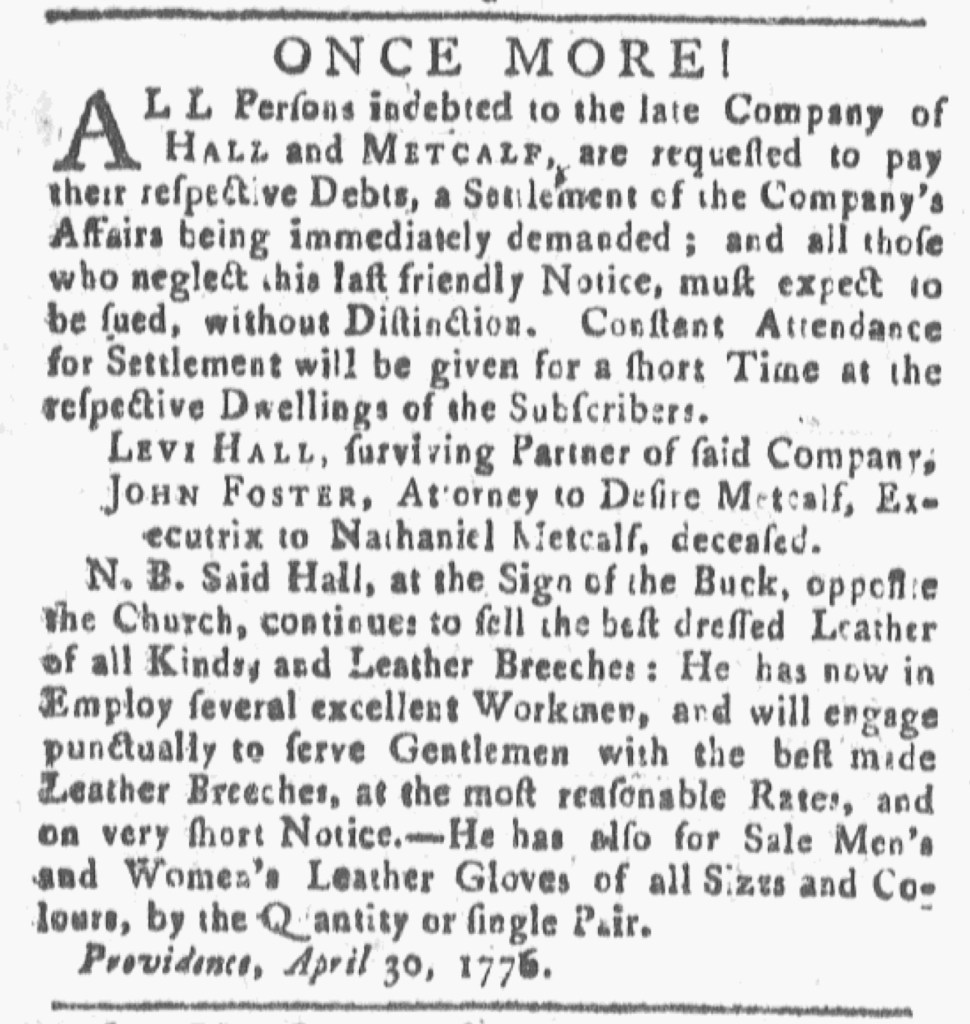
“ONCE MORE!”
Levi Hall and John Foster wanted the headline for their advertisement in the May 18, 1776, edition of the Providence Gazette to catch the attention of readers. Every advertiser certainly wanted their notice to reach the public, but crafting a catchy headline was not a standard practice in the eighteenth century. Some advertisements did not have headlines at all. Others gave a generic summary of the purpose of the notice, such as “WANTED,” “FOUND,” and “TO BE SOLD.” Some named items offered for sale, like “WRITING PAPER,” and others gave the name of the advertiser, including “NATHANIEL GREENE,” “CLARK and NIGHTGALE,” and “ELIHU ROBINSON, Hatter.” John Sebring, the “saddler and Cap-Maker, from London,” once again deployed his mononym, “SEBRING,” as the headline for an advertisement. Weel after week, similar headlines for paid notices appeared in the Providence Gazette.
That made “ONCE MORE!” stand out. Its distinctiveness may have enticed readers to look more closely at the rest of the advertisement. When they did, they learned that Hall and Metcalf called on those “indebted to the late Company of HALL and METCALF … to pay their respective Debts.” Hall placed the notice as the “surviving Partner of said Company,” while Foster did so as the “Attorney to Desire Metcalf, Executrix to Nathaniel Metcalf, deceased.” Tyey reported that a “Settlement of the Company’s Affairs [was] immediately demanded,” warning that “those who neglect this last friendly Notice, must expect to be sued, without Distinction.” In other words, neither social status nor customer loyalty nor any other factor would prevent Hall and Foster from taking to court those who refused to settle accounts. Hall and Metcalf’s widow had placed a similar advertisement nearly a year earlier on July 29, 1775, so it was not the first time that such a notice appeared in the Providence Gazette, but it would be the last, especially considering that an attorney rather Desire Metcalf signed the notice. “ONCE MORE!” signaled some frustration, even though Hall and Foster asked readers to think of the advertisement as a “friendly Notice.” The headline underscored that they were running out of patience.
In both advertisements, Hall, the “surviving Partner,” added a nota bene to inform the public that he “continues to sell the best dressed Leather of all kinds” and made “Leather Breeches, at the most reasonable Rates, and on very short Notice.” Although the partnership had been dissolved upon the death of Metcalf, Hall continued the business “at the Sign of the Buck, opposite the Church,” hoping that years of experience serving the residents of Providence would help him gain and maintain his clientele.
