
What was advertised in a colonial American newspaper 250 years ago today?
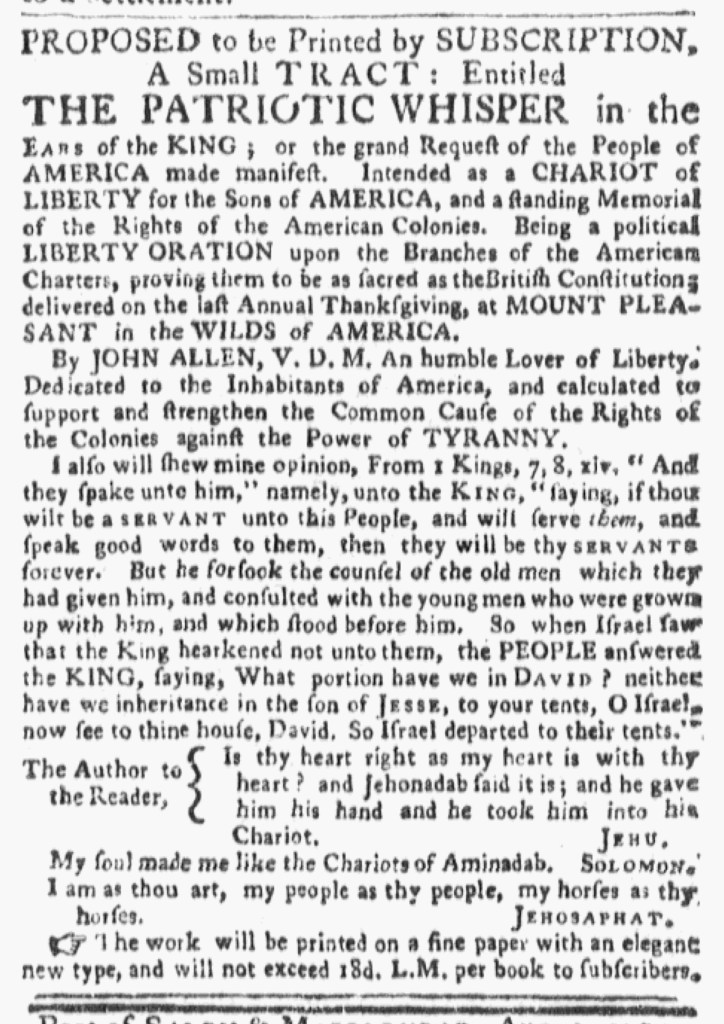
“THE PATRIOTIC WHISPER in the EARS of the KING.”
The imperial crisis intensified in the summer of 1774. In response to the Boston Port Act, the Massachusetts Government Act, and the other Coercive Acts that Parliament enacted following the Boston Tea Party, printers, booksellers, and others marketed an array of books and pamphlets that advocated for the rights and liberties of the American colonies. On August 8, Benjamin Edes and John Gill continued advertising Considerations on the Measures Carrying on with Respect to the British Colonies in North-America in the Boston-Gazette. That same day, a subscription proposal for “A Small TRACT: Entitled THE PATRIOTIC WHISPER in the EARS of the KING” appeared in the Boston Evening-Post.
The lengthy secondary title of the proposed tract deployed similar rhetoric: “the grand Request of the People of AMERICA made manifest. Intended as a CHARIOT of LIBERTY for the Sons of AMERICA, and a standing Memorial of the Rights of the American Colonies. Being a political LIBERTY ORATION upon the Branches of the American Charters, proving them to be as sacred as the British Constitution.” The subscription proposal delivered an impassioned plea to readers whether or not they happened to purchase copies to examine in more detail.
This “PATRIOTIC WHISPER” originated as a sermon that John Allen gave “on the last Annual Thanksgiving.” Many colonizers in Boston were familiar with his sermons and tracts. Allen had previously published The American Alarm, or the Bostonian Plea, for the Rights and Liberties, of the People and An Oration, Upon the Beauties of Liberty, or the Essential Rights of the Americans, though he had adopted the pen name “A British Bostonian” for both. The extended title of the Oration, Upon the Beauties of Liberty identified it as a sermon “Delivered at the Second Baptist-Church in Boston. Upon the Last Annual Thanksgiving.” That made it possible for readers to deduce the identity of “A British Bostonian.” The subscription notice described Allen as a “humble Lover of Liberty, Dedicated to the Inhabitants of America,” and further explained that the tract was “calculated to support and strengthen the Common Cause of the Rights of the Colonies against the Power of Tyranny.” Again, the advertising copy made a powerful political statement.
That, however, does not seem to have been enough to garner the necessary number of subscribers to take the tract to press. Yet Allen’s views on the politics of the moment found their way into print in other pamphlets in 1774. In Salem, Ezekiel Russell printed The Watchman’s Alarm to Lord N—h; or, The British Parliamentary Boston Port-Bill Unwrap[p]ed. The title page attributed the work to “the British Bostonian.” In Hartford, Ebenezer Watson reprinted a “carefully corrected” fifth edition of Allen’s Oration on the Beauties of Liberty. The widespread dissemination of tracts by Allen promoted John M. Bumsted and Charles E. Clark to describe him as “New England’s Tom Paine” in the twentieth century.[1] Even though Allen’s “PATRIOTIC WHISPER” did not go to press in a crowded market, the subscription proposal that ran in the Boston Evening-Post contributed to the discourse condemning ongoing abuses by Parliament.
**********
[1] John M. Bumsted and Charles E. Clark, “New England’s Tom Paine: John Allen and the Spirit of Liberty,” William and Mary Quarterly, 3rd ser., 21, no. 4 (October 1964): 561-570.


