December 21

What was advertised in a revolutionary American newspaper 250 years ago today?

New-York Journal (December 21, 1775).

“WILL BE PUBLISHED … A JOURNAL OF THE PROCEEDINGS OF THE CONTINENTAL CONGRESS.”

On Thursday, December 21, 1775, John Anderson, the printer of the Constitutional Gazette, ran an advertisement in the New-York Journal to stimulate interest in one of his forthcoming projects.  “On SATURDAY NEXT,” he announced, “will be published, by JOHN ANDERSON … A JOURNAL OF THE PROCEEDINGS OF THE CONTINENTAL CONGRESS.”  Just two weeks earlier, William Bradford and Thomas Bradford, the printers of the Pennsylvania Journal, advertised that they would soon publish the “JOURNAL OF THE PROCEEDINGS OF THE CONGRESS, HELD AT PHILADELPHIA, May 10, 1775.”  It appears that Anderson quickly acquired a copy and set about printing a local edition for the New York market, making him the first printer outside of Philadelphia to publish an overview of the Second Continental Congress when it convened after the battles at Lexington and Concord.  The volume that Anderson published had a slightly different title than what appeared in the advertisement: Extracts from the Votes and Proceedings of the American Continental Congress: Held at Philadelphia, 10th May, 1775.  In the rush to take it to press, the compositor introduced several errors in the page numbers, according to the American Antiquarian Society’s catalog.

Neither the Bradfords nor Anderson merely printed these collections of records of the Second Continental Congress and then advertised them.  Instead, both encouraged readers to anticipate their publication, making the eventual announcements that they were available for purchase even more enticing and persuasive.  On Saturday, December 23, Anderson’s own newspaper featured an advertisement promising that “This Day will be published by the Printer.  A Journal of the Proceedings of the Continental Congress.”  Eager customers could visit his printing office “at Beekman’s-Slip” to see if copies were ready for purchase.  By December 27, they were certainly available.  In the issue of the Constitutional Gazette distributed that day, Anderson described the volume as “Just published by the Printer” and listed three local agents who also sold it.  An updated advertisement also appeared in the New-York Journal on December 28, nearly identical to the one from the previous issue with the first two lines replaced with a single line.  Anderson’s advertisement began, “Just published, and to be sold by” instead of “On SATURDAY NEXT / WILL BE PUBLISHED, by.”  Using a series of advertisements in two of New York’s newspapers, Anderson announced the forthcoming publication of a local edition of “THE PROCEEDINGS OF THE CONTINENTAL CONGRESS” and kept the public informed of its progress and availability.

October 25

Who was the subject of advertisements in a revolutionary American newspaper 250 years ago today?

Constitutional Gazette (October 25, 1775).

“RUN-AWAY … a Negro man, named MINGO.”

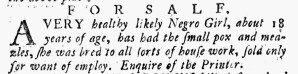
“FOR SALE, A VERY healthy Negro Girl.”

In the fall of 1775, John Anderson joined the ranks of newspaper printers who helped perpetuate slavery by disseminating advertisements about enslaved people in their publications.  In this case, one advertisement concerned “a Negro man, named MINGO,” who liberated himself from Benjamin Hutchinson by escaping from Hutchinson of Southold in Suffolk County on Long Island in early October.  The enslaver described the young man, both his physical features and his clothing, and offered a reward for his capture and return.  Another advertisement offered a “healthy Negro Girl, about 18 years of age,” for sale.  She was capable of “all sorts of house work” and sold “only for want of employ” rather than any deficiency.

Those advertisements first appeared in the October 25 edition of the Constitutional Gazette, a newspaper that commenced publication near the beginning of August.  The new publication initially did not carry advertisements, though Anderson began soliciting them by the end of the month.  Local entrepreneurs who had experience advertising in other newspapers, including goldsmith and jeweller Charles Oliver Bruff and Abraham Delanoy, who pickled lobsters and oysters, soon placed notices in the Constitutional Gazette.  Beyond marketing consumer goods and services, others ran advertisements for a variety of purposes, replicating the kinds of notices found in other newspapers of the period.

Constitutional Gazette (October 25, 1775).

That included advertisements about enslaved people.  Two months after first soliciting advertisements (and less than three months after publishing the inaugural issue), Anderson disseminated Hutchinson’s advertisement about Mingo’s escape from slavery and another notice offering an enslaved young woman for sale.  Like printers from New England to Georgia, he compartmentalized the contents of his newspaper, not devoting much thought to the juxtaposition of news and editorials advocating on behalf of the American cause and advertisements placed for the purpose of perpetuating slavery and the slave trade.

Even as Anderson used his newspaper to advocate for liberty for colonizers who endured the abuses perpetrated by Parliament, he used it to constrain the freedom of Black men, women, and children.  The advertisement about Mingo encouraged readers to engage in surveillance of Black men to determine if any they encountered matched his description.  In addition to publishing advertisements about enslaved people, Anderson also served as a broker.  The advertisement for the young enslaved woman whose name was once known instructed interested parties to “Enquire of the Printer.”  Anderson did more than merely disseminate information.  He actively participated in the sale of the young enslaved woman as one of the services he provided as printer.

October 21

What was advertised in a revolutionary American newspaper 250 years ago today?

Constitutional Gazette (October 21, 1775).

The Public are hereby informed, that the Constitutional Post, goes three times a week between this city and Philadelphia.”

It was yet another advertisement for the Constitutional Post, this time in the October 21, 1775, edition of the Constitutional Gazette, a newspaper printed by John Anderson in New York.  William Goddard, himself a printer, first envisioned the Constitutional Post as an alternative to the imperial postal system in 1773.  The Second Continental Congress adopted a modified version of Goddard’s plan in the summer of 1775 following the outbreak of hostilities at Lexington and Concord.  By then, some local branches of the Constitutional Post had already been established.  Under the direction of Benjamin Franklin, selected as Postmaster General even though Goddard desired the position, the system approved by the Second Continental Congress added new branches and integrated those already in operation to create a network for disseminating information in letters and newspapers from New England to Georgia.

In the fall of 1775, advertisements promoting the Constitutional Post proliferated in American newspapers, especially in those published in the Mid Atlantic.  On October 11, Mary Katharine Goddard, printer of the Maryland Journal in Baltimore, postmaster in that town, and sister of William Goddard, inserted a notice about the schedule for the “CONSTITUTIONAL POST-OFFICE.”  Two days later, Richard Bache, the postmaster in Philadelphia (and son-in-law of Benjamin Franklin), published a more extensive advertisement in Story and Humphreys’s Pennsylvania Mercury.  A little over a week later, Anderson inserted an unsigned notice about the Constitutional Post in the Constitutional Gazette, the newspaper he established in support of the American cause at the beginning of August.   The placement of the notice does not reveal whether Anderson considered it news like the items that appeared immediately above it or an advertisement like his own for “American made DRUMS” immediately below it and the paid notices that appeared on the next page.  For Anderson, that may have been a distinction without a difference.  What mattered was letting the public know that the Constitutional Post dispatched riders to and from Philadelphia three times a week and the system reached “as far as New-Hampshire” in the north and “as far as Savanna, in Georgia,” to the south.

August 26

What was advertised in a revolutionary American newspaper 250 years ago today?

Constitutional Gazette (August 26, 1775).

“He proposes to continue his business of pickling oysters and lobsters.”

John Anderson’s effort to solicit advertisements in the August 23, 1775, edition of the Constitutional Gazette yielded results.  When he published the next issue three days later, the final page carried four advertisements.  The printer was responsible for two of them, one for a pamphlet, “Defensive War in a Just Cause Sinless,” and the other for “All sorts of Blanks used in this Province,” children’s books, and “New Pamphlets.”  Another advertisement hawked “JOYCE’s Grand American Balsam,” a patent medicine sometimes advertised in other newspapers.  Customers could acquire the medicine and directions from “Mrs. Joyce, at Brookland Ferry” and from “Messrs. Anderson, Gaine, and Rivington, Printers in New-York.”  Although Edward Joyce’s widow or the other two printers may have played a role in placing the advertisement, Anderson certainly had a hand in publishing it.

One advertisement, however, had not connection to the printer of the Constitutional Gazette.  Abraham Delanoy placed a notice “to inform his customers, and the public in general, THAT … he proposes to continue his business of pickling oysters and lobsters; and also puts up fired oysters so as to keep a long time even in a hot climate.”  His advertisement featured a woodcut depicting a lobster trap and an oyster cage, accounting for half the space and attracting attention in a newspaper that did not have any other visual images.  That woodcut previously accompanied Delanoy’s advertisement in Rivington’s New-York Gazetteer.  He either retrieved it from another printing office to deliver to Anderson or carefully stored it in anticipation of using it again.  Delanoy also replicated much of the copy from that previous advertisement. The similarities suggest that he either copied directly from it, making minor revisions as he went, or indicated changes directly on a clipping of the advertisement.  Some readers likely recognized Delanoy’s advertisement, but this time it generated revenue for John Anderson and the Constitutional Gazette.  The printer must have been pleased that Delanoy set an example for others to advertise in this new publication.

August 23

What was advertised in a revolutionary American newspaper 250 years ago today?

Constitutional Gazette (August 23, 1775).

The Public will easily perceive the advantage of advertising in the Constitutional Gazette.”

A new newspaper began circulating in New York at the beginning of August 1775.  John Anderson commenced publication of the Constitutional Gazette on August 2, judging from the date of the earliest known issue dated August 9.  Anderson published the broadsheet newspaper twice a week, on Wednesdays and Sundays.  It lasted a little more than a year.  Anderson distributed the last known issue on August 28, 1776.  As Clarence S. Brigham surmises, “the paper must have been soon discontinued, as the British entered New York in September, 1776.”[1]

On August 23, 1775, Anderson converted the seventh issue from a single leaf folio to a quarto of four pages.  At a glance, that would have been the most striking alteration to the format of the newspaper, but it was also the first issue to carry advertisements.  They ran on the final page.  One, placed by the printer himself, filled nearly an entire column.  In it, Anderson hawked pamphlets available at his printing office, including “Defensive War in a Just Cause Sinless,” a sermon by David Jones, “Self-Defensive War Lawful,” a sermon by John Carmichael, and a narrative of “Two Visits Made to some Nations of INDIANS, On the West Side of the River OHIO, In the Years 1772 and 1773,” drawn from Jones’s journal.  Another advertisement offered a reward for returning a lost pocketbook.  The anonymous advertisement instructed anyone who found the pocketbook to deliver it to the printer.  Beekman may have placed it himself or he may have manufactured it to suggest that others had sufficient confidence in the circulation of his newspaper to merit investing in advertising in it.

Another notice from the printer followed the advertisement about the lost pocketbook, this one soliciting more advertisements.  Anderson declared that he published advertisement “for half the price charged by others.”  In making his case, he insisted that the “Public will easily perceive the advantage of advertising in the Constitutional Gazette, when we positively assure them that near Two Thousand of this Gazette circulated twice a week through this City and its Environs.”  Furthermore, “a considerable number are sent to most of the country towns, in, and contiguous to this province.”  According to Anderson, the Constitutional Gazette quickly achieved an impressive circulation that rivaled other newspapers.  If prospective advertisers wanted to reach readers near and far, Anderson argued, then they should place their notices in his new newspaper.

**********

[1] Clarence S. Brigham, History and Bibliography of American Newspaper, 1690-1820 (Worcester, Massachusetts: American Antiquarian Society, 1947), 618.

March 27

What was advertised in a colonial American newspaper 250 years ago today?

Newport Mercury (March 27, 1775).

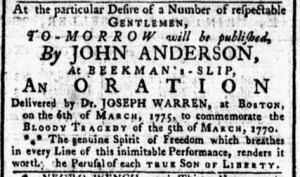
“Worth the Perusal of each TRUE SON OF LIBERTY.”

In the years after British soldiers fired into a crowd of protestors and killed several colonizers on March 5, 1770, the residents of Boston staged an annual commemoration of the “horrid MASSACRE.”  They called on a prominent patriot to give an “ORATION” about what occurred and the dangers of having British soldiers quartered in urban ports during times of peace.  Colonizers did not need to be present for the oration to experience it for themselves.  Each year, printers published and marketed the oration, commodifying an event that played an important role in the imperial crisis becoming a revolution.

New-York Gazette and Weekly Mercury (March 27, 1775).

In the first several years, printers in Boston published the oration and newspapers in Massachusetts carried advertisements for it.  In 1775, however, printers in other colonies produced their own editions of Joseph Warren’s oration commemorating the fifth anniversary of the Boston Massacre.  Benjamin Edes and John Gill, the printers of the Boston-Gazette, and Joseph Greenleaf, the publisher of the Royal American Magazine, partnered in printing and advertising a Boston edition.  Not long after, Solomon Southwick, the printer of the Newport Mercury, advertised his own edition, giving the notice a privileged place as the first item in the first column on the first page of the March 27 edition of his newspaper.  On that same day, John Anderson inserted a notice in the New-York Gazette and Weekly Mercury to alert readers of the imminent publication of a local edition undertaken “At the particular Desire of a Number of respectable GENTLEMEN.”  Patriots expressed intertest in obtaining their own copies of Warren’s oration; in turn, printers believed they could generate even greater demand.  To that end, Anderson declared, “The genuine Spirit of Freedom which breathes in every Line of this inimitable Performance, renders it worth the Perusal of each TRUE SON OF LIBERTY.”

The political climate had shifted since printers in Boston disseminated John Hancock’s oration commemorating the fourth anniversary of the Boston Massacre.  Since then, colonizers experienced how Parliament reacted to the destruction of tea during what has become known as the Boston Tea Party.  The Coercive Acts, including the Boston Port Act that closed the harbor until residents paid restitution, prompted delegates from throughout the colonies to gather in Philadelphia for the First Continental Congress in the fall of 1774.  They adopted a nonimportation agreement, the Continental Association, that remained in effect in the spring of 1775.  Given the events that transpired in 1774 and early 1775, it made sense that the anniversary of the “BLOODY TRAGEDY of the 5th of MARCH, 1770” garnered greater attention beyond Massachusetts.

June 21

What was advertised in a colonial American newspaper 250 years ago today?

Supplement to the Pennsylvania Packet (June 21, 1773).

“Esteemed to be a paper of as good credit and utility as any extant.”

As Samuel F. Parker and John Anderson prepared to take over publishing the New-York Gazette or Weekly Post-Boy when the lease held by Samuel Inslee and Anthony Car came to an end in August 1773, they placed notices in both the New-York Journal and the Pennsylvania Packet.  They hoped to attract local subscribers in New York and nearby towns as well as distant subscribers in Pennsylvania, Delaware, Maryland, and New Jersey, just as James Rivington had successfully solicited subscriptions for Rivington’s New-York Gazetteer or Connecticut, New-Jersey, Hudson’s-River, and Quebec Weekly Advertiser from far beyond the bustling urban port in recent months.

To entice prospective subscribers, Parker and Anderson emphasized that they intended to publish content “for the especial service of the commercial interest” in addition to articles “for the amusement and information of private families.”  They realized that merchants in Philadelphia and other towns served by the Pennsylvania Packet benefitted from various features that regularly appeared in newspapers published in New York, including prices current for commodities, entries about vessels arriving and departing from the customs house, and news about the location and progress of ships as reported by captains and others when they arrived in port.  Even paid notices, such as advertisement for consumer goods and legal notices, provided valuable intelligence for merchants keeping track of markets.

Parker and Anderson boasted about the reputation of the New-York Gazette or Weekly Post-Boy when Parker’s father previously published it, declaring that it was “esteemed to be a paper of as good credit and utility as any extant.”  The printers suggested that under their management the newspaper would rival any of the others published in New York, making it as good or better a choice for merchants in Philadelphia who wished to consult newspapers from that city.  Parker and Anderson did not invest as much effort in marketing their newspaper to prospective subscribers and other readers in neighboring colonies as Rivington did, but their advertisements in the Pennsylvania Packet demonstrates that they recognized the potential to increase their circulation by acquiring subscribers beyond New York.

April 18

What was advertised in a colonial American newspaper 250 years ago this week?

New-York Journal (April 15, 1773).

“A Paper of as good Credit and Utility as any extant.”

An advertisement address to “the respectable Publick” informed readers of the New-York Journal that Samuel F. Parker and John Anderson “entered into Partnership together … and propose in August next, to publish the New-York Gazette, or the Weekly Post Boy.”  The newspaper, founded as the New-York Weekly Post-Boy in 1743, had a long history in the city.

James Parker, great-uncle to Samuel F. Parker, established the newspaper, took William Weyman into partnership in 1753, and dissolved the partnership one week before retiring in 1759.[1]  At that time, his nephew, Samuel Parker, continued the newspaper, taking John Holt into partnership the following year.  When Parker and Holt dissolved their partnership in 1762, Holt became the publisher of the newspaper.  According to Isaiah Thomas, the newspaper “appeared in mourning on the 31st of October, 1765, on account of the stamp act; it was, however, carried on as usual, without any suspension, and without any stamps.”[2]  When Parker wished to resume printing a newspaper in 1766, Holt opted to adopt a new title, the New-York Journal, and continued the volume numbering of the New-York Gazette or Weekly Post-Boy.  Parker regained that title and resumed publication in October 1766, also continuing the volume numbering.  Upon Parker’s death in 1770, Samuel Inslee and Anthony Car leased the newspaper from his son, Samuel F. Parker, and printed it until the end of their lease in August 1773.

Parker and Anderson anticipated the conclusion of that lease.  While they likely did not expect the public to know all the details of the newspaper’s publication history, they did believe that many readers would have been familiar with Parker’s father and the reputation of the newspaper as “a Paper of as good Credit and Utility as any extant since the first Commencement thereof.”  They intended to continue that tradition “by every possible Means” and pledged to deliver “especial Service [for] the Commercial Interest.”  In addition to publishing shipping news, prices current, and other content for the benefit of merchants, they also planned to provide for “the Amusement and Information of private Families in Matters both Foreign and Domestick.”  Amid the debates of the period, Parker and Anderson promised “free Access to all Parties without Distinction.”  In other words, they did not intend to operate a partisan press but instead welcomed “Pieces directed to the Proprietors” as long as the “Subject Matter” was “consistent, and within due Bounds to admit of Publication.”

Such lofty goals, however, did not meet with success.  Parker and Anderson published the New-York Gazette or Weekly Post-Boy for a few weeks in August and September 1773.  They may have continued the newspaper into November, but no issues bearing their imprint have been identified.  On December 9, Anderson ran an advertisement in Rivington’s New-York Gazetteer that announced the partnership had dissolved and called on “all persons that may have any demands against said partnership [to] bring in their accompts and receive payment.”  Anderson also noted that he “continues carrying on the Printing-Business in all its branches.”  Despite the difficulty he experienced with the New-York Gazette or Weekly Post-Boy, Anderson launched another newspaper, the Constitutional Gazette, in August 1775.  It lasted thirteen months, folding when the British occupied New York in September 1776.[3]

**********

[1] Unless otherwise noted, the details of the publication history come from the entries for the New-York Gazette, or Weekly Post-Boy (635-6) and New-York Weekly Post-Boy (704) in Clarence S. Brigham, History and Bibliography of American Newspapers, 1690-1820 (Worcester, Massachusetts: American Antiquarian Society, 1947).

[2] Isaiah Thomas, The History of Printing in America: With a Biography of Printers and an Account of Newspapers (1810; New York: Weathervane Books, 1970), 494.

[3] See the entry for the Constitutional Gazette in Brigham, History and Bibliography of American Newspapers, 618.