October 11

What was advertised in a revolutionary American newspaper 250 years ago today?
Maryland Journal (October 11, 1775).

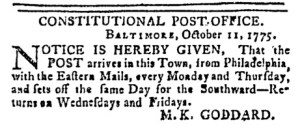
“CONSTITUTIONAL POST-OFFICE.  BALTIMORE.”

The contents of the October 11, 1775, edition of the Maryland Journal were organized such that the first advertisement that readers encountered promoted the Baltimore branch of the “CONSTITUTIONAL POST-OFFICE” established by the Second Continental Congress as an alternative to the imperial postal system operated by the British government.  It completed the middle column on the third page, a column otherwise filled with news from Cambridge, Hartford, New York, and Philadelphia.  Two lines separated it from other content, indicating a transition from news to advertising, yet the notice seemed a continuation of updates about current events, including an inaccurate report that General Richard Montgomery had captured Montreal as part of the American invasion of Quebec.  Advertisements inserted for other purposes, such as fencing lessons and descriptions of runaway indentured servants, appeared in the next column and on the next page.

“NOTICE IS HEREBY GIVEN,” the advertisement proclaimed, “That the POST arrives in this Town, from Philadelphia, with the Eastern Mailes, every Monday and Thursday, and sets off the same Day for the Southward.”  It returned from that direction on Wednesdays and Fridays.  The notice was signed, “M.K. GODDARD.”  The colophon at the bottom of the final page also listed “M.K. GODDARD, at the PRINTING-OFFICE in MARKET-STREET” as the printer of the Maryland Journal.  Mary Katharine Goddard operated the printing office in Baltimore.  Like many other printers, she simultaneously served as postmaster.  Many of them, as Joseph M. Adelman explains, had been “associated with the old imperial system” and “shifted [their] service from the British post office to the American one.”  They included Solomon Southwick, the printer of the Newport Mercury, John Carter, the printer of the Providence Gazette, and Alexander Purdie, the printer of the Virginia Gazette.  Appointed to the position in 1775, Goddard served as postmaster in Baltimore for fourteen years “until she lost her position in 1789 to a new postmaster more closely connected to the new Federal Postmaster General.”[1]

Women participated in the American Revolution in many ways.  They signed nonimportation agreements and made decisions in the marketplace that reflected their political principles, they spun wool and made homespun garments as alternatives to British imports, and they raised funds to support the Continental Army.  Some served in more formal roles, including Mary Katharine Goddard as both the printer of the Maryland Journal and the postmaster at the “CONSTITUTIONAL POST-OFFICE” in Baltimore.

**********

[1] Joseph M. Adelman, “‘A Constitutional Conveyance of Intelligence, Public and Private’: The Post Office, the Business of Printing, and the American Revolution,” Enterprise and Society 11, no. 4 (December 2010): 742.
September 5

Who was the subject of an advertisement in a revolutionary American newspaper 250 years ago today?

Postscript to the Baltimore Journal, &c. (September 5, 1775).

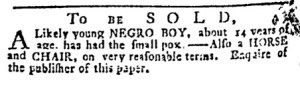
“TO BE SOLD, A Likely young NEGRO BOY, about 14 years of age.”

On September 5, 1775, Mary Katharine Goddard, the printer of the Maryland Journal, and the Baltimore Advertiser, published a two-page Postscript to the Baltimore Journal, &c. to supplement the news and other content that appeared in the standard edition.  It appeared a day ahead of the weekly edition.  Goddard apparently believed that she had news that could not wait as well as not enough space to print it all, making the Postscript necessary.  The first page of the supplement featured news from New York and Watertown, Massachusetts, in a larger font, while the second page consisted almost entirely of news from the “PROVINCIAL CONVENTION” held in Annapolis in a smaller font.  A note preceding the headline indicated that coverage was “Continued from our last.”  Even devoting an entire page in smaller font to that news did not allow Goddard to print all of it.  A note at the end promised, “To be continued.”

That left just enough space for Goddard to insert one advertisement.  An advertisement about a “Likely young NEGRO BOY” and a “HORSE and CHAIR” (a kind of carriage) that ran in the previous issue was the right length to complete the final column on the second page of the Postscript.  It did not provide much information about the enslaved young man, noting only that he was “about 14 years old” and “has had the small pox” so he would not contract that disease again.  Interested parties should “Enquire of the publisher of this paper” the advertisement instructed.  Like other printers who published newspapers from New England to Georgia, Goddard not only disseminated advertisements about enslaved people but also served as a broker who facilitated sales when those advertisements directed readers to learn more at the printing office.  In this instance, publishing news from Maryland’s provincial convention meant greater circulation for an advertisement offering an enslaved youth for sale.  That advertisement ran once again in the standard issue the next day, placing it before the eyes of readers with greater frequency than any other notices in that newspaper.  Even as the provincial convention met to discuss how to defend the liberties of colonizers and the Maryland Journal carried the news, the newspaper also worked to constrain the freedom of enslaved people, including one “Likely young NEGRO BOY” in particular.

April 12

What was advertised in a colonial American newspaper 250 years ago today?

Maryland Journal (April 12, 1775).

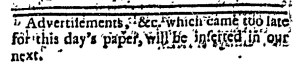
“Advertisements, &c. which came too late for this day’s paper, will be inserted in our next.”

Some advertisers and correspondents may have been frustrated when the content they submitted to the printing office did not appear in the April 12, 1775, edition of the Maryland Journal.  To mollify them, the printer, William Goddard, inserted a brief note advising that “Advertisements, &c. which came too late for this day’s paper, will be inserted in our next.”  No printer wished to disappoint advertisers who paid to run their notices nor correspondents who contributed the “FRESHEST ADVICES, both FOREIGN and DOMESTIC” that subscribers expected to find when they perused colonial newspapers.  In this instance, some material just had not arrived in time to set the type and integrate it into the issue, but Goddard pledged that it would appear in print the following week.

The placement of the printer’s notice at the bottom of the final column on the third page suggests that he made the decision to include it shortly before taking the issue to press.  Each edition of the Maryland Journal, like other colonial newspapers, consisted of four pages, two printed on each side of a broadsheet folded in half.  Printers typically printed the side with the first and fourth pages and then the side with the second and third pages.  As a result, the newest content, whether articles, letters, editorials, or advertisements, appeared “inside” the newspaper rather than on the front page. Goddard had just enough space for his notice to advertisers and correspondents when the compositor finished setting type and laying out the rest of the third page (the last page prepared for the press).

Many of the advertisements that did appear in that issue featured datelines, sometimes including both the town and date and other times just the date.  Most on the fourth page (the first prepared for the press) were from March, along with a couple from February and the most recent from April 1, April 3 and April 4.  All of them ran in the previous issue on April 5, so the compositor merely used type already set.  The advertisements immediately above Goddard’s notice on the third page were dated April 6 and April 10, further demonstrating that where advertisements appeared in an issue depended in part on when they arrived in the printing office.  Goddard did not play favorites or decide that some advertisements were more important than others.  Instead, time constraints prevented him from immediately printing every advertisement submitted to him.  Those advertisers could depend on their notices running in the next issue.

January 9

What was advertised in a colonial American newspaper 250 years ago today?

Maryland Journal (January 9, 1775).

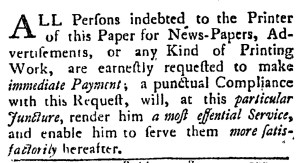
“ALL Persons indebted to the Printer … are earnestly requested to make immediate Payment.”

Among the advertisements that filled the first page of the January 9, 1775, edition of the Maryland Gazette, William Goddard inserted his own notice that requested “ALL Persons indebted to the Printer of this Paper for News-Papers, Advertisements, or any Kind of Printing Work … make immediate Payment.”  Printers often placed such notices calling on subscribers to settle accounts and, sometimes, incorporating overdue payments for other services.

The inclusion of “Advertisements” in Goddard’s notice raises questions about the business model usually associated with colonial printers.  Historians of the early American press have long asserted that printers extended credit for subscriptions while demanding payment in advance for advertisements.  Accordingly, advertising represented the real revenue in publishing newspapers.  Yet several printers periodically called on customers to pay for “Advertisements.”  Those notices, however, do not make clear what they meant by “Advertisements.”  They may have referred to paid notices that appeared in their newspapers, in which case some printers deviated from the (standard?) practice of requiring payment in advance, but they might have instead meant handbills, broadsides, and other advertising media that many printers stated that they could prepare on short notice.

In the colophon at the bottom of the final page, Goddard gave the location of his printing office in Baltimore, “where ADVERTISEMENTS, for ready Money only, and SUBSCRIPTIONS for this PAPER … are taken in.”  That suggests that Goddard did indeed have a policy of insisting on payment for advertisements before printing them in the Maryland Journal.  Does that definitively mean that “Advertisements” in his call for customers to pay their bills meant handbills and broadsides and not newspaper notices?  Not necessarily.  Goddard may have invoked a relatively new policy.  The colophon that asserted that he inserted advertisements “for ready Money only” had been in use for about three months, since October 1774, but prior to that he had used a streamlined version that did not mention any of the services he provided.  In its entirety, it read: “BALTIMORE: Printed by W. GODDARD, at his Printing-Office near the FOUNTAIN-INN, MARKET-STREET.”  Perhaps Goddard previously extended credit to advertisers but changed his policy when too many took advantage.  His notice and his colophons do not give a straightforward answer but instead suggest that the business practices of some printers may have been more complex than often assumed.

Maryland Journal (January 9, 1775).

September 8

What was advertised in a colonial American newspaper 250 years ago today?

Maryland Gazette (September 8, 1774).

“IF a certain E.V. does not immediately pay for his family picture, his name shall be published at full length in the next paper.”

A private scuffle over paying for a portrait became a public spectacle when Charles Willson Peale resorted to shaming Elie Vallette, author of the Deputy Commissary’s Guide, in a newspaper advertisement.  A notice in the September 8, 1774, edition of the Maryland Gazette advised that “IF a certain E.V. does not immediately pay for his family picture, his name shall be published at full length in the next paper.”  The painter, who signed his name as “CHARLES PEALE,” was near the beginning of his career, though he had already studied with Benjamin West in London for two years and then provided his services in Annapolis for a dozen more.  Still, at the time he sought the overdue payment, he was not yet the prominent figure, one of the most influential America painters and naturalists of his era, that he would become in the decades after the American Revolution.  He gained access to the power of celebrity later in his career, but at the moment he vied with Vallette he sought to leverage public shaming as the most effective tool available.

As Martha J. King notes, Peale “obtained a commission to paint a group portrait of the Vallette family and portrayed the author seated at a table with the engraved title page of the Deputy Commissary’s Guide clearly visible in the foreground.  [His] wife and two children clustered in the picture’s right.”[1]  Vallette had extensively advertised the Deputy Commissary’s Guide in the Maryland Gazette, gaining prominence for himself and his manual for settling estates and writing wills.  Commissioning a family portrait served to further enhance his status, yet the dispute that followed did not necessarily reflect well on Vallette.  On May 28, 1774, Peale sent a letter to Vallette to request payment, explaining that he needed to cover immediate expenses that included rent on the house where his family resided.[2]  The author did not heed that request.  Three months later, Peale decided to escalate his methods for collecting on the debt, placing the advertisement that gave Vallette’s initials and enough information that the author would recognize himself and perhaps enough that some readers could work out his identity, but not so much that readers in Annapolis and throughout the colony knew without a doubt that Peale addressed Vallette.  Was this strategy effective?  Next week the Adverts 250 Project will examine the subsequent issue of the Maryland Gazette to determine whether Peale had to further escalate his demand for payment.

**********

[1] Martha J. King, “The Printer and the Painter: Portraying Print Culture in an Age of Revolution,” Transactions of the American Philosophical Society 109, no. 5 (2021): 78.

[2] King, “Printer and the Painter,” 78.

August 29

What was advertised in a colonial American newspaper 250 years ago today?

Dunlap’s Pennsylvania Packet (August 29, 1774).

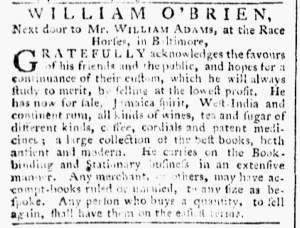
“He carries on the Bookbinding and Stationary business in an extensive manner.”

Among the many advertisements that ran in the August 29, 1774, edition of Dunlap’s Pennsylvania Packet, one from William O’Brien offered several goods and services.  He first offered several varieties of alcohol and popular groceries, including “Jamaica spirit, West-India and continent rum, all kinds of wines, tea and sugar of different kinds, coffee, cordials and patent medicines.”  In addition to that inventory, he also stocked “a large collection of the best books, both antient and modern.”  Yet O’Brien also identified himself as a bookbinder and stationer, promoting in particular custom-made account books, ruled or unruled, to any size as bespoke.”  He offered those items to both merchants and retailers who might buy in volume “to sell again.”

Although O’Brien advertised in Dunlap’s Pennsylvania Packet, published in Philadelphia, he lived and worked in Baltimore.  He likely did not expect that his notice would generate much business among readers in Philadelphia; instead, he sought customers in his own town and the surrounding area, realizing that for many years the Pennsylvania Gazette, the Pennsylvania Journal, Dunlap’s Pennsylvania Packet, and other newspapers printed in Philadelphia served as local newspapers for towns in Pennsylvania, Delaware, New Jersey, and Maryland.  O’Brien could have chosen to advertise in the Maryland Journal, Baltimore’s first newspaper, in addition to or instead of one of the newspapers in Philadelphia, though he may have had doubts about the efficacy of doing so.  Commencing publication on August 20, 1773, the Maryland Journal had just marked its first year, yet its appearance had been sporadic during that time rather than sticking to a weekly schedule.  O’Brien turned to a more reliable newspaper, likely familiar with its circulation in Maryland and, as a result, having greater confidence in the money he invested in advertising in Dunlap’s Pennsylvania Packet. William Goddard, the printer of the Maryland Journal, still had work to do to win over prospective advertisers in Baltimore.

July 2

What was advertised in a colonial American newspaper 250 years ago today?

Maryland Journal (July 2, 1774).

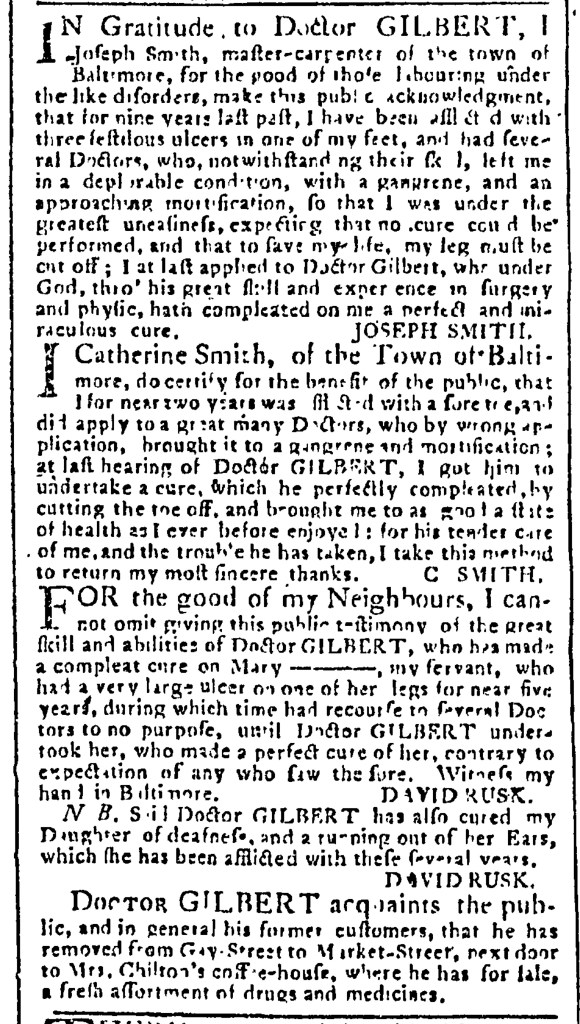
“IN Gratitude to Doctor GILBERT, I … make this public acknowledgment.”

When Doctor Gilbert moved to a new location on Market Street from Gay Street in Baltimore in 1774, he alerted “the public, and in general his former customers” in an advertisement in the Maryland Journal.  Yet that information appeared at the end of a lengthy advertisement devoted primarily to testimonials from some of the patients he served.  The advertisement began with Joseph Smith, “master-carpenter of the town of Baltimore,” expressing his gratitude to the doctor and doing so in the public prints “for the good of those labouring under the like disorders.”  He then explained that for nine years he had suffered from ulcers that would not heal on one of his feet, despite the skill of other doctors he consulted.  His condition reached such a “deplorable condition” that he feared that his leg would need to be amputated “to save my life.”  Fortunately, he “applied to Doctor Gilbert” who “thro’ his great skill and experience in surgery and physic, hath completed on me a perfect and miraculous cure.”

Similarly, Catherine Smith offered an account of her experience with a “sore toe” that would not heal.  She saw several doctors, but they unsuccessfully treated her and instead “brought it to a gangrene and mortification.”  She turned to Gilbert.  Although he could not save her toe, after he amputated it he “brought me to as good a state of health as I ever before enjoyed.”  Smith offered her “most sincere thanks” for “his tender care of me,” making a statement in an advertisement “for the benefit of the public.”  David Rusk felt a similar duty to report on how Gilbert aided members of his household.  “FOR the good of my Neighbours,” he explained, “I cannot omit giving this public testimony of Doctor GILBERT.”  His servant, Mary, had “a very large ulcer on one of her legs for near five years.”  She had also seen many doctors “to no purpose,” but then Gilbert “made a perfect cure of her, contrary to expectation of any who saw the sore.”  In addition, Gilbert cured Rusk’s daughter of deafness through treating “a running out of her Ears, which she has been afflicted with these several years.”

For his part, Gilbert did not describe his services or his training.  He merely informed readers of his new location and mentioned that he sold “a fresh assortment of drugs and medicines.”  He apparently believed that he did not need to expound on his credentials or his experience like others who provided medical services often did in their advertisements, figuring that testimonials from his former patients told a more compelling and more convincing story than anything he could say about himself.  Those stories of successful treatments offered hope to prospective patients, a powerful motivation to seek Gilbert’s services.

June 11

What was advertised in a colonial American newspaper 250 years ago today?

Maryland Journal (June 11, 1774).

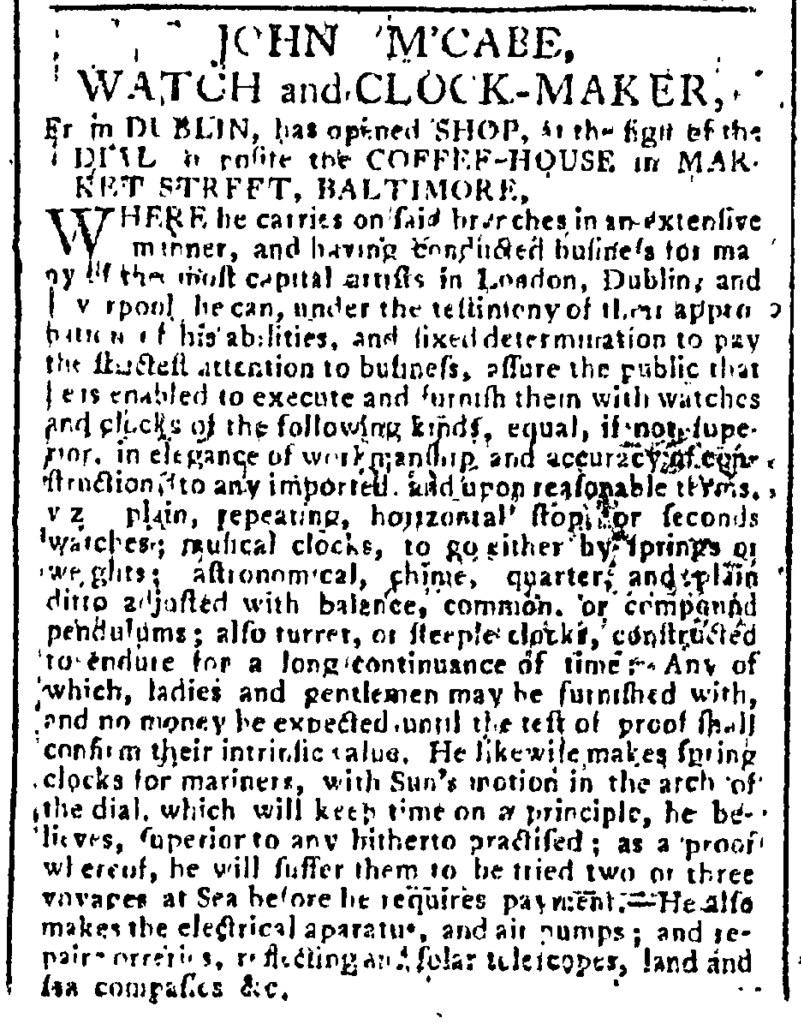
“No money be expected until the test of proof shall confirm their intrinsic value.”

When he set up shop “at the sign of the DIAL” in Baltimore, John McCabe, a “WATCH and CLOCK-MAKER, From DUBLIN,” deployed a marketing strategy commonly undertaken by artisans who migrated across the Atlantic to the colonies.  In an advertisement in the June 11, 1774, edition of the Maryland Journal, he sought to establish his reputation in a town that did not have firsthand knowledge of his skill.  Instead, he relied on an overview of his experience, asserting that he had “conducted business for many of the most capital artists in London, Dublin, and Liverpool.”  Having worked in the most exclusive shops in urban centers, especially the cosmopolitan center of the empire, gave the newcomer a certain cachet, enhanced even more by the “testimony of their approbation of his abilities” that he claimed he could produce.

Yet McCabe did not rest on such laurels that were not immediately apparent to readers.  Instead, he simultaneously declared that his “fixed determination to pay the strictest attention to business.”  Underscoring his industriousness also came from the playbook developed by other artisans, a familiar refrain in their advertisements.  Prospective customers who might have been skeptical of McCabe’s credentials could judge for themselves whether he made clocks and watches “equal, if not superior, in elegance of workmanship and accuracy of construction to any imported.”  They could acquire such timepieces “upon reasonable terms,” getting the same style and quality as watches and clocks from London without paying exorbitant prices.

Even though the initial portions of his advertisement resembled notices placed by other artisans, McCabe, he did include an offer not made nearly as often: allowing a trial period for customers to decide if they wished to purchase or return watches and clocks from his shop.  The enterprising artisan declared that “ladies and gentlemen may be furnished” with any of the variety of clocks and watches listed in his advertisement and “no money be expected until the test of proof shall confirm their intrinsic value.”  McCabe did not explicitly state that customers could return items they found lacking, so confident was he that they would indeed be satisfied with his wares during the trial.  He extended a similar offer for “spring clocks for mariners … which keep time on a principle, he believes, superior to any hitherto practised.”  Customers could make that determination for themselves: “he will suffer them to be tried two or three voyages at Sea before he requires payment.”  Such arrangements would have required some negotiation about the amount of time and the length of those voyages, but allowing for such trials before collecting money from customers did not put McCabe at a disadvantage in the eighteenth-century commercial culture of extending extensive credit to consumers.  Prospective customers likely expected credit, so McCabe gained by transforming the time that would elapse between purchase and payment into a trial, giving those customers the impression that they received an additional benefit from doing business with him.  For some, that may have been the more effective marketing strategy than any claims about his experience working in the best shops in London, Dublin, and Liverpool.

June 4

What was advertised in a colonial American newspaper 250 years ago today?

Maryland Journal (June 4, 1774).

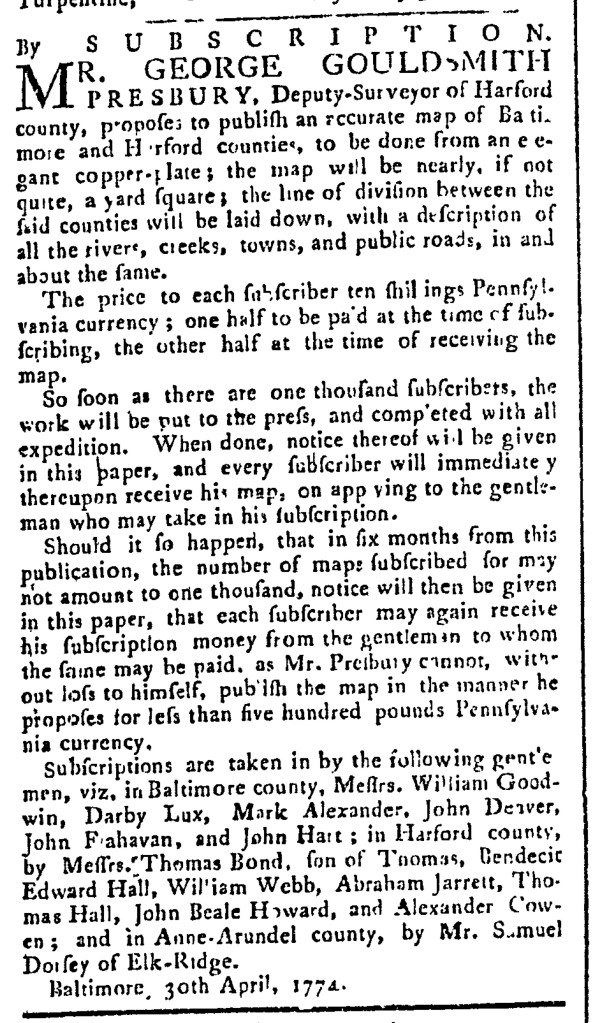
“An accurate map of Baltimore and Harford counties.”

Authors, booksellers, and printers often published books and magazines by subscription in the eighteenth century … or at least attempted to do so.  Before taking publications to press, they distributed subscription proposals to encourage interest and assess demand.  Subscribers reserved copies in advance, sometimes paying deposits.  If the publishers determined that the number of subscribers would make books or magazines viable enterprises, they moved forward with the proposed works.  If subscriptions did not generate sufficient revenue, publishers abandoned projects.

Artists and engravers also used subscriptions for publishing prints, as did surveyors for maps.  George Gouldsmith Presbury, “Deputy-Surveyor of Harford county” in Maryland, published subscription proposals for “an accurate map of Baltimore and Harford counties” in the Maryland Journal, Baltimore’s first newspaper, in 1774.  That the surveyor envisioned a market for this map testified to the growing significance of Baltimore on the eve of the American Revolution.  The map “will be nearly, if not quite, a yard square” and feature “a description of all the rivers, creeks, town, and public roads.”  Presbury needed commitments from “one thousand subscribers” before “the work will be put to press.”  To aid in the endeavor, more than a dozen local agents in Baltimore, Harford, and Anne Arundel Counties accepted subscriptions and deposits.  Upon publication, Presbury would advertise in the Maryland Journal once again, calling on subscribers to collect their maps form the local agents who accepted their subscriptions.

Presbury also allowed for the possibility that the market would not yet support this project.  He allowed for six months for subscribers to reserve their copies, advising that he “cannot, without loss to himself, publish the map in the manner he proposes” if he did not raise enough funds.  If necessary, “notice will then be given in this paper” that the proposal had not succeeded and “each subscriber may again receive his subscription money” from the local agent that received it.  Apparently, that was the case, though Presbury did publish A New and Accurate Map of Baltimore-Town six years later. Presbury and other prospective publishers used subscription proposals to take risks in the marketplace for books, magazines, prints, and maps, but only to an extent, while shielding themselves from losses.

May 28

What was advertised in a colonial American newspaper 250 years ago today?

Maryland Journal (May 28, 1774).

“Next door but one to the London coffee-house, on Fell’s-Point, Baltimore.”

Baltimore was growing in importance on the eve of the American Revolution, though the port did not yet rival or surpass Annapolis.  In August 1773, William Goddard launched the Maryland Journal, the first newspaper printed in Baltimore.  Joseph Rathell attempted to establish a circulating library in the fall of 1773, but in the end could not compete with bookseller William Aikman’s library in Annapolis.  Still, the advertisements in the Maryland Journal testified to other amenities available in Baltimore, a town that offered a style of life becoming increasingly sophisticated.

Among the advertisements in the May 28, 1774, edition, one promoted a “Stage … between the city of Philadelphia and Baltimore-Town.”  Instead of directing their attention solely toward Annapolis, residents of Baltimore also cultivated connections with Philadelphia, the largest and most cosmopolitan city in the colonies.  In addition to transporting passengers, the operators of the “stage wagon” and “stage boat” also carried goods.  Yet consumers in Baltimore did not need to rely on placing orders with merchants and shopkeepers in Philadelphia or any other city.  Retailers in their own town carried all sorts of imported goods.  Christopher Johnson and Company advertised their “neat and general assortment of goods, just imported … from LONDON,” listing an array of textiles and housewares comparable to the selection available in towns of all sizes throughout the colonies.  In his advertisement, William O’Bryan previewed a “fresh supply of Books, of the latest Publication, from London, Dublin, and Edinburgh.”

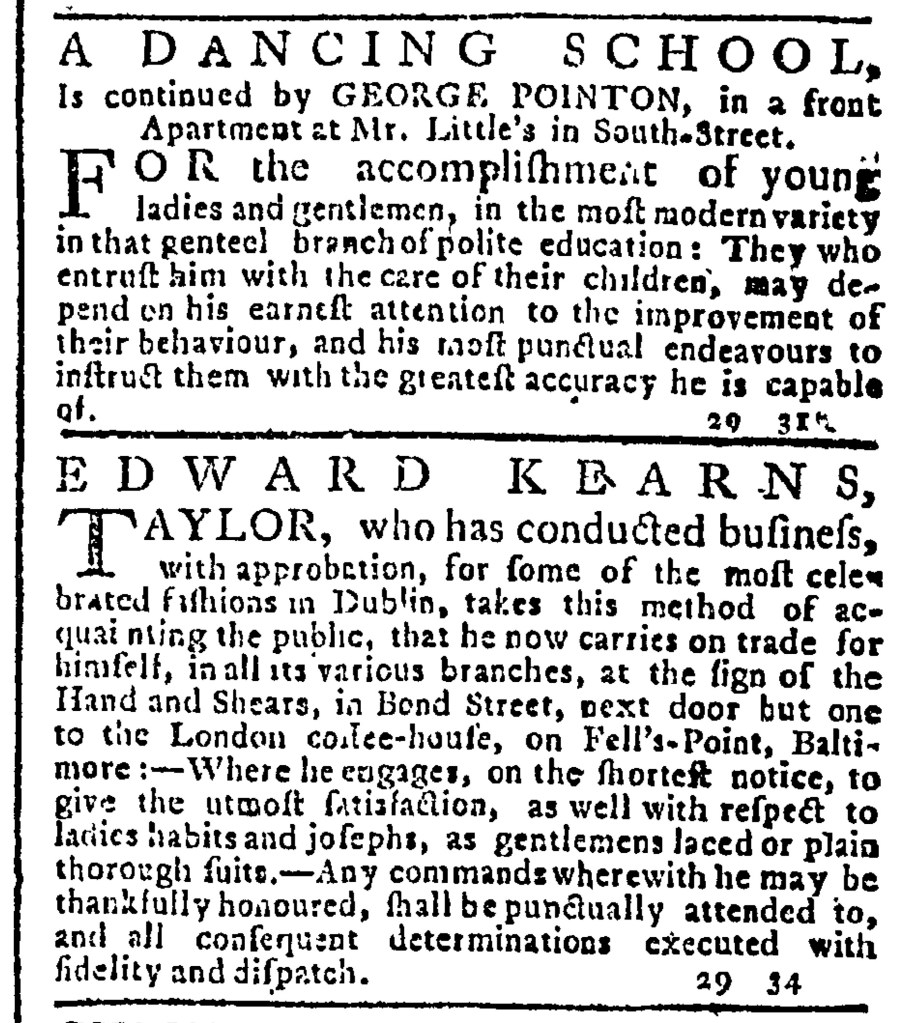
Yet it was not solely the availability of goods that marked Baltimore’s participation in the transatlantic consumer revolution.  Residents also appreciated the latest fashions, aiming to demonstrate that even at a distance they kept up with current styles.  Edward Kearns, a tailor, trumpeted that he “has conducted business, with approbation, for some of the most celebrated fashions in Dublin.”  Clients could find his shop “at the sign of the Hand and Shears, … next door but one to the London coffee-house.”  That establishment also represented connections to the metropolis that elevated Baltimore’s standing as more than a distant outpost.  In addition, George Pointon ran a “DANCING SCHOOL … FOR the accomplishment of young ladies and gentlemen, in the most modern variety in that genteel branch of polite education.”  The dancing master also tended to the comportment of his pupils, pledging “his earnest attention to the improvement of their behaviour.”  His description of his services corresponded with newspaper notices placed by dancing masters in major urban ports like Philadelphia, New York, and Charleston.  Displays of gentility mattered as much to colonizers in Baltimore as in other cities and towns.  Not only did they acquire clothing and goods that matched the latest fashions, they also developed manners that confirmed their status … or at least had opportunities to do so, according to the goods and services represented among the advertisements in the Maryland Journal.