January 4

What was advertised in a revolutionary American newspaper 250 years ago today?
New-England Chronicle (January 4-11, 1776).

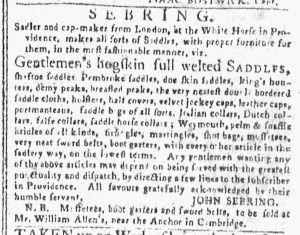
“SEBRING, Sadler and cap-maker from London, at the White Horse in Providence.”

After migrating to the colonies from England in the early 1770s, John Sebring occasionally placed advertisements in the Providence Gazette, offering his services as a “Saddler, Chaise and Harness Maker.”  Though he remained in Providence at the beginning of the Revolutionary War, he saw an opportunity to advertise in the New-England Chronicle, printed in Cambridge, in January 1776.  As the siege of Boston continued, he introduced himself to readers as a “Sadler and cap-maker from London.”  Even though it had been more than three years since he left the largest and most cosmopolitan city in the British Empire, he continued to stress his connection to it.  Prospective customers, after all, associated both skill and taste with artisans who had trained in London or gained experience working there.  Sebring also deployed one of the signature elements of his advertisements, using solely his surname rather than his full name as the headline.  That initial proclamation, the mononym “SEBRING,” suggested celebrity and an established reputation.

In this advertisement, Sebring declared that he “Makes all sorts of Saddles, with proper furniture for them, in the most fashionable manner.”  Practical was good, but stylish was even better!  He listed a variety of items that he made “at the White Horse in Providence,” the location featured in his newspaper notices since he first began advertising, and then advised that “Any gentleman wanting any of the above articles may depend on being served with the greatest punctuality and dispatch, by directing a few lines” to him.  Sebring had previously confined his advertisements to the Providence Gazette, but he apparently believed that the disruptions of the war opened new markets to him.  American officers and soldiers gathered in Cambridge and nearby towns, many of them dispatched from distant places.  As they would have been unfamiliar with local artisans, Sebring presented his workshop to supply saddles and other equipment via a mail order system.  In a nota bene at the conclusion of the advertisement, he offered a chance to examine some of his wares before placing orders for customized items.  “Mussetees [or musette bags, lightweight knapsacks used by soldiers], boot garters and sword belts,” Sebring stated, “to be sold at Mr. William Allen’s, near the Anchor in Cambridge.”  Sebring apparently recruited a local agent to help him break into a new market.

**********

Clarification:  Readers of the New-England Chronicle did not encounter this advertisement in the issue distributed on January 4, 1776.  It should not have been the featured advertisement on January 4, 2026.  Here’s how the mistake happened.

The format for the date in the masthead of some colonial newspapers confuses modern readers.  That’s because some newspapers published weekly did not state only the date on which the newspaper was published but instead indicated the week that it covered.  The New-England Chronicle was one of those newspapers.  Rather than giving “January 4, 1776” as the date, the masthead for that issue stated, “From THURSDAY, Decem. 28, 1775, to THURSDAY, January 4, 1776.”  For the issue published on January 11, the masthead stated, “From THURSDAY, January 4, to THURSDAY, January 11, 1776.”

While America’s Historical Newspapers associates the correct publication date with the issues of the vast majority of newspapers in the database, a couple newspapers use the date for the beginning of the week rather than the publication date.  When an undergraduate research assistant downloaded digital copies of all American newspapers published in 1776, I neglected to warn him that was the case for the New-England Chronicle.  I compounded the error by not looking at the masthead closely enough when I consulted the issue for January 4-11 to select an advertisement to feature on January 4.  I only noticed the problem after publishing the entry.

Since advertisements for consumer goods and services typically ran for multiple weeks, I hoped that Sebring’s advertisement also appeared in the December 28 – January 4 issue.  If that had been the case, I would have simply cropped the image from that issue and substituted it in this entry.  However, Sebring’s notice made its first appearance in the January 4-11 issue.

I decided that the next best solution was updating the date in the citation that accompanies the image of Sebring’s advertisement and adding this clarification.  It provides insight into the process of conducting research with digitized sources … and a warning about the importance of attention to detail.  I have more than a decade of experience working with digitized eighteenth-century newspapers.  I initially saw what I expected to see, not what was actually there, and only discovered the error when I took a closer look at the newspapers as I continued production of this project.  Fortunately, I caught the error quickly and updated the filenames for the downloaded newspapers accordingly.  In addition to this clarification, I am also making small adjustments to the Slavery Adverts 250 Project to adhere to the dates advertisements about enslaved people were published in the New-England Chronicle.
December 28

What was advertised in a revolutionary American newspaper 250 years ago today?

New-England Chronicle (December 28, 1775).

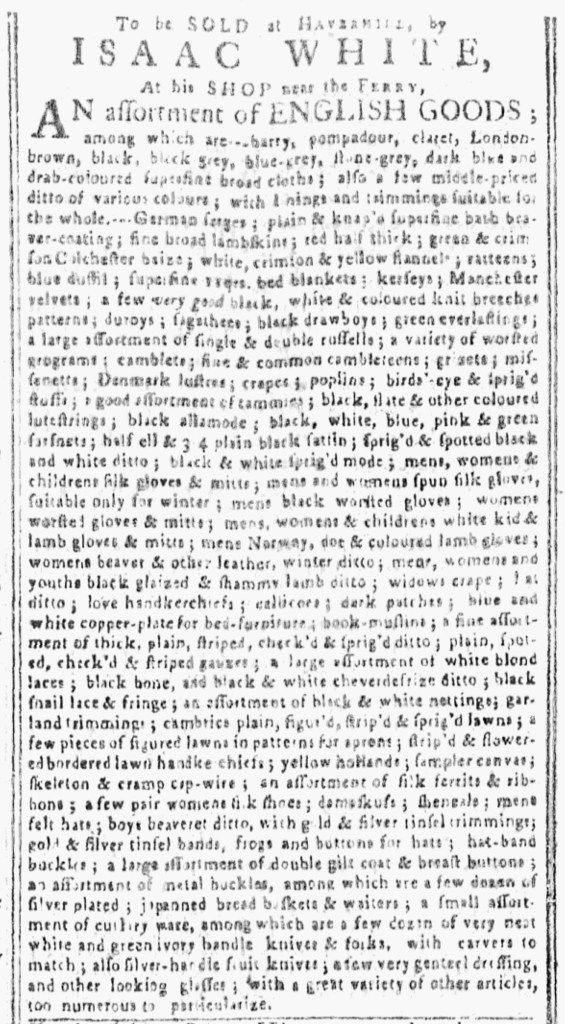
“AN assortment of ENGLISH GOODS … too numerous to particularize.”

Isaac White placed an advertisement for an “assortment of ENGLISH GOODS” available at “his SHOP near the FERRY” in Haverhill, Massachusetts, in the December 28, 1775, edition of the New-England Chronicle.  Despite the outbreak of hostilities at Lexington and Concord eight months earlier and the Continental Association remaining in effect, his advertisement looked much like those that so frequently appeared in American newspapers at times when colonizers did not attempt to use nonimportation agreements as political leverage in their contest with Parliament.  White listed dozens of items, including many varieties and colors of textiles, ribbons, “a large assortment of double gilt coat & breast buttons,” “a few very genteel dressing, and other looking glasses,” and “a small assortment of cutlery ware, among which are a few dozen of very neat white and green ivory handle knives & forks, with carvers to match.”  As if that was not enough, White concluded his catalog with a promise of “a great variety of other articles, too numerous to particularize.”

The shopkeeper did not mention when he acquired his merchandise, whether all those items arrived in the colonies before the Continental Association went into effect, yet he did rely on a familiar marketing strategy by presenting readers with an array of choices and inviting them to imagine themselves visiting his shop, examining his inventory, selecting the goods they desired, and displaying their style and taste to others after they made their purchases.  Consumption certainly had political dimensions during the imperial crisis, but even after the Revolutionary War began habits that had developed (and that advertisers like White had helped in cultivating) did not easily fade.  In the same issue of the New-England Chronicle, Martin Bicker ran an advertisement about a “fresh supply” of “ENGLISH GOODS … just received from New-York and Philadelphia … now selling off at his store in Cambridge.”  Though not as extensive as White’s notice, Bicker’s advertisement listed several kinds of textiles and handkerchiefs.  It concluded with “&c. &c. &c.”  Repeating the common abbreviation for et cetera made the same promise of even more items as White’s assertions about “a great variety of other articles, too numerous to particularize.”  In addition, Bicker declared, “Those that intend to purchase must speedily apply, otherwise they will be disappointed.”  He expected to do brisk business.

That colonizers continued consuming during the Revolutionary War does not necessarily merit attention.  After all, people needed goods.  Then as now, warfare disrupted commerce but did not eliminate it.  Yet the advertisements placed by White and Bicker did not suggest that they served customers who merely sought to purchase necessities.  Instead, they continued to cater to the desires of consumers who continued to shop for many of the reasons they did before the war began.  Some may have had a new purpose, seeking distractions from current events.  How readers responded, these advertisements do not reveal, yet they do indicate that White and Bicker saw opportunities for business as usual.

December 14

What was advertised in a revolutionary American newspaper 250 years ago today?

New-England Chronicle (December 14, 1775).

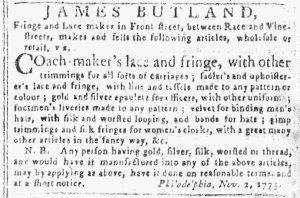
“Fringe and Lace maker in Front street, between Race and Vine-streets, … Philadelphia.”

James Butland, a “Fringe and Lace maker,” placed several newspaper advertisements in 1775.  In February, he inserted an advertisement in the Pennsylvania Journal, advising prospective customers that he “Continues to make and sell” all sorts of fringes and laces equal in quality to any imported from England.  He also assured the public that “no advantage shall be taken on account of the troubles between Britain and America,” signaling that he abided by the Continental Association and did not raise prices once that nonimportation agreement went into effect.  In July, he placed a new advertisement in the Pennsylvania Evening Post, once again promoting his fringes and laces made in Philadelphia.  He also requested “unfashionable” scraps “not fit for sale,” asserting that he could upcycle them into new pieces.

In December, he published another advertisement.  Like the others, it included a list of the types of fringes and laces he made, including “Coach-maker’s lace and fringe, with other trimmings for all sorts of carriages; sadler’s and upholsterer’s lace and fringe, with line and tassels made to any pattern or colour; gold and silver epaulets for officers, with other uniforms, [and] footmen’s liveries made to any pattern.”  In a nota bene, Butland invited “Any person having gold, silver, silk, worsted or thread” who would like it “manufactured into any of the above articles” to apply to his shop “between Race and Vine-streets” in Philadelphia.  It was much like the advertisements he previously published … except for the newspaper that carried it.  This notice appeared in the New-England Chronicle, printed in Cambridge as the siege of Boston continued.  Other advertisements in the December 14 edition came from towns in the vicinity, including Beverly, Braintree, Brookline, Cambridge, Concord, Danvers, Gloucester, Medford, Menotomy, Newton, Plymouth, Roxbury, Salem, Topsfield, Waltham, and Woburn.  One concerning a stray horse came from Epping, New Hampshire.  Like other newspapers, the New-England Chronicle served an entire region, yet advertisements for artisans (or shopkeepers or merchants) in cities and towns beyond that region rarely appeared in any colonial newspapers.  Printers and booksellers often distributed subscription proposals and other advertisements more widely in their efforts to incite enough demand and generate enough sales to make their projects viable.  Other advertisers, however, focused on cultivating local clienteles.  Even those who offered mail order goods and services lived and worked within the region served by the newspapers that carried their advertisements.  That made Butland’s advertisement for fringe and lace made in Philadelphia in the New-England Chronicle quite unusual, raising questions without easy answers.  Why did he choose to advertise in that newspaper?  How did that fit into his overall marketing strategy?  How effective did he anticipate his advertisement would be?

September 21

What was advertised in a revolutionary American newspaper 250 years ago today?

New-England Chronicle (September 21, 1775).

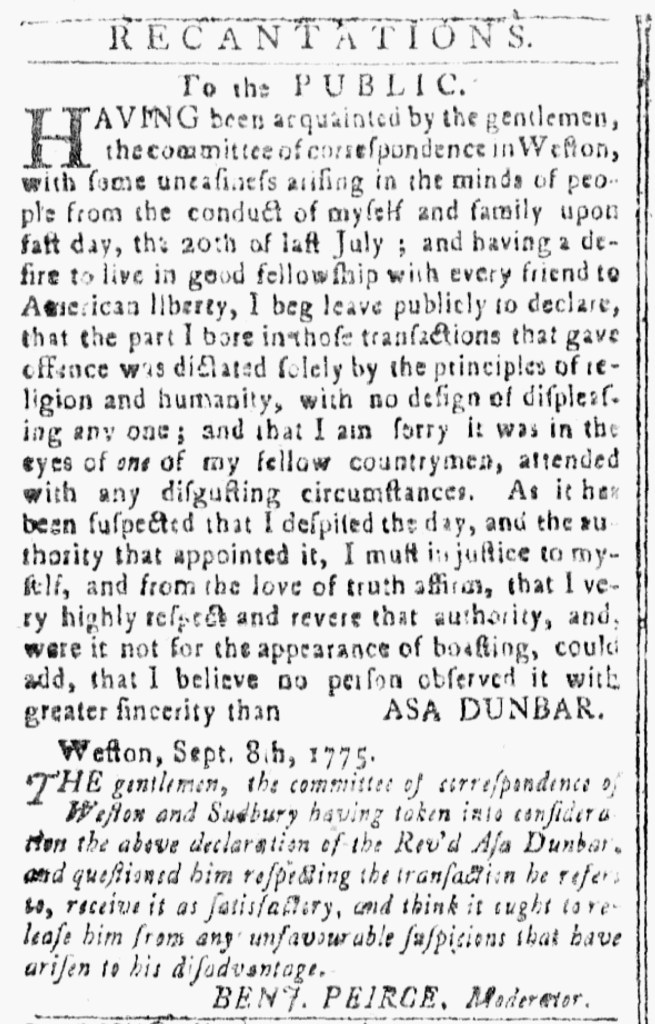
“Uneasiness arising in the minds of people from the conduct of myself and family upon the fast day.”

The final page of the September 21, 1775, edition of the New-England Chronicle had an entire column of “RECANTATIONS.”  Five notices appeared under that header, four of them colonizers who expressed regret for signing an address to Thomas Hutchinson, the former governor of the colony, in February 1774.  Such advertisements had become a regular feature in newspapers published in New England over the past year.  In the first of the “RECANTATIONS,” however, Asa Dunbar, a minister in Salem, apologized for something else that had caused concern in his community.

He had been “acquainted by the gentlemen, the committee of correspondence in Weston” about “some uneasiness arising in the minds of people from the conduct of myself and family upon the fast day, the 20th of last July.”  Katherine Carté, author of Religion and the American Revolution: An Imperial History, explains that on June 12 the Second Continental Congress passed a resolution to declare the fast on July 20, allowing for enough time for the news to reach distant colonies from Philadelphia.  The fast day became, Carté asserts, “in effect our first national holiday.”  Furthermore, it “was probably one of the only moments of the Revolutionary War that Americans experienced simultaneously, though not everyone celebrated it.  In a short essay, “Why We Should Remember July 20, 1775,” she chronicles commemorations of the fast day throughout the colonies, noting that many embraced the occasion and a few “marked it in protest.”

Something happened that day that cast suspicion on Dunbar and his support for the American cause: “I beg leave publicly to declare, that the part I bore in those transactions that gave offence was dictated solely by the principles of religion and humanity, with no design of displeasing any one.”  Whatever had occurred, the minister had not intended to make a statement, unlike Samuel Seabury who had “closed the doors of his church in protest” on the day of the fast.  “As it has been suspected that I despised the day, and the authority that appointed it,” Dunbar proclaimed, “I must in justice to myself, and from the love of truth affirm, that I very highly respect and revere that authority.”  Furthermore, “were it not for the appearance of boasting, [I] could add, that I believe no person observed it with greater sincerity.”

A short note from Benjamin Peirce, the moderator of Weston and Sudbury’s Committee of Correspondence, accompanied Dunbar’s recantation.  He reported that the committee took into account Dunbar’s “declaration” and “questioned him respecting the transaction he refers to,” but he did not elaborate on that transgression.  Whatever had occurred, the committee considered Dunbar’s explanation “satisfactory, and think it ought to release him from any unfavourable suspicions that have arisen to his disadvantage.”  That must have been a relief to Dunbar.  Like so many others, he resorted to an advertisement in the public prints to confess, to apologize, and to assure his community that he was not an enemy to American liberties.

August 17

What was advertised in a revolutionary American newspaper 250 years ago today?

New-England Chronicle (August 17, 1775).

“Cash given … for homespun Cloth … and for yarn Stockings.”

Stephen Hall III placed an advertisement in the August 17, 1775, edition of the New-England Chronicle to inform “the Publick” that he “has again opened his Shop” in Medford, Massachusetts, and offered a variety of textiles, “Gloves and Mitts,” “handsome Fans and Ribbons,” and other items for sale.  The shopkeeper did not indicate when he had acquired these imported items, whether they had arrived in the colony before the Continental Association went into effect on December 1, 1774.

He did, however, state that he paid cash for “homespun Cloth” and “yarn Stockings” produced locally rather than imported from Britain.  The Continental Association called on colonizers to “encourage Frugality, Economy, and Industry; and promote Agriculture, Arts, and the Manufactures of this Country” as alternatives to imported goods.  That gave textiles and garments made from them political meaning beyond testifying to taste and status as consumers deployed their choices in the marketplace as leverage in their contest with Parliament.  In response to the Stamp Act in 1765, the duties levied in the Townshend Acts in the late 1760s, and the provisions of the Coercive Acts in 1774, colonizers participated in boycotts – nonimportation and nonconsumption agreements – to pressure Parliament to repeal offensive legislation.  Each round of boycotts came with renewed efforts to produce and to consume “domestic manufactures.”

This also presented women with opportunities to participate in politics.  They did so when they made choices as consumers, such as selecting homespun cloth over the “Shalloons,” “Serges,” “Ginghams,” “Poplins,” “Calimancoes,” and other fabrics that Hall and other merchants and shopkeepers imported.  Yet their role as producers gained political significance as well.  They undertook carding and spinning with new purpose, sometimes holding spinning bees in public spaces rather than the usual domestic settings to make their contributions to the American cause more visible and to inspire others to join them.  Similarly, weaving and making clothing also became political acts.  Although Hall did not mention women as producers in his newspaper advertisement, readers knew that women produced the “homespun Cloth” and “yarn Stockings” he sought.  They participated in the American Revolution in their own way.

July 27

What was advertised in a revolutionary American newspaper 250 years ago today?

New-England Chronicle (July 27, 1775).

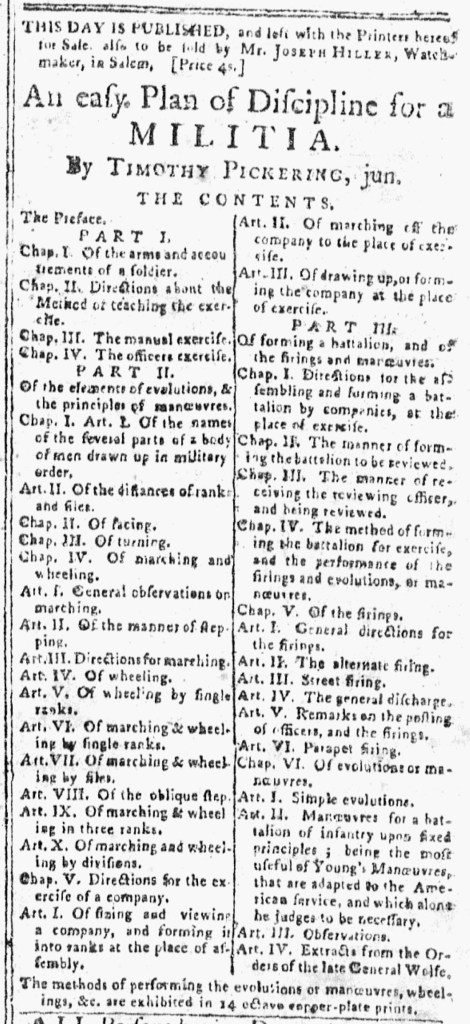
“An easy Plan of Discipline for a MILITIA. By TIMOTHY PICKERING.”

As the imperial crisis intensified when the Coercive Acts went into effect in 1774, the Massachusetts Provincial Congress recommended publication of a manual for training militia throughout the colony, The Manual Exercise as Ordered by His Majesty in 1764: Together with Plans and Explanations of the Method Generally Practis’d at Reviews and Field-Days.  Over the next several months, several printers in New England published their own editions.  Advertisements for The Manual Exercise appeared frequently in newspapers throughout the region.  Printers beyond New England followed their lead.  After the battles at Lexington and Concord, advertisements for other military manuals proliferated, including advertisements for Thomas Hanson’s Prussian Evolutions in Actual Engagements published by subscription in Philadelphia.

Samuel Hall and Ebenezer Hall, printers of the New-England Chronicle, published and advertised yet another military manual, An Easy Plan of Discipline for a Militia by Timothy Pickering, Jr.  An advertisement for the work appeared in the July 27, 1775, edition of their newspaper.  The Halls indicated that they had copies available at their printing office in Cambridge, where they had only recently moved from Salem and renamed and continued publishing the Essex Gazette. In addition, Joseph Hiller, a watchmaker in Salem, also sold the manual.  The advertisement consisted primarily of an extensive list of the contents, demonstrating to prospective customers what they could expect to find in the volume, followed by a short note that the “methods of performing the evolutions or manœuvres, wheelings, &c. are exhibited in 14 octavo copper-plate prints.”  The illustrations were an important addition that would aid readers in understanding the various maneuvers described in the book.

In addition to the advertisement the Halls inserted in the New-England Chronicle, Pickering pursued another means of marketing the book.  He sent a copy directly to George Washington with a request that he consider “recommending or permitting its use among the officers & soldiers under your command.”  Pickering flattered the commander of the Continental Army following his appointment to the post by the Second Continental Congress, declaring that the army had been “committed to your excellency’s care & direction” “to the joy of every American.”  Pickering asserted his own “duty & inclination” inspired him to compose the manual and present it to the general for his consideration.  He deemed it a “service [to] my country” that he hoped “may well prove advantageous in an army hastily assembled.”  Washington did indeed take note.  According to the American Revolution Institute, “Washington promoted the use of several published works, including Timothy Pickering’s An Easy Plan of Discipline for a Militia and Thomas Hanson’s The Prussian Evolutions” during the early years of the Revolutionary War.  In 1779, Baron von Steuben’s Regulations for the Order and Discipline of the Troops of the United States became the first official manual of the Continental Army.  Until then, Pickering’s manual was a popular choice for training American soldiers.

June 22

What was advertised in a revolutionary American newspaper 250 years ago today?

New-England Chronicle (June 22, 1775).

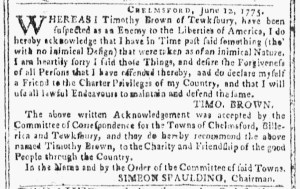
“I … declare myself a Friend to the Charter Privileges of my Country.”

Timothy Brown of Tewksbury, Massachusetts, wanted to return to the good graces of his community in the summer of 1775.  He had fallen out of favor because he had not always supported the American cause with as much fervor as his neighbors wished, so he realized that he needed to apologize and pledge to do better.  To that end, he not only submitted a “written Acknowledgment” to the Committee of Correspondence for the towns of Chelmsford, Billerica, and Tewksbury but also benefitted from the publication of their response in the New-England Chronicle for readers far and wide to see.

“WHEREAS I … have been suspected as an Enemy to the Liberties of America,” Brown confessed, “I do hereby acknowledge that I have in Time past said something (tho’ with no inimical Design) that were taken as of an inimical Nature.”  Like others who had signed an address to Governor Thomas Hutchinson when he departed for England, Brown simultaneously admitted what he had done and attempted to distance himself from it.  He had not intended his words, he claimed, in the way that they had been interpreted, though he understood how whatever he had said had been received.  “I am heartily sorry I said those Things,” Brown lamented, “and desire the Forgiveness of all Persons that I have offended thereby.”  Furthermore, he declared himself “a Friend to the Charter Privileges of my Country” and pledged that he would “use all lawful Endeavours to maintain and defend the same.”

Brown presented that statement in writing to the Committee of Correspondence for Chelmsford, Billerica, and Tewksbury.  In turn, the committee recommended him “to the Charity and Friendship of the good People through the Country.”  Simeon Spaulding, the chairman, published Brown’s acknowledgment of his error and the committee’s response in the New-England Chronicle “In the Name and by the Order of the Committee of said Towns.”  It appeared next to the second insertion of the advertisement that cleared Ebenezer Bradish of attempting “to do any Injury to his Country,” part of a trend of using newspaper advertisements to designate which colonizers once suspected of sympathizing with Tories now expressed support for the Patriot cause.  That the advertisement concerning Brown was inserted in the New-England Chronicle “by the Order of the Committee” suggests that Brown was not the only one to benefit from its publication.  The committee paid for an advertisement to make a public display of Brown falling in line, an example for others who had not yet done so and a testament to the unity they hoped to achieve among colonizers as the imperial crisis became a war of resistance in the spring and summer of 1775.

June 15

What was advertised in a revolutionary American newspaper 250 years ago today?

New-England Chronicle (June 15, 1775).

“We are satisfied that Mr. Bradish had no Desire … to do any Injury to his Country.”

On the eve of the American Revolution and during the first months of the war, colonizers in New England resorted to newspaper to clarify their positions and frame their own narratives about how their experiences fit into current events.  They used advertisements to set the record straight for a public that might have misunderstood their actions or principles.  For nearly a year before the battles at Lexington and Concord, some of those who signed an address to the former governor, Thomas Hutchinson, upon his departure from Massachusetts to return to England ran advertisements with recantations and assurances that they supported the American cause.

Once hostilities commenced, others depended on advertisements endorsed by reputable patriots to clear their names.  Such was the case with Ebenezer Bradish, Jr., of Cambridge who had been “represented as a Person unfriendly to the just Rights and Liberties of his Country.”  To make matters worse, he moved to Boston on the same day as “the late unhappy Commencement of Hostilities betweed the Troops under the Command of General Gage,” the governor, and “the Inhabitants of this Province.”  That “increased public Suspicions against him” and “rendered [him] more odious and disagreeable to his Countrymen.”

Yet that unfortunate coincidence did not tell the entire story, according to ten men who signed a notice in which they recommended that “all Persons” treat Bradish “as a Gentlemen who is not unfriendly to the Rights and Privileges of his Countrymen,” at least “so far as we are able to discover upon strict Enquiry into his late Conduct.”  They declared that they had investigated “the Cause of his going to Boston at the Time aforesaid” as well as “his Conduct since” and determined that Bradish “had no Desire by that Means, to any Injury to his Country.”  On the contrary, they asserted,” his Design was friendly, and his Conduct was justifiable,” though they did not give more details about the circumstances.  The men who signed the notice came from various towns in Massachusetts (and one from Connecticut).  Most listed their ranks, with “Seth Pomeroy, of Northampton, (General.)” first and then five colonels, two majors, and one captain.  Even though Bradish was suspect, these men were not.  Readers could trust them when they said that they wished “to do Justice to Mr. Bradish” by “remov[ing] from the Minds of our beloved Friends and Countrymen, all groundless Apprehensions” about his conduct.

When Bradish published the conclusions reached by their “Enquiry” as an advertisement in the June 15, 1775, edition of the New-England Chronicle, he appended a nota bene that made clear he had no sympathy for British authorities or the conduct of the troops under their command.  “Whereas a Report had been unjustly spread abroad, that it not the Regulars but our own People who took the Goods lost out of my House,” Bradish proclaimed, “this is to certify to all good People, that said Report is false.”  Furthermore, it “never came from me” but instead from someone else with malicious intent.  To leave no doubt about where he stood, Bradish concluded with an indictment of British troops: “I am certain my House was not only shot at but plundered by the Regulars.”  In publishing the letter from the men who investigated his actions and his own account of what happened to his house as a newspaper advertisement, Bradish hoped to harness the power of the public prints to clear his name and restore himself to good standing among those who supported the patriot cause.

June 8

What was advertised in a revolutionary American newspaper 250 years ago today?

New-England Chronicle (June 8, 1775).

“I am ready to assist them in their Struggles for Liberty and Freedom.”

A year later, John Prentice of Londonderry, New Hampshire, had second thoughts about having signed an address lauding Governor Thomas Hutchinson when he left office and departed Massachusetts for England.  On June 6, 1775, Prentice wrote about the mistake he made, acknowledged that he misjudged the governor’s motives, vowed his support for the American cause, and submitted his missive for publication in the New-England Chronicle.  “I the Subscriber was so unfortunate (some Time since),” he explained, “as to sign an Address to the late Governor Hutchinson, so universally and so justly deemed an Enemy to American Liberty and Freedom.”  Prentice claimed he had not understood that in the spring of 1774 – “at the Time I signed the said Address, I intended the Good of my Country” – but now understood his error.  He lamented that to his “Sorrow” signing the address had “a quite contrary Effect.”

Some of the “contrary Effect” that Prentice regretted, however, may have been the reception that he received from his neighbors and others in his community who refused to associate with him socially or to conduct business with him.  Such treatment had previously prompted others who signed the address to the governor to recant and to beg for forgiveness.  Yet Prentice did not mention how others treated him, nor did he apologize, though he did “hope that my injured and affronted Fellow Countrymen will overlook my past Misconduct.”  Perhaps the battles at Lexington and Concord and the ensuing siege of Boston inspired a sincere change of heart, inspiring Prentice to “renounce the same Address in every Part” and proclaim that he was “ready to assist [his countrymen] in their Struggles for Liberty and Freedom, in whatever Way I shall be called upon by them.”

How did Prentice really feel about the address?  Did it matter to readers of the New-England Chronicle?  William Huntting Howell argues that the authenticity of such a conversion was not nearly as important as the ability of a local Committee of Safety or similar panel of Patriots to induce those who signed the address to make public declarations – in print – that they renounced their past actions and now supported the American cause.[1]  The June 8, 1775, edition of the New-England Chronicle carried other letters similar to the one submitted by Prentice, though an adjudication accompanied each of those.  The Committee of Safety in Salem, for instance, absolved thirteen signers of the address who “now to our Sorrow find ourselves mistaken” and “Wish to live in Harmony with our Neighbours” and “to promote to the utmost of our Power the Liberty, the Welfare and Happiness of our country, which is inseparably connected with our own.”  The same committee accepted a more succinct petition from Alexander Walker, while the Committee of Correspondence for Groton accepted Samuel Dana’s apology for “adopt[ing] Principles in Politics different from the Generality of my Countrymen” that contributed to “the Injury of my Country.”

No such endorsement appeared with Prentice’s letter.  In addition, the layout of the issue that carried it suggests that it could have been a letter to the editor that the printers, Samuel Hall and Ebenezer Hall, chose to publish because it matched their political principles or an advertisement that Prentice paid to insert because he considered it so important to place before the public.  Either way, it buttressed the narrative that more and more colonizers recognized the tyranny perpetrated against them once fighting commenced in Massachusetts in the spring of 1775.

**********

[1] William Huntting Howell, “Entering the Lists: The Politics of Ephemera in Eastern Massachusetts, 1774,” Early American Studies 9, no. 1 (Winter 2011): 208-215.

May 25

What was advertised in a revolutionary American newspaper 250 years ago today?

New-England Chronicle (May 25, 1775).

“CONSTITUTIONAL POST … to the CAMPS at ROXBURY and CAMBRIDGE.”

During the siege of Boston that followed the battles at Lexington and Concord in the spring of 1775, Nathan Bushnell, Jr., advertised his services as a post rider along a route that connected Boston and New London.  He placed advertisements simultaneously in the New-England Chronicle, published in Cambridge, and the Connecticut Gazette, published in New London.  With militia unites from throughout New England converging on Boston, the demand for his services significantly increased.

Bushnell asserted that he was affiliated with the Constitutional Post, a network operated independently of the British postal system.  William Goddard, formerly the printer of the Maryland Journal and the Pennsylvania Chronicle, founded the Constitutional Post in 1774.  As an alternative to the British postal system, it allowed colonizers to send letters and to disseminate newspapers without interference from British officials.  The first route connected Philadelphia and Baltimore, but the Constitutional Post extended to New England by the time the Revolutionary War began.  Bushnell mentioned several associates, each with established routes between towns in Connecticut, Massachusetts, and Rhode Island.

Although Bushnell accepted correspondence of all sorts, he emphasized letters sent to soldiers away from home now that the imperial crisis had taken a new turn.  He rode to “the CAMPS at ROXBURY and CAMBRIDGE, and as often as practicable, to BOSTON.”  On the return trip, he carried “Letters from the Camps.”  In a nota bene, he advised that “when Letters are directed to private Soldiers, the Regiment they belong to may be mentioned” to aid in efficient delivery.

This was such an important service, especially considering the events unfolding in New England, that Bushnell did not expect those who sent letters to fund it by themselves.  Instead, he placed subscription papers “in the Hands of Gentlemen in several Towns … to encourage this expensive Undertaking — and the smallest Favours will be acknowledged.”  The post rider anticipated that subscribers would make pledges to fund the enterprise, recognizing its value and affirming their support of an alternative to the Parliamentary Post.  As the Smithsonian Institution’s National Postal Museum notes, the Constitutional Post “proved quite popular as a way of rejecting British rule.”