June 8

What was advertised in a revolutionary American newspaper 250 years ago today?
New-England Chronicle (June 8, 1775).

“I am ready to assist them in their Struggles for Liberty and Freedom.”

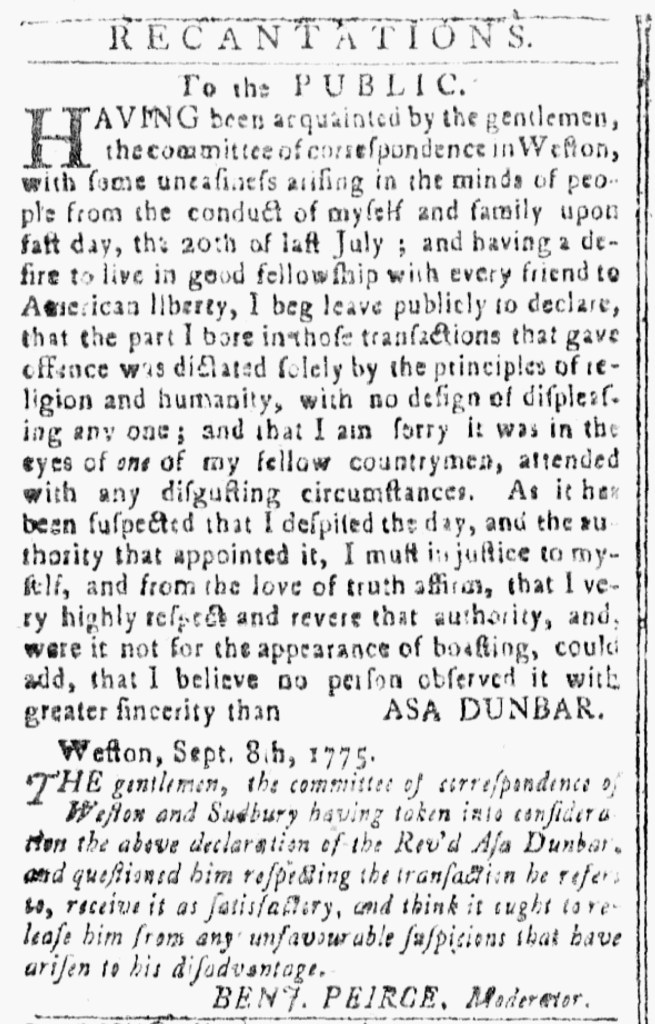
A year later, John Prentice of Londonderry, New Hampshire, had second thoughts about having signed an address lauding Governor Thomas Hutchinson when he left office and departed Massachusetts for England.  On June 6, 1775, Prentice wrote about the mistake he made, acknowledged that he misjudged the governor’s motives, vowed his support for the American cause, and submitted his missive for publication in the New-England Chronicle.  “I the Subscriber was so unfortunate (some Time since),” he explained, “as to sign an Address to the late Governor Hutchinson, so universally and so justly deemed an Enemy to American Liberty and Freedom.”  Prentice claimed he had not understood that in the spring of 1774 – “at the Time I signed the said Address, I intended the Good of my Country” – but now understood his error.  He lamented that to his “Sorrow” signing the address had “a quite contrary Effect.”

Some of the “contrary Effect” that Prentice regretted, however, may have been the reception that he received from his neighbors and others in his community who refused to associate with him socially or to conduct business with him.  Such treatment had previously prompted others who signed the address to the governor to recant and to beg for forgiveness.  Yet Prentice did not mention how others treated him, nor did he apologize, though he did “hope that my injured and affronted Fellow Countrymen will overlook my past Misconduct.”  Perhaps the battles at Lexington and Concord and the ensuing siege of Boston inspired a sincere change of heart, inspiring Prentice to “renounce the same Address in every Part” and proclaim that he was “ready to assist [his countrymen] in their Struggles for Liberty and Freedom, in whatever Way I shall be called upon by them.”

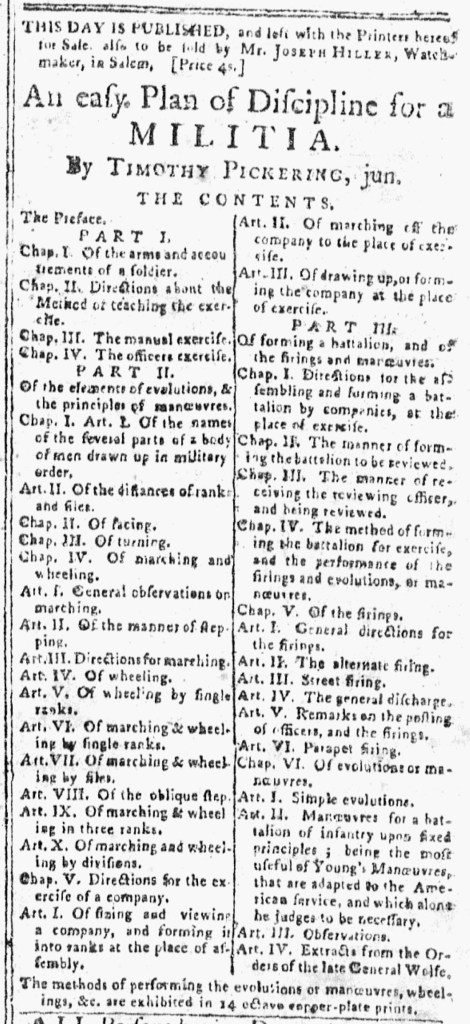
How did Prentice really feel about the address?  Did it matter to readers of the New-England Chronicle?  William Huntting Howell argues that the authenticity of such a conversion was not nearly as important as the ability of a local Committee of Safety or similar panel of Patriots to induce those who signed the address to make public declarations – in print – that they renounced their past actions and now supported the American cause.[1]  The June 8, 1775, edition of the New-England Chronicle carried other letters similar to the one submitted by Prentice, though an adjudication accompanied each of those.  The Committee of Safety in Salem, for instance, absolved thirteen signers of the address who “now to our Sorrow find ourselves mistaken” and “Wish to live in Harmony with our Neighbours” and “to promote to the utmost of our Power the Liberty, the Welfare and Happiness of our country, which is inseparably connected with our own.”  The same committee accepted a more succinct petition from Alexander Walker, while the Committee of Correspondence for Groton accepted Samuel Dana’s apology for “adopt[ing] Principles in Politics different from the Generality of my Countrymen” that contributed to “the Injury of my Country.”

No such endorsement appeared with Prentice’s letter.  In addition, the layout of the issue that carried it suggests that it could have been a letter to the editor that the printers, Samuel Hall and Ebenezer Hall, chose to publish because it matched their political principles or an advertisement that Prentice paid to insert because he considered it so important to place before the public.  Either way, it buttressed the narrative that more and more colonizers recognized the tyranny perpetrated against them once fighting commenced in Massachusetts in the spring of 1775.

**********

[1] William Huntting Howell, “Entering the Lists: The Politics of Ephemera in Eastern Massachusetts, 1774,” Early American Studies 9, no. 1 (Winter 2011): 208-215.

May 25

What was advertised in a revolutionary American newspaper 250 years ago today?

New-England Chronicle (May 25, 1775).

“CONSTITUTIONAL POST … to the CAMPS at ROXBURY and CAMBRIDGE.”

During the siege of Boston that followed the battles at Lexington and Concord in the spring of 1775, Nathan Bushnell, Jr., advertised his services as a post rider along a route that connected Boston and New London.  He placed advertisements simultaneously in the New-England Chronicle, published in Cambridge, and the Connecticut Gazette, published in New London.  With militia unites from throughout New England converging on Boston, the demand for his services significantly increased.

Bushnell asserted that he was affiliated with the Constitutional Post, a network operated independently of the British postal system.  William Goddard, formerly the printer of the Maryland Journal and the Pennsylvania Chronicle, founded the Constitutional Post in 1774.  As an alternative to the British postal system, it allowed colonizers to send letters and to disseminate newspapers without interference from British officials.  The first route connected Philadelphia and Baltimore, but the Constitutional Post extended to New England by the time the Revolutionary War began.  Bushnell mentioned several associates, each with established routes between towns in Connecticut, Massachusetts, and Rhode Island.

Although Bushnell accepted correspondence of all sorts, he emphasized letters sent to soldiers away from home now that the imperial crisis had taken a new turn.  He rode to “the CAMPS at ROXBURY and CAMBRIDGE, and as often as practicable, to BOSTON.”  On the return trip, he carried “Letters from the Camps.”  In a nota bene, he advised that “when Letters are directed to private Soldiers, the Regiment they belong to may be mentioned” to aid in efficient delivery.

This was such an important service, especially considering the events unfolding in New England, that Bushnell did not expect those who sent letters to fund it by themselves.  Instead, he placed subscription papers “in the Hands of Gentlemen in several Towns … to encourage this expensive Undertaking — and the smallest Favours will be acknowledged.”  The post rider anticipated that subscribers would make pledges to fund the enterprise, recognizing its value and affirming their support of an alternative to the Parliamentary Post.  As the Smithsonian Institution’s National Postal Museum notes, the Constitutional Post “proved quite popular as a way of rejecting British rule.”

May 12

What was advertised in a revolutionary American newspaper 250 years ago today?

New-England Chronicle (May 12, 1775).

“We have removed our Printing-Office from Salem to this Place.”

Sameul Hall and Ebenezer Hall printed the first issue of the New-England Chronicle: Or, the Essex Gazette “at their Office in Stoughton-Hall, HARVARD COLLEGE,” on May 12, 1775.  As they explained in a notice to readers, “we have removed our Printing-Office from Salem to this Place” after receiving encouragement from “many respectable Gentlemen, Members of the Honourable Provincial Congress, and others.”  They did so during the siege of Boston that followed the battles at Lexington and Concord on April 19.  The several newspapers previously published in Boston either ceased or suspended publication, leaving Salem’s Essex Gazette as one of the only newspapers in the colony.  The Provincial Congress, recognizing the value of having ready access to a press and a weekly newspaper, invited the Halls, already known as vigorous advocates of the patriot cause, to join them in Cambridge.  When the Halls commenced printing the New-England Chronicle, they continued the volume and numbering of the Essex Gazette.

Still, circumstances made the New-England Chronicle a new newspaper in the eyes of many readers and renewed the commitment of the printers “to conduct the Business [of printing] in general, and this Paper in particular, in such a Manner as will best promote the public Good.”  The Halls proclaimed that it was imperative that they do so “at this important Crisis — when the Property, the LIVES, and (what is infinitely more valuable) the LIBERTY, of the good People of this Country, are in Danger of being torn from them by the cruel Hands of arbitrary Power.”  The printers made their editorial perspective clear as they introduced the new New-England Chronicle to the public and solicited subscribers.  They hoped to continue providing subscriptions to residents of Salem who had previously supported them, yet they also had an opportunity to expand circulation to new subscribers interested in keeping up with current events, including those who previously read newspapers published in Boston.  The Halls published the New-England Chronicle in Cambridge for eleven months, Samuel maintaining the newspaper on his own following Ebenezer’s death in February 1776.  The last issue printed in Cambridge appeared on April 4, 1776.  Soon after the British evacuated Boston on March 17, 1776, Samuel Hall moved the New-England Chronicle to Boston, dropped the reference to the Essex Gazette in the extended title, and continued the volume and numbering.

New-England Chronicle (May 12, 1775).