January 2

What was advertised in a colonial American newspaper 250 years ago today?

Boston-Gazette (January 2, 1775).

The GRAND AMERICAN CONTINENTAL ASSOCIATION … to be pasted up in every Family.”

In the first issue of the Boston-Gazette published in 1775, Benjamin Edes and John Gill, the printers, opened with a notice concerning the Continental Association as the first item in the first column on the first page.  The First Continental Congress had devised that nonimportation, nonconsumption, and nonexportation pact when it met in Philadelphia in September and October 1774, intending for it to go into effect on December 1.  The Continental Association answered the Boston Port Act, the Massachusetts Government Act, and the other Coercive Acts that Parliament had passed in retaliation for the Boston Tea Party, perhaps not expecting a unified response from the colonies.  The First Continental Congress, however, devised a plan that allowed consumers from New England to Georgia to express their political principles through the decisions they made in the marketplace., drawing inspiration from the nonimportation agreements that went into effect to protest the Stamp Act and the duties on imported goods in the Townshend Acts.

Edes and Gill helped to raise awareness of the Continental Association not only through newspaper coverage but also by disseminating copies far and wide.  “ANY Town or District within this Province,” their notice advised, “may be supplied by Edes and Gill, on the shortest Notice, with the GRAND AMERICAN CONTINENTAL ASSOCIATION, printed on one Side of a Sheet of Paper.”  They offered the pact as a broadside “on purpose to be pasted up in every Family.”  The printers wished for local governments to purchase their edition of the Continental Association and distribute them to households for constant reference.  Putting the pact on display demonstrated support for the American cause against Parliament or at least signaled an intention to comply.  Posting it in homes as well as public spaces made it easy to consult, reminding everyone that they had a part to play in the protest.  The Continental Association made decisions about participating in the marketplace inherently political, making it impossible for any individual or household to take a neutral stance.  Edes and Gill recognized that was the case.  Although they stood to generate revenue from selling broadside copies of the Continental Association by the dozen or gross, the political stance they consistently advanced throughout the imperial crisis suggested that increasing awareness of the pact and encouraging compliance with it motivated them as much or even more.
December 22

What was advertised in a colonial American newspaper 250 years ago today?

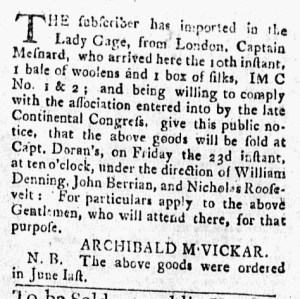
New-York Journal (December 22, 1774).

“Willing to comply with the association entered into by the late Continental Congress.”

When a shipment of “1 bale of woolens and 1 box of silks” arrived in New York via the Lady Gage on December 10, 1774, Archibald McVickar surrendered the good to the local Committee of Inspection and placed an advertisement to that effect in the New-York Journal.  He declared that he was “willing to comply with the association entered into by the late Continental Congress.”  Accordingly, those goods “will be sold … under the direction of William Denning, John Berrian, and Nicholas Roosevelt.”  Anyone wishing to learn more about the sale should “apply to the above Gentlemen” rather than to the McVickar.

McVickar abided by the Continental Association, a nonimportation agreement enacted by the First Continental Congress in response to the Coercive Acts.  In particular, the tenth article stated, “In Case any Merchant, Trader, or other Persons, shall import any Goods or Merchandise after the first Day of December [1774], and before the first Day of February next, the same ought forthwith, at the Election of the Owner, to be either reshipped or delivered up to the Committee of the County or town wherein they shall be imported, to be stored at the Risk of the Importer, until the Non-importation Agreement shall cease, or be sold under the Direction of the Committee aforesaid.”  In other words, McVickar had three options since his shipment arrived on December 10.  He could return it, turn the goods over to the committee to store until the nonimportation agreement ended, or turn the goods over to the committee to sell.

McVickar chose the final option.  The Continental Association made further provisions that he would be reimbursed for the cost of the goods yet could not earn any profit on them.  Instead, any profit was to be applied to relief efforts for Boston where the harbor had been closed and blockaded since the Boston Port Act went into effect on June 1.  McVickar added a nota bene to clarify that the “goods were ordered in June last.”  At that time, colonizers suspected that a nonimportation agreement might go into effect in the future, but the First Continental Congress had not yet met or composed and disseminated the Continental Association.  McVickar suggested that he had not deliberately attempted to get around that agreement, as he further demonstrated in asserting that he was “willing to comply with the association.”  Whatever he lost in profit, he gained in staying in the good graces of members of the community who supported the Patriot cause.

December 7

What was advertised in a colonial American newspaper 250 years ago today?

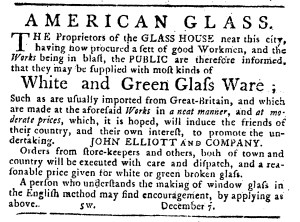
Pennsylvania Journal (December 7, 1774).

“White and Green Glass Ware; Such as are usually imported from Great-Britain.”

A headline in capital letters and a large font proclaimed, “AMERICAN GLASS.”  In a secondary headline composed of font of the same size, John Elliott and Company promoted “White and Green Glass Ware” that they produced ay their “GLASS HOUSE” near Philadelphia.  That advertisement happened to appear in the December 7, 1774, edition of the Pennsylvania Journal, the first issue published since the Continental Association went into effect on December 1.  Throughout the colonies, retailers and consumers adopted that boycott of goods imported from Britain, some enthusiastically and some under pressure.  They hoped that measure would help convince Parliament to repeal the Coercive Acts passed in retaliation for the Boston Tea Party.

Ever since the boycotts inspired by the Stamp Act nearly a decade earlier, supporters of the American cause emphasized the importance of “domestic manufactures” or goods produced in the colonies.  Such products offered an alternative to imported wares while also bolstering local economies and creating jobs.  The Continental Association had the potential to disrupt consumption practice, but it also presented opportunities for American entrepreneurs, including Elliott and Company.

In their advertisement, the proprietors of the Glass House reported that they had “procured a sett of good Workmen” and the glassworks were “in blast.”  That meant that the public “may be supplied with most kinds of White and Green Glass Ware; Such as are usually imported from Great-Britain.”  Prospective customers did not need to worry about the quality or cost of this alternative.  Elliott and Company offered assurances that they produced glassware “in a neat manner, and at moderate prices.”  In their appeal to “the PUBLIC,” Elliott and Company did not address consumers alone.  They also hoped to entice retailers, noting that “Orders from store-keepers and others, both of town and country will be executed with care and dispatch.”  They hoped these various appeals would “induce the friends of their country, and their own interest, to promote the undertaking.”  It was a win-win-win situation for the protest against Parliament, for customers, and for Elliott and Company.

December 3

What was advertised in a colonial American newspaper 250 years ago today?

Providence Gazette (December 3, 1774).

“ENGLISH GOODS, &c. Providence, November 26, 1774.”

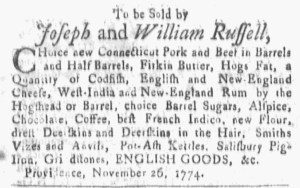
Joseph Russell and William Russell, two of the most prosperous merchants in Providence on the eve of the American Revolution, regularly advertised a variety of wares in the Providence Gazette.  On December 3, 1774, they ran an advertisement for several commodities, including “Connecticut Pork and Beef in Barrels and Half Barrels, … a Quantity of Codfish, … West-India and New-England Rum by the Hogshead or Barrell, … Chocolate, Coffee, … and “drest Deerskins and Deerskins in the Hair.”  They concluded their notice with “ENGLISH GOODS,” indicating that they stocked and sold merchandise imported from Britain.

This advertisement appeared two days after the Continental Association, a nonimportation agreement adopted by the First Continental Congress, went into effect.  However, that was not the first time that it ran in the Providence Gazette.  A date appended to the end of the advertisement established that the Russells composed it on November 26, matching the date of the first issue of the newspaper that carried it.  Advertisements usually ran for a minimum of three weeks, though advertisers could arrange for notices to appear for much longer.  In this instance, the Russells opted for four weeks, commencing just days before the Continental Association went into effect and continuing when that pact was supposed to constrain buying and selling imported goods.  In the December 3 edition of the Providence Gazette, their advertisement appeared one column over from a notice promoting the Extracts from the Votes and Proceedings of the American Continental Congress, a pamphlet that included “the Association” along with “a List of Grievances” and “occasional Resolves.”  By including the date, the Russells may have sought to offer prospective customers some leeway in purchasing “ENGLISH GOODS” that had been received before the nonimportation agreement went into effect.  They made it easier for readers to feel comfortable with that decision than Richard Mathewson did.  His advertisement, which also ran before the Continental Association went into effect and continued into December, proclaimed that he sold a “large and general Assortment of GOODS” that were “Just imported from London.”  That notice did not include a date, making it less apparent when he received the goods.  Readers could reasonably conclude that Mathewson had ordered that merchandise before learning of the Continental Association, but that required more work on their part than the Russells did when they included a date in their advertisement.

November 17

What was advertised in a colonial American newspaper 250 years ago today?

Massachusetts Spy (November 17, 1774).

“To the whole is added, The ASSOCIATION of the Grand AMERICAN CONGRESS.”

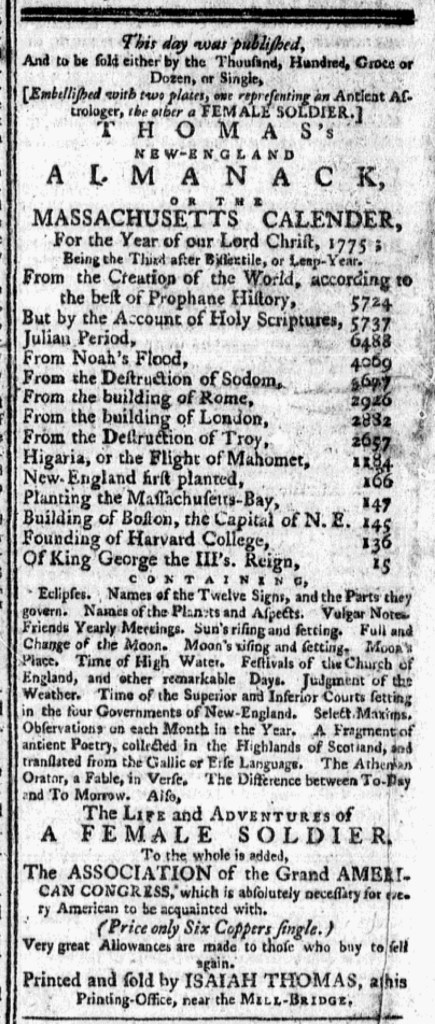
Like many colonial printers, Isaiah Thomas generated significant revenue from publishing almanacs.  From the most affluent to the most humble households in port cities and in the countryside, each year colonizers acquired these handy reference manuals that included all kinds of information.  Thomas’s “NEW-ENGLAND ALMANACK, OR THE MASSACHUSETTS CALENDER, For the Year of our Lord Christ, 1775,” for instance, had everything from the tides or “Time of High Water” to a schedule of “the Superior and Inferior Courts setting in the four Governments of New-England” to poetry.  Thomas “Embellished” the almanac with two images, “one representing an Antient Astrologer, the other a FEMALE SOLDIER.”  The latter corresponded to the “LIFE and ADVENTURES of A FEMALE SOLDIER” that the printer promoted among the content of his almanac.  Practically every almanac included the tides and many listed the dates for important meetings in Connecticut, Massachusetts, New Hampshire, and Rhode Island, so Thomas and other printers sought ways to distinguish their almanacs from others, including images and novel stories.

Thomas anticipated doing brisk business with the contents that he selected for his almanac.  He announced that he sold it “by the Thousand, Hundred, Groce or Dozen, or Single,” offering peddlers, booksellers, and shopkeepers the opportunity to purchase in volume for resale.  A single copy cost “Six Coppers,” yet Thomas promised that “Very great Allowances are made to those who buy to sell again.”  In addition to turning a profit on his almanac, this patriot printer also wanted it disseminated widely because of a particular item that he inserted among the contents.  His almanac included “The ASSOCIATION of the Grand AMERICAN CONGRESS.”  He referred to the Continental Association, a nonimportation agreement recently adopted by the First Continental Congress when it met in Philadelphia in September and October 1774.  The inclusion of the Continental Association distinguished Thomas’s almanac from others advertised in the same issue of the Massachusetts Spy, including “BICKERSTAFF’S BOSTON ALMANACK” published by Nathaniel Mills and John Hicks and “LOW’S ALMANACK” published by John Kneeland.  That newspaper also featured advertisements for two different editions of “EXTRACTS from the Votes and Proceedings of the American Continental CONGRESS,” which included the Continental Association.  Whether or not readers happened to purchase that political pamphlet, Thomas provided easy access to what they needed to know about the nonimportation agreement in an almanac that they would consult for a variety of purposes throughout the coming year.  He asserted that the Continental Association “is absolutely necessary for every American to be acquainted with” … and since so many colonizers already planned to purchase an almanac for 1775 they might as well become acquainted with the Continental Association by purchasing Thomas’s almanac, the one that he sought to distribute “by the Thousand, Hundred, Groce or Dozen” to get into as many households as possible.

November 6

What was advertised in a colonial American newspaper 250 years ago this week?

Postscript to the Virginia Gazette [Purdie and Dixon] (November 3, 1774).

“It has been thought necessary, for the publick Good, to enter into several particular Resolves.”

As the imperial crisis intensified in the fall of 1774, the distinction between news items and advertisements in colonial newspapers became blurry with greater frequency.  Such was the case with letter-advertisements expressing regret for signing “an Address to the late Governor Hutchinson, on his leaving this Province” in several newspapers in Massachusetts.  Another instance appeared in the Virginia Gazette, published by Alexander Purdie and John Dixon in Williamsburg.  On November 3, they distributed a two-page Postscript to accompany the standard four-page issue.  That supplement included nothing but advertising except, perhaps, the first item in the first column on the first page.  With a dateline that read, “EDENTON, NORTH CAROLINA, October 25, 1774,” it featured the petition signed by fifty-one women at the Edenton Tea Party and listed their names in two columns.

Those women expressed their support for resolutions protesting the Tea Act of 1773 passed by the North Carolina Provincial Congress in August.  They proclaimed, “AS we cannot be indifferent on any Occasion that appears nearly to affect the Peace and Happiness of our Country, and as it has been thought necessary, for the publick Good, to enter into several particular Resolves, by a Meeting of Members deputed from the whole Province, it is a Duty which we owe, not only to our near and dear Connections, who have concurred in them, but to ourselves, who are essentially interested in their Welfare, to do every Thing as far as lines in our Power to testify our sincere Adherence to the same; and we do therefore accordingly subscribe this Paper, as a Witness of our fixed Intention and solemn Determination to do so.” In a single sentence, the women of Edenton declared their position on current events and pledged to participate in politics through the decisions they made about consumption.  They added their voices to those who adopted nonimportation agreements.

Why did their petition appear in an advertising supplement?  Had the women involved in the Edenton Tea Party sent their petition to Purdie and Dixon to feature in the Virginia Gazette?  Probably not, but they may have submitted it to the printer of the North-Carolina Gazette in New Bern.  The few extant issues of that newspaper have not been digitized for greater accessibility, making it difficult to determine if the petition appeared in that newspaper and then Purdie and Dixon reprinted it.  After all, colonial printers constantly reprinted items from other newspapers.  The printers in Williamsburg could have received an issue of the North-Carolina Gazette with the petition from the Edenton Tea Party after they printed the November 3 edition of the Virginia Gazette but did not wish to wait a week to disseminate it in the next issue.  Take into consideration as well that news, especially “Extracts from the Votes and Proceedings of the AMERICAN CONTINENTAL CONGRESS,” filled much of the newspaper, crowding out advertisements.  The printers had reason to produce an advertising supplement, yet they may have also wished to highlight the petition signed by patriotic women in Edenton.  The “Extracts” started with an overview of the Continental Association, a nonimportation agreement, as the first news item.  The women’s petition ran as the first item in the Postscript, mirroring the placement of the Continental Association and demonstrating the commitment already expressed for such measures even before the First Continental Congress formally adopted them.  At a glance, it looked like another advertisement among those in the Postscript, yet it delivered important news to readers.

September 29

What was advertised in a colonial American newspaper 250 years ago today?

Maryland Gazette (September 29, 1774).

“It is probable a non-importation agreement may be soon entered into by the colonies.”

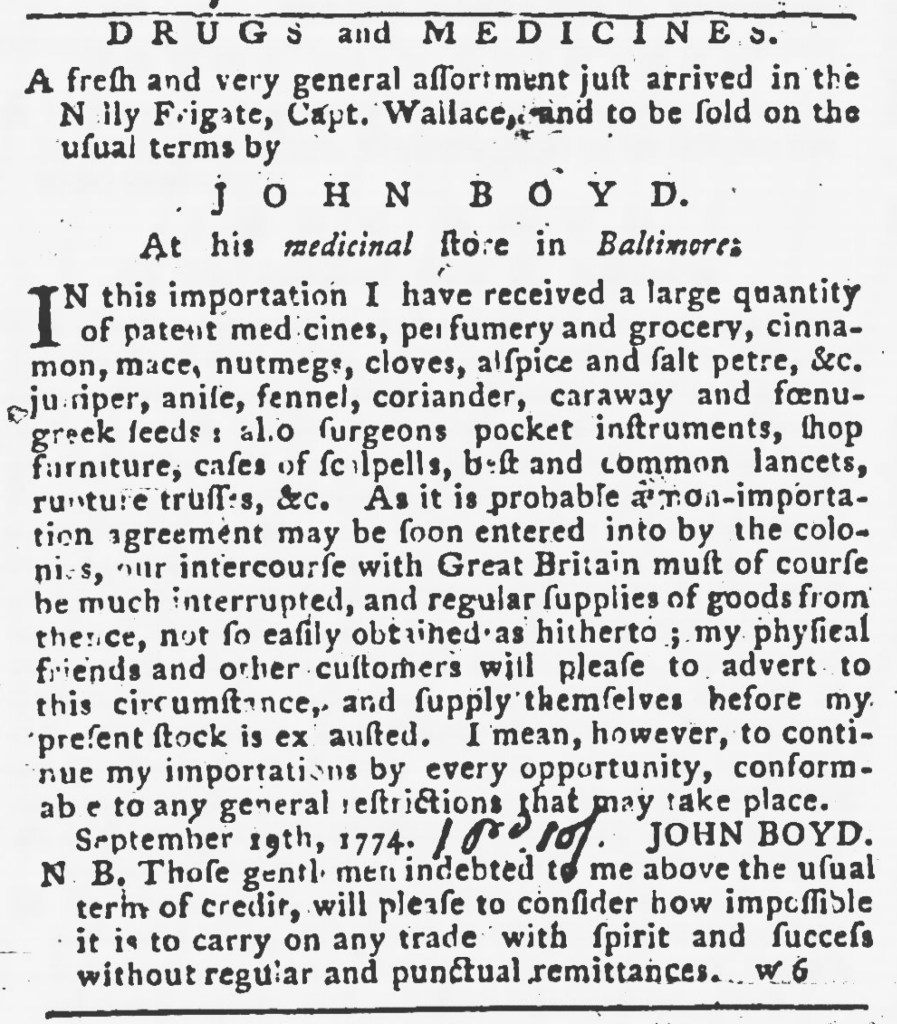
In the fall of 1774, John Boyd advertised the “DRUGS and MEDICINES” available at “his medicinal store in Baltimore” in both the Maryland Gazette, published in Annapolis, and the Maryland Journal, published in Baltimore.  The latter was still so new that the apothecary realized many of his prospective customers still relied on the former as their local newspaper.  He reported that he just imported a “fresh and very general assortment” of patent medicines, “perfumery and grocery” items, spices, and medical equipment.

Boyd also leveraged current events in hopes of moving his merchandise.  At that moment, the First Continental Congress was meeting in Philadelphia, deliberating over responses to the Coercive Acts passed after the Boston Tea Party.  He reminded readers that “it is probable a non-importation agreement may be soon entered into by the colonies” and when that happened “our intercourse with Great Britain must of course be much interrupted, and regular supplies of goods from thence, not so easily obtained as hitherto.”  That being the case, he advised doctors, his “physical friends,” and his other customers to “supply themselves before my present stock is exhausted.”  In other words, they needed to make purchases while the items they needed or wanted were still available.  A boycott would result in scarcity and, eventually, empty shelves, storerooms, and warehouses.  Boyd was not the only entrepreneur making that argument.  In Charleston, Samuel Gordon recommended to “the Ladies” that they needed to buy his textiles, accessories, and housewares while supplies lasted because “a Non-importation Agreement will undoubtedly take Place here.”  Boyd’s advertisement made clear that it was not solely “the Ladies” who needed to worry about politics causing disruptions in the marketplace.

He vowed to do what he could to limit the effects, stating that he would “continue my importations by every opportunity,” though he carefully clarified that he would do so “conformable to any general restrictions that may take place.”  He would continue accepting shipments for as long as possible, replenishing his stock to ward off scarcity, yet there would come a time that he would have to yield to whatever agreement colonizers adopted.  His advertisement preemptively suggested to prospective customers that they should check with him when they discovered that other apothecaries no longer stocked their usual wares.  Colonizers had experienced nonimportation twice in the past decade, first in response to the Stamp Act and later in response to the duties on certain imported goods in the Townshend Acts.  Savvy entrepreneurs like Boyd reminded them how to prepare for what looked to be inevitable disruptions.

September 2

What was advertised in a colonial American newspaper 250 years ago today?

South-Carolina and American General Gazette (September 2, 1774).

“A Non-importation Agreement will undoubtedly soon take Place here.”

A week in advance of an auction to be held on September 9, 1774, Samuel Gordon took to the pages of the South-Carolina and American General Gazette to promote the various items up for bids.  The sale would include “MUSLINS plain & flowered; Fine Humhums, … fashionable Silks for Gowns, Silk and Satin Cloaks, Bonnets and Hats elegantly trimmed, Silk and Satin Petticoats, Womens Silk Hose, and Shoes, [and] Sash and other Ribbons.”  In addition, Gordon listed “Table Cloths, Table Knives and Fork, [and] some blue and white and enamelled Table China.”  He concluded with “&c.” (an abbreviation for et cetera) to indicate that consumers could acquire a variety of other wares at the auction.

Gordon appended a nota bene to his notice: “As a Non-importation Agreement will undoubtedly soon take Place here, the Ladies may not, for some Years, have the same Opportunity of supplying themselves cheap, with any of the above necessary Articles.”  The auctioneer referred to measures under consideration in response to the Boston Port Act, the Massachusetts Government Act, and the other Coercive Acts passed by Parliament in retaliation for the Boston Tea Party.  Throughout the colonies, patriots came to the defense of Massachusetts, rallying to determine common measures to address infringements on their liberty and rights as English subjects.  At the moment that Gordon published his advertisement, delegates were already arriving in Philadelphia for what would become known as the First Continental Congress.  Their deliberations would result indeed result in the Continental Association, a trade boycott intended as political leverage.  Colonizers had previously adopted similar nonimportation agreements in response to the Stamp Act and the duties on certain goods levied in the Townshend Acts.

Gordon encouraged readers to draw on their memories of the conditions during those boycotts or imagine what would likely happen when another nonimportation agreement went into effect.  He stoked fear and anxiety that goods would become scarce and, as a result, much more expensive.  Colonizers needed to acquire textiles and housewares while they were available and while they were affordable.  To facilitate that, he offered credit until January for purchases that exceeded fifty pounds.  That suggests that even though he addressed “Ladies,” the colonizers so often accused of the vice of luxuriating in consumption in newspaper editorials of the era, that he actually anticipated that it would be merchants and retailers, most of them men, who would make bids and purchase this merchandise with the intention of selling it once again.  Still, readers considered Gordon’s warning as they perused the many other advertisements for imported goods in the newspaper.  The auctioneer committed to print what many colonizers were likely thinking about their prospects for purchasing goods in the coming months and years.

May 16

What was advertised in a colonial American newspaper 250 years ago today?

Newport Mercury (May 16, 1774).

“Fresh Imported … direct from LONDON … English & India GOODS.”

The crisis over tea hit the boiling point as Christopher Champlin inserted a new advertisement in the May 16, 1774, edition of the Newport Mercury.  Relying on standard language that appeared in notices placed by merchants and shopkeepers, he informed readers in Rhode Island that he stocked a “general assortment of English & India GOODS, Suitable for the Season, Which he continues to sell, by WHOLESALE and RETAIL.”  His merchandise was “Fresh Imported” on two ships “direct from LONDON.”  In a final appeal, Champlin asserted that he sold his wares “As low, for cash, as at any store or shop in the colony.”  Considering the news that ran immediately to the left of his advertisement, Champlin’s marketing strategy may not have been resonated differently than he originally intended.

Word of the Boston Port Act had arrived in Newport.  A news update with a headline that proclaimed, “JOIN or DIE!!” described the “act of parliament for blockading the harbour of Boston, in order to reduce its spirited inhabitants to the most servile and mean compliance ever attempted to be imposed on a free people” as leading to a fate “worse than death—SLAVERY.”  The editor had the news from “a gentleman” who recently arrived in Newport from Boston.”  That source stated that “a number of the first merchants in London had wrote the manufacturers in inland towns of England, not to send them any more goods, and had wrote to the merchants in Boston, that the surest way to settle the present difference, between the two countries, is to stop all trade immediately, and advised a strict union between all the colonies in this measure.”  Whether merchants in London had actually done any of that or it was wishful thinking on the part of patriots who sought allies on the other side of the Atlantic, colonizers had experience with nonimportant agreements (or boycotts) as political leverage in response to the Stamp Act and the Townshend Acts.  The update reminded readers “that hydra the Stamp Act … was destroyed by our firmness and union.”

By the end of October, the First Continental Congress adopted the Continental Association, a trade boycott intended to pressure Parliament into repealing the Boston Port Act and the rest of the Coercive Acts passed in retaliation for the Boston Tea Party as well as address other grievances.  For the moment, however, no boycott was in place when Champlin published his advertisement promoting his “Fresh Imported” goods.  The news that accompanied that notice perhaps caused some consumers to reconsider what they might purchase, but it might also have served to encourage sales among colonizers who suspected that it was only a matter of time before another boycott went into effect.  They could buy what they wished with a clear conscience and without others censuring them for doing so.  Whatever they chose to do in May 1774, consumers in Rhode Island made decisions in the context of news arriving from Boston, London, and other places.

May 29

GUEST CURATOR: Julia Tardugno

What was advertised in a colonial American newspaper 250 years ago today?

New-Hampshire Gazette (May 29, 1772).

“The very best of BOHEA TEA.”

This advertisement immediately struck me because tea was such an important symbol during the time of the American Revolution. Parliament’s taxed tea was through the Indemnity Act of 1767, one of the notorious Townshend Acts. When the Townshend Acts went into place, the colonists were so furious that they resorted to nonimportation agreements in which they no longer purchased goods from Britain. On October 28, 1767, a town meeting took place at Faneuil Hall in Boston to discuss the Townshend Acts and their negative impact on the colonies. A broadside distributed after the meeting said that colonists decided to meet “That some effectual Measures might be agreed upon to promote Industry, Economy, and Manufacturers; thereby to prevent the unnecessary Importation of European Commodities, which threaten the Country with Poverty and Ruin.” This petition to start the nonimportation agreements was voted on unanimously and the residents of Boston listed the items that they vowed not to purchase imported goods. Instead, they would encourage “Manufacturers” in the colonies. That included “Labrador tea.” The colonists felt strongly about implementing the nonimportation agreements at first, but they put an end to the boycotts in 1770 after Parliament repealed most of the taxes on imports. The tax on tea remained. The colonists canceled the nonimportation agreements two years prior to William Elliot’s advertisement about Bohea tea, a popular consumer good. That did not mean that colonists stopped worrying about the taxes on tea. In 1773, they participated in the Boston Tea Party. Tea became an even more important symbol of the American Revolution as a result of the Boston Tea Party, but that is not the whole story.

**********

ADDITIONAL COMMENTARY: Carl Robert Keyes

William Elliot was not alone in marketing tea to readers of the New-Hampshire Gazette in the spring of 1772.  Jeremiah Libbey listed tea alongside two other beverages, coffee and chocolate, in an advertisement that also promoted an “Assortment of ENGLISH GOODS.”  In another advertisement, David Cutler and J. Cutler provided an extensive list of their “General Assortment of GOODS that came in the last Ships from London.”  The groceries they stocked included “Bohea Tea, Coffee, [and] Chocolate.”  John Penhallow published an even more extensive catalog of “GOODS … Just Imported from LONDON.”  Like his competitors, he sold “choice Bohea Tea.”  Colonizers in Portsmouth and other towns had plenty of options when it came to purchasing tea.  Throughout the colonies, merchants and shopkeepers supplemented their other inventory with tea.

The ubiquity of tea makes it an ideal commodity for examining a variety of interlocking topics in my Revolutionary America class.  We discuss trade and commerce; consumer culture and rituals that helped build a sense of community; and boycotts, politics, and protests.  I introduce students to the traditional narrative about tea and taxes, but we also take into consideration details that complicate that narrative.  As Julia notes, colonizers rescinded the nonimportation agreements when Parliament repealed the duties on most imported goods even though the tax on tea remained in place.  Some colonizers advocated for holding firm until they achieved all of their goals, but most merchants wanted to resume trade and bring an end to the disruption in transatlantic commerce.  We examine how women participated in politics as consumers, especially as consumers of tea, when they made decisions about whether they would purchase imported goods.  In October 1774, women in Edenton, North Carolina, formalized their position by signing a petition in which they resolved to boycott tea and other imported goods.  In response, engraver Philip Dawe created a print that critiqued those women who did not seem to know their place … and, by extension, their male relations incapable of exercising proper authority within their households.  We also read Peter Oliver’s account of the “Origins & Progress” of the American Revolution, including his accusation that women devised various strategies for gathering together to drink tea and cheating on the boycott.  In addition, we discuss T.H. Breen’s descriptions of colonizers destroying tea at public gatherings and enforcing compliance with boycotts.  Many students initially view tea as a quaint vestige of the eighteenth century, associating it primarily with the Boston Tea Party.  Throughout the semester, we repeatedly return to tea so they gain a better understanding of the intersection of colonial culture and politics during the era of the American Revolution.