September 17

What was advertised in a colonial American newspaper 250 years ago this week?
Sep 17 - 9:14:1769 New-York Journal
New-York Journal (September 17, 1769).

“As cheap … as he did before the Non-Importation Agreement took Place.”

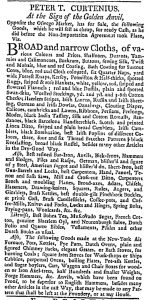
According to an advertisement he inserted in the September 14, 1769, edition of the New-York Journal, Peter T. Curtenius sold a vast assortment of merchandise at his shop “At the Sign of the Golden Anvil.” He listed an array of textiles, accessories, and accouterments among “many other Articles in the Dry-Good Way,” but he also stocked housewares, hardware, and even a few books and grocery items. In many ways, his lengthy list of the wares he made available resembled other advertisements emphasizing consumer choice that had been running in American newspapers for the better part of two decades.

Yet Curtenius’s advertisement was also the product of a particular moment. It opened and closed with a nod to the politics of the period. In 1769 New Yorkers, like many other colonists, participated in a nonimportation agreement as an economic protest against the taxes levied on imported paper, tea, glass, and other items by the Townshend Acts. Before he even described his inventory to prospective customers, Curtenius pledged that he set prices “as cheap … as he did before the Non-Importation Agreement took Place.” In other words, the shopkeeper did not take advantage of the situation to engage in price gouging. Curtenius suggested that as supply of imported goods dwindled that colonists could expect prices to rise, but he pledged to shield his customers from that aspect of the market. This may not have been solely an altruistic sacrifice on his part if he happened to have surplus goods in stock and welcomed an opportunity to rid himself of merchandise that had been taking too long to sell before the nonimportation agreement went into effect.

Curtenius concluded his advertisement with a list of “Goods made at the New-York Air Furnace,” including pots, kettles, and stoves of various sorts. As an alternative to importing goods from Britain, discontented colonists embraced “domestic manufactures,” goods produced in the colonies. Instead of consuming imported wares, they encouraged the conspicuous consumption of items made locally. The proprietors of the New-York Air Furnace frequently advertised their products, as did shopkeepers like Curtenius who intermixed politics and commerce. Curtenius assured prospective customers of the quality of the items produced at the New-York Air Furnace, asserting that the hammers in particular “have been found on Proof, to be superior to English Hammers.”

At a glance, the format of Curtenius’s advertisement did not look different from others that regularly appeared in the New-York Journal and other newspapers published throughout the colonies. On closer inspection, however, colonists discovered that Curtenius engaged with the politics of the imperial crisis as a means of marketing his merchandise. He promised that he did not inflate his prices while simultaneously offering consumers alternatives to some of the items they previously imported.
August 27

What was advertised in a colonial American newspaper 250 years ago this week?

Aug 27 - 8:24:1769 South-Carolina Gazette
South-Carolina Gazette (August 24, 1769).

“He is determined … not to import any more Goods.”

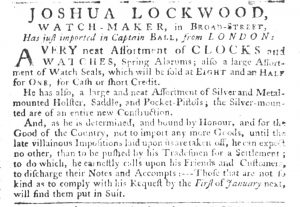
In August 1769, Joshua Lockwood promoted “A VERY neat Assortment of CLOCKS and WATCHES” that he had “just imported … from LONDON.” He also carried “a large and neat Assortment of Silver and Metal-Mounted Holster, Saddle, and Pocket-Pistols.” He was careful, however, not to run afoul of the resolutions recently adopted by merchants and traders in Charleston, a nonimportation agreement similar to those already in effect in Boston and New York. In several of the largest urban ports, colonists leveraged economic resistance to the Townshend Acts, vowing not to import a vast array of goods from Britain while Parliament levied taxes on imported paper, tea, glass, lead, and paint. For his part, Lockwood alerted the public that he “is determined, and bound by Honour, and for the Good of the Country, until the late villainous Impositions laid upon us are taken off.” The watchmaker established for prospective customers and the community that he supported the nonimportation agreement, wedding commerce and politics in his advertisement.

Lockwood joined other merchants, shopkeepers, and artisans who attempted to leverage the nonimportation agreement to sway consumers with their political sentiments. Unlike others, however, he used the boycott for another purpose: calling in debts. Lockwood anticipated that the tradesmen on the other side of the Atlantic who supplied his clocks and watches would demand “a Settlement” once he suspended placing new orders. They would not extend credit indefinitely to a customer who no longer actively purchased their wares. To pay his own bills, Lockwood called on “his Friends and Customers” to settle their accounts with him. He offered several months to do so, but warned that he would sue those who were “not so kind as to comply with his Request” by the first of the year. Newspapers from New England to Georgia carried advertisements that called on colonists to pay debts or end up in court. In that regard, Lockwood’s notice was not extraordinary. Using the nonimportation agreement as a means of encouraging those who owed him money to settle accounts, on the other hand, was innovative. He sought to harness (or exploit) a political movement for the benefit of his business in a new way. Plenty of advertisers asked consumers to patronize their shops because they supported nonimportation, but they did not use the boycott as a justification for calling in debts. What were the ramifications for Lockwood? Did readers find themselves in sympathy and more inclined to pay their debts to alleviate any hardships Lockwood might face as a result of suspending his orders from Britain? Or did they question Lockwood’s commitment to making a sacrifice on behalf of the cause and resent his effort to use the nonimportation agreement as rationale for taking colonists to court?

July 30

What was advertised in a colonial American newspaper 250 years ago this week?

Jul 30 - 7:24:1769 New-York Gazette Weekly Mercury
New-York Gazette and Weekly Mercury (July 24, 1769).

“If the Patriotic Americans, should approve, large Quantities can readily be furnished.”

In the summer of 1769, Isaac Adolphus turned to the public prints to propose a new venture. In an advertisement in the July 24, 1769, edition of the New-York Gazette and Weekly Mercury, he invited fellow colonists to visit his house to examine “some Patterns of Hosiery” that he proposed to make in larger quantities if those samples met with approval. To incite interest, he sketched out some of the most important aspects of the enterprise, positioning his hosiery as a viable alternative to imports from Britain. In so doing, Adolphus made appeals to both quality and price, two of the most common marketing strategies in the eighteenth century. He pledged that his hosiery was “superior in Goodness to British Goods of the Kinds.” Prospective customers did not have to settle for inferior quality if they chose to support local production. Furthermore, they did not have to pay a premium for that support. Adolphus’s hosiery was “equal in Price” to wares imported from England.

Beyond quality and price, Adolphus placed production and consumption of his hosiery in a political context. He called on “Patriotic Americans” to examine his wares and make determinations for themselves. Merchants, traders, and others in New York had instituted a nonimportation agreement in response to new duties levied by the Townshend Acts. The success of the nonimportation strategy depended in part on colonists both producing goods themselves and consuming those domestic manufactures. Yet not everyone acceded to the plan. A detailed account of haberdasher, jeweler, and silversmith Simeon Cooley flagrantly violating the nonimportation agreement appeared on the same page as Adolphus’s advertisement. After other colonists asserted considerable pressure, Cooley eventually apologized to his “Fellow Citizens” and attempted to make amends in order to avoid the further “Contempt and just Resentment of an injured People.” Cooley had appeared in New York’s newspapers with some regularity in July 1769.

Adolphus recognized an opportunity to enlist “Patriotic Americans” as customers for the hosiery he produced. Yet he was not willing to risk too much on the venture until he had better assurances of success. He presented himself and his wares as an alternative to men like Cooley and their “British Goods of the Kinds” he produced locally, but he delayed making “large Quantities” until he had enough orders to justify the investment of time and resources. Adolphus recognized an opportunity in the marketplace, but he used his advertisement to further gauge his prospects for success. In that regard, his advertisement facilitated rudimentary market research in the eighteenth century. The nonimportation agreement, calls to encourage domestic manufacturers, and news of Cooley’s violations all primed the pump for “Patriotic Americans” to react positively to Adolphus’s hosiery once they had an opportunity to examine it for themselves.

July 20

What was advertised in a colonial American newspaper 250 years ago today?

Jul 20 - 7:20:1769 New-York Journal
New-York Journal (July 20, 1769).

“Violaters of the Non-importation Agreement.”

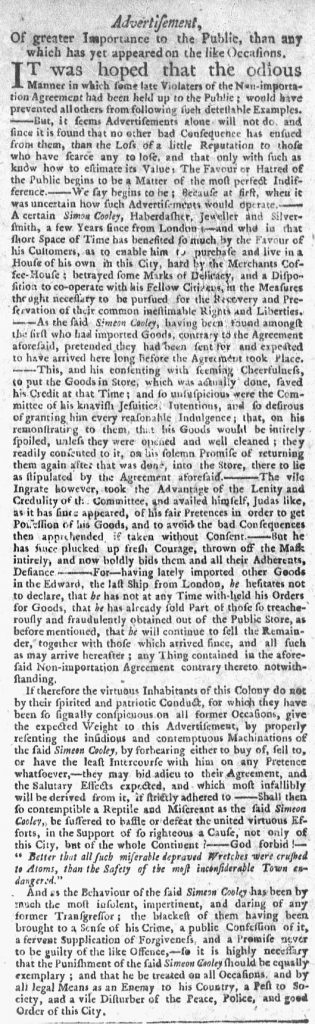
An advertisement concerning violations of the nonimportation agreement in New York, one “Of greater Importance to the Public, than any which has yet appeared on the like Occasions,” ran in the July 20, 1769, edition of the New-York Journal. It detailed the indiscretions of Simeon Cooley, “Haberdasher, Jeweller and Silversmith,” who had moved to New York from London a few years earlier. Cooley had done well for himself, benefitting “so much by the Favour of his Customers” that he had managed to purchases a house in the city, near the Merchants Coffee House. When it came to the politics of nonimportation, Cooley initially displayed “a Disposition to co-operate with his Fellow Citizens, in the Measures thought necessary to be pursued for the Recovery and Preservation of their common inestimable Rights and Liberties.”

Yet Cooley did not abide by the nonimportation agreement that he had willingly signed. He was one of the first residents of New York suspected of having broken the pact, yet he explained that his goods did not fall under the agreement because they had been ordered before it went into effect. They arrived later than expected, but he had not submitted new orders since signing the agreement. Seemingly to his credit, he agreed to place those goods in storage while the agreement was still in effect, but that was just a ruse that took advantage of the leniency of the committee responsible for enforcement. Cooley attempted to salvage his reputation; the committee did not realize his “knavish Jesuitical Intentions.” He insisted that his goods would be ruined “unless they were opened and well cleaned.” Under that subterfuge, the “vile Ingrate” did not return all of the offending goods to the storehouse.

Even more boldly, he more recently imported other goods in the Edward, the “last Ship from London.” A record of the Edward arriving in New York appeared in the shipping news on the same page as the advertisement detailing Cooley’s transgressions. Cooley had finished pretending to submit to the nonimportation agreement: “he hesitates not to declare, that he has not at any time with-held his Orders for Goods, that he has already sold Part of those so treacherously and fraudulently obtained out of the Public Store, as before mentioned, that he will continue to sell the Remainder, together with those which arrived since, and all such as may arrive hereafter.” Cooley had no regard for anything stated in the nonimportation agreement, even though he had willingly signed it.

In response, the advertisement called on “the virtuous Inhabitants of this Colony” to exercise the appropriate “spirited and patriotic Conduct” when it came to Cooley and his “contemptuous Machinations.” This was not merely a matter of refusing to buy and sell from “so contemptible a Reptile and Miscreant” but also refusing to “have the least Intercourse with him on any Pretence whatsoever.” In other words, those who supported “so righteous a Cause” as the nonimportation agreement were instructed to shun Cooley. Furthermore, it was necessary to make an example of Cooley to keep his contagion from spreading. The advertisement demanded that he should “be treated on all Occasions, and by all legal Means as an Enemy to his Country, a Pest to Society, and a vile Disturber of the Peace, Police, and good Order of this City.”

Through his own actions, Cooley had damaged his reputation. He neglected to learn from his mistakes and refused to back down when discovered. This lengthy advertisement documented his violations of the nonimportation agreement and recommended punishments appropriate to the egregious manner he conducted himself. The repercussions were not confined to the realm of commerce but instead extended to his everyday interactions with the “virtuous Inhabitants of this Colony” as they shunned him for his violations. Cooley had earned the “Hatred of the Public.”

July 2

What was advertised in a colonial American newspaper 250 years ago this week?

Jul 2 - 6:29:1769 New-York Journal
New-York Journal (June 29, 1769).

“Doing so was contrary to the Non-Important Agreement.”

The success of the nonimportation agreements adopted during the imperial crisis depended not only on the cooperation of merchants and consumers but also on surveillance and enforcement, both formal and informal. Committees of merchants and traders devised the nonimportation agreements and then set about policing themselves, but colonists also observed their friends and neighbors to assess whether they complied and, when necessary, shame them in public and deprive them of business as punishment for not adhering to the agreement.

The June 26, 1769, edition of the New-York Journal carried an advertisement that testified to the stakes of following the nonimportation agreement. It told a story about Peter Clopper, “Merchant of this City, whose Zeal for promoting he good of his Country, has never been called in Question.” To that end, he was one of the first merchants in New York to sign the nonimportation agreement. About two weeks before the advertisement ran in the New-York Journal, Clopper traveled to Philadelphia to attend to “Business of Importance” and, while there, purchased “one Piece of Callico, two Pieces of coloured, and one Piece of black Persian.” He did not intend to sell these fabrics in New York, instead acquiring them “principally for the Use of his Family.” Still, this violated the nonimportation agreement, as Clopper soon realized. He then packaged up the textiles and sent them back to Philadelphia, yet that was not the end of atoning for his transgression. He voluntarily approached the Committee of Inspection into the Importation of Goods to relay the entire story and received credit for his honesty since the infraction “otherwise in all Probability never [would have] come to Light.”

In response to this incident, the committee determined that Clopper’s purchase was an “involuntary Transaction” that “ought not to be imputed to him as a Crime.” Having returned the merchandise and then presented himself to the committee of his own accord, he was “intitled to the Favour of the Committee for his candid Behaviour.” Yet Clopper did not seek the “Favour of the Committee” alone. He also wished to defend and maintain his reputation among the residents of New York, colonists who were also current and prospective customers. The introduction to the account of Clopper’s indiscretion and remedy depicted the alternatives. On the one hand, “it must afford great Satisfaction to every Friend of the American Colonies” to know the “Indignation and Abhorrence” that would be incurred by anyone who “willfully and personally” behaved in a manner “to counteract the Agreement entered into” for the “common Preservation” of the entire colony. On the other hand, “it must also give them Pleasure to know how cautious and fearful Individuals are of incurring the Censure of the Public.”

The merchants and traders who signed and enforced the nonimportation agreement were not Clopper’s only concern when he took action to fix his supposedly inadvertent mistake. He also worried about maintaining his reputation among the general public and avoiding the “Censure of the Public” that could spell ruin for his business. Yet it was not only commerce at stake. Clopper realized that his error could also affect his social relationships with friends and neighbors who supported the nonimportation agreement. When it came to adhering to that pact, political acts had personal ramifications. The purpose of the advertisement in the New-York Journal was to diffuse those ramifications for Clopper, given his eager cooperation once he realized his transgression, as well as remind others of the consequences if they willfully tried to evade the nonimportation agreement.

June 12

What was advertised in a colonial American newspaper 250 years ago today?

Jun 12 - 6:12:1769 Boston-Gazette
Boston-Gazette (June 12, 1769).

“UMBRILLOES.”

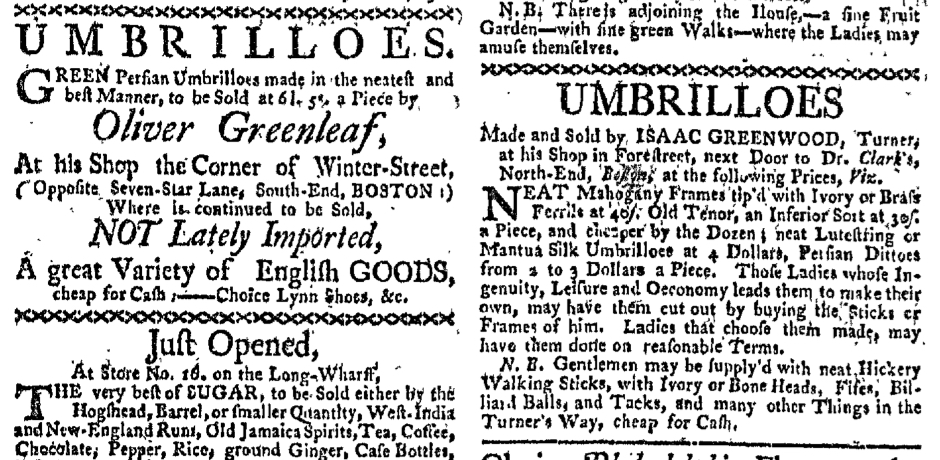
Oliver Greenleaf and Isaac Greenwood placed competing advertisements for “UMBRILLOES” in the June 12, 1769, edition of the Boston-Gazette. They relied on different marketing strategies, but both presented umbrellas as accessories perfectly appropriate for colonists, especially women, to acquire and use. Kate Haulman explains that umbrellas were a source of debate in the era of the American Revolution. They had only recently appeared in England and its colonies in North America. “Though large and clumsy by modern standards,” Haulman explains, “the umbrellas of the late eighteenth century were brightly colored items of fashion made of oiled silk, stylistic spoils of empire hailing from India.” Yet some colonists were uncertain that they should adopt this fashion. Beyond the space devoted to advertising, debates about umbrellas appeared elsewhere in colonial newspaper, “the forum best suited to prescribe or proscribe certain styles and behaviors for a wide audience of readers.” Some colonists considered umbrellas “ridiculous and frivolous, serving no purpose that a good hat could not supply.” Others allowed for their use, but only by women. In the eighteenth-century, many considered the umbrella a feminine accessory.[1]

Other colonists, however, defended umbrellas. Greenleaf and Greenwood addressed them, though they likely hoped to win new converts with their advertisements as well. Greenleaf did not acknowledge the debate over umbrellas. Instead, he positioned his umbrellas and the “great Variety of English GOODS” available at his shop within another debate about consumer culture. He proclaimed that his umbrellas and other goods were “NOT Lately Imported.” Usually merchants and shopkeepers emphasized that they carried the latest fashions that only recently arrived via ships from English ports, but in 1769 the vast majority in Boston participated in a nonimportation pact in protest of the duties on certain goods imposed by the Townshend Acts. A committee of merchants and traders monitored adherence and published reports in the city’s newspapers. Greenleaf’s livelihood and his reputation both depended on assuring the public that he did not peddle goods that violated the nonimportation agreement, hence his assertion that his merchandise was “NOT Lately Imported.”

Prospective customers interested in making purchases from Greenwood, on the other hand, did not need to worry about when he had acquired his umbrellas because he made them at his shop in the North End of Boston. Along with the nonimportation agreement, merchants, shopkeepers, and other colonists emphasized the importance of local production, what they termed domestic manufactures, coupled with virtuous consumption of goods produced in the colonies. This required the commitment of both suppliers and consumers. As a producer, Greenwood fulfilled the first part; he depended on consumers to do their part by choosing his umbrellas over those imported by Greenleaf, regardless of when they might have been transported across the Atlantic. He did imply that women might be more interested in umbrellas than men when he addressed “Ladies whose Ingenuity, Leisure and Oeconomy leads them to make their own.” They could save some money and demonstrate their own industry by purchasing the materials – fabrics and “Sticks or Frames” – from Greenwood and then putting together the umbrellas on their own. Although Greenleaf more explicitly commented on the nonimportation agreement then in effect, Greenwood more effectively placed his umbrellas within the discourse of local production.

Umbrellas were the subject of several debates and controversies in the decade before the American Revolution. Some colonists questioned their use at all, depicting them as unnecessary luxuries and frivolous feminine accessories. Others advocated for umbrellas, but only those that did not violate the terms of the nonimportation agreements. Those produced in local workshops possessed even greater cachet. In that regard, umbrellas became imbued with political as well as cultural meaning.

**********

[1] Kate Haulman, “Fashion and the Culture Wars of Revolutionary Philadelphia,” William and Mary Quarterly, 3rd ser., 62, no. 4 (October 2005): 632.

March 19

GUEST CURATOR: Ceara Morse

What was advertised in a colonial American newspaper 250 years ago today?

Mar 19 - 3:19:1767 Massachusetts Gazette
Massachusetts Gazette (March 19, 1767).

“To be sold by WILLIAM JACKSON, at his Shop at the Brazen Head.”

This advertisement made me curious about William Jackson and the Brazen Head since I am from a town close to Boston. These curiosities led me to the Massachusetts Historical Society’s article on William Jackson.

Jackson was born in 1731. Mary Jackson, his widowed mother kept the Brazen Head Tavern next to the Town House (which is now known as the Old State House) in Boston. In 1758, William went into business with his mother, starting a “variety store” selling an assortment of goods in the same location,.

William Jackson was a Loyalist who adamantly supported the king throughout the imperial crisis and the Revolution. The Massachusetts Historical Society notes that in a Boston newspaper Jackson was named along with others for being “those who audaciously continue to counteract the united Sentiments of the Body of Merchants throughout NORTH AMERICA, by importing British goods contrary to the agreement.” He was such a loyalist to the king, that when the British abandoned Boston in March of 1776, he tried to leave as well, only to be caught and imprisoned for a year. In the end, William Jackson returned to England, where he resided until his death in 1810.

**********

ADDITIONAL COMMENTARY: Carl Robert Keyes

At a glance, William Jackson’s advertisement does not appear to explicitly reveal much about women’s roles in the eighteenth-century marketplace, either as consumers or producers/sellers. However, Ceara and I did not need to do much research to discover that William Jackson’s story cannot be told without acknowledging women’s participation in commerce and consumer culture. As Ceara has already outlined, one of Jackson’s first forays into the world of business involved a partnership with his mother, already an experienced businesswoman who operated a tavern. Although widows may have been more likely to operate businesses than their married sisters, in the century before the Revolution wives stepped forward to act as what Laurel Thatcher Ulrich has described as “deputy husbands” who attended to matters of business in the temporary absence of their husbands. Many eighteenth-century advertisements make reference to wives or other female relations who worked in shops owned by their husbands, but historians have demonstrated that even if women’s contributions were not acknowledged in the marketing materials that they were indeed present and assisting in the operation of the family business.

Mar 19 - Jackson Broadside
Anonymous broadside accusing William Jackson of not abiding by nonimportation agreements (Boston:  ca. 1769-1770).  Courtesy Massachusetts Historical Society.

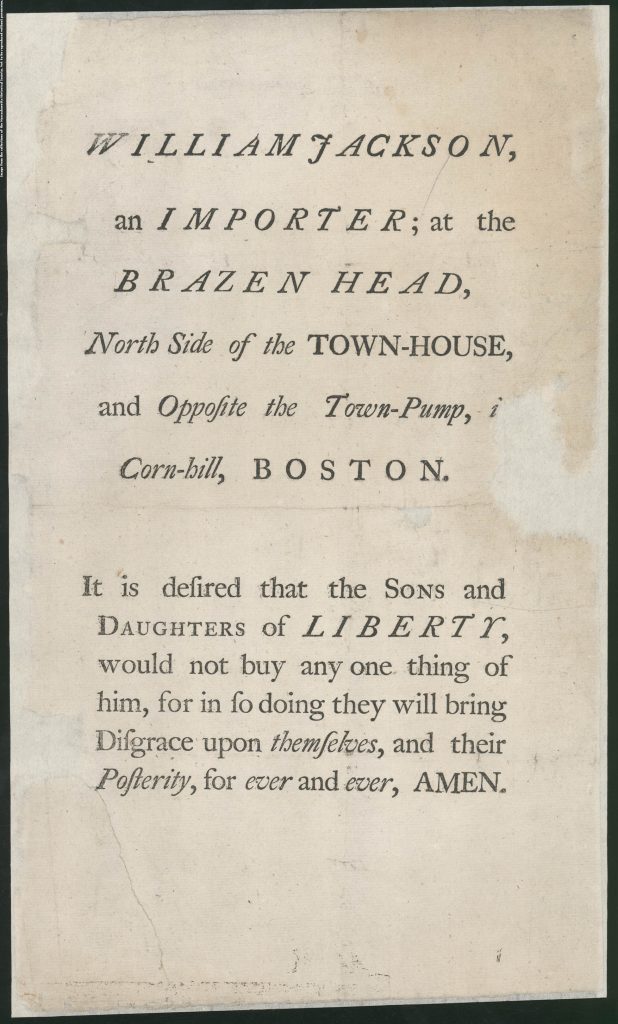
To learn more about William Jackson, Ceara consulted the online collections of the Massachusetts Historical Society. In addition to a short biography of the prominent Loyalist shopkeeper, the MHS has made available an image of an anonymous broadside (ca. 1769-1770) warning “SONS and DAUGHTERS of LIBERTY” against purchasing goods from Jackson, “an IMPORTER,” who operated in violation of a non-importation agreement that most merchants and shopkeepers had signed in 1768 in response to the Townshend Acts. Note that the broadside addressed both “SONS” and “DAUGHTERS,” imbuing decisions that both men and women made about consumption with political meaning. Barred from formal mechanisms of political participation – voting and holding office – women engaged in political debates and civic discourse through other means, including the politicization of consumer culture. Nonimportation and nonconsumption agreements, what we would call boycotts today, were effective only if they had widespread approval and adherence. Women’s role in managing their household economy took on political significance as each personal choice whether to buy certain goods made a statement about their views. As acts of consumption increasingly had political valence, neutrality became impossible. During the imperial crisis, women were political actors in the overlapping marketplace of goods and marketplace of ideas.

William Jackson’s advertisement is an especially fine choice to examine during Women’s History Month. It reminds us that much of women’s history has been obscured but not hidden beyond recovery. A willingness to conduct a little more research, to ask new questions, and to approach sources from new perspectives allows us to tell a much more complete story of the American past.