January 25

What was advertised in a revolutionary American newspaper 250 years ago today?
Pennsylvania Evening Post (January 25, 1776).

“A new edition of COMMON SENSE … with large and interesting additions by the author.”

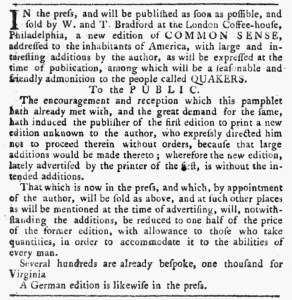
A battle over publishing Thomas Paine’s Common Sense played out in advertisements became apparent to the public when they perused the advertisements in the January 25, 1776, edition of the Pennsylvania Evening Post.  Sixteen days earlier, that newspaper had been the first to carry an advertisement for the inflammatory political pamphlet.  Robert Bell, the publisher, promoted it, while Paine remained anonymous.  It sold so quickly that Bell began advertising “A NEW EDITION of COMMON SENSE” on January 20.  Five days later, he ran an updated version of the original advertisement, using type already set.  The compositor merely replaced the first line, removing the date (“Philadelphia, January 9, 1776”) and replacing it with a headline that proclaimed, “The second edition,” in a larger font.

Yet Paine and Bell had had a falling out.  Bell’s “second edition” was an unauthorized edition, as a new advertisement on the first page of the Pennsylvania Evening Post made clear.  William Bradford and Thomas Bradford, printers of the Pennsylvania Journal, announced that they had a “new edition” of Common Sense “IN the press, and will be published as soon as possible.”  Unlike Bell’s second edition advertised elsewhere in that issue, their new edition featured “large and interesting additions by the author, as will be expressed at the time of publication.”  As a preview, the Bradfords indicated that the bonus materials included a “seasonable and friendly admonition to the people called QUAKERS.”  To entice prospective customers to reserve copies or purchase them as soon as they were available, the Bradfords noted that “Several hundred are already bespoke,” including “one thousand for Virginia.”  Advertisements for the pamphlet already appeared in newspapers in New York.  The Bradfords made plans to distribute the pamphlet south of Philadelphia.  In addition, they reported that a “German edition is likewise in the press” for the benefit of the many German settlers in Pennsylvania and the backcountry extending down to North Carolina.

This advertisement included an address “To the PUBLIC,” perhaps composed by Paine, that outlined the dispute between the author and the original publisher.  “The encouragement and reception which this pamphlet hath already met with, and the great demand for the same,” the address declared, “hath induced the publisher of the first edition to print a new edition unknown to the author.”  Paine had “expressly directed him not to proceed therein without orders, because that large additions would be made hereto.”  He also did not appreciate that Bell had not managed to turn a profit on the first edition, though that did not receive mention in the address in the advertisement.  Readers needed to be aware that Bell’s new edition, “lately advertised by the printer of the first [edition], is without the intended additions.”  That being the case, readers who exercised a little patience for the Bradfords’ edition “now in the press” and authorized by the author could acquire both the contents of the original pamphlet and the additions in a single volume … and at a bargain price!  Even with the new material, the cost “will … be reduced to one half of the price of the former edition.”  Bell advertisements consistently listed “two shillings” for the pamphlet.  The Bradfords charged one shilling.  They also gave “allowance to those who take quantities” or a discount for purchasing in volume, either to retail or distribute to friends, family, and associates.  That would “accommodate [the pamphlet] to the abilities of every man.”  In other words, the lower price made it possible to disseminate Common Sense even more widely.  When it came to airing grievances over the publication of Common Sense in newspaper advertisements, this address “To the PUBLIC” was only the opening salvo.  The dispute continued in subsequent editions of the Pennsylvania Evening Post and other newspapers.
July 14

What was advertised in a revolutionary American newspaper 250 years ago today?

North-Carolina Gazette (July 14, 1775).

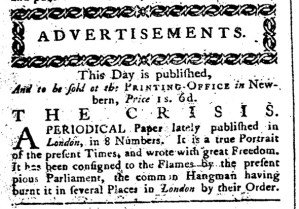
“THE CRISIS. A PERIODICAL Paper lately published in London, in 8 Numbers.”

Along with continued coverage of the Battle of Bunker Hill, the July 14, 1775, edition of the North-Carolina Gazettecarried an advertisement for The Crisis, a “PERIODICAL Paper lately published in London, in 8 Numbers.”  According to Neil L. York, The Crisis, published between January 1775 and October 1776, “was the longest-running weekly pamphlet series printed in the British Atlantic World during those years.”  (That London publication should not be confused with Thomas Paine’s “American Crisis,” a series of essays published in the United States between 1776 and 1783.)  The Crisis eventually included ninety-two editions, but James Davis, printer of the North-Carolina Gazette, had access to only the first eight.  According to his advertisement, he collected them together into a single volume.

Davis used the pamphlet’s colorful history in marketing it to readers in North Carolina.  “It is a true Portrait of the present Times,” he declared, “and wrote with great Freedom.  It has been consigned to the Flames by the present pious Parliament, the common Hangman having burnt it in several Places in London by their Order.”  York provides this overview: “The Crisis was condemned informally by leaders in the British government, and then formally in court, as a dangerous example of seditious libel [due to the depictions of George III].  Copies of it were publicly burned, and yet publication continued uninterrupted.”  American Patriots had their supporters among the British public, including authors and printers who “played on shared beliefs and shared fears: beliefs in the existence of fundamental rights … and the fear that loss of those rights in Britain’s American colonies could lead to their loss in Britain itself.”  York posits that the “men behind The Crisis were determined to interest the British public in American affairs and were no doubt pleased when various issues were reprinted in the colonies.”  Indeed, newspapers reprinted some of the essays in their entirety.  Printers also recognized opportunities to generate revenue while disseminating The Crisis to colonizers.  Advertisements for individual numbers of the pamphlet peppered the pages of American newspapers in the spring and summer of 1775 as printers in several colonies distributed new issues as they came to hand.  The day before Davis ran his advertisement in the North-Carolina Gazette, John Anderson announced in a notice in the New-York Journal that “on Monday will be published No. 9 of the CRISIS.”  Instead of printing one issue at a time, Davis packaged the first eight issues together for readers, hoping that providing such convenient access would entice them to buy the volume.

**********

This entry marks the final appearance of the North-Carolina Gazette in the Adverts 250 Project.  Few issues of that newspaper survive.  Only seven, all of them from 1775, have been digitized for greater access via databases of early American newspapers.  I have selected advertisements from the North-Carolina Gazette as often as possible to present a more complete representation of newspapers from throughout the colonies.

July 8

What was advertised in a revolutionary American newspaper 250 years ago today?

Pennsylvania Evening Post (July 8, 1775).

“A SELF DEFENSIVE WAR lawful, Proved in a SERMON … before Captain Ross’s company of militia.”

An advertisement in the July 8, 1775, edition of the Pennsylvania Evening Post promoted a forthcoming pamphlet that would certainly be of interest to readers in Philadelphia and beyond.  John Dean, a bookbinder who ran a shop in Laetitia Court, aimed to encourage anticipation for “A SELF DEFENSIVE WAR lawful, Proved in a SERMON … By the Rev. JOHN CARMICHAEL.”  The pamphlet would soon be available for purchase since it was “in the press, and will be published in a few days.”  The advertisement suggested that Dean collaborated with Carmichael on the project.

Dean gave more details about both the origins and the physical attributes of the pamphlet.  Carmichael gave the sermon “at Lancaster, before Captain Ross’s company of militia, in the Presbyterian church on Sabbath morning, June 4th, 1775.”  By then, word of the battles at Lexington and Concord and the siege of Boston had reached the town of Lancaster.  One local militia company apparently appreciated the sermon so much that they wanted copies distributed more widely.  Perhaps some thought that they would purchase their own copies to review at their leisure or even consult it as a means of better rehearsing Carmichael’s arguments and evidence when they needed to explain why they believed a “self defensive war” was indeed lawful.  Francis Bailey, a printer in Lancaster, printed Carmichael’s sermon “for Captain Ross’s Company of Militia,” according to the imprint, and “at the request of said Company,” according to the subtitle.  The new edition, printed in Philadelphia, was “published at the request of the Author, and corrected by himself from the copy printed at Lancaster.”  In addition to being a more accurate rendering of the sermon, the Philadelphia edition would be “Printed on a good paper and type, octavo size.”

Dean and Carmichael envisioned a more extensive audience for the sermon than the Lancaster edition reached.  The advertisement stated that it was “Humbly offered to the perusal of the MILITARY ASSOCIATORS of the city, liberties and county of Philadelphia.”  The bookbinder-publisher and the author hoped to leverage patriotism and current events to sell more copies of the sermon, though they likely also wished to contribute to public discourse about whether military action was justified as the imperial crisis escalated and became a war.  Carmichael’s dedication in the Lancaster edition highlighted another purpose: “TO all the brave SONS of LIBERTY in North-America, but in particular, to the Company of MILITIA in the Borough of Lancaster, known by the name of ROSS’S COMPANY.”  The same dedication appeared in the Philadelphia edition, honoring all the “Officer and Soldiers” who defended American liberties throughout the colonies, especially the local men who did so.

August 1

What was advertised in a colonial American newspaper 250 years ago today?

Boston-Gazette (August 1, 1774).

“This pamphlet has had a wonderful effect in removing the prejudices and convincing the people of England.”

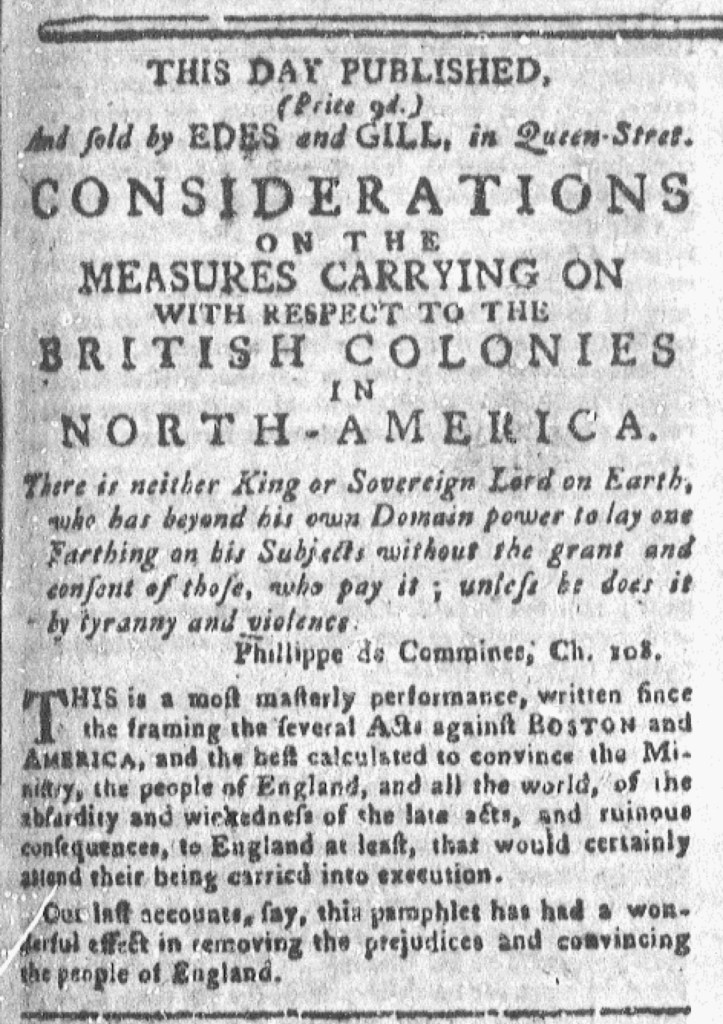
Benjamin Edes and John Gill, the printers of the Boston-Gazette, gave an advertisement for their American edition of Considerations on the Measures Carrying On with Respect to the British Colonies in North-America a prominent place in the August 1, 1774, edition of their newspaper.  It appeared as the first item in the first column on the first page, making it difficult for readers to miss.  The printers wished to call attention to the book, originally published in London, not only because they hoped to generate revenue from its sales but also as a means for colonizers to become even better informed about current events and the political challenges they faced as Parliament passed a series of laws, the Coercive Acts, following the Boston Tea Party.  As the imperial crisis intensified, patriot printers like Edes and Gill published newspapers, broadsides, pamphlets, books, and other items that documented the ongoing contest with Parliament, the king, and royal officials in the colonies.

To convince prospective customers of the necessity of purchasing and perusing this pamphlet, Edes and Gill explained that it was the “most masterly performance, written since the framing of the several Acts against BOSTON and AMERICA,” including the Boston Port Act and the Massachusetts Government Act, and “the best calculated to convince the Ministry, the people of England, and all the world, of the absurdity and wickedness of the late acts.”  Colonizers used newspapers and other publications in their efforts to shape opinion in the colonies, yet they were just as concerned with the information environment on the other side of the Atlantic.  In their publications and letters, they hoped to sway both officials and the general public in London and throughout Great Britain.  They also took note of the support they received for their plight.  In their advertisement for Considerations, Edes and Gill reported that their “last accounts” indicated “this pamphlet had had a wonderful effect in removing the prejudices and convincing the people of England” that Parliament had not been just in its treatment of the colonies.  Whether that was accurate or wishful thinking likely varied from person to person, but the printers wanted to believe that it was true.

Edes and Gill applauded how the pamphlet made a case about the “ruinous consequences, to England at least,” not just the colonies, “that would certainly attend” from the Coercive Acts “being carried into execution.”  Printers in Hartford, New York, and Philadelphia shared those sentiments, producing other American editions in each of those towns.  They hoped that the dissemination of the ideas expressed in Considerations would buttress the resolve of colonizers distressed by Parliament’s most recent legislation, especially upon learning how their allies in England made a case on their behalf.

June 19

What was advertised in a colonial American newspaper 250 years ago today?

New-York Journal (June 9, 1774).

“A PARTICULAR account of Mr. THOMAS SAY … who had fallen into a trance.”

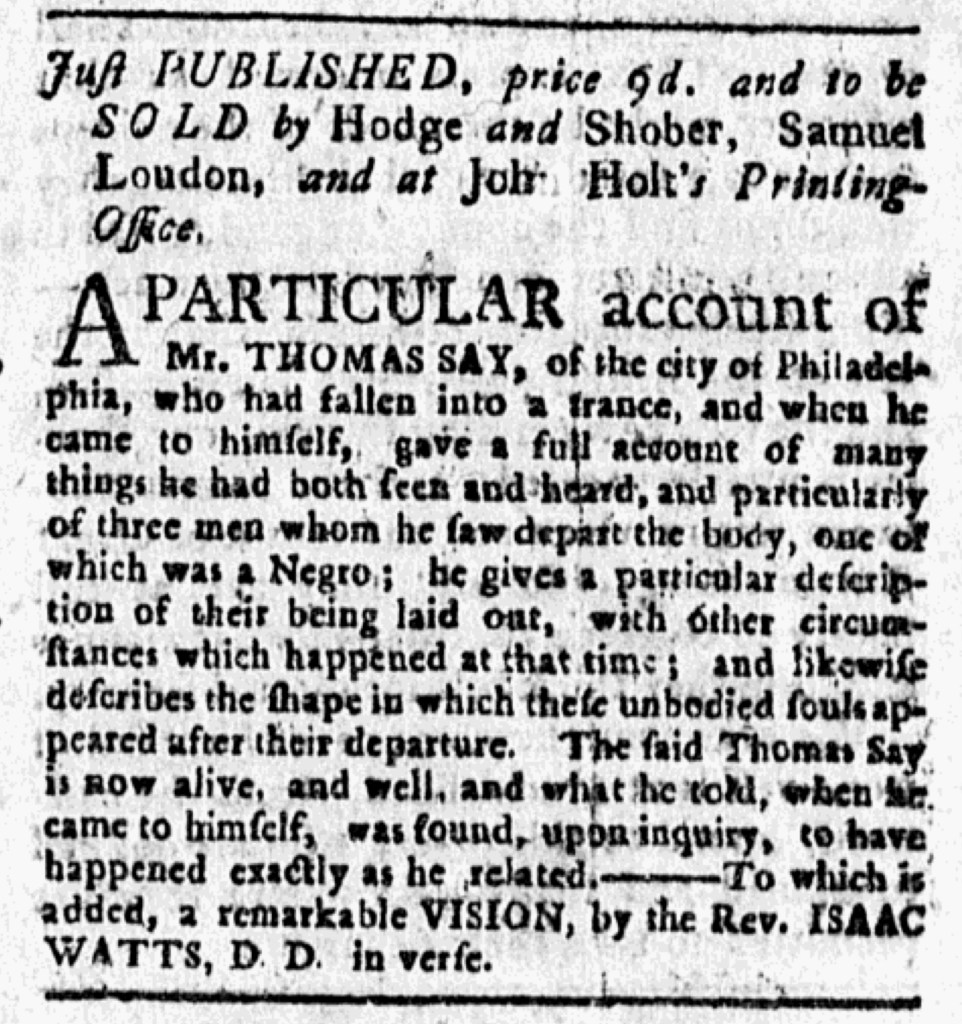
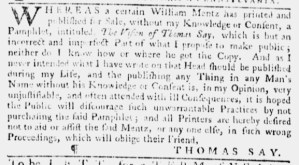
When William Mentz published The Visions of a Certain Thomas Say, of the City of Philadelphia, Which He Saw in a Trance without permission, Say placed an advertisement in the Pennsylvania Gazette to voice his objection.  He described the text as an “incorrect and imperfect” rendition of what he wished to reveal to the public, further asserting that “publishing any Thing in any Man’s Name without his Knowledge or Consent is, in my Opinion, very unjustifiable.”  He concluded with an appeal to “all Printers … not to aid or assist the said Mentz, or anyone else, in such wrong Proceedings.”

Unfortunately for Say, printers and booksellers in New York either did not see that advertisement or, if they did, chose to disregard it in favor of generating revenue by selling the pamphlet.  An advertisement in the June 16, 1774, edition of the New-York Journal described the contents of the work and noted that readers could purchase copies from printers Robert Hodge and Frederick Shober, bookseller Samuel Loudon, and John Holt, printer of the newspaper that carried the advertisement.  Mentz apparently shipped copies of The Visions of a Certain Thomas Say to New York, perhaps exchanging them for titles printed there.  Local agents felt the pamphlet merited a separate advertisement.  Loudon, for instance, simultaneously ran an advertisement for “BOOKS … TO BE SOLD ON THE LOWEST TERMS” that listed dozens of titles but did not mention The Visions of a Certain Thomas Say.  That advertisement also did not promote any books by providing summaries, unlike the advertisement about the pamphlet that Say wished to withdraw from circulation.

In his own advertisement, Say stated that he “never intended what I have wrote … should be published during my Life.”  More than two decades later, Benjamin Say, his son, published A Short Compilation of the Extraordinary Life and Writings of Thomas Say: In Which Is Faithfully Copied, from the Original Manuscript, the Uncommon Vision, Which He Had When a Young Man.  That work, released following Say’s death in 1796, presumably abided by his wishes for disseminating what he recorded of his vision.  During his lifetime, however, a public notice in the Pennsylvania Gazettehad not been enough to prevent the marketing of an unauthorized account.

April 27

What was advertised in a colonial American newspaper 250 years ago today?

Pennsylvania Gazette (April 27, 1774).

“These Baths and Waters … have been for some Years deservedly in the highest Repute.”

As spring gave way to summer in 1774, the proprietors of the “BRISTOL BATHS and CHALYBEATE WELLS” ran an advertisement in the Pennsylvania Gazette to advise residents of Philadelphia and other towns that they provided services “in the most commodious Manner, for such Persons who may incline to make Use of them [during] the approaching Season.”  For any “Strangers” who were not familiar with “these Baths and Waters,” the proprietors proclaimed that they “have been for some Years deservedly in the highest Repute” for their “Effects in a Number of Diseases, which had resisted every other Medicine.”  The chalybeate (or iron-infused) waters had a restorative effect that made visiting the spa an occasion for recuperation as well as relaxation.  The proprietors provided several examples of maladies that the bathing in and drinking the chalybeate waters alleviated.  They asserted that the waters strengthened the stomach, “promoting a good Appetite,” and rejuvenated “relaxed debilitated Constitutions, whether arising from Sickness, residing too long in a warm Climate, or too free living.”  In addition, the iron-infused waters “have infallibly removed” “Obstructions in the Liver, Spleen, and mesenterick Glands.”

Pennsylvania Gazette (April 27, 1774).

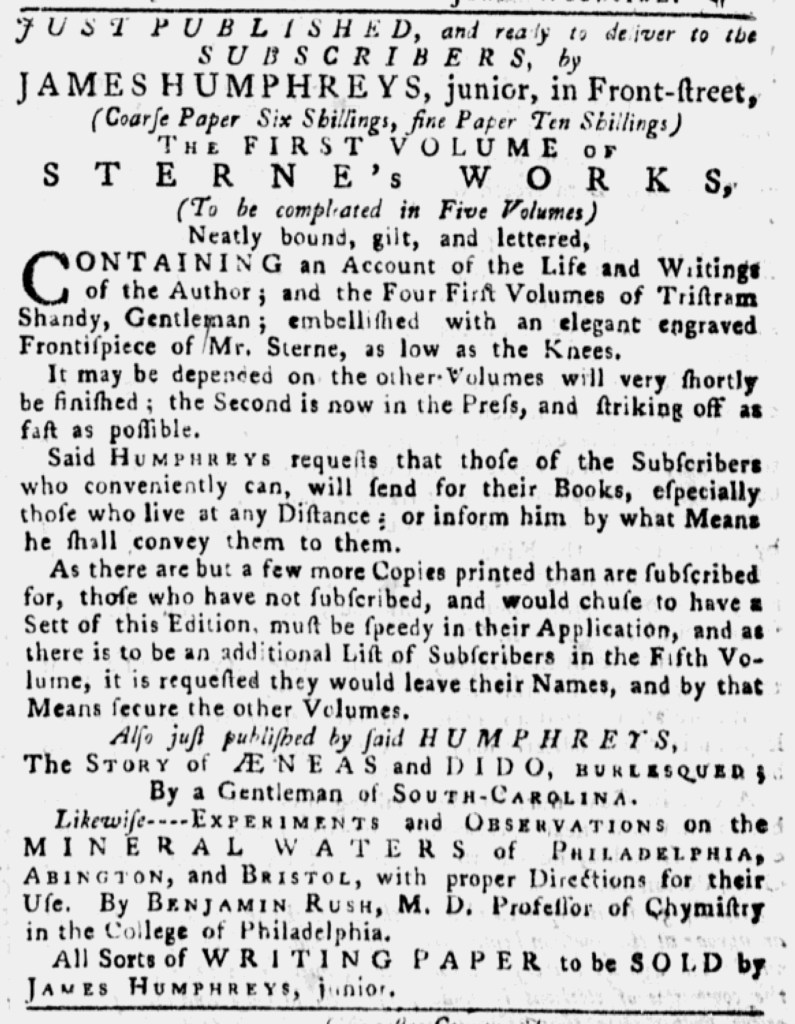
Yet the proprietors did not ask prospective patrons simply to take their word about the effects of the baths and wells in Bristol.  Instead, they declared that the “Advantages to be obtained from Chalybeate Waters are too extensive for an Advertisement, for which Reason the Public are referred” to a pamphlet “by BENJAMIN RUSH, M.D.”  The prominent physician had read a paper, “Experiments and Observations on the Mineral Waters of Philadelphia, Abington, and Bristol,” to the American Philosophical Society on June 18, 1773, and then published it.  The proprietors of the Bristol Baths, Rush gave a more particular Account of their Uses, and the advantageous Situation of Bristol.”  Historian Vaughan Scribner explains that Rush “nurtured colonists’ expanding interest in the science and commercialization of mineral springs.”  The doctor provided a “general location and description of each spring,” described experiments with “mix[ing] more than twenty-one different substances with the mineral waters,” noted several diseases the waters cured (along with only a couple of exceptions), and “contended that the springs could hardly be rivaled for their health and commercial values.”[1]  In the April 27 edition of the Pennsylvania Gazette, printer James Humphreys, Jr., conveniently placed an advertisement on the opposite side of the page as the notice about the Bristol Baths and Chalybeate Wells.  Most of it concerned an update for subscribers to “STERNE’s WORKS,” but the printer appended a note that he sold “EXPERIMENTS and OBSERVATIONS on the MINERAL WATERS … By BENJAMIN RUSH, M.D. Professors of Chymistry in the College of Philadelphia.”  Perhaps that was a happy coincidence for the proprietors of the Bristol Baths and Chalybeate Waters, but maybe they had coordinated with Humphreys to have their advertisements run at the same time.  Either way, they did not direct the public to an obscure pamphlet.  Instead, anyone interested in learning more could easily acquire Rush’s tract.

**********

[1] Vaughn Scribner, “‘The happy effects of these waters’: Colonial American Miner Spas and the British Civilizing Mission,” Early American Studies: An Interdisciplinary Journal 14, no. 3 (Summer 2016): 437, https://doi.org/10.1353/eam.2016.0020.

March 2

What was advertised in a colonial American newspaper 250 years ago today?

Pennsylvania Gazette (March 2, 1774).

“It is hoped the Public will discourage such unwarrantable Practices by not purchasing the said Pamphlet.”

In the winter of 1774, William Mentz published The Visions of a Certain Tho. Say, of the City of Philadelphia, Which He Saw in a Trance.  That pamphlet did not receive attention in the public prints because Mentz advertised it but instead because Thomas Say ran notices repudiating the work.  On March 2, Say inserted advertisements in the Pennsylvania Gazette and the Pennsylvania Journal.  Five days later, he ran the same notice in Dunlap’s Pennsylvania Packet.  He was so intent on disseminating his message as widely as possible that he invested in advertisements in all three of the English-language newspapers published in Philadelphia at the time.

Mentz did not advertise the pamphlet, so Say’s notices may have generated more attention than anything else.  Did they have the intended effect?  Did colonizers refrain from purchasing the pamphlet because Say reacted so strongly to its publication?  Or did the controversy whet their appetites to see what was contained within its pages?  Say denounced “a certain Mentz [who] has printed and published for Sale, without my Knowledge or Consent, a Pamphlet … which is but an incorrect and imperfect Part of what I propose to make public.”  Furthermore, Say did not know “how or where he got the Copy.”  He excoriated Mentz: “publishing any Thing in any Man’s Name without his Knowledge or Consent is, in my Opinion, very unjustifiable, and often attended with ill Consequences.”  Addressing the public, Say made a plea that they “will discourage such unwarrantable Practices by not purchasing said Pamphlet.”  He also requested that printers neither aid nor assist Mentz “in such wrong Proceedings.”

Did that incite instead of quell demand for the pamphlet?  Mentz issued a second version, The Visions of a Certain Thomas Say, of the City of Philadelphia, Which He Saw in a Trance: To Which Is Added, Another Vision. By the Late Reverend Isaac Watts, D.D.  Perhaps he did so because Say’s unintended marketing of the pamphlet yielded interest in it.  On the other hand, Say may have managed to inhibit sales, prompting Mentz to package the pamphlet with a similar item by a popular author in hopes of rescuing the endeavor from financial failure.  Either way, the visibility that the pamphlet received in Philadelphia’s newspapers came solely from Say’s efforts to constrain sales rather than marketing undertaken by the publisher.

October 19

What was advertised in a colonial American newspaper 250 years ago today?

Essex Gazette (October 19, 1773).

“The REPRESENTATIONS of Governor Hutchinson, and others, Contained in certain LETTERS transmitted to England.”

Among the various advertisements in the October 19, 1773, edition of the Essex Gazette, Samuel Hall and Ebenezer Hall, the printers of the newspaper, offered a pamphlet “Just published in Boston” and available at their printing office.  Many readers likely already knew about the contents of the pamphlet, “The REPRESENTATIONS of Governor Hutchinson, and others, Contained in certain LETTERS transmitted to England, and afterwards returned from thence, and laid before the GENERAL ASSEMBLY of the MASSACHUSETTS-BAY, Together with the RESOLVES of the two Houses thereon.”  Acquiring the pamphlet and reading the correspondence for themselves, however, gave colonizers an opportunity to see for themselves exactly what Thomas Hutchinson and others had reported to ministers and members of Parliament in letters that had not been intended for public consumption.  Purchasing and perusing the pamphlet also presented another means of participating in politics.

As Jordan E. Taylor explains in Misinformation Nation: Foreign News and the Politics of Truth ion Revolutionary America, this was not the first instance of printers publishing private letters from colonial officials to associates in London.[1]  In the wake of the arrival of British soldiers in Boston in 1768, Benjamin Edes and John Gill, printers of the Boston-Gazette, published Letters to the Ministry from Governor Bernard, General Gage, and Commodore Hood.  The Halls reprinted the pamphlet and sold it in Salem.  Taylor describes the letters as “quite benign – dull even,” yet a “few passages, nevertheless, aroused indignation,” including “Bernard’s suggestion that the Massachusetts charter be altered to weaken the council and strengthen the office of the governor.”  In addition, letters from customs commissioners recommended “two or three Regiments” to “restore and support Government” in Boston.  From the perspective of the printers and many colonizers, these letters were “hard evidence that a group of officials was conspiring to intentionally exaggerate the disorder in Massachusetts and bring troops into Boston.”

In 1773, the Representations of Governor Hutchison and Others further misrepresented the situation in Massachusetts, at least according to colonizers who advocated for the patriot cause and who recognized a pattern in how the misunderstandings between the colonies and Parliament occurred.  This pamphlet included letters from Thomas Hutchinson, Andrew Oliver, the lieutenant governor, and Charles Paxton, a customs officer.  One passage written by Hutchinson addressed “the abridgment of the colonists’ liberties,” though the governor “claimed that he was predicting, rather than prescribing, that those liberties might eventually be limited.”  Paxton requested “two or three regiments” or else “Boston will be in open rebellion.”  Taylor notes that printers “widely shared the letters in their newspapers,” making them widely accessible and perhaps even generating demand for a volume that collected them together.  The letters gained sufficient interest for the pamphlet to go through ten editions as colonizers examined what Hutchinson and others had written for themselves and constructed their own narrative that the Representations and representations of colonial officials amounted to misrepresentations that caused and exacerbated the imperial crisis.

**********

[1] For a more complete account of Letters to the Ministry and Representations of Governor Hutchinson, see Jordan E. Taylor, Misinformation Nation: Foreign News and the Politics of Truth in Revolutionary America (Baltimore: Johns Hopkins University Press, 2022), 52-54.

May 31

What was advertised in a colonial American newspaper 250 years ago today?

May 31 - 5:31:1770 Pennsylvania Journal
Pennsylvania Journal (May 31, 1770).

“The LIFE and CONFESSION of HERMAN ROSENCRANTZ; Executed in the city of Philadelphia.”

True crime!  James Chattin hoped to capitalize on interest in current events when he hired Joseph Crukshank to print The Life and Confession of Herman Rosencrantz.  An advertisement in the May 31, 1770, edition of the Pennsylvania Journal, presumably placed by Chattin, provided an overview of Rosencrantz’s story.  Just a few weeks earlier he had been “Executed in the city of Philadelphia, on the 5th day of May, 1770, for counterfeiting and uttering the bills of credit of the province of Pennsylvania.”  To incite greater interest and achieve a greater return on his investment, Chattin declared that the Confession was “Taken from his own mouth, in one of the cells of the goal [jail], a short time before he was executed,” the words of a man condemned to die for his crimes.  Chattin also asserted that he published the Confession, a short pamphlet, at Rosncrantz’s request “as a warning to all others.”

While that may have been Rosencrantz’s motivation for dictating his Confession, Chattin likely hoped to earn a profit by publishing and distributing this story of the consequences of a life misled.  He proclaimed that it was “SOLD by the Booksellers in Philadelphia” and had already gained such popularity, the “sale of 2000 of this interesting piece,” to require “that a new impression should be struck off.”  Chattin intended that “Hawkers, Pedlars, and others that buy to sell again” would acquire and distribute the new edition of the pamphlet.  He offered “good allowance,” a discount for purchasing by volume, to retailers and peddlers.  Chattin’s claim that 2000 copies had already sold was most likely inflated to suggest to prospective customers that they stood to miss out on something that had enthralled a good portion of their community.

Chattin also traded on the spectacle of the entire affair, from Rosencrantz’s life that led to his conviction for counterfeiting to his confession delivered in jail to his execution.  The pamphlet also included “an Account [of] his CONFEDERATES,” though much of that part of the narrative was pure imagination.  In The Death Penalty: An American History, Stuart Banner notes that “in a last-minute effort to gain favor” the condemned man “named so many innocent people as his accomplices that the publisher of his confession felt compelled to clear their names in an appendix.”[1]  The false accusations, an attempt to buy time, added to the spectacle.

Chattin aimed to create the eighteenth-century equivalent of a bestseller, trumpeting that he already sold 2000 copies of the account of this extraordinary event.  He invited hawkers and peddlers to disseminate the pamphlet even further beyond the city of Philadelphia, spreading Rosencrantz’s “warning to others” while generating greater revenues.

**********

[1] Stuart Banner, The Death Penalty: An American History (Cambridge: Harvard University Press, 2002), 61.

May 28

What was advertised in a colonial American newspaper 250 years ago today?

May 28 - 5:28:1770 New-York Gazette and Weekly Mercury
New-York Gazette and Weekly Mercury (May 28, 1770).

“THIS Pamphlet was published for the Benefit of Prisoners of Philadelphia Goal [Jail].”

At first glance the advertisement did not look much different than others that offered books and pamphlets for sale: “Very lately published in the City of Philadelphia, and to be sold by the Printer hereof, two Discourses by a Layman of the Church of England.”  Hugh Gaine inserted that notice in the May 28, 1770, edition of the New-York Gazette and Weekly Mercury.  He offered further description of the “Discourses,” stating that they contemplated “the two following Texts; Matt. xv. 15. 25, Then came she and worshipped him saying, Lord help me; Isaiah xlv. 15. Verily thou art a God that hidest thyself, O God of Israel the Saviour.”  Gaine likely drew directly from the title page in composing that portion of the advertisement.

That part of the advertisement could have stood alone.  It provided the same amount of information as others placed by printers and booksellers in colonial American newspapers.  It was in the second portion that the printer made a sales pitch that distinguished this particular advertisement from others for books and pamphlets that ran in the same issue and in other newspapers.  Gaine informed prospective readers that “THIS Pamphlet was published for the Benefit of Prisoners of Philadelphia Goal [Jail].”  Purchasing it, he suggested, was an act of charity and an expression of concern for the public good.  If that was not enough to influence readers to buy the pamphlet, then they could consider it an opportunity to practice philanthropy at a bargain.  Gaine asserted that even though the pamphlet sold for eight pence in Philadelphia, he charged only “the small Sum” of four pence for each copy.  He ran a half-price sale.

Though brief, Gaine’s advertisement contained two marketing strategies that the printer expected would resonate with prospective customers: a bargain price and an opportunity to aid the less fortunate.  That he sold the pamphlet also enhanced Gaine’s own reputation, demonstrating that he supported efforts to benefit the prisoners in Philadelphia. Eighteenth-century advertisements should not be dismissed as simple because they were short or lacked striking visual elements.  In a few short sentences, Gaine made a powerful case for purchasing the pamphlet.