What was advertised in a revolutionary American newspaper 250 years ago today?
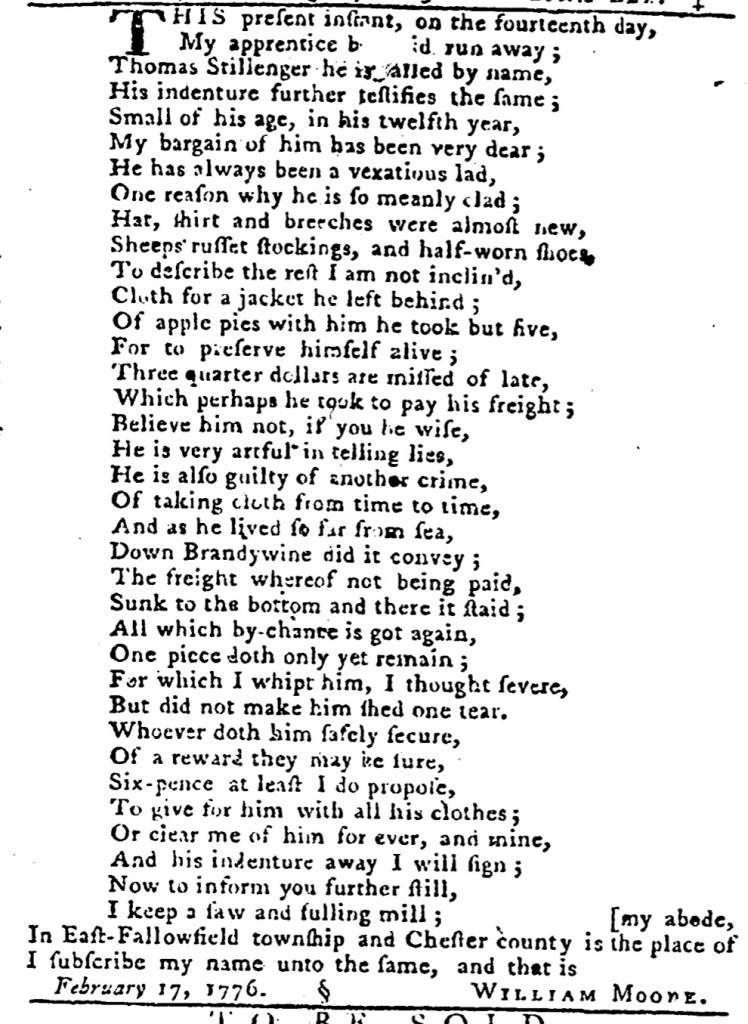
“Whoever doth him safely secure, / Of a reward they may be sure.”
William Moode wanted to increase the chances that his advertisements about his runaway apprentice attracted attention when he ran it in the March 6, 1776, edition of the Pennsylvania Gazette. Instead of the usual paragraph of dense text he composed more than a dozen rhyming couplets that told the story of the young rascal: “Thomas Stillenger he is called by name, / His indenture further testifies the same.”
As Moode told it, Stillenger had never been an ideal apprentice (“He has always been a vexatious lad, / One reason he is so meanly clad”) but instead a troublemaker who told lies (“Believe him not, if you be wise, / He is very artful in telling lies”) and stole goods from the fulling mill that Moode operated (“He is also guilty of another crime, / Of taking cloth from time to time”). Punishing him, Moode claimed, had no effect (I whipt him, I thought severe, / But did not make him shed one tear”), though perhaps it played a part in Stillenger’s decision to run away. Like other aggrieved masters of runaway apprentices and indentured servants, Moode offered a reward for capturing and returning the boy (“Whoever doth him safely secure, / Of a reward they may secure”), though he also indicated his willingness to be rid of Stillenger if anyone would purchase his remaining time (“Or clear me of him for ever, and mine, / And his indenture away I will sign”).
When setting the type, the compositor indented all but the last two lines of the poem, creating a significant amount of white space along the left side of the advertisement. Most lines ended far short of the right side of the column rather than being justified too it like other advertisements. That allowed for even more white space that distinguished Moode’s advertisement from all the other news and notices in that issue of the Pennsylvania Gazette. That likely drew attention. Readers may have become even more intrigued when they saw the rhyming couplets. Although the Pennsylvania Gazettewas not one of them, some newspapers had a regular feature, the “Poet’s Corner” on the final page, with poems of no better quality than the one Moode wrote. Readers may have taken note of the advertisement for its novelty and entertainment value. For his part, Moode may have derived more pleasure from writing this poem than from any of his interactions with Stillenger when the apprentice worked in his mill.