What was advertised in a revolutionary American newspaper 250 years ago today?
Pennsylvania Gazette (February 21, 1776).
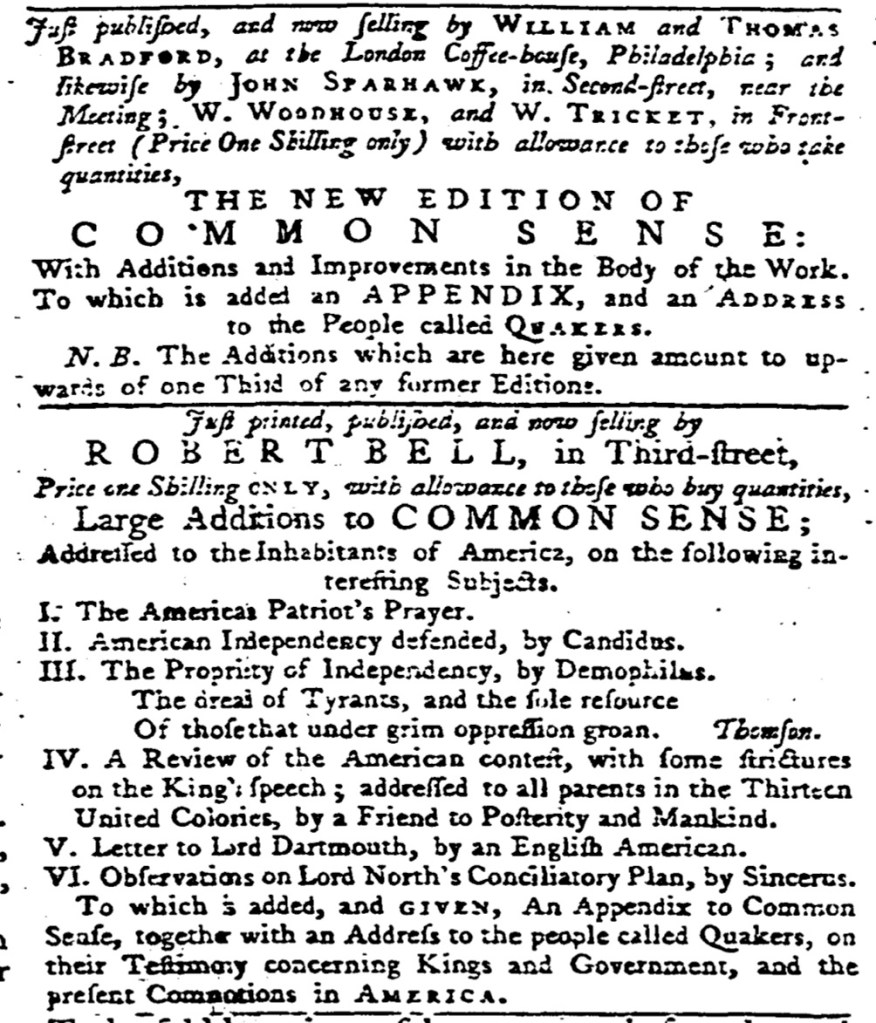
“THE NEW EDITION OF COMMON SENSE.”
“Large Additions to COMMON SENSE.”
Although Benjamin Towne most frequently published advertisements for Thomas Paine’s Common Sense in his Pennsylvania Evening Post, he was not the only printer in Philadelphia to generate revenue from advertisements for competing editions of the pamphlet. Other newspapers also carried advertisements for Common Sense. After Paine and Robert Bell, the publisher of the first edition, had a falling out, Bell went forward with an unauthorized second edition and Paine worked with William Bradford and Thomas Bradford, the printers of the Pennsylvania Journal, on an expanded edition that featured new material. Not to be outdone, Bell advertised, published, and sold other supplementary material that he billed as “Large Additions to COMMON SENSE,” though Paine was not the author of those pieces that Bell instead reprinted from newspapers. Bell and Paine and then Bell and the Bradfords engaged in bitter exchanges in their advertisements in the Pennsylvania Evening Post.
They also placed more subdued notices in other newspapers. In the February 21, 1776, edition of the Pennsylvania Gazette, for instance, their advertisements ran one after the other. In the first, the Bradfords announced that they “Just published … THE NEW EDITION OF COMMON SENSE: With Additions and Improvements in the Body of the Work.” To entice readers to select their pamphlet, they added a nota bene that stated that the “Additions … amount to upwards of one Third of any former Editions.” Customers could acquire this new edition from the Bradfords “at the London Coffee-house” and from associates in the book trades, including John Sparhawk, William Trickett, and William Woodhouse. Immediately below that advertisement, Bell hawked his “Large Additions.” He listed the contents, just as he had done in his first advertisements for the first edition of Common Sense. He also declared that he added Paine’s “Address to the people called Quakers,” pirated from the Bradfords’ new edition. Like Towne, the printers of the Pennsylvania Gazette, William Hall, David Hall, and William Sellers, did not need to sell a single copy of the pamphlet to generate revenue from it. They made their money on Common Sense from the competing advertisements placed by Bell and the Bradfords!
What was advertised in a revolutionary American newspaper 250 years ago today?
Pennsylvania Gazette (January 24, 1776).
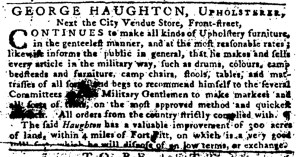
“GEORGE HAUGHTON,, UPHOLSTERER … makes and sells every article in the military way.”
In January 1776, George Haughton, an upholsterer in Philadelphia, placed an advertisement in the Pennsylvania Gazetteto remind the public that he “CONTINUES to make all kinds of Upholstery furniture.” A year earlier, he introduced himself as an “UPHOLSTERER, lately from LONDON,” in a notice in the January 30, 1775, edition of the Pennsylvania Journal. Like other newcomers, he realized that prospective customers did not know him like reputation. “He being a stranger,” Haughton declared, “has no recommendation but his skill in his profession, which he hopes the Public will give him an opportunity to shew.” The upholsterer underscored that he “had the advantage of serving a regular apprenticeship to that trade in one of the most capital shop in London, and working in most of the others” distinguishing him from other upholsterers in Philadelphia.
In his new advertisement, Haughton tried a new marketing appeal. He targeted customers who needed military equipment, proclaiming that he “makes and sells every article in the military way.” That included “drums, colours [or flags and pennants], camp bedsteads and furniture, camp chairs, stools, tables, and mattrasses of all sorts.” Fashion mattered, even during times of war, so Haughton assured prospective customers that he produced his wares “in the genteelest manner,” yet they did not overcharge. He sold these items “at the most reasonable rates.” Haughton addressed “the several Committees [of the] Military Gentlemen,” hoping to “recommend himself” to them to supply “markees [marquees (officers’ field tents)] and all sorts of tents, on the most approved method and quickest dispatch.” Quality and efficiency mattered, as did providing officers and soldiers with exactly what they needed whether they appeared at his shop in person or sent orders from a distance. “All orders from the country,” Haughton pledged, “strictly complied with.” The Revolutionary War presented new business opportunities for some entrepreneurs. Haughton hoped to turn the situation to his advantage with an advertisement in one of Philadelphia’s most popular newspapers.
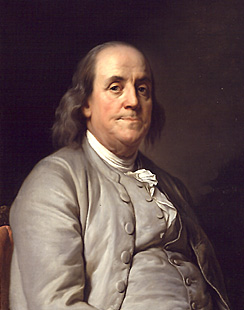
Today is an important day for specialists in early American print culture, for Benjamin Franklin was born on January 17, 1706 (January 6, 1705, Old Style), in Boston. Among his many other accomplishments, Franklin is known as the “Father of American Advertising.” Although I have argued elsewhere that this title should more accurately be bestowed upon Mathew Carey (in my view more prolific and innovative in the realm of advertising as a printer, publisher, and advocate of marketing), I recognize that Franklin deserves credit as well. Franklin is often known as “The First American,” so it not surprising that others should rank him first among the founders of advertising in America.
Franklin purchased the Pennsylvania Gazette in 1729. In the wake of becoming printer, he experimented with the visual layout of advertisements that appeared in the weekly newspaper, incorporating significantly more white space and varying font sizes in order to better attract readers’ and potential customers’ attention. Advertising flourished in the Pennsylvania Gazette, which expanded from two to four pages in part to accommodate the greater number of commercial notices.
Advertisements with white space, varying sizes of font, capitals and italics, and a woodcut from Benjamin Franklin’s Pennsylvania Gazette (December 9-16, 1736).
Many historians of the press and print culture in early America have noted that Franklin became wealthy and retired as a printer in favor of a multitude of other pursuits in part because of the revenue he collected from advertising. Others, especially David Waldstreicher, have underscored that this wealth was amassed through participation in the colonial slave trade. The advertisements for goods and services featured in the Pennsylvania Gazette included announcements about buying and selling enslaved men, women, and children as well as notices offering rewards for those who escaped from bondage.
Advertisement for an enslaved woman and an enslaved child from Benjamin Franklin’s Pennsylvania Gazette (December 9-16, 1736).
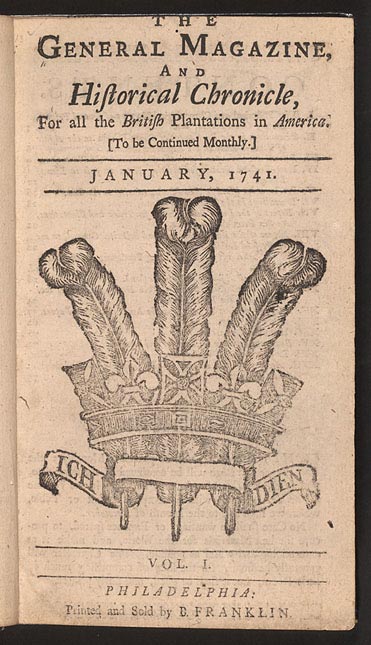
In 1741 Franklin published one of colonial America’s first magazines, The General Magazine and Historical Chronicle, for all the British Plantations in America (which barely missed out on being the first American magazine, a distinction earned by Franklin’s competitor, Andrew Bradford, with The American Magazineor Monthly View of the Political State of the British Colonies). The magazine lasted only a handful of issues, but that was sufficient for Franklin to become the first American printer to include an advertisement in a magazine (though advertising did not become a standard part of magazine publication until special advertising wrappers were developed later in the century — and Mathew Carey was unarguably the master of that medium).
General Magazine and Historical Chronicle, For all the British Plantations in America (January 1741). Library of Congress.
In 1744 Franklin published an octavo-sized Catalogue of Choice and Valuable Books, including 445 entries. This is the first known American book catalogue aimed at consumers (though the Library Company of Philadelphia previously published catalogs listing their holdings in 1733, 1735, and 1741). Later that same year, Franklin printed a Catalogue of Books to Be Sold at Auction.
Franklin pursued advertising through many media in eighteenth-century America, earning recognition as one of the founders of American advertising. Happy 320th birthday, Benjamin Franklin!
What was advertised in a revolutionary American newspaper 250 years ago today?
Pennsylvania Gazette (January 10, 1776).
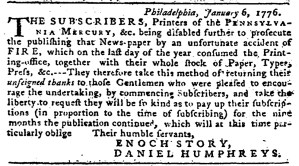
“Disabled further to prosecute the publishing that News-paper by an unfortunate accident of FIRE.”
As the imperial crisis intensified, Enoch Story and Daniel Humphreys launched the Pennsylvania Mercury (quickly renamed Story and Humphreys’s Pennsylvania Mercury) on April 7, 1775. That newspaper joined two others founded earlier in the year, the Pennsylvania Evening Post on January 24 and the Pennsylvania Ledger on January 28, as well as Dunlap’s Pennsylvania Packet, the Pennsylvania Gazette, the Pennsylvania Journal, and the Wochentliche Pennsylvanische Staatsbote. During the first four months of 1775, Philadelphia surpassed Boston in terms of the number of newspapers printed there. With the outbreak of hostilities at Lexington and Concord on April 19 and the ensuing siege of Boston, several of Boston’s newspapers ceased publication or relocated to other towns.
Yet Boston was not the only major port city that saw one of its newspapers cease publication during the first year of the Revolutionary War. Story and Humphreys’s Pennsylvania Mercury lasted less than a year, though disruptions caused by the war did not lead to its demise. Unfortunately, “an unfortunate accident of FIRE … consumed the Printing-office, together with their whole Stock of Paper, Types, Press,” and other equipment on December 31. The situation did not leave any possibility for the partners to recover and eventually resume publication. “[B]eing disabled further to prosecute the publishing [of] that News-paper,” they announced in an advertisement in the Pennsylvania Gazette, they instead expressed “their unfeigned thanks” to the subscribers who had supported the venture and requested that they “will be so kind as to pay up their subscriptions (in proportion to the time of subscribing) for the nine months the publication continued.” In other words, they expected customers to make prorated payments based on the number of issues they received. Humphreys eventually tried again, but not until after the Revolutionary War. On August 20, 1784, he commenced publishing a new Pennsylvania Mercury.
Even with the loss of Story and Humphreys’s Pennsylvania Mercury, Philadelphia still had more newspapers than any other city or town in the colonies. As the war continued, not all of them survived. Some closed permanently while others moved to other towns or suspended publication during the British occupation of Philadelphia. Yet, as the “unfortunate accident of FIRE” at Story and Humphreys’s printing office demonstrated, disruptions caused by the war were not the only dangers that forced newspapers to fold.
What was advertised in a revolutionary American newspaper 250 years ago this week?
Connecticut Journal (December 27, 1775).
“He will publish No. I. of a News-Paper … THE NEW-YORK PACKET; OR THE AMERICAN ADVERTISER.”
The American Revolution resulted in an explosion of print. The disruptions of the war led to the demise of some newspapers, but others continued, joined by new publications during the war and, especially, even more newspapers after the war ended. The major port cities had one or more newspapers before the Revolutionary War. Many minor ports also had a newspaper. Once the new nation achieved independence, printers commenced publishing newspapers in many more towns. Thoughtful citizenship depended in part on the widespread dissemination of news. Samuel Loudon’s New York Packet was part of that story.
In December 1775, Loudon announced that he “will publish No. I. of a News-paper, (To be continued weekly)” on Thursday, January 4. He initially advertised in other newspapers printed in New York, but by the end of the month others carried his proposals, including the Connecticut Journal, published in New Haven, and the Pennsylvania Gazette, published in Philadelphia. Newspapers circulated far beyond their places of publication. Printers wanted them to supply content for their own newspapers. The proprietors of coffeehouses and taverns acquired them for their patrons. Merchants used them for updates about both commerce and politics. Loudon had a reasonable expectation of attracting subscribers beyond New York. A nota bene at the end of his advertisement in the Connecticut Journal noted that “Subscriptions [were] taken by the Printers, and all the Post Riders,” a network of local agents that assisted in distributing Loudon’s newspaper.
Pennsylvania Gazette (December 27, 1775).
To entice potential subscribers, Loudon explained that he “is encouraged to undertake this arduous work by the advice and promised literary assistance of a numerous circle of warm friends to our (at present much distressed) country.” That signaled to readers that Loudon supported the American cause. It also offered assurances that he had the means to acquire sufficient content to publish a weekly newspaper. To that end, Loudon pledged “to do everything in his power to render it a complete and accurate NEWS-PAPER, that the Public may thereby receive the earliest intelligence of the state of our public affairs, and of the several interesting occurrences which may occasionally happen whether at home or abroad.” In the spirit of newspaper providing the first draft of history, the printer declared that he “flatters himself that the NEW YORK PACKET, will influence every discerner of real merit, who may encourage the work, to preserve it in volumes, as a faithful Chronicle of our own time.”
In addition to expressing such ideals, Loudon also tended to the business aspects of establishing a newspaper. He reported that he “already possessed himself of a neat and sizeable set of TYPES … together with every other necessary for carrying on a splendid News Paper.” Soon enough, “the best of hands shall be procured to perform the mechanical part.” Subscribers could expect the New York Packet “will be printed … on a large Paper, of a good Quality, and equal in Size to the other News-Papers published in this City.” Subscriptions cost twelve shillings per year. Loudon also solicited advertisements, indicating that they “will be inserted at the usual Price of Five Shillings, when of a moderate Length, and continued Four Weeks.” As was the practice in other printing offices, “longer Advertisements to be charged accordingly.”
Loudon did indeed launch the New York Packet on January 4, 1776. It lasted only eight months in New York, suspended after the August 29 edition, as Clarence S. Brigham explains, “immediately prior to the entry of the British into New York. Loudon re-established the paper at Fishkill in January, 1777, and at the close of the War returned to New York.”[1] Without changing the volume numbering, he continued publishing the New York Packet from November 13, 1783, through January 26, 1792. By then, Loudon published the newspaper three times a week, part of that explosion of print that occurred during the era of the American Revolution. Shortly after closing the New York Packet, Loudon and his son, Samuel, established a daily newspaper, The Diary; or Loudon’s Register. Unfortunately, the issues of the New York Packet published in 1776 have not been digitized for greater access, though the run for 1783 through 1792 is available via Readex’s America’s Historical Newspapers. That means that advertisements and other content from that newspaper will not be featured in the Adverts 250 Project, its story confined to the subscription proposals that ran in other newspapers.
**********
[1] Clarence S. Brigham, History and Bibliography of American Newspapers, 1690-1820 (Worcester, Massachusetts: American Antiquarian Society, 1947), 675.
What was advertised in a revolutionary American newspaper 250 years ago today?
Pennsylvania Gazette (December 27, 1775).
“I DO hereby give Information / A BULL broke into my Plantation.”
A stray bull that came to a farm was a nuisance, at best, and placing a newspaper advertisement in hopes of identifying the owner was even more of an inconvenience, yet Thomas Paxson of Middletown in Bucks County, Pennsylvania, decided to have some fun with it. Rather than write a standard notice, the type that appeared in newspapers throughout the colonies, he composed half a dozen rhyming couplets:
I DO hereby give Information,
A BULL broke into my Plantation,
About three Months before this Date,
Whose natural Marks I shall relate;
His Face is white, his Sides are black,
With a white List along his Back;
I think the strange mischievous Beast,
Must be three Years of Age at least;
And if the Owner does appear,
Before the last Day of the Year,
And prove his Right and Charges pay,
Then he may drive his Beast away.
Though certainly not the belles lettres popular among the better sorts in the eighteenth century, the poem likely drew the attention of readers from various backgrounds as they perused the December 27, 1775, edition of the Pennsylvania Gazette. The compositor indented each line of the poem, creating white space that differentiated Paxson’s advertisement from any other notices or news in that issue. The format likely inspired readers to give the advertisement an initial glance out of curiosity, then the novelty of the rhymes may have encouraged them to spend just a moment reading through it.
News covered elsewhere in that issue included updates about the Revolutionary War from Massachusetts, New York, Maryland, and Virginia as well as a smattering of news from Pennsylvania. Some readers may have appreciated Paxson’s creativity and the moment of levity that he introduced among more serious news. Unlike other newspapers that regularly printed a “Poets Corner” on the final page, the Pennsylvania Gazette did not have that feature. When he paid to insert his advertisement, Paxson made an editorial decision to remedy it, at least for one issue.
What was advertised in a revolutionary American newspaper 250 years ago today?
Pennsylvania Gazette (November 29, 1775).
“We, the subscribers, do recommend the above named John Spering as a Rider.”
In the fall of 1775, John Spering, a resident of Easton, took to the pages of the Pennsylvania Gazette to announce that he “proposes to ride POST” between Philadelphia and Northampton. Along the way he would make stops in “Germantown, Bussel-town [now Bustleton], Four-lane-end [now Langhorne], Newtown, Durham, Easton, Bethlehem, and Northampton.” Until January 1, he would depart Philadelphia each Wednesday evening. In January, February, and March, he planned to scale back service to “once every fortnight,” presumably due to the weather, and then resume weekly service on April 1. He assured “All Gentlemen and ladies who are pleased to encourage this undertaking” that they “may depend upon being punctually served, and that the greatest care will be taken of such letters, or other things,” such as small parcels, entrusted to him. Given that the Pennsylvania Gazette circulated widely beyond Philadelphia, Spering hoped that his advertisement would attract patrons in the many towns along his route.
He also realized that most prospective customers did not know him and thus might be cautious about handing over letters and packages. To address such concerns, he included a character reference signed by nine residents of Easton. “We, the subscribers,” they declared, “do recommend the above named John Spering as a Rider, as we believe he will perform his duty therein faithfully and honestly.” They noted that Spering had been “a resident in Easton for upwards of thirteen years, where he has, during that time, behaved himself very well.” Prospective clients could have confidence that he would faithfully deliver their letters without tampering with them. The signatories would have been as unknown to most readers as Spering, but the titles that accompanied some of their names testified to their trustworthiness and standing in their community: “Lewis Gordon, Esq; Henry Fullert, Esq; Dr. Andrew Ledlie, [and] Jacob Orndt, Esq.” That so many of his neighbors endorsed Spering at the risk of their own reputations may have helped to convince the “Gentlemen and Ladies” that Spering addressed to avail themselves of his services when they had letters to post.
What was advertised in a revolutionary American newspaper 250 years ago today?
Pennsylvania Gazette (November 22, 1775).
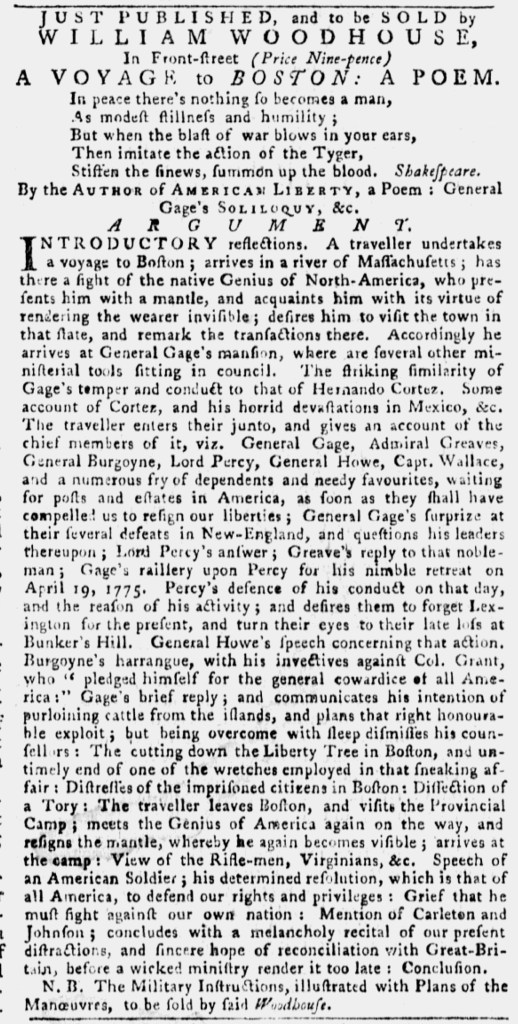
“A VOYAGE to BOSTON: A POEM.”
An advertisement for a new publication, “A Voyage to Boston: A Poem,” appeared on the front page of the November 18, 1775, edition of the Pennsylvania Ledger. William Woodhouse, a bookseller, stationer, and bookbinder marketed a work that historians attribute to the pen of Philip Freneau and the press of Benjamin Towne. The imprint on the title page merely stated, “Philadelphia: Sold by William Woodhouse, in Front-Street.” The advertisement did advise that “A Voyage to Boston” was “By the same Author of AMERICAN LIBERTY: A Poem. General Gage’s SOLILOQUY, &c.” A similar note appeared on the title page. Woodhouse likely hoped that associating this publication with ones already familiar to readers would aid in inciting demand for the work. He also inserted five lines about peace and war from Shakespeare, transcribing them from the title page of the pamphlet.
Four days later, he published a much more extensive advertisement in the Pennsylvania Gazette. It contained all the content from the version in the Pennsylvania Ledger, including a nota bene that announced, “The Military Instructions, illustrated with Plans of the Manœuvres, to be sold by said Woodhouse.” The new advertisement also featured the “ARGUMENT” of the poem. That summary provided an overview of recent events as observed by an imaginary “traveller [who] undertakes a voyage to Boston” and, after being bestowed with a cloak of invisibility by the “Genius of North-America,” entered the city and witnessed General Thomas Gage and “several other ministerial tools sitting in council” as they discussed the battles at Lexington and Concord and “their late loss at Bunker’s Hill,” the “cutting down of the Liberty Tree in Boston,” and the “Distresses of the imprisoned citizens in Boston” as the siege of the city continued. The traveler departed from Boston, visited “the Provincial Camp,” returned the cloak, saw “the Rifle-men, Virginians,” and others who supported the American cause, and listened to the “Speech of an American Soldier,” delivered with “determined resolution, which is that of all America, to defend our rights and privileges.” The poem concluded with a “sincere hope of reconciliation with Great-Britain, before a wicked ministry render it too late.” Most colonizers still sought a redress of grievances rather than separating from the British Empire. In adding this lengthy “ARGUMENT” to the advertisement, Woodhouse did not compose original copy. Instead, just as the lines from Shakespeare came from the title page of the pamphlet, the “ARGUMENT” filled two pages of the pamphlet preceding the poem. Although he did not write the copy, Woodhouse apparently decided that providing more information about the contents of the poem would help to increase sales.
What was advertised in a revolutionary American newspaper 250 years ago today?
Pennsylvania Gazette (November 8, 1775).
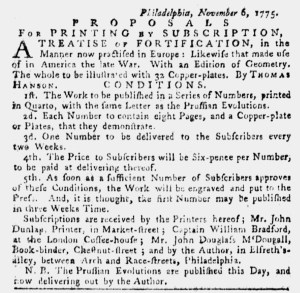
“PROPOSALS FOR PRINTING BY SUBSCRIPTION, A TREATISE OF FORTIFICATION.”
Thomas Hanson announced a new project in the November 8, 1775, editions of the Pennsylvania Gazette and the Pennsylvania Journal. For several months he had been engaged in soliciting subscribers for his Prussian Evolutions in Actual Engagements, a military manual that garnered the support of both officers and politicians. With that book “published … and now delivering out by the Author,” Hanson distributed subscription proposals for printing “A TREATISE OF FORTIFICATION, in the Manner now practiced in Europe: Likewise that made use of in America the late War.” The Prussian Evolutions included thirty copperplate engravings; similarly, this new endeavor would be “illustrated with 32 Copper-plates.”
Hanson adopted a different method for publishing the proposed treatise than he had for the Prussian Evolutions. Rather than produce a single volume, he planned for the “Work to be published in a Series of Numbers, printed in Quarto, with the same Letter as the Prussian Evolutions,” “Each Number to contain eight Pages, and a Copper-plate or Plates, that they demonstrate,” and “One number to be delivered to the Subscribers every two Weeks.” Eighteenth-century readers would have been familiar with such “CONDITIONS” for publishing books. Hanson planned to use the type (“same Letter”) as his first book, giving the two works a similar appearance. Instead of taking the entire book to press at one time, Hanson planned to print and distribute two sheets (“eight Pages”) and the corresponding illustrations once every two weeks. Each sheet would have four pages on it, creating a quarto sized book when folded by the printer, bookbinder, or subscriber. Subscribers paid six pence “per Number” or set of eight pages with corresponding illustrations upon delivery.
Hanson declared that “the Work will be engraved and put to the Press” once “a sufficient Number of Subscribers approves of these Conditions.” Why did he opt to publish his treatise on fortifications in smaller parts rather than all at once? Perhaps Hanson had grown frustrated with the delays in publishing the Prussian Evolutions. In an earlier advertisement, he noted that he first published subscription proposals on May 3, shortly after learning about the battles at Lexington and Concord. In July, he thought that the book would be completed “in three or four weeks,” yet more than three months passed before the volume was published and ready for delivery. Printing and distributing a new “Number” every two weeks would keep the project moving forward and the revenues collected upon delivery would likely help as well. Hanson expected that “the first Number may be published in three Weeks Time,” but it seems that he was disappointed once again. It does not appear that this proposed project met with the same success as the Prussian Evolutions. Even if some “Numbers” went to press, no complete volume of the proposed treatise survives today. Most likely, Hanson did not entice a “sufficient Number of Subscribers.” According to the American Revolution Institute of the Society of the Cincinnati, he faced a lot of competition. Presses in Philadelphia produced more than thirty works on military subjects in 1775 and 1776, including Hanson’s Prussian Evolutions.
What was advertised in a revolutionary American newspaper 250 years ago today?
Pennsylvania Gazette (September 20, 1775).
“A neat and correct VIEW of the late BATTLE at CHARLESTOWN, not inferior to any hithero proposed.”
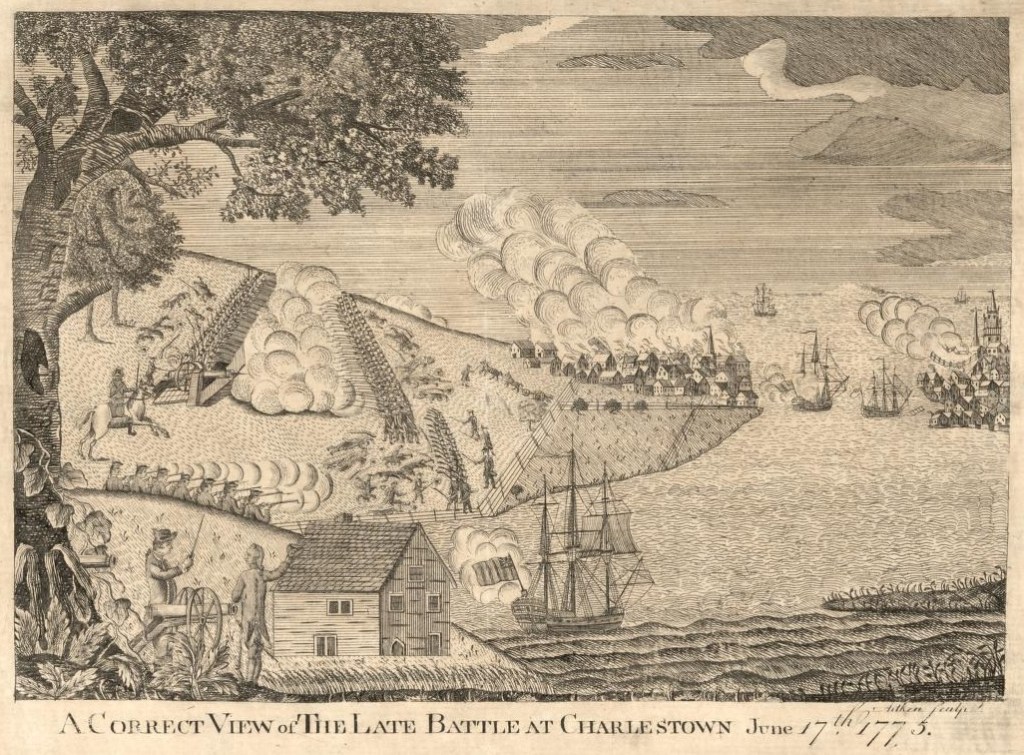
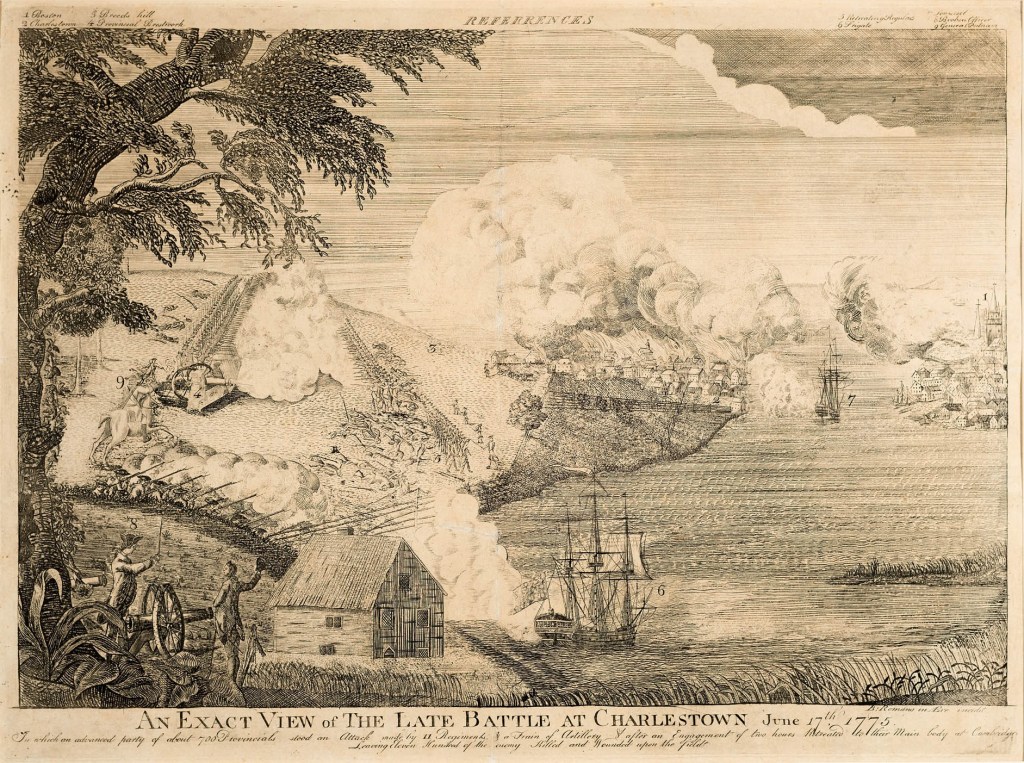
After appearing in the Pennsylvania Ledger on September 16, 1775, the subscription proposal for “An exact VIEW of the late Battle at Charlestown,” now known as the Battle of Bunker Hill, ran in the Pennsylvania Gazette four days later. It featured nearly identical copy, including a list of local agents, among them several printers in Philadelphia, who collected the names of subscribers in that city and other towns from New York to Virginia. The notice named Nicholas Brooks as the “printer of said view,” but did not mention that he collaborated with Bernard Romans, the cartographer and engraver. An addition at the bottom of the advertisement, “Frames and Glass may be had at the abovesaid N. Brooks’s,” suggested that Brooks managed the marketing of the proposed print.
Immediately below that advertisement, Robert Aitken announced, “NOW engraving for the Pennsylvania Magazine, or American Monthly Museum, a neat and correct VIEW of the late BATTLE at CHARLESTOWN, not inferior to any hitherto proposed.” Aitken, who was not among the printers listed as local agents for the Brooks and Romans print, promoted a competing print! This one, however, “shall be printed in a size proper for the Magazine.” The two prints looked strikingly similar, not unlike the competing prints of the Boston Massacre produced by Henry Pelham and Paul Revere in 1770, though one was larger than the other. Aitken’s print measured 18 x 26 cm (approximately 7 x 10 inches), the right size to tuck it inside the magazine for delivery to subscribers. Brooks and Romans’s print measured 31.5 x 42.2 cm (approximately 12.5 x 16.5 inches) on a 40.6 x 50.5 cm sheet (approximately 16 x 20 inches), perhaps making it a better candidate to frame and display.
Robert Aitken (engraver and publisher), “A Correct View of the Late Battle at Charlestown” (1775). Courtesy Library of Congress.
Subscribers to the Pennsylvania Magazine received the print as a premium. Nonsubscribers could purchase the issue for “One Shilling and Sixpence, on account of the great expence of the engraving.” On other occasions, including the September 16, 1775, edition of the Pennsylvania Ledger, Aitken advertised the price as one shilling per issue. He now informed “those Gentlemen who incline to purchase this View of the Battle may be furnished with it at the moderate price of Sixpence.” In effect, he did not give readers who purchased a single issue of the magazine any sort of discount, perhaps hoping to encourage them to subscribe to receive the print as a gift. Whatever the case, Aitken’s print was slightly more expensive than the five shillings that Brooks and Romans charged for their uncolored print.
Nicholas Brooks (publisher) and Bernard Romans (engraver), “An Exact View of the Late Battle at Charlestown” (1775). Courtesy Massachusetts Historical Society.
Given the similarity of the prints, did Aitken pirate his “VIEW of the late BATTLE at CHARLESTOWN” from Brooks and Romans? That had been the case with Revere issuing a print based on a drawing by Pelham before the artist managed to publish his own. Or did Aitken collaborate with Brooks and Romans? It was not the first time that an image that accompanied his magazine resembled one of their projects. The July 1775 issue of the Pennsylvania Magazinefeatured a map, “A New and Correct Plan of the Town of Boston, and Provincial Camp.” Aitken marketed it at the same time that Brooks and Romans published a map of eastern Massachusetts and northern Rhode Island that featured an inset showing a “Plan of BOSTON and its ENVIRONS 1775.” The two did not resemble each other as much as the “VIEW” that each advertised. Whether they collaborated or competed, Aitken and Brooks and Romans all aimed to disseminate a commemorative item that simultaneously kept buyers better informed and inspired them to support the American cause.