June 15

What was advertised in a colonial American newspaper 250 years ago today?
Pennsylvania Journal (June 15, 1774).

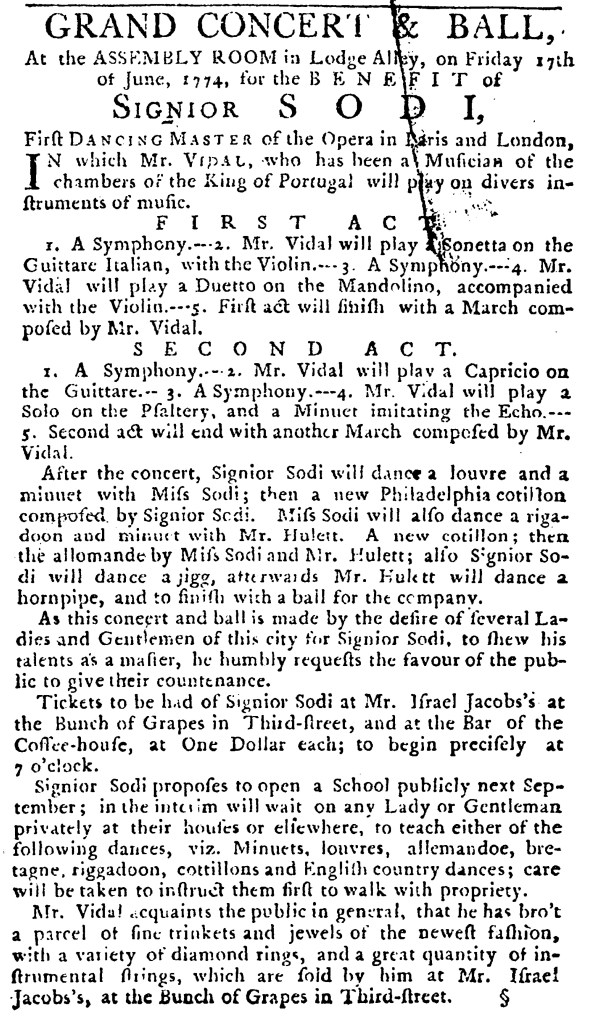
“This concert and ball is made by the desire of several Ladies and Gentlemen of this city.”

Genteel residents of Philadelphia did not want to miss the “GRAND CONCERT & BALL, At the ASSEMBLY TOOM in Lodge Alley” on June 17, 1774.  At least that was the intention of Signior Sodi, “First DANCING MASTER of the Opera in Paris and London,” when he advertised the event in the Pennsylvania Journal.  Sodi worked with “Mr. VIDAL, who has been a Musician of the chambers of the King of Portugal,” in putting together a program that included ten musical performances in two acts followed by demonstrations of Sodi’s dancing.  He claimed that he hosted the event “by the desire of several Ladies and Gentlemen of this city” who wished for him “to shew his talents as a master.”  For his part, he “humbly requests the favour of the public to give their countenance.”  To do that, the audience needed to purchase tickets, either from Sodi “at the Bunch of Grapes” on Third Street or “at the Bar” at the London Coffee House, a popular place for socializing and conducting business.

Whether or not “Ladies and Gentlemen of this city” encouraged Sodi to host a concert and ball, he used the opportunity to market other endeavors to support himself beyond ticket sales for that event.  He used the occasion to announce that he planned to “open a School” in September.  Until then, he “will wait on any Lady or Gentleman privately at their houses or elsewhere” to give lessons.  In addition to learning the steps for several dances, his students would also receive instruction “to walk with propriety.”  His pupils, Sodi suggested, would demonstrate more grace both on and off the dance floor, an important goal for colonizers anxious about so many aspects of their comportment.  Indeed, those interested in lessons from Sodi may have also taken note of lessons that Francis Daymon, “Master of the French and Latin Languages,” advertised in the same column in the Pennsylvania Journal.  Yet Sodi did not stake his entire livelihood on teaching the genteel and those aspiring to join their ranks to dance.  He also “acquaints the public in general” that he “bro’t a parcel of fine trinkets and jewels of the newest fashion, with a variety of diamond rings, and a great quantity of instrumental strings.”  He offered those items for sale at the Bunch of Grapes.  His “GRAND CONCERT & BALL” presented an opportunity for merchandising, not unlike the modern entertainment industry.

June 1

What was advertised in a colonial American newspaper 250 years ago today?

Pennsylvania Journal (June 1, 1774).

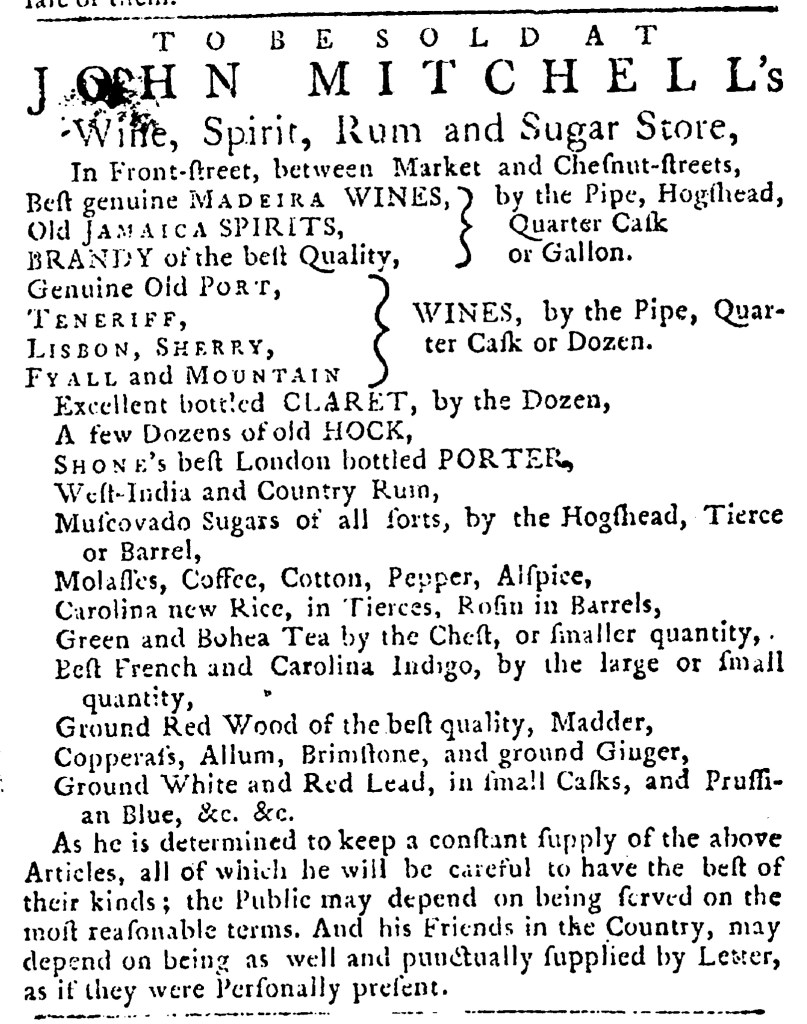
“Wine, Spirit, Rum and Sugar Store.”

John Mitchell ran the “Wine, Spirit, Rum and Sugar Store” on Front Street in Philadelphia in the 1770s.  Thomas Batt’s “WINE and SPIRIT STORE” was among his competitors for customers in the bustling urban port and its hinterlands.  To attract the attention of prospective customers, Mitchell provided an extensive list of his inventory in his advertisement in the June 1, 1774, edition of the Pennsylvania Journal.  He sold “Best genuine MADEIRA WINES, Old JAMAICA SPIRITS, [and] BRANDY of the best Quality, by the Pipe, Hogshead, Quarte Cask or Gallon.”  Similarly, his patrons could purchase several kinds of wine, including “Genuine OLD PORT, [and] TENRIFF, LISBON, SHERRY, FYALL and MOUNTAIN” wines, “by the Pipe, Quarter Cask or Dozen.  Like Batt, he offered a choice among quantities.  “Excellent bottled CLARET,” “SHONE’S best London PORTER,” and “West-India and Country Rum” rounded out his selection of alcohol.  Mitchell also stocked groceries, including sugar, molasses, coffee, rice, and the increasingly problematic “Green and Bohea Tea.”

Beyond such a selection, Mitchell also aimed to convince readers that he made shopping at his store convenient.  He advised “Friends in the Country” that they “may depend on being as well and punctually supplied by Letter, as if they were Personally present.”  In other words, Mitchell did not give preference or better treatment to customers who visited his store; instead, he cultivated relationships with customers in towns and villages outside of Philadelphia by providing the same level of service, including filling orders as quickly as possible, so they felt comfortable continuing to buy from him rather than turn to his competitors.  That also meant maintaining “a constant supply” of the merchandise listed in his advertisement so customers did not have to wait on his supply chain after placing their orders.  Mitchell combined these appeals with promises of superior quality and fair prices, declaring that he “will be careful to have the best of their kinds” and that “the Public may depend on being served on the most reasonable terms.”  Although the list of his wares accounted for most of the space in his advertisement, Mitchell deployed a variety of other marketing strategies to entice customers to shop at the “Wine, Spirit, Rum and Sugar Store.”

May 11

What was advertised in a colonial American newspaper 250 years ago today?

Pennsylvania Journal (May 11, 1774).

“Booksellers, in any part of America, may be supplied with frontispieces of any kind.”

When John Norman, an “ARCHITECT and LANDSCAPE-ENGRAVER, from London,” arrived in Philadelphia in the spring of 1774, he introduced himself to the public with an advertisement in the May 11 edition of the Pennsylvania Journal.  He offered his services to “Any Gentlemen, who please to favour him their commands,” promising that they “may depend on having their work carefully and expeditiously executed on the lowest terms and in the best manner.”  The newcomer promised quality engravings at the best prices.  In addition to local customers, he also sought clients in other cities and towns.  In a nota bene, he addressed “Booksellers, in any part of America,” informing them that they “may be supplied with frontispieces of any kind.”  He produced such work “as reasonable as in England,” while also pledging to meet the schedules of his clients.  For those marketing books with frontispieces by subscription, Norman would invest “great care … to dispatch [the engravings] at the time they are wanted.”

Norman experienced success, first in Philadelphia and later in Boston.  He eventually became “one of the significant cartographic engravers and publishers of the early Republic.”  In 1775, he published an American edition of Abraham Swan’s The British Architect: or, the Builder’s Treasury of Staircases, printed by Robert Bell.  The copies in the collections of the American Antiquarian Society and the Library of Congress have two subscription proposals and a list of “ENCOURAGERS” (or subscribers) bound into them.  The engraver hoped that after recruiting nearly two hundred subscribers for The British Architect that the “generous ARTISTS, who encouraged this AMERICAN EDITION, and all others who wish to see useful and ornamental ARCHITECTURE flourish in AMERICA” would reserve one or more copies of “THE GENTLEMAN AND CABINET-MAKERS’S ASSISTANT” and “A COLLECTION OF DESIGNS IN ARCHITECTURE.”  For both volumes, “SUBSCRIPTIONS are gratefully received” by Norman and Bell in Philadelphia and local agents in Annapolis, Baltimore, Charleston, and New York.

The engraver relocated to Boston during the Revolutionary War.  In the final years of the war, he produced portraits of patriot leaders, including His Excellency George Washington, Esqr., General and Commander in Chief of the Allied Armies, Supporting the Independence of America; The Honorable Samuel Adams, Esqr., First Delegate to Congress from Massachusetts; and His Excellency Nathaniel Green, Esqr., Major General of the American Army.  In 1782, Norman engraved, published, and advertised Plan of the Town of Boston, with the ATTACK on BUNKERS-HILL, in the Peninsula of CHARLESTOWN, the 17th of June, 1775.  His engravings, both portraits and maps, contributed to the commodification of patriotism during the era of the American Revolution, a different sort of project than the “ARCHITECT and LANDSCAPE-ENGRAVER” first envisioned in his advertisement in the Pennsylvania Journal.

May 4

What was advertised in a colonial American newspaper 250 years ago today?

Pennsylvania Journal (May 4, 1774).

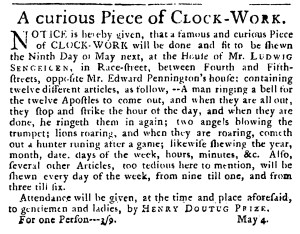
“A famous and curious Pieces of CLOCK-WORK.”

Advertisements in colonial newspapers sometimes testified to popular culture and entertainment options in port cities.  Such was the case with an advertisement about, as the headline proclaimed, a “curious Piece of CLOCK-WORK” that ran in the May 4, 1774, edition of the Pennsylvania Journal.  Henry Doutug Prize announced that he was in the process of assembling a “famous and curious Piece” to display “at the House of Mr. LUDWIG SENGEIGEN” on Race Street in Philadelphia.  Viewings would commence on May 9, but Prize took to the public prints in advance to incite interest and anticipation for this novelty.

The complex piece of machinery featured various figures, including a “man ringing a bell for the twelve Apostles to come out, and when they are all out, they stop and strike the hour of the day, and when they are done, he ringeth them in again.”  If that was not to delight viewers, the clockwork also had “two angels blowing the trumpet” as well as “lions roaring, and when they are roaring, cometh out a hunter running after a game.”  The animals that the hunter chased showed “the year, month, date, days of the week, hours, minutes,” and more.  Prize did not wish to reveal all the surprises that were part of the experience of viewing the clockwork.  Instead, he promised “several other Articles, too tedious to mention,” though his advertisement suggested that those figures were not “tedious” at all.  Readers had to see them to satisfy their curiosity.

In the next issue of the weekly Pennsylvania Journal, the proprietor of this mechanical wonder confirmed that assembly “is done, and fit to be seen” on any day of the week “from nine till one, and from three till six.”  For admission, he charged three shillings and nine pence per person for “gentlemen and ladies” to witness the clockwork in action, the angels with their trumpets, the apostles with their bells, the hunter with the animals, and everything else.  Prize offered a diversion to entertain audiences, something out of the ordinary that deserved their attention.  Even as he marketed a “curious Piece of CLOCK-WORK,” he appealed to the curiosity of readers who saw his advertisement and others who heard about mechanism as word spread.

February 23

What was advertised in a colonial American newspaper 250 years ago today?

Pennsylvania Journal (February 23, 1774).

“A RIDER between Philadelphia and that place.”

William Stenson played a part in establishing and maintaining the communication infrastructure that connected Baltimore and Philadelphia and points in between in the mid 1770s.  Though it had not displaced Annapolis, Baltimore became an increasingly significant urban port on the eve of the American Revolution.  In August 1773, William Goddard launched the Maryland Journal, the city’s first newspaper.  At about the same time, Joseph Rathell attempted to establish a subscription library, but could not manage to generate sufficient interest to compete with William Aikman’s circulating library in Annapolis.  For a small fee, Aikman delivered books to subscribers in Baltimore.

Still, Baltimore was becoming an increasingly important commercial center, a place of interest for merchants and others in Philadelphia.  That created an opportunity for Stenson.  On February 23, 1774, he informed readers of the Pennsylvania Journal that he was “employed by a number of Gentlemen in Baltimore, &c. as a RIDER between Philadelphia and that place” and offered his services during his weekly transit.  He left Philadelphia “early every Thursday morning” and arrived in Baltimore “on Friday evening.”  He stayed until Monday morning and returned to Philadelphia “on Tuesday evenings.”

Stenson attempted to hire his services by the year, suggesting how regularly he believed some prospective clients in Philadelphia wished to contact correspondents in Baltimore and towns on the way.  He offered a “yearly subscription,” pledging that “whatever affairs may be committed to the care of the subscriber, will be performed with all possible fidelity and dispatch.”  For those not ready to pay for his services for an entire year, the rider promised that they “may have their business done at reasonable rates.”  Clients could contact him or leave orders “at Mr. WILLIAM GRAHAM’s, at the sign of the Black Horse” on Market Street.  Alternately, a “subscription paper now lies at the London Coffee-House,” a popular gathering place for Philadelphia’s merchants to conduct business.  Stenson aimed to make procuring his services as convenient as possible for his prospective clients.

February 9

What was advertised in a colonial American newspaper 250 years ago today?

Pennsylvania Journal (February 9, 1774).

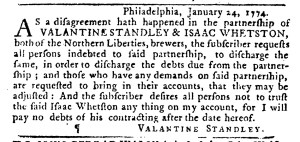
“I will pay no debts of his contracting after the date hereof.”

Valantine Standley and Isaac Whetston had a falling out at the beginning of 1774.  The brewers formed a partnership in the Northern Liberties on the outskirts of Philadelphia, but, as Standley explained in an advertisement in the February 9 edition of the Pennsylvania Journal, “a disagreement hath happened” that caused them to dissolve their partnership and go their separate ways.  Accordingly, Standley sought to separate his finances from Whetston, issuing a call for those who had done business with the brewers to settle accounts.  He requested “all persons indebted to said partnership, to discharge the same, in order to discharge the debts due from the partnership.”  At the same time, he asked that “those who have any demands on said partnership … bring in their accounts, that they may be adjusted.”

Standley could have left it there.  Merchants, shopkeepers, artisans, printers, and other entrepreneurs regularly placed advertisements asking their associates to settle accounts.  Similarly, executors often did so on behalf of the estates they administered.  Standley, however, inserted additional instructions to the partnership’s associates and to the general public, instructions that resembled those given by aggrieved husbands who ran what have become known as “runaway wife” advertisements to warn purveyors of goods and services not to extend credit to wives who had abandoned their husbands and households.  Standley advised “all persons not to trust the said Isaac Whetston any thing on my account, for I will pay no debts of his contracting.”  He replicated language that appeared in advertisements that resulted from marital discord but not usually in notices about business partnerships dissolving.  That Standley did so testified to the “disagreement” between the brewers.  He did not consider it sufficient that an announcement that they were no longer in business together would cause others to refrain from allowing Whetston to make charges on Standley’s account.  Instead, he explicitly forbade such transactions, suggesting that he did not trust his former partner to comport himself appropriately.  Rather than a dry and routine notification that the brewers were no longer in business together, Standley’s advertisement hinted at the acrimony between the two men, perhaps inciting curiosity among their neighbors and associates.  In this instance, an advertisement delivered both news and gossip.

January 26

What was advertised in a colonial American newspaper 250 years ago today?

Pennsylvania Journal (January 26, 1774).

“THOMAS & MARY GRIFFITH, Are removed from Christian-street, to … Sixth-street.”

When Thomas Griffith and Mary Griffith took the pages of the Pennsylvania Gazette at the end of January 1774, they incorporated the same headline they used in their advertisement the previous August.  They promoted their services “TO THE LADIES” of Philadelphia and nearby towns, Thomas his “FAN-MAKING business” and Mary cleaning various kinds of laces “to look like new.  The Griffiths had recently “removed from Christian-street” and now operated their businesses on Sixth Street, occasioning the new advertisement.

Despite deploying the same headline, this notice was shorter than the other one.  Perhaps the Griffiths felt that they had established their reputations in Philadelphia and did not need to provide as much information for a clientele that they wished to follow them to their new location as they had when they introduced themselves upon arriving in a new city.  Thomas had described himself as a “Fan-Maker from London, but last from Charlestown,” but did not do so in the new advertisement, nor did he go into any detail except to say that he “intends to continue the FAN-MAKING business in general.”  Similarly, Mary provided only a brief overview, but did not mention her “new method” for cleaning laces to entice prospective customers.  The Griffiths did “return thanks to the Ladies for the encouragement they received,” another suggestion that they had cultivated a clientele over the last six months.

The secondary headline for their new advertisement included both their names, “THOMAS & MARY GRIFFITH,” whereas Thomas’s name alone ran as the secondary headline in their other advertisement.  This time, Mary’s contribution to the household economy received the same visibility as Thomas’s “FAN-MAKING business,” though his enterprise still received top billing.  It may have been that publishing a shorter advertisement prompted this change, though the Griffiths may have also realized that Mary’s enterprise brought as many or more of “THE LADIES” to the shop in their house as the fans that Thomas made and sold.  Whatever convinced them to take a new approach, they apparently considered their previous newspaper advertisements effective enough to merit investing in a new advertisement when they moved to a new location.

January 19

What was advertised in a colonial American newspaper 250 years ago today?

Pennsylvania Journal (January 19, 1774).

JEDIDIAH SNOWDEN … carries on his business of Cabinet and Windsor Chair-Making … The MILLINARY BUSINESS is carried on as usual, by ANN SNOWDEN.”

Jedidiah Snowden and Ann Snowden pursued different lines of business, but they placed a joint advertisement in the January 19, 1774, edition of the Pennsylvania Journal.  Jedidiah informed the public that he moved from Market Street to Front Street, “where he carries on his business of Cabinet and Windsor Chair-Making, and sells them at the most reasonable rates.”  For her part, Ann declared that the “MILLARY BUSINESS is carried on as usual” and she “has imported a large and general assortment of MILLINARY.”  She then listed dozens of items among her inventory, including “a genteel assortment of figured and plain ribbands,” “mens, womens, boys and girls white and coloured gloves,” “pearl, French and English white wax necklaces,” and “India, ivory, bone, and black fans.”

The Snowdens did not specify their relationship to each other in their advertisement.  Most likely they were husband and wife, though they could have been father and daughter, mother and son, brother and sister, cousins, or some other relations.  Whatever the case, Jedidiah was the head of household, so his name and information about his business came first.  Although Ann’s name ran in the same size font as Jedidiah’s name, “Cabinet and Windsor Chair-Making” appeared as a secondary headline, also in a larger font than the rest of the advertisement, while “MILLINARY BUSINESS” merely appeared in capital letters integrated into the regular copy rather than treated as another headline.  Still, Ann’s portion of the advertisement occupied the most space on the page, approximately four times as much as Jedidiah’s portion.  The Snowdens made a much larger investment in promoting Ann’s “MILLINARY BUSINESS” than Jedidiah’s “Cabinet and Windsor Chair-Making.”  Perhaps Jedidiah believed that he had established such a reputation for his work that he did not need to provide more details beyond telling readers that he had moved and sold the furniture he made “at the most reasonable rates.”  Ann, on the other hand, competed with merchants, shopkeepers, and milliners who constantly imported new wares and updated their advertisements in the several newspapers published in Philadelphia.  Demonstrating that she offered the same selection of merchandise as her competitors may have been imperative to the milliner.  Advertisements jointly placed by husbands and wives or other male and female relations rarely listed the female entrepreneur first, but no matter their format they did reveal that both advertisers contributed to the household economy through their participation in the marketplace.

December 15

What was advertised in a colonial American newspaper 250 years ago today?

Pennsylvania Journal (December 15, 1773).

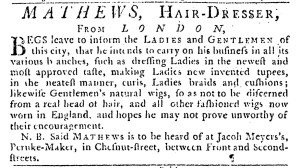
“Gentlemen’s natural wigs … and all other fashioned wigs now worn in England.”

In December 1773, “MATHEWS, HAIR-DRESSER, FROM LONDON,” introduced himself to prospective clients in Philadelphia via advertisements in the Pennsylvania Gazette and the Pennsylvania Journal.  He informed “LADIES and GENTLEMEN of this city, that he intends to carry on his business in all its various branches.”  That included “dressing Ladies in the newest and most approved taste,” no doubt drawing on his connections to London to make sure they followed the latest trends, and “making Ladies new invented tupees, in the neatest manner.”  He also made “natural wigs” for gentlemen, “so as not to be discerned from a real head of hair,” as well as “other fashioned wigs now worn in England.”  His clients, Mathews suggested, could depend on looking as sophisticated as their cosmopolitan cousins in the capital of the empire.

Mathews had several choices for disseminating this message.  He opted for two newspapers, increasing the number of readers who would see his advertisement compared to publishing it in just one.  In addition to the Pennsylvania Gazetteand the Pennsylvania Journal, he could have placed it in the Pennsylvania Chronicle and the Pennsylvania Packet.  The cost of advertising may have prevented him from running notices in all four English-language newspapers published in Philadelphia at the time (and he likely considered advertising in the Wöchtenliche Pennsylvanische Staatsboteimpractical, even though the printer translated advertisements gratis).  Yet why did he choose the Pennsylvania Gazetteand the Pennsylvania Journal over the others?  The printers distributed those two newspapers on Wednesdays, while the printers of the Pennsylvania Chronicle and the Pennsylvania Packet distributed their publications on Mondays.  Mathews did not aim to have his advertisements spread out on different days, but that may not have mattered much in the context of weekly rather than daily publication.  Perhaps the cost of advertising influenced his decision, but that may not have been the case.  Although none of the printers included advertising fees in their colophons, they likely offered competitive rates.  All of them except for the Pennsylvania Gazette did include the annual subscription cost in their colophon.  The consistency, ten shilling for each of them, suggests that they set similar fees for advertising.  Perhaps Mathews selected the Pennsylvania Gazette and the Pennsylvania Journal because he believed they had a wider circulation or reached more of the local gentry that he hoped to cultivate as clients.  His example raises a larger question about why any advertiser in cities with multiple newspapers (including Boston, Charleston, New York, and Williamsburg) chose one over another or some over others to run their notices.

December 8

What was advertised in a colonial American newspaper 250 years ago today?

Pennsylvania Journal (December 8, 1773).

“Any gentlemen who shall employ him, will be freed from the unnecessary trouble of trying on the cloaths.”

Upon arriving in Philadelphia, “KIRK, TAYLOR, from London,” placed an advertisement in the Pennsylvania Journal to introduce himself to prospective clients.  Like so many other artisans who migrated across the Atlantic, Kirk did not have the benefit of his new community’s long familiarity with his work.  Instead, he had to establish his reputation by reporting on his prior experience serving customers in faraway places.  To that end, Kirk proclaimed that he “has been employed in cutting in the most eminent shops of London and Dublin.”  Prospective clients in the largest city in the colonies associated some level of cachet with such connections to even larger and more cosmopolitan cities.  Furthermore, his origins suggested that Kirk had special insight into the latest trends in those places, especially when he declared that he made garments “in the most genteel and newest fashion.”

When he set up shop in Philadelphia, Kirk took the house “where William Robinson lately lived” on Fourth Street.  Not only did he take over that residence, the tailor also hoped to acquire Robinson’s clientele, an efficient means of cultivating relationships in his new city.  The newcomer “begs the favour to be employed by Mr. Robinson’s customers, who may depend on his care and fidelity.”  Earning repeat business, generating word-of-mouth recommendations, and bolstering his reputation depended on attentive service and producing quality work for Robinson’s customers and anyone else who gave him a chance.  Kirk clearly communicated that he was confident in his abilities.  He was such a good tailor, he reported, that “gentlemen who shall employ him, will be freed from the unnecessary trouble of trying on the cloaths,” so precise were his measurements and sewing.  They did not need to tarry in his shop, spending unnecessary time better devoted to their own business or leisure.

Kirk aimed to capture some portion of the market for tailoring services in Philadelphia.  He devised an advertisement that gave prospective clients good reason to give him a chance and then decide for themselves if he merited more orders.  He hoped to gain some of the clients accustomed to visiting a tailoring shop at the same location, but did not entrust his fate to that circumstance alone.  Instead, he advised Robinson’s former customers and other prospective customers that he had experience in the best shops in London and Dublin, knowledge of the latest fashions, and the skills necessary “to give satisfaction to all his employers.”