November 9

What was advertised in a colonial American newspaper 250 years ago today?
Pennsylvania Journal (November 9, 1774).

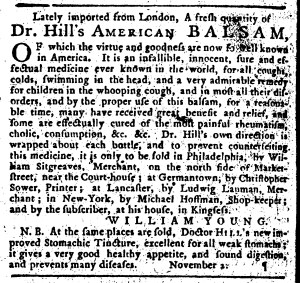
“Dr. Hill’s own direction is wrapped about each bottle.”

In the fall of 1774, William Young and his associates offered consumers exclusive access to “Dr. Hill’s AMERICAN BALSAM.”  According to an advertisement in the November 9 edition of the Pennsylvania Journal, this patent medicine “is an infallible, innocent, sure and effectual” cure for “coughs, colds, [and] swimming in the head” as well as a “very admirable remedy for children in the whooping cough, and in most all their disorders.”  Young implied that such recommendations may not have been necessary since the “virtue and goodness” of the medicine “are now so well known in America,” yet figured that trumpeting the efficacy of Dr. Hill’s American Balsam would aid in convincing consumers not yet familiar with this product.

As a means of guarding the reputation of this medicine and “to prevent counterfeiting,” a limited number of local agents stocked and sold this medicine.  Young made it available in Kingsess (or Kingsessing), just outside of Philadelphia.  William Sitgreaves, a merchant in Philadelphia, Christoper Sower, a printer in Germantown, and Ludwig Lauman, a merchant in Lancaster, each sold it as well.  Young also distributed Dr. Hill’s American Balsam to Michael Hoffman, a shopkeeper in New York, to sell there.  He had relied on that method for some time, having placed similar advertisement in May and October 1772.  Unlike some popular patent medicines widely stocked by apothecaries, merchants, shopkeepers, printers, booksellers, and other retailers throughout the colonies, only a select few carried Dr. Hill’s American Balsam.  The medicine came with “Dr. Hill’s own direction … wrapped about each bottle” to instruct patients how to use it to relieve or even cure “the most painful rheumatism, cholic, consumption,” and other maladies.  Such packaging represented another layer of marketing for this product, continuing to promote it to customers after they purchased it and took it home.

Young apparently considered these various strategies effective given that he invested in them on several occasions.  His marketing of Dr. Hill’s American Balsam incorporated the same elements in November 1774 that he deployed two and a half years earlier in May 1772.  That does not demonstrate the impact those methods had on consumers yet does suggest that Young considered them successful enough to repeat when he advertised once again.

November 2

What was advertised in a colonial American newspaper 250 years ago today?

Pennsylvania Journal (November 2, 1774).

“EXTRACTS FROM THE VOTES AND PROCEEDINGS OF THE AMERICAN CONTINENTAL CONGRESS.”

Delegates to the First Continental Congress met in Philadelphia from September 5 through October 26, 1774.  When the meetings adjourned, an advertisement for “EXTRACTS FROM THE VOTES AND PROCEEDINGS OF THE AMERICAN CONTINENTAL CONGRESS” appeared in the next issue of the Pennsylvania Journal.  William Bradford and Thomas Bradford, printers of that newspaper, did not merely announce their plans to print the Extracts; they proclaimed that the pamphlet was “JUST PUBLISHED AND TO BE SOLD” at their printing office.  The Extracts hit the presses as soon as the delegates finished their business, providing an overview of “The BILL of RIGHTS; a List of GRIEVANCES; occasional RESOLVES; the ASSOCIATION; an ADDRESS to the People of Great-Britain; and a MEMORIAL to the Inhabitants of the British American Colonies.”

In their coverage of the meetings, the Bradfords promoted the Extracts, simultaneously distributing them as a service to the public and a seeking to generate revenue from their sale.  “On Wednesday last,” they reported, “the AMERICAN CONTINENTAL CONGRESS broke up, after having passed a Number of spirited Resolves, wrote several Letters, &c. which are printed in a Pamphlet, and may be had of the Printers.”  Just as Thomas Fleet and John Fleet, printers of the Boston Evening-Post, had taken the unusual step of interspersing news and advertising to hawk a publication related to recent meetings in Massachusetts earlier that same week, the Bradfords directed readers who consumed the news to consume a pamphlet they printed as well.  Readers could do more than learn about current events; they could participate in them by purchasing the Extracts, becoming better informed about colonial grievances, and following the directions for boycotting imported goods detailed in the Continental Association.

Such opportunities quickly became available in other places.  The Bradfords had the scoop for the moment, yet other printers soon published and disseminated other editions in Philadelphia and nearly a dozen other towns.  By the end of the year, one or more local editions appeared in Albany; Annapolis; Boston; Hartford; Lancaster, Pennsylvania; New London, Connecticut; Newport, Rhode Island; New York; Norwich, Connecticut; Providence; and Williamsburg, Virginia.  Heinrich Miller, the printer of the Wochentliche Pennsylvanische Staatsbote, also printed a German translation of the Extracts.  This important pamphlet supplemented newspaper coverage by conveniently collating a summary of the First Continental Congress for easy reference.

October 12

What was advertised in a colonial American newspaper 250 years ago today?

Pennsylvania Journal (October 12, 1774).

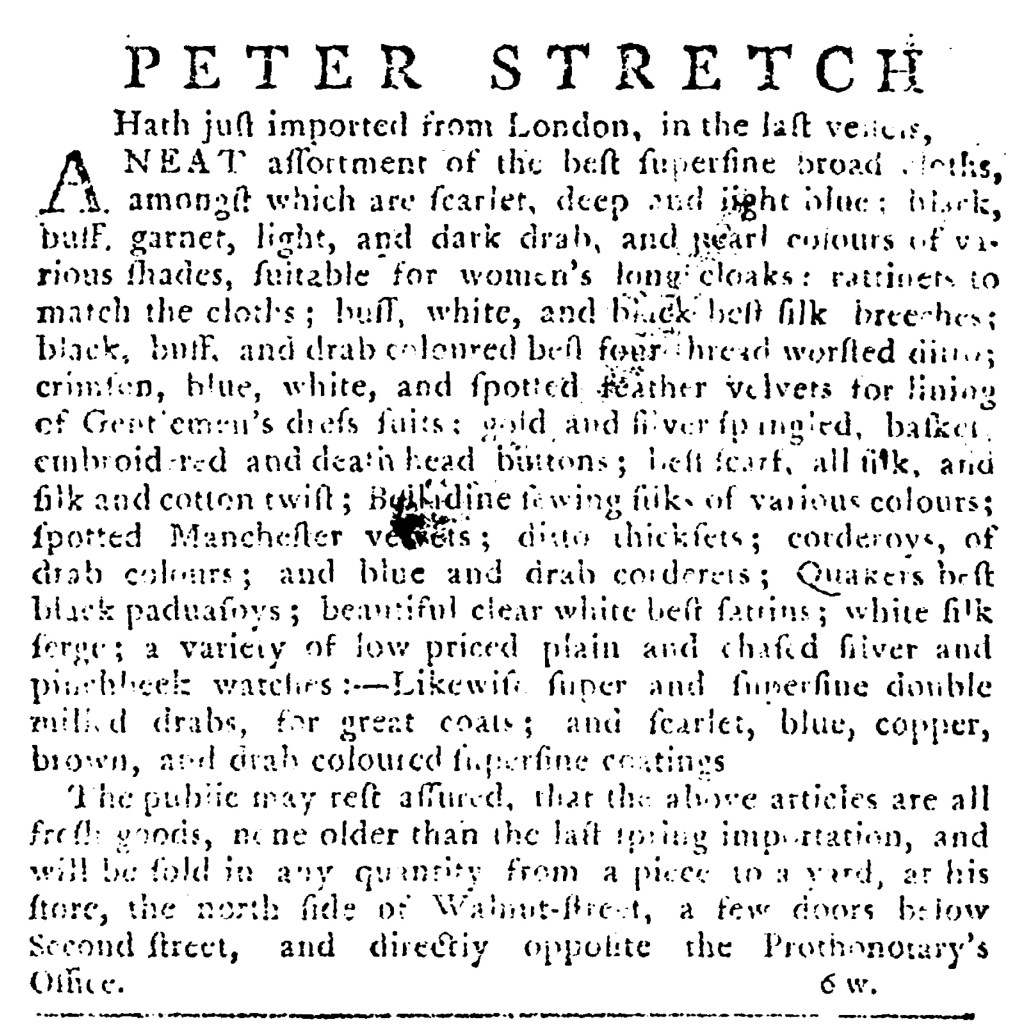
“The above articles are all fresh goods, none older than the last spring importation.”

In the fall of 1774, Peter Stretch advertised a “NEAT assortment” of textiles and accessories that he “Hath just imported from London, in the last vessels.”  In an advertisement in the October 12 edition of the Pennsylvania Journal, he listed many of those items, including “the best superfine broad cloths, amongst which are scarlet, deep and light blue, black, buff, garnet, light, and dark drab and pearl colours of various shades, suitable for women’s long cloaks,” “crimson, blue, white, and spotted feather velvets for lining of Gentlemen’s dress suits,” and “gold and silver spangled, basket, embroidered and death head buttons.”

In stating that he had recently imported his wares “in the last vessels,” Stretch deployed language commonly used by merchants and shopkeepers in their marketing efforts.  Elsewhere on the same page, for instance, Barclay and Mitchell declared that they stocked merchandise “Imported in the last vessels from England.”  Yet Stretch decided to provide further details about when he received his inventory at the end of his advertisement.  “The public may rest assured,” he confided, “that the above articles are all fresh goods, none older than the last spring importation.”  Stretch was in a bit of an awkward position.  He wanted the public to think of his goods as new rather than as leftovers that had been lingering on the shelves or in the storeroom, yet not too new.  As the First Continental Congress continued to meet in Philadelphia, just a short distance from Stretch’s store, the colonies prepared to adopt a nonimportation agreement in protest of the Coercive Acts imposed by Parliament following the Boston Tea Party.  Stretch seemingly did not want the public to get the impression that he had imported surplus goods with the intention of sidestepping any nonimportation agreement when it went into effect.  That would have meant allegations that he technically lived up to the letter of the pact but not the spirit.  Rather than hoarding goods in recent months to sell once a nonimportation made imported wares scarce, Stretch “assured” the public that he acquired much of his inventory during “the last spring importation” before the colonies knew about the Boston Port Act, the Massachusetts Government Act, and other legislation passed by Parliament.  He hoped that made it acceptable for patriots to make purchases at his store even as they became wary of the goods carried by his competitors.

September 14

What was advertised in a colonial American newspaper 250 years ago today?

Pennsylvania Journal (September 14, 1774).

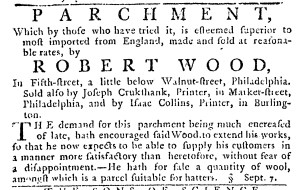
“PARCHMENT … esteemed superior to most imported from England.”

In September 1774, Robert Wood took to the pages of Dunlap’s Pennsylvania Packet and the Pennsylvania Journal to promote the parchment that he made in Philadelphia.  To entice prospective customers, he resorted to a variety of appeals.  Most significantly, he invoked customer satisfaction, seeking to convince readers not yet familiar with his product that he already gained a positive reputation among those who had used it.  For instance, he declared that “those who have tried it” considered his parchment “superior to most imported from England.”  He previously encouraged readers to “Buy American” in another advertisement more than two years earlier.  As the First Continental Congress convened in Philadelphia to consider how to respond to the Coercive Acts, including the possibility of another round of nonimportation pacts, Wood had a head start in presenting a “domestic manufacture,” an item produced in the colonies, as an alternative to imported parchment.  Customers did not have to sacrifice quality, plus they could acquire Wood’s parchment “at reasonable rates.”

To further bolster his reputation, Wood declared that the demand for his parchment had “much encreased of late.”  Those familiar with it wished to purchase it in greater quantities, at least according to Wood, another testimonial to the quality of the product.  Wood was prepared to meet the demand, having “extend[ed] his works, so that he now expects to be able to supply his customers in a manner more satisfactory than heretofore.”  Serving his customers included establishing a distribution network for their convenience in acquiring his parchment.  Joseph Crukshank, a printer in Philadelphia, sold Wood’s parchment, as did Isaac Collins, a printer in Burlington, New Jersey.  Taking all of this into consideration, Wood confidently declared that consumers who purchased and used his parchment could do so “without fear of a disappointment.”  He did not make an argument in favor of domestic manufactures as explicitly as he had in other advertisements, but perhaps he did not consider it necessary at a time that the imperial crisis had intensified so significantly.  Stating that his parchment had been “esteemed superior” to English imports sufficiently made the connection for readers, allowing Wood to focus on the demand for his product rather than convince prospective customers of their duty to privilege American products as a means of practicing politics.

September 7

What was advertised in a colonial American newspaper 250 years ago today?

Pennsylvania Journal (September 7, 1774).

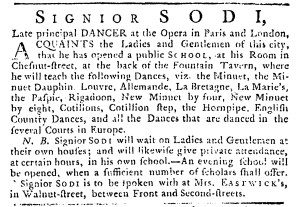
“He will teach … all the Dances that are danced in the several Courts in Europe.”

It could have been a coincidence that dancing masters Mr. Pike and Signior Sodi placed advertisements in Dunlap’s Pennsylvania Packet, the Pennsylvania Gazette, and the Pennsylvania Journal at the same time.  When Pike arrived in the Pennsylvania after teaching fencing and dancing in Charleston for a decade, he introduced himself to prospective pupils and the rest of the public with an advertisement in the September 5, 1775, edition of Dunlap’s Pennsylvania Packet.  He placed the same advertisement in the Pennsylvania Gazette two days later.

Sodi ran his own advertisement in the same issue of Dunlap’s Pennsylvania Packet.  The two notices appeared on the same page, Sodi’s at the bottom of one column and Pike’s at the top of the next one.  Two days later, Sodi inserted his advertisement in the Pennsylvania Journal.  Perhaps the “Late principal DANCER at the Opera in Paris and London” had previously intended to advertise in early September.  After all, he stated in his newspaper notice about a “GRAND CONCERT & BALL” in June that he “proposes to open a School publicly next September.”  He did not, however, commence advertising that school before Pike was on the scene.  Sodi may have heard that a new competitor would soon offer lessons to the local gentry, prompting him to advertise in the city’s newspaper published on Mondays and one of the two published on Wednesdays.

While Pike touted his experience as an instructor and a reputation that could be confirmed by “many respectable gentlemen” from South Carolina “present in this city,” likely including delegates to the First Continental Congress, Sodi emphasized his connections to some of the most cosmopolitan and refined places in Europe.  In addition to describing himself as the “Late Principal DANCER at the Opera in Paris and London,” he declared that he assisted students in learning “all the Dances that are dance in the several Courts in Europe.”  He also gave French names for several dances, suggesting the sophistication associated with the steps he taught at the Fountain Tavern and at private lessons in the homes of his pupils.

The advertisements that ran in Philadelphia’s newspapers outlined the choices available to prospective students and their families.  They could engage the services of a newcomer with endorsements from prominent men visiting the city or an Italian dancing master with experience in Paris, London, and European courts.  No matter which one they chose, the presence of these advertisements in the public prints reminded readers that dancing proficiently and gracefully was an important part of demonstrating gentility and status.

August 24

What was advertised in a colonial American newspaper 250 years ago today?

Pennsylvania Journal (August 24, 1774).

“They neatly engrave: Shop Bills; Bills of Exchange; Bills of Lading.”

When John Norman, “ARCHITECT and LANDSCAPE-ENGRAVER, from London,” arrived in Philadelphia in May 1774, he introduced himself to prospective clients via an advertisement in the Pennsylvania Journal.  A few months later, he once again took to the pages of that publication, this time to announce that the partnership of Norman and Ward, “ENGRAVERS and DRAWING-MASTERS,” had opened a shop where they engraved a variety of items and sold “an assortment of Pictures and Frames … much cheaper than imported.”  In addition, they established “an Evening Drawing School” for teaching “that most noble and polite Art in all its various and useful Branches.”  Still a newcomer in the city, Norman devised multiple ways to earn his livelihood.

The various kinds of engraving that Norman and Ward proposed testified to the prevalence of advertising in early America, especially in urban ports.  They indicated that they could produce all sorts of items but could not list them all because they were “too tedious to mention in an Advertisement.”  Yet they named more than a dozen kinds of engraved items, leading their list with “Shop Bills.”  They likely meant both trade cards with an engraved image that filled the entire sheet and billheads that featured an engraved image at the top and blank space for recording purchases.  On occasion, merchants, shopkeepers, and artisans wrote receipts on the reverse side of trade cards.  Norman and Ward next named “Bills of Exchange; Bills of Lading; [and] Bills of Parcels.”  Those could have been simple printed blanks, but that would have defeated the purpose of ordering them from an engraver rather than acquiring those common business forms from printers who produced them in volume.  In this instance, the bills of exchange, bills of lading, and bills of parcels likely included engraved images, not solely text, that served as advertisements for the merchants who ordered them.  Later in the list, Norman and Ward considered “Devices for News-Papers” important enough to include rather than “too tedious to mention.”  Presumably they produced woodcuts in additional to copperplate engravings.  In addition to newspaper printers seeking images to adorn their mastheads and stock images for use elsewhere, the engravers offered their services to advertisers who desired unique images that represented their businesses exclusively.  Trade cards, billheads, and other advertising ephemera have not survived in the numbers that they were likely produced and circulated in early America, yet Norman and Ward’s advertisement suggests that they were part of everyday life as colonizers engaged in commerce and participated in consumer culture.

July 27

What was advertised in a colonial American newspaper 250 years ago today?

Pennsylvania Journal (July 27, 1774).

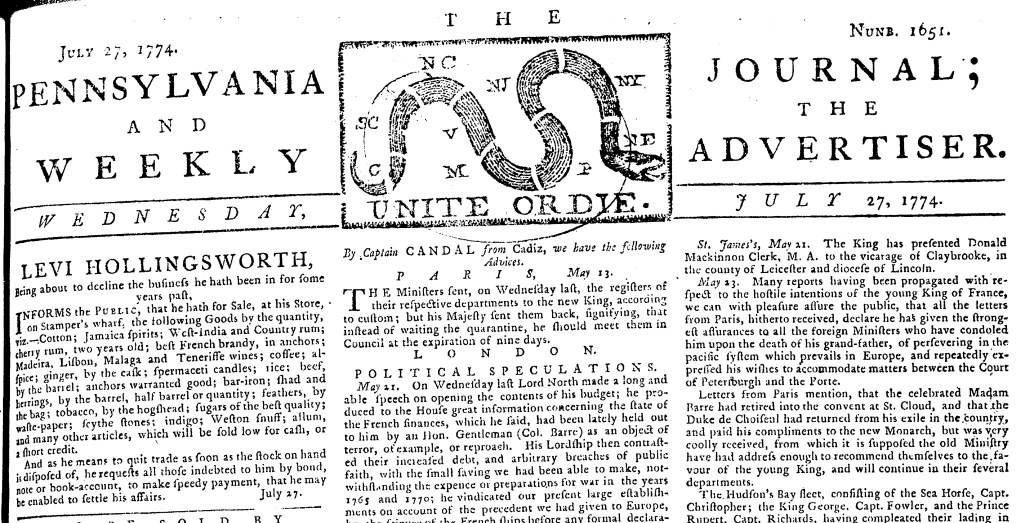
“Many other articles, which will be sold low for cash, or a short credit.”

Levi Hollingsworth’s advertisement for a variety of goods available “at his Store, on Stamper’s wharf,” in Philadelphia in the July 27, 1774, edition of the Pennsylvania Journal appeared immediately below a masthead that featured a new image.  Previously, the device had four components.  In the center, a newspaper bearing the title “JOURNAL” sat on a pedestal above a cartouche that showed a ship at sea, those items testifying to information that the newspaper disseminated and the commerce that it facilitated.  An indigenous American on the left and an angel representing Fame on the right flanked the newspaper and ship.  The new device depicted a divided snake, each segment assigned to a colony, with the motto, “UNITE OR DIE.”

In recent weeks, at least two other American newspapers incorporated similar images into their mastheads.  The New-York Journal, printed by John Holt, had done so on June 23.  The images were so similar that William Bradford and Thomas Bradford, printers of the Pennsylvania Journal, likely copied directly from Holt’s newspaper after they received it via exchange networks that linked printers throughout the colonies.  On July 7, Isaiah Thomas adopted an even more elaborate image in the masthead of the Massachusetts Spy, one that showed a divided snake with a pointed tongue and a pointed tail facing off against a dragon that represented Great Britain.  Its admonition demanded that readers “JOIN OR DIE.”  Once the Bradfords updated their masthead, a newspaper published in three of the four largest American port cities circulated the divided snake political cartoon to subscribers and other readers every week.  The Pennsylvania Journalcontinued doing so for fifteen months, returning to its previous device at the end of October 1775.  By that time, the Revolutionary War had started.

In his History of Printing in America (1810), Isaiah Thomas stated that the Pennsylvania Journal “was devoted to the cause of the country.”[1]  Each time that Hollingsworth or other advertisers placed notices in that newspaper they aided in underwriting a partisan press that advocated for the rights of colonizers as British subjects and, eventually, independence from Great Britain.  Each time a reader perused those advertisements, they likely saw the political cartoon in the masthead, forced to engage with its message even if they did not read the news and editorials closely.

**********

[1] Isaiah Thomas, The History of Printing in America: With a Biography of Printers and an Account of Newspapers (1810; New York: Weathervane Books, 1970), 437.

July 23

What was advertised in a colonial American newspaper 250 years ago today?

Postscript Extraordinary to the Pennsylvania Journal (July 23, 1774).

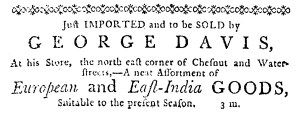
“Just IMPORTED … European and East-India GOODS.”

William Bradford and Thomas Bradford printed and distributed the Pennsylvania Journal on Wednesdays, but in the summer of 1774 they had news of such significance that they opted to issue a Postscript Extraordinary on a Saturday.  It bore the same number, 1650, as the weekly edition from July 20, but a different date, July 23, that confirms that the printers issued it a few days later than the weekly edition.  They had previously printed a two-page Supplement to the Pennsylvania Journal and a two-page Postscript to the Pennsylvania Journal, both dated July 20, that doubled the amount of content in the standard issue.  As the imperial crisis intensified, the Bradfords sought to provide extensive coverage for subscribers and other readers.

At the same time, they scooped the other newspapers printed in English in Philadelphia, Dunlap’s Pennsylvania Packetand the Pennsylvania Gazette.  The Postscript Extraordinary featured news from a “PROVINCIAL MEETING of DEPUTIES chosen by the several Counties in Pennsylvania; held at PHILADELPHIA” on July 15 and continuing for several days.  Dunlap’s Pennsylvania Packet carried the same news, perhaps reprinted from the Postscript Extraordinary, on Monday, July 25, its usual day of publication, two days after the Bradfords had disseminated it.  In turn, the Pennsylvania Gazette provided the same coverage in a Postscript that accompanied the weekly issue on Wednesday, July 27.  All three newspapers carried rhetoric that condemned the Boston Port Act and the anticipated passage of the Massachusetts Government Act as well as proposed instructions for Pennsylvania’s delegates who would attend “a Congress of Deputies from the several Colonies,” now known as the First Continental Congress.

Yet coverage of the meeting of delegates from throughout the colony did not fill both sides of the broadsheet.  A dozen advertisements completed the Postscript Extraordinary.  Disseminating the news provided an occasion provided another opportunity for circulating advertisements placed for various purposes, including notices for “European and East-India GOODS” sold by George Davis and “a large Assortment of DRY GOODS, and CROCKERY” imported by Alexander Bartram.  The Postscript Extraordinary gave those advertisements greater visibility, yet news from the meeting framed how colonizers might think about commerce and consumption in the current political environment.  Among their various resolutions, the deputies from across Pennsylvania’s counties supported a nonimportation agreement if the First Continental Congress determined that a boycott would aid in achieving their political goals.  At the same time, they cautioned that “the venders of Merchandize of every kind within this province, ought not to take advantage of Resolves relating to Non-Importation” by raising prices and gouging customers.  The news put all readers on notice about how to behave as consumers while also warning merchants, shopkeepers, and other purveyors of goods about how they should comport themselves.

July 13

What was advertised in a colonial American newspaper 250 years ago today?

Pennsylvania Journal (July 13, 1774).

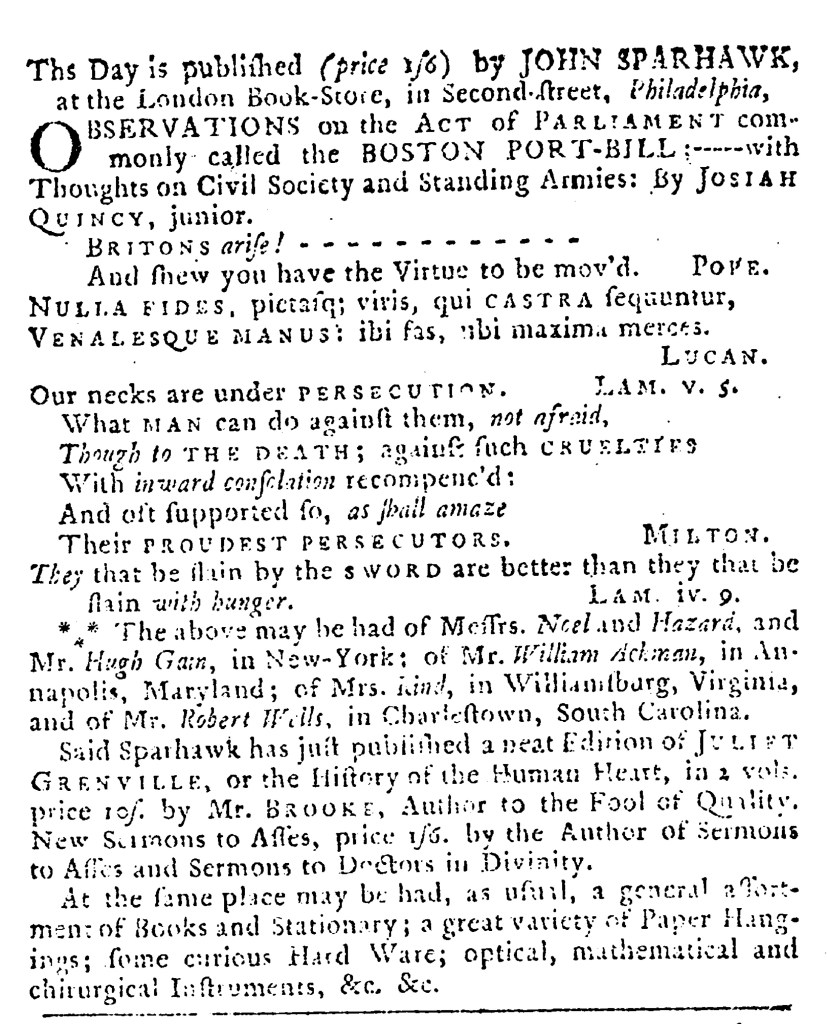
“OBSERVATIONS on the ACT of PARLIAMENT commonly called the BOSTON PORT-BILL … BY JOSIAH QUINCY, junior.”

In the spring of 1774, Josiah Quincy, Junior, of Boston, a prominent lawyer and noted patriot, penned Observations on the Act of Parliament Commonly Called the Boston Port-Bill: With Thoughts on Civil Society and Standing Armies.  In it, Quincy encouraged colonizers to unite in opposition to abuses perpetrated by Parliament, continuing work he had undertaken in 1773 when he visited South Carolina to strengthen ties among patriots in northern and southern colonies.  He had also published political essays in the Boston-Gazette, known for its support of the patriot cause, for several years. According to Daniel R. Coquillette and Neil Longley York, the editors of his major political and legal papers, the pamphlet “was the culmination of his thinking and writing about the problem of balancing imperial authority and colonial liberty.”

Benjamin Edes and John Gill printed the tract and advertised it in their newspaper, the Boston-Gazette, a publication known for advocating the patriot cause.  Soon, advertisements appeared widely in other newspapers published in Boston as well as newspapers in other towns in New England.  In general, they were brief announcements that merely named the title and author; Quincy’s reputation as writer, orator, and political philosopher was so well established that printers and booksellers did not consider it necessary to elaborate on what he had written to convince colonizers to purchase copies of the Observations.  Quincy’s pamphlet experienced even greater dissemination when John Sparhawk, a bookseller in Philadelphia, published an edition there and advertised it in the Pennsylvania Journal.  In addition to stocking it at his “London Book-Store,” Sparhawk advised readers that they could acquire copies from local agents, most of them printers and booksellers, in New York, Annapolis, Williamsburg, and Charleston.  That distribution network certainly made Quincy’s Observations more accessible to colonizers beyond New England, helping to explain how his “attempt to define and defend American rights” became, as Coquillette and York assert, “an essential part of the debate over rights in the empire.”