What was advertised in a colonial American newspaper 250 years ago today?

“A GENERAL ASSORTMENT of EUROPEAN and EAST INDIA GOODS.”
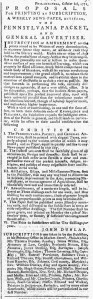
In “PROPOSALS FOR PRINTING BY SUBSCRIPTION, A WEEKLY NEWS-PAPER, ENTITLED, THE PENNSYLVANIA PACKET, AND GENERAL ADVERTISER,” dated October 8, 1771, John Dunlap declared that the newspaper would commence publication on Monday, November 25 “or sooner, if sufficient encouragement should offer.” That “encouragement” included acquiring both subscribers and advertisers whose fees would support the new enterprise.
Even though printers already published several newspapers – the Pennsylvania Chronicle, the Pennsylvania Gazette, the Pennsylvania Journal, and the Wochentliche Pennsylvanische Staatsbote – in Philadelphia, Dunlap garnered the attention he needed to launch the Pennsylvania Packet much earlier than expected, four weeks ahead of schedule. On Monday, October 28, he distributed the first issue. In a note “TO THE PUBLIC” on the front page, he extended “his most hearty thanks … for the generous encouragement … whereby he is enabled to issue this new publication in about half the time he proposed.”
The front page also included three advertisements, a brief notice in which Lennox and Turnbull promoted their “GENERAL ASSORTMENT of EUROPEAN and EAST INDIA GOODS,” a lengthy list cataloging the “large and neat Assortment of MERCHANDIZE” sold by John Biddle and Clement Biddle, and a testimonial about Enoch Story’s services as a broker and auctioneer signed by several prominent merchants. The testimonial, dated May 16, 1771, previously ran in newspapers published in Philadelphia and Annapolis.
Those notices were just a few of many that appeared in the first issue of the Pennsylvania Packet. Dunlap devoted half of a column on the third page to the shipping news from the customs house and then filled the rest of the page with advertisements. The fourth page consisted entirely of advertisements and the colophon running across the bottom. Dunlap even distributed a two-page supplement. Essays appeared on the front and advertisements, mostly from Dunlap and other printers, on the back. Dunlap even inserted a brief note to alert readers that “Some Advertisements which came too late, are deferred till next week, when they shall be carefully regarded.”
Many newspapers carried minimal advertising when they first launched. Advertisers waited to see what kind of reception a publication received before investing in advertising. They wanted to make sure newspapers had sufficient circulation to justify the expense. How did Dunlap acquire so many advertisers so quickly? Some may have responded to the pledge he made in the proposals when he stated that the “first Number shall be given gratis” to prospective subscribers. Some advertisers may have believed that would yield sufficient circulation to merit placing their notices in the inaugural issue and then assessing whether they wished to continue. If that was the case, Dunlap and his advertisers mutually benefitted. The number of advertisements made the new Pennsylvania Packet look like a robust endeavor, one worthy of more subscribers.