February 17

What was advertised in a colonial American newspaper 250 years ago today?

Pennsylvania Packet (February 17, 1772).

“The only true and genuine sort … is sealed with my seal and coat of arms.”

Beware of counterfeiters!  So warned Thomas Anderton in his advertisement for “TURLINGTON’s BALSAM OF LIFE; OR THE TRUE AMERICAN BALSAM.”  Anderton proclaimed that this patent medicine was recognized among Europeans, Americans, and “West-Indians” for its “true merit, of universal experience, utility and reputation,” superior to “all the other known Balsams.”  Continuing with the superlatives, Anderton trumpeted that Turlington’s Balsam of Life was “the best adapted in all cases, in every climate, to relieve the various ailments and diseases of the human body … that pharmacy, since the creation of the world, has produced.”  Tending to the quality of the product he marketed, Anderton asserted that he “faithfully prepared” the balsam “from a true copy of the original receipt, taken out of the Chancery-office, in London, where it is recorded on oath, when the patent was granted.”

Anderton claimed an exclusive right to produce and sell this extraordinary medicine in the colonies, yet that did not prevent others from distributing counterfeits.  He explained how consumers could distinguish the authentic balsam from imposters “which are to be met with every where.”  Those produced by Anderton were “sealed with my seal and coat of arms, and the direction bill given with each bottle is signed with my name in my own hand writing.”  Armed with that information, discerning customers could avoid being fooled by unscrupulous vendors who passed off inferior medicines as authentic Turlington’s Balsam of Life.  Some “very modest counterfeiters,” like Martha Wray and Mary Sopp, provided “direction bills” with the medicines they sold, but, according to Anderton, they “conscientiously avoid forging the proprietors names.”  Others, however, were more sophisticated in their efforts to hoodwink consumers.  They engaged in “forgery in a gross degree,” aided by “Printers and Engravers that have been employed to counterfeit the direction and seals.”  Anderton pledged to expose everyone involved, including “venders of such counterfeit rubbish,” at a later time, but for the moment warned consumers to be wary of products purported to be authentic Turlington’s Balsam of Life.  In exercising caution, consumers could safeguard their own purchases to their own benefit as well as prevent further injustices to the producer of the “TRUE AMERICAN BALSAM.”

January 27

What was advertised in a colonial American newspaper 250 years ago today?

Pennsylvania Packet (January 27, 1772).

“GEORGE BARTRAM’s WOOLLEN DRAPERY AND HOSIERY WAREHOUSE, At the Sign of the GOLDEN FLEECE’s HEAD.”

Much of the content of George Bartram’s advertisement in the January 27, 1772, edition of the Pennsylvania Packet resembled what appeared in notices placed by other merchants and shopkeepers.  Bartram informed prospective customers that he “Just imported … A very large Assortment” of textiles “from BRITAIN and IRELAND.”  He then listed a variety of fabrics to demonstrate the choices available to consumers.

In addition to providing an overview of his merchandise, Bartram deployed other means of making his business memorable.  For instance, he marked it with a sign that featured a distinctive device, advising prospective customers to visit “the Sign of the GOLDEN FLEECE’S HEAD” on Second Street.  Some colonial entrepreneurs used similar signs, but many did not.  Among the other advertisers in the January 27 edition of the Pennsylvania Packet, John Carnan, a jeweler, ran a shop “AT THE GOLDEN LION,” but Joseph Carson, Francis Hopkinson, William Miller, Alexander Power, John Sparhawk, Mary Symonds, and James Wallace did not mention signs that marked their locations.  Bartram further enhanced his advertisement with an image of a golden fleece’s head that may have replicated his shop sign.  Most advertisers who called attention to their signs did not make the additional investment in woodcuts.  Bartram apparently made the investment only once.  He ran an advertisement with the same copy, but no image, in the Pennsylvania Chronicle on the same day.

Bartram also gave his business a name, another marketing strategy adopted by relatively few advertisers in the eighteenth century.  Some merchants, shopkeepers, and artisans used their shop signs as the names for their businesses, but most advertisers did not give their businesses any sort of name.  Printers and booksellers were the most likely to name their businesses.  Although he did not have a sign with a distinctive device, Sparhawk called his shop the “LONDON BOOK-STORE” in his advertisement.  John Dunlap, printer of the Pennsylvania Packet, advertised books available at the “NEWEST PRINTING-OFFICE.”  Among advertisers from other occupations, Bartram distinguished his shop from others by calling it “GEORGE BARTRAM’s WOOLLEN DRAPERY AND HOSIERY WAREHOUSE, At the Sign of the GOLDEN FLEECE’s HEAD.”  He incorporated his own name, a sign, an image depicting that sign, and a name for his business into his advertisement, distinguishing it from others and making his endeavor more memorable.

January 1

What was advertised in a colonial American newspaper 250 years ago this week?

Pennsylvania Packet (December 30, 1771).

“JOHN CARNAN … AT THE GOLDEN LION.”

In its exploration of advertising and daily life in colonial America, the Adverts 250 Project features an advertisement originally published in an American newspaper 250 years ago that day … on most days.  It is not always possible, however, to select an advertisement from the exact date.  Two factors play significant roles.  First, no printers produced newspapers on Sundays, which means that once a week the Adverts 250 Project instead features an advertisement published sometime during the previous week 250 years ago.

Second, most newspapers were weekly publications.  Even though printers staggered the dates they distributed new issues (with clusters on Mondays and Thursdays), at least one newspaper appeared somewhere in the colonies every day of the week (Sundays excepted) throughout most of the late 1760s and early 1770s, the period covered by the Adverts 250 Project.  (I say most of the late 1760s and early 1770s because several newspapers ceased publication while the Stamp Act was in effect in late 1765 and early 1766.  As a result, fewer newspapers appeared on fewer days of the week for several months.)  Even though printers published and disseminated newspapers every day except Sundays, copies of those newspapers have not necessarily survived in research libraries, historical societies, and other collections.  Those still extant have not all been digitized, making them difficult to access for inclusion in the Adverts 250 Project.

January 1, 1772, is one of those days without any digitized newspapers to consider.  The first day of 1772 fell on a Wednesday, a day that printers did indeed publish newspapers.  Yet no newspapers for January 1, 1772, are available in any of the several databases that I consult in producing the Adverts 250 Project.  James Johnston printed the Georgia Gazette on Wednesdays, but that newspaper has not been part of the Adverts 250 Project since May 23, 2020, because the May 23, 1770, edition was the last one digitized.  According to Edward Connery Lathem’s Chronological Tables of American Newspapers, 1690-1820, no copies of the Georgia Gazette are extant from 1771 and very few have survived from 1772 and 1773.  Complete or extensive coverage exists for 1774 and 1775, but no copies published after 1770 have been digitized.

Johnston likely published a new edition of the Georgia Gazette on January 1, 1772.  It likely included at least a page of advertisements, including multiple notices about enslaved people for sale and others offering rewards for the capture and return of those who liberated themselves from their enslavers.  Yet no copy is available for examination and inclusion in the Adverts 250 Project, a reminder of one of the many factors that makes the curation of this project incomplete despite efforts to be as extensive as possible.  In addition, the Slavery Adverts 250 Project does not include every advertisement about enslaved people originally published in American newspapers 250 years ago, only those in newspapers that have been digitized.  Such advertisements were even more ubiquitous than the Slavery Adverts 250 Project demonstrates.

All of this means that the Adverts 250 Project does not begin 2022 with an advertisement from 1772.  Instead, I have selected an advertisement that ran in the Pennsylvania Packet on December 30, 1771.  Regular visitors to the Adverts 250 Project will recognize John Carnan’s notice with its distinctive woodcut depicting a golden lion, an image that has appeared on the project’s homepage since its inception.  I previously examined another advertisement placed by Carnan, that one in the Pennsylvania Gazette on August 1, 1771, the first time he included the image in one of his notices.  Tomorrow the Adverts 250 Project will feature its first advertisement from 1772, one selected by a student in my Revolutionary America class in Fall 2021.  We’ll get 1772 and 2022 started with an advertisement seeking a “Journeyman COMPOSITER” that Isaiah Thomas inserted in his own newspaper, the Massachusetts Spy.

December 30

What was advertised in a colonial American newspaper 250 years ago today?

Pennsylvania Packet (December 30, 1771).

“I am so rejoiced at my own good fortune, that I had almost forgot to thank you for curing my wife of hardness of hearing.”

When Dr. Graham, an “oculist and auralist,” arrived in Philadelphia in the fall of 1771, he placed an advertisement in the November 11, 1771, edition of the Pennsylvania Packet to inform “the inhabitants of British America in general, that he may be consulted … in all the disorders of the eyes, and in every species of deafness.”  Like many other physicians who migrated across the Atlantic, he presented his credentials, stating that “after several years study at the justly celebrated University of Edinburgh, he has travelled and attended upon the Hospitals and Infirmaries in London, Edinburgh, [and] Dublin.”  He acknowledged that many “practitioners in physic and surgery, gentlemen eminent in their profession,” already provided their services in Philadelphia, but nonetheless asserted that he “had more experience as an oculist and auralist, than, perhaps, any other Physician and Surgeon on this vast Continent.”  At the end of his advertisements, Graham inserted five short testimonials from patients in towns in New Jersey.

By the end of the year, his advertising strategy consisted almost entirely of publishing testimonials in the Pennsylvania Packet.  The December 30 edition included a “(COPY)” of a letter that the doctor received from John Thomas, a resident of Race Street in Philadelphia.  Thomas explained that he had been “afflicted with the unspeakable misfortune of total deafness in both ears” for thirty years.  He sometimes resorted to “a large trumpet, which assisted my hearing considerably in one ear.”  Upon seeing Graham’s advertisement “in this useful paper,” Thomas sought his services.  As a result of the doctor’s care, he no longer had “the least occasion for the trumpet” because he could “hear ordinary conversation” and could “conduct my business with a satisfaction, that for 30 years past I have been an utter stranger to.” In a postscript, Thomas also revealed that Graham cured his wife of “hardness of hearing, which she had been afflicted with for above fourteen years.”

An editorial note appeared at the end of the advertisement, almost certainly inserted by Graham rather than by the printer.  “As it is impossible for us to insert the great number of cures Dr. Graham has performed since his arrival in this city,” the note declared, “we must therefore refer the public for further information to the Doctor, at his apartments.”  This note seemed to give another third-party recommendation of Graham’s abilities to treat “all the disorders of the eye or its appendages; and in every species of deafness, [and] hardness of hearing,” but John Dunlap, the printer of the Pennsylvania Packet did not sign it.  Rather than a referral from the printer, Graham devised the note to bolster an advertising campaign centered on endorsements from others.  Having introduced himself in previous notices, he disseminated testimonials from local residents to bolster his reputation among prospective patients.

December 4

What was advertised in a colonial American newspaper 250 years ago this week?

Pennsylvania Packet (December 2, 1771).

“To be Sold on the cheapest Terms.”

When John Dunlap commenced publication of the Pennsylvania Packet in the fall of 1771, he quickly gained advertisers.  From the very first issue, he distributed two-page supplements because the standard four-page issue could not contain all of the notices submitted to his printing office.  Many merchants and shopkeepers who placed advertisements in the Pennsylvania Packet replicated a style more common in newspapers published in Boston and New York rather than those that appeared in the Pennsylvania Chronicle, the Pennsylvania Gazette, and the Pennsylvania Journal.  A substantial number of advertisements in Dunlap’s newspaper featured extensive lists, naming dozens or even hundreds of items and occupying a significant amount of space.  Perpendicular lines ran down the center of each, creating two columns within those advertisements.  Rather than dense paragraphs of text, one or two items ran on each line, making it easier for readers to navigate the contents.  Many of these catalogs of merchandise extended half a column or more.  Philip Benezet’s advertisement filled an entire column.

Why did notices with this particular format appear in great numbers in the Pennsylvania Packet in the fall of 1771 but not in other newspapers published in Philadelphia?  Did price play a role?  Dunlap included the costs for subscriptions and advertising in the proposals he distributed prior to launching his newspaper.  “The Price to Subscribers will be Ten Shillings per year,” he stated.  In addition, “Advertisements, of a moderate length, will be inserted at Three Shillings each for one week, and One Shilling for each continuance.”  Benezet’s advertisement certainly was not “a moderate length.”  In such instances, Dunlap asserted that he published “those of greater length at such proportionable prices as may be reasonable.”  David Hall and William Sellers did not include the price for subscriptions or advertisements in the colophon for the Pennsylvania Gazette, but William Bradford and Thomas Bradford indicated that “Persons may be supplied with” the Pennsylvania Packetat Ten Shillings a Year.”  William Goddard also charged ten shilling for an annual subscription to the Pennsylvania Chronicle.  None of the printers, however, included prices for advertising in the colophons of their newspapers.

Dunlap set the same rate for subscriptions as his competitors, but did he attempt to undercut them when it came to advertising?  If so, was that strategy only temporary, intended to come to an end once he felt his newspaper had been firmly established?  His proposals included other savvy marketing strategies.  He listed local agents in more than a dozen towns, from Boston in New England to Charleston in South Carolina, demonstrating that he planned for wide dissemination of the Pennsylvania Packet.  He also distributed the first issue “gratis” in hopes of cultivating interest and leveraging commitments from prospective subscribers.  Dunlap may or may not have charged lower rates for advertising as a means of jumpstarting his newspaper, but doing so was certainly within the realm of possibility in Philadelphia’s competitive media market.

November 20

Who was the subject of an advertisement in a colonial American newspaper 250 years ago this week?

Supplement to the Pennsylvania Packet (November 18, 1771).

“I am no servant.”

As soon as the Pennsylvania Packet commenced publication in late October 1771, William Henry Stiegal placed advertisements to promote the American Flint Glass Manufactory at Manheim in Lancaster County.  That advertisement ran for several weeks.  Stiegal soon supplemented it with another notice, that one offering “FIVE PISTOLES REWARD” for “a certain servant man, named FELIX FARRELL, by trade a Glass Blower” who ran away from the factory.  Stiegal described Farrell and promised the reward to whoever “secures him in any of his Majesty’s [jails].”  It was one of many advertisements for runaway servants that ran in newspapers printed in Philadelphia that fall.

Most went unanswered, but Felix Farrell published a response to set the record straight.  Readers encountered both Stiegal’s notice claiming Farrell ran away and Farrell’s response in the November 18 edition.  Farrell acknowledged Stiegal’s advertisement, but warned that he was “no way desirous of having any person plunge himself into an expensive law-suit.”  He then filled in details that Stiegal overlooked in his notice, stating that he and other men migrated to Pennsylvania “to pursue the business of making glass-ware.”  They were “pleased with the civility” that Stiegal demonstrated to them when they first arrived, especially since they were “strangers in America.”  Stiegal convinced them “to enter into articles of agreement with him.”  The relationship, however, turned sour, at least according to Farrell.  He reported that Stiegal “forfeited the covenant on his part” by not paying the promised wages.  That meant that Farrell had “a right to leave his employ and to bring action against him” rather than “drudge and spend my whole life and strength” upholding a broken contract.

Most significantly, Farrell declared, “I am no servant.”  He did not reach that conclusion on his own, but had instead “taken the opinion of an eminent gentlemen of the law” who examined the articles of agreement between Stiegal and Farrell.  Furthermore, Farrell warbed that “no person can be justified in apprehending me.”  Anyone who attempted to do so “will subject himself to an action of false imprisonment.”  Farrell retained a copy of the articles of agreement, asserting his willingness to publish them for consideration in the court of public opinion as well as pursue more formal legal proceedings if Stiegal continued to harass him.

The power of the press usually operated asymmetrically when it came to runaway advertisements in eighteenth-century America.  Wives who “eloped” from their husbands usually did not publish responses.  Enslaved men and women who liberated themselves did not place notices, nor did most indentured servants.  Felix Farrell was one of those rare exceptions, someone who had both the resources to pay for an advertisement and firm enough standing not to place himself in further jeopardy by calling additional attention to himself.

November 6

What was advertised in a colonial American newspaper 250 years ago this week?

Pennsylvania Packet (November 4, 1771).

“If any wholesale dealers have any of the Universal or Poor Robin’s Almanacks for 1771 on hand … they shall have new ones.”

When it came to publishing and advertising almanacs for 1772, William Evitt was late to the game.  He inserted an advertisement in the November 4, 1771, edition of the Pennsylvania Packet to inform readers that he had “Just Published … THE UNIVERSAL AMERICAN ALMANACK, OR YEARLY MAGAZINE, For the YEAR of our LORD, 1772” as well as “POOR ROBIN’S ALMANACK for 1772.”  To entice prospective customers, he listed the various contents of each.  In addition, he declared that the “Gentleman and Citizen’s POCKET ALMANACK for 1772, will be published soon.”  He was still in the process of gathering “the many curious and useful lists, tables, &c. &c.”

Evitt offered an apology for his tardiness in taking these almanacs to press and advertising them for sale.  He regretted that “he could not get them published as soon as some others, which was owing to several unexpected disappointments.”  He hoped, however, that since they contained “what is really useful, instructing and entertaining” that it would “make amends for a few weeks delay in publication, which he could not possibly avoid.”

In addition to those apologies, Evitt offered a deal to retailers who took a chance on acquiring these almanacs for resale at such a late date.  After all, many consumers, even those who favored the titles published by Evitt, likely already purchased other almanacs that had been on the market for weeks.  Realizing that retailers did not want to get stuck with surplus inventory that would never sell, the printer instructed “Country store-keepers, and others who purchase these Almanacks from his office” that they could “have them exchanged, in case any should lay on hand till this time twelve-month.”  In other words, Evitt offered a guarantee of sorts to retailers who took a chance on stocking his almanacs even though so much of the season for purchasing them already passed.  If the almanacs did not sell by early November 1772, retailers could exchange them for new almanacs for 1773.

Evitt also informed “wholesale dealers” who had “any of the Universal or Poor Robin’s Almanacks for 1771 on hand” that they could exchange them for “new ones” for 1772.  He retroactively applied the promise he made about almanacs for 1772 to those for 1771 that had not yet sold (and were extremely unlikely to sell with less than two months remaining in the year).  Other printers may have made similar arrangements with “Country store-keepers” and other retailers, but they did not promote such exchanges in their advertisements.  Alternately, Evitt may have improvised that deal out of necessity when “unexpected disappointments” prevented him from making his almanacs available in a busy marketplace at the same time as his competitors.  In general, printers marketed their almanacs to both consumers and retailers.  They depended on the latter purchasing in volume and distributing their product.

November 4

Who was the subject of an advertisement in a colonial American newspaper 250 years ago today?

Pennsylvania Packet (November 4, 1771).

“WANTED, A NEGRO BOY … apply to the Printer.”

Two issues.  It took only two issues for John Dunlap, the printer of the Pennsylvania Packet, to become a slave broker.  Dunlap published the inaugural issue of his newspaper on October 28, 1771.  It overflowed with advertising.  So many advertisers submitted notices to the printing office that Dunlap published a two-page supplement and inserted a note that other advertisements arrived too late for publication that week but would appear in the next edition.  Most advertisements in that first issue promoted consumer goods and services.

The following week, however, Dunlap ran another sort of advertisement that regularly appeared in newspapers from New England to Georgia:  a notice in which an unnamed advertiser sought to purchase an enslaved person.  “WANTED,” the advertisement proclaimed, “A NEGRO BOY, from fourteen to twenty years of age, that can be well recommended.”  In running that advertisement, John Dunlap and the Pennsylvania Packet helped to perpetuate slavery and the slave trade.  Yet Dunlap did more than provide space in his newspaper in exchange for advertising fees that made his new publication a viable venture.  The advertisement instructed that “Any person who has such to dispose of, may hear of a Purchaser by applying to the Printer.”  Dunlap brokered the sale by supplying additional information to readers who responded to the advertisement.

That was a common practice throughout the eighteenth century.  In “Enquire of the Printer: Newspaper Advertising and the Moral Economy of the North American Slave Trade, 1704-1807,” Jordan E. Taylor analyzes a “dataset of more than 2,100 unique eighteenth-century North American ‘enquire of the printer’ newspaper slave advertisements appearing from 1704 through 1807.”[1]  Most of those advertisements ran for multiple weeks, making them even more ubiquitous before the eyes of readers and profitable for printers.  Dunlap, then, was not an outlier among printers during the era of the American Revolution.  Instead, he very quickly adopted a widespread practice.  Not exclusively a broker of information, the printer also served as a broker of enslaved men, women, and children.

**********

[1] Jordan E. Taylor, “Enquire of the Printer: Newspaper Advertising and the Moral Economy of the North American Slave Trade, 1704-1807,” Early American Studies: An Interdisciplinary Journal 18, no. 3 (Summer 2020): 290.

November 1

What was advertised in a colonial American newspaper 250 years ago today?

New-London Gazette (November 1, 1771).

“Subscriptions are taken in by T. GREEN.”

When John Dunlap distributed subscription proposals in advance of publishing the Pennsylvania Packet, he expressed his intention to disseminate the new newspaper widely.  He lined up local agents from a variety of occupations in towns in Pennsylvania and far beyond.  They included “James Wilson, Esq; Attorney at Law, Carlisle,” Pennsylvania, “Richard Thomas, Esq; Sheriff, Charlestown,” Maryland, “Rev. William Dunlap, King and Queen county, Virginia.”  He also enlisted booksellers Noel and Hazard in New York as well as printers in the major port cities.  Some of them published their own newspapers, yet they assisted a fellow printer in another town launch his own publication.  They likely received complimentary copies of the Pennsylvania Packet, part of an exchange network that allowed printers to liberally reprint content from one newspaper to another.  From Cape May, Massachusetts, to Charleston, South Carolina, local agents stood ready to receive subscriptions to the Pennsylvania Packet.  Beyond the continent, “Messrs. Esmand and Walker, Printers in Bridgetown, Barbados” also accepted subscriptions on Dunlap’s behalf.

In addition to that extensive list, the proposals ended with a note that “many other Gentlemen, whose names will be particularized in our first Number” also served as local agents in other towns.  Timothy Green, printer of the New-London Gazette was one of those local agents.  His newspaper carried the same subscription proposals for the Pennsylvania Packet that ran in the Pennsylvania Chronicle, though Green trimmed the list of local agents.  The final line simply stated, “Subscriptions are taken in by T. GREEN.”  When it came to local subscribers, Green probably did not worry too much about the Pennsylvania Packet competing with the New-London Gazette.  Given the time required to deliver it from Philadelphia to Connecticut, its contents supplemented rather than replaced the “freshest ADVICES, both FOREIGN and DOMESTICK” that the masthead of the New-London Gazette promised.  In addition, Green’s newspaper exclusively carried certain content, including local advertisements, legal notices, and shipping news from the custom house.  Colonial printers served as editors, selecting items from multiple newspapers to reprint, but some readers also acted as their own editors through consulting several newspapers on their own, deciding for themselves which “ADVICES” they considered most important.  When they served as local agents for newspapers published in other towns, printers like Green facilitated that process.

October 30

What was advertised in a colonial American newspaper 250 years ago this week?

Pennsylvania Packet (October 28, 1771).

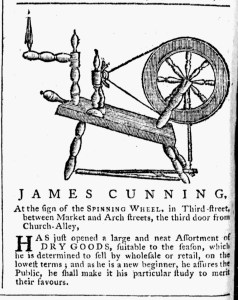
“JAMES CUNNING, At the sign of the SPINNING-WHEEL.”

When John Dunlap launched the Pennsylvania Packet on October 28, 1771, the first edition featured an astounding number of advertisements, enough that he distributed a supplement containing some of the news and advertising that did not fit in the standard issue.  Still, he did not print all of the advertisements submitted to his printing office.  Dunlap included a note that “Some Advertisements … are deferred till next week, when they shall be carefully regarded.”  Most colonial newspapers did not benefit from such an abundance of advertising in their inaugural issues.  Advertisers tended to wait to assess the success and circulation of new newspapers before investing in advertising that might not be seen by many readers.  Dunlap may have attracted so many advertisers because he announced in the subscription proposals that “The first Number shall be given gratis.”  Many advertisers may have assumed that free newspapers would result in high demand, at least for that first issue, making their own advertisements sound investments.

James Cunning, a merchant who did business “At the sign of the SPINNING WHEEL, in Third-street,” was among the advertisers who placed notices in the first issue of the Pennsylvania Packet.  He adorned his advertisement with an image of a spinning wheel, replicating the sign that marked his location.  That image, however, was not unique to the Pennsylvania Packet.  It previously appeared in advertisements Cunning placed in the Pennsylvania Journal on October 10 and October 17.  Colonial printers tended to supply stock images of ships, houses, horses, enslaved people, and indentured servants to advertisers, but advertisers who wished to publish other kinds of images had to commission woodcuts that then belonged to them, not the printers.  Three advertisements in the inaugural issue of the Pennsylvania Packet included images of ships at sea, but Cunning’s was the only advertisement with a specialized image keyed to his particular business.  To make that happen, he had to retrieve his woodcut of the spinning wheel from the printing office operated by William Bradford and Thomas Bradford at the corner of Front and Market Streets and deliver it, along with copy for his advertisement, to Dunlap’s “NEWEST PRINTING-OFFICE” on Market Street.  Already in the first issue of the Pennsylvania Packet, Dunlap participated in a longstanding practice of providing stock images for advertisers while also incorporating more specialized woodcuts that advertisers submitted with their copy.