December 1

What was advertised in a revolutionary American newspaper 250 years ago today?
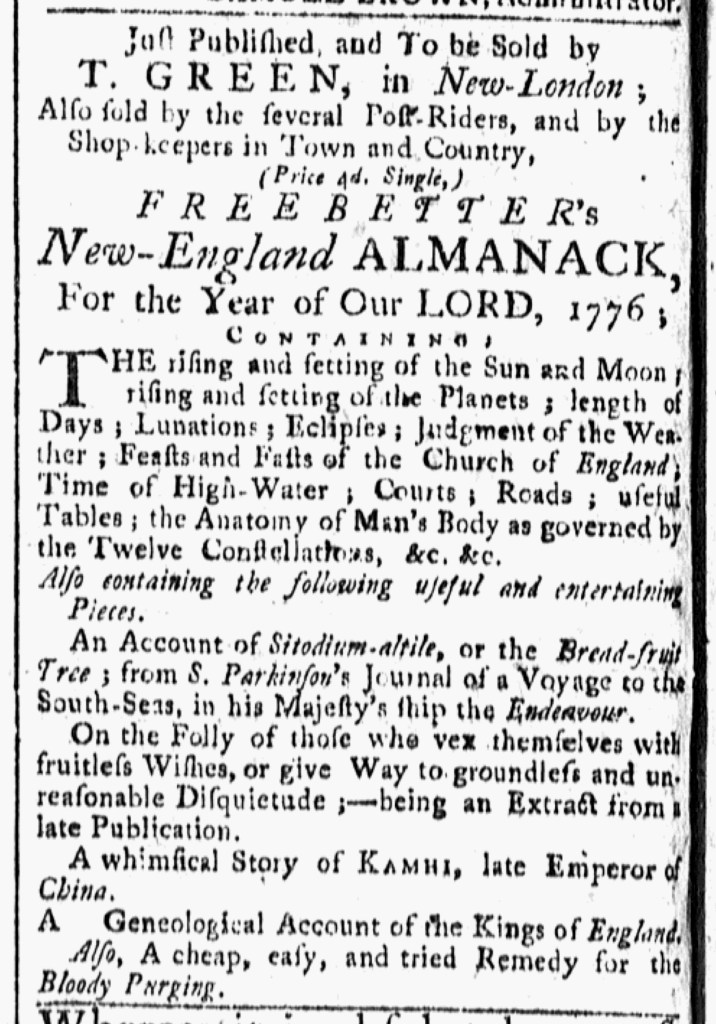
Connecticut Gazette (December 1, 1775).

“Sold by the several Post-Riders, and by the Shop-keepers in Town and Country.”

With only a month until the new year began, Timothy Green, the printer of the Connecticut Gazette, advertised “FREEBETTER’s New-England ALMANACK, For the Year of Our LORD, 1776.”  He emphasized items that usually appeared in almanacs and called attention to special features.  The former included the “rising and setting of the Sun and Moon; rising and setting of the Planets; length of Days; Lunations; Eclipses; Judgment of the Weather; Feasts and Fasts of the Chrich of England; Times of High-Water; Courts; Roads; useful Tables; [and] the Anatomy of Man’s Body as governed by the Twelve Constellations.”  The special features included a “whimsical Story of KAHM, late Emperor of China,” and a “Geneological Account of the Kings of England.”  They also included an “Account of Sitodium-altile, or the Bread-fruit Tree; from S. Parkinson’s Journal of a Voyage to the South-Seas, in his Majesty’s ship the Endeavour” and an essay on “the Folly of those who vex themselves with fruitless Wishes, or give Way to groundless and unreasonable Disquietude; –being an Extract from a late Publication.”  Green may have intended those excerpts as teasers to encourage readers to purchase the original works at his printing office in New London.

To acquire the almanac, however, customers did not have to visit Green or send an order to him.  Instead, he advised that “the several Post-Riders” with routes in the region and “the Shop-keepers in Town and Country” also sold “FREEBETTER’s New-England ALMANACK, For … 1776.”  The printer established a distribution network for the useful reference manual.  Shopkeepers often stocked a variety of almanacs so their customers could choose among popular titles.  Printers sometimes offered discount prices for purchasing multiple copies, usually by the dozen or by the hundred.  That allowed retailers to charge competitive prices to generate revenue with small markups over what they paid.  In this instance, Green did not indicate how much shopkeepers paid for the almanac, only that it sold for “4d. Single” or four pence for one copy.  That constrained shopkeepers when it came to marking up prices.  In addition to shopkeepers, “several Post-Riders” sold the almanac.  That arrangement meant greater convenience for customers and, printers hoped, increased sales and circulation.  In the 1770s, printers in New England began mentioning postriders in their advertisements for almanacs and other printed materials, perhaps acknowledging an existing practice or perhaps establishing a new means of engaging with customers.  The price that Green listed in his advertisement also kept customers aware of reasonable prices charged by post riders.
August 30

What was advertised in a revolutionary American newspaper 250 years ago today?

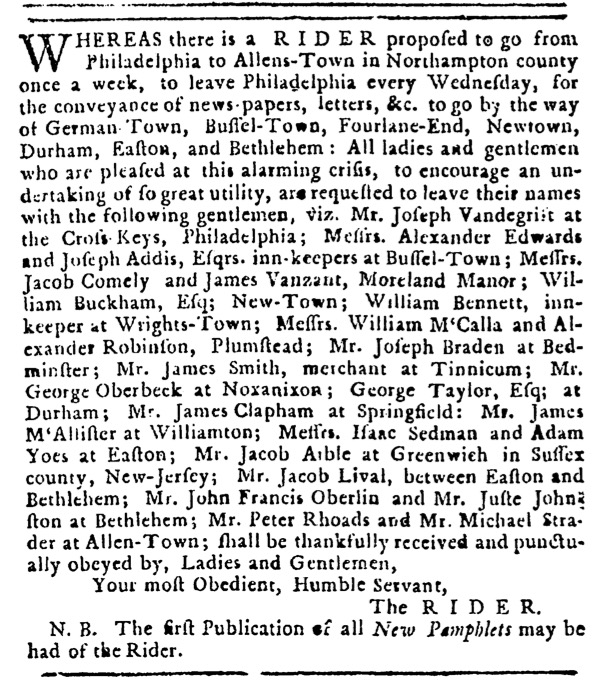
Pennsylvania Journal (August 30, 1775).

“The first Publication of all New Pamphlets may be had of the Rider.”

An anonymous post rider advertised his services in the August 30, 1775, edition of the Pennsylvania Journal, stating that the “Proposed to go from Philadelphia to Allens-Town in Northampton county once a week.”  He intended to depart from Philadelphia each Wednesday, the same day that a new issue of the Pennsylvania Journal, a weekly publication, hit the streets.  Subscribers to that newspaper along his route would benefit from the quickest possible access to the news in the latest edition.  Although “The RIDER” did not give details about collecting fees, he likely envisioned providing his services via subscription, similar to the plan that Thomas Sculley outlined in an advertisement for his route between Philadelphia and Lewes, Delaware, in the Pennsylvania Ledger a month earlier.  Both post riders contributed to an expanding communication infrastructure.  The same issue of the Pennsylvania Journal that carried the anonymous rider’s advertisement also featured a notice that gave the days the new Constitutional Post departed Philadelphia to carry letters to “New-York, Connecticut, Rhode-Island, Massachusetts-Bay, [and] New-Hampshire.”

The rider framed carrying “news-papers, letters, &c.” as a public service at an important moment, instructing “ladies and gentlemen who are pleased at this alarming crisis, to encourage an undertaking of so great utility … to leave their names with the following gentlemen.”  He then listed twenty-three associates in sixteen towns, demonstrating that he had already devoted significant effort to establishing a network for transmitting information.  The outbreak of hostilities in Massachusetts, the “alarming crisis,” made it more important than ever that colonizers residing in smaller towns gained regular access to newspapers and correspondence.  Some were so eager to read the latest news that they may have been stealing copies of Dunlap’s Maryland Gazette.  The rider aimed to keep colonizers along his route well informed.  “The first Publication of all New Pamphlets,” he stated in a nota bene, “may be had of the Rider.”  The “&c.” (or etc.) in “news-papers, letters, &c.” included the political pamphlets and sermons about current events so often advertised in the Pennsylvania Journal and other newspapers printed in Philadelphia.  Post riders in New England had sometimes acted as local agents for disseminating political pamphlets earlier during the imperial crisis.  The anonymous rider joined their ranks, delivering “news-papers, letters, &c.” with a purpose beyond merely earning his own livelihood.

April 18

What was advertised in a colonial American newspaper 250 years ago today?

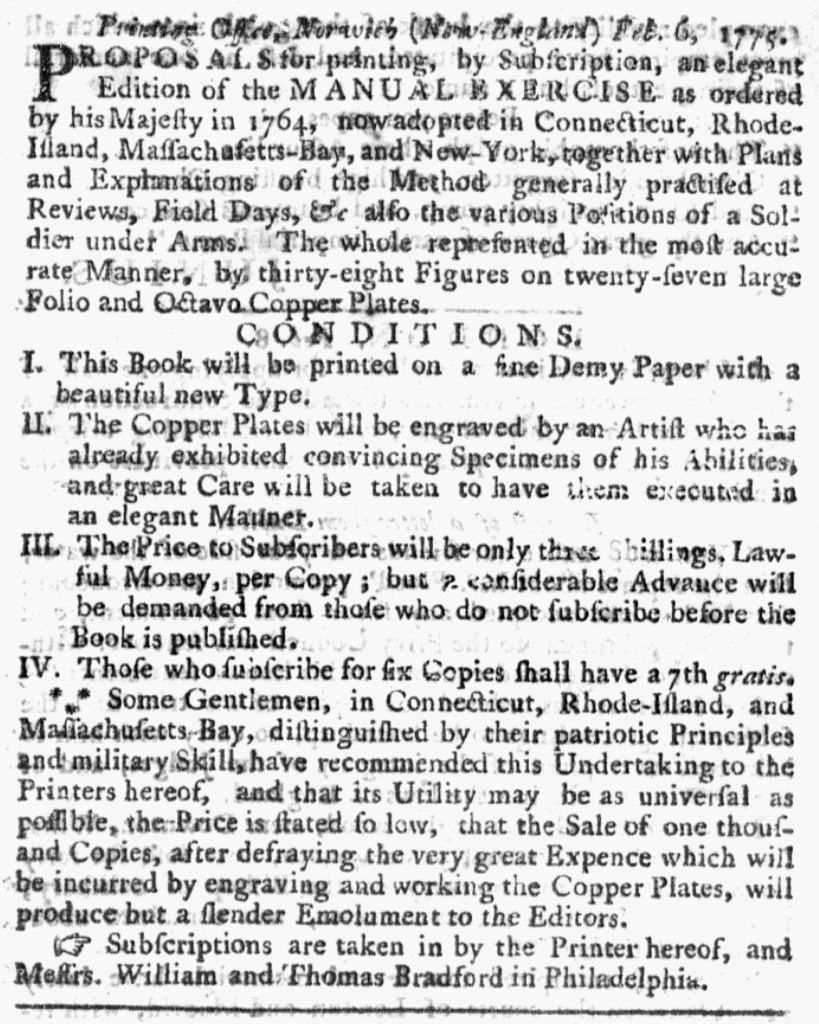
“An elegant Edition of the MANUAL EXERCISE [with] the various Positions of a Soldier under Arms.”

Pennsylvania Evening Post (April 18, 1775).

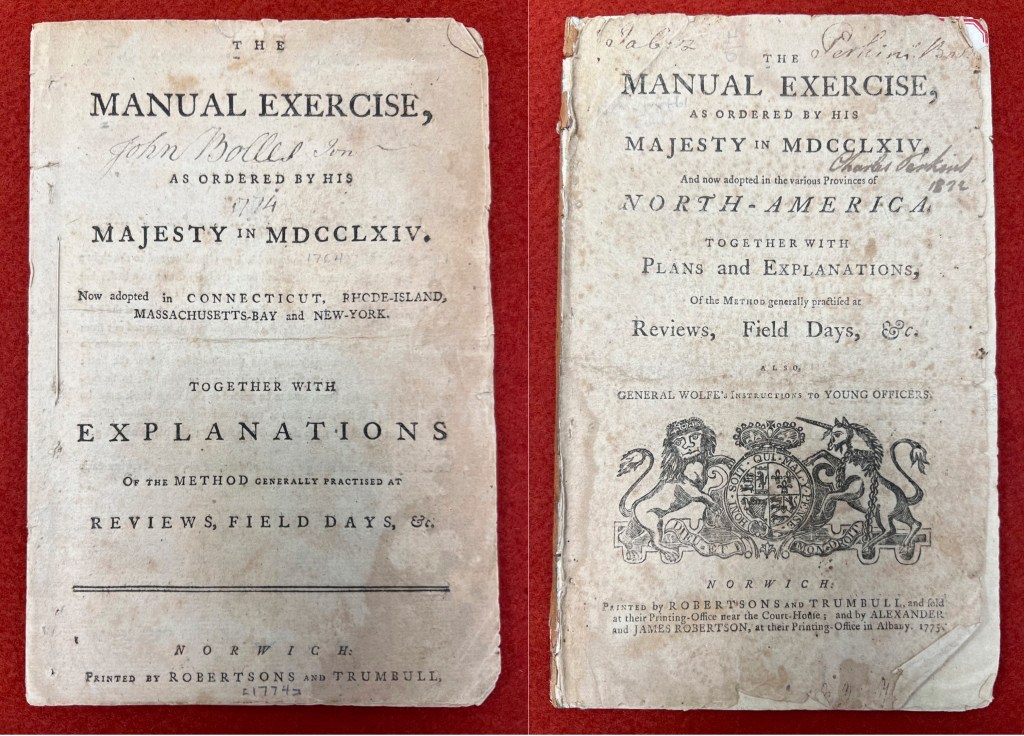
Advertisements for The Manual Exercise as Ordered by His Majesty in 1764: Together with Plans an Explanations of the Method Generally Practised at Reviews and Field-Days appeared in several newspapers printed in New England in 1774, one indication of how colonizers reacted to the trouble brewing with Great Britain.  Printers in five towns produced their own editions, including Ezra Lunt and Henry-Walter Tinges in Newburyport, Massachusetts, John Carter in Providence, Rhode Island, Judah Paddock Spooner in Norwich, and Thomas Green and Samuel Green in New Haven, Connecticut.  In Boston, Isaiah Thomas printed the book and Thomas Fleet and John Fleet issued three variant editions.  They may have also published a previous edition in 1773, based on an inscription that appears in one surviving copy.

In 1775, printers beyond New England produced other editions after the skirmishes at Lexington and Concord and the ensuing military actions.  In New York, Hugh Gaine published one edition; another printed by J. Anderson has been dated to that year.  William Bradford and Thomas Bradford issued the book in Philadelphia.  So did Robert Aitken, meeting with sufficient demand to issue a second edition.  Francis Bailey in Lancaster, Pennsylvania, James Adams in Wilmington, Delaware, and John Dixon and William Hunter in Williamsburg, Virginia, each published local editions in 1775.

Alexander Robertson, James Robertson, and John Trumbull in Norwich, Connecticut, were among the printers who published an edition in 1774.  In the October 13 edition of the Norwich Packet, they advertised that they had “Just published … THE MANUAL EXERCISE, AS ORDERED BY HIS MAJESTY, And now adopted in the Colonies of CONNECTICUT, RHODE-ISLAND, and Province of MASSACHUSETTS-BAY.”  On February 23, 1775, they ran much more elaborate subscription proposals for another edition, an “ELEGANT EDITION” that would include “38 Figures on 27 large Folioand Octavo Copper Plates” that depicted the “various POSITIONS of a SOLDIER UNDER ARMS.”  They explained that “Some Gentlemen, distinguished by their patriotic Principles and military Skill, have recommended this Undertaking to the Printers” as a service to the public.  In the interest of disseminating the book widely so “its Utility may be as universal as possible,” the printers set a low price, “only three Shillings … per Copy” for subscribers who ordered theirs in advance.  Those “who do not subscribe before the Book is published,” on the other hand, could expect to pay “a considerable Advance” (or higher price).  The Robertsons and Trumbull set the price such that “the Sale of 500 Copies” would defray “the very great Expence which will be incurred by the engraving and working the Copper Plates” and yield “but a slender Emolument to the Editors.”

In those proposals, the printers listed local agents who collected subscriptions in Boston, Chelsea, Newburyport, and Salem in Massachusetts, Portsmouth in New Hampshire, and Providence in Rhode Island.  In addition, three post riders also took orders from subscribers.  Eventually, a version of the proposals ran in the Pennsylvania Evening Post.  It did not include the lengthy list of local agents in New England, but instead specified that Benjamin Towne, the printer of the Pennsylvania Evening Post, and William Bradford and Thomas Bradford, the printers of the Pennsylvania Journal, collected subscriptions in Philadelphia.  Perhaps the Bradfords had not yet determined to publish their own edition.  Those proposals also doubled the number of subscribers necessary for “defraying the great Expence” of the engravings to one thousand.

Even though the Robertsons and Trumbull promoted the copper plates, asserting that they “will be engraved by an Artists who has already exhibited convincing Specimens of his Abilities, and great Care will be taken to have them executed in an elegant Manner,” they did not include those illustrations with the new edition they published in 1775.  That edition closely paralleled their previous edition, though it did have a new title page and “Instructions for young OFFICERS.  By GENERAL WOLFE” on the final page, which had been blank in the 1774 edition.  While it is possible that the engravings were removed from the copy in the collections of the American Antiquarian Society at some point over the past 250 years, it seems more likely that events overtook the printers.  Once the imperial crisis became a war, they may have been less concerned about commissioning copperplate engravings and more interested in issuing a new edition of the Manual Exercise to meet the demand of colonizers who believed more than ever that they needed the instructions in that volume.

Copies of The Manual Exercise printed by Robertsons and Trumbull in the collections of the American Antiquarian Society. Left: 1774 edition. Right: 1775 edition.

November 11

What was advertised in a colonial American newspaper 250 years ago today?

Connecticut Journal (November 11, 1774).

“To be sold by the Printers hereof, And by Nathan Hicok, Post-Rider.”

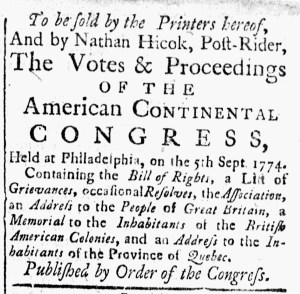
Throughout the colonies, printers provided updates from the First Continental Congress during its meeting in September and October 1774.  After the delegates adjourned and traveled home, printers quickly set about publishing, advertising, distributing, and selling a pamphlet that included an overview of the “Votes & Proceedings” as well as “the Bill of Rights, a List of Grievances, occasional Resolves, the Association, an Address to the People of Great Britain, a Memorial to the Inhabitants of the British American Colonies, and an Address to the Inhabitants of the Province of Quebec.”  William Bradford and Thomas Bradford, printers of the Pennsylvania Journal, first made the pamphlet available in Philadelphia just a week after the meeting ended.  Other printers soon joined them, producing their own local editions.

That included Thomas Green and Samuel Green, the printers of the Connecticut Journal and New-Haven Post-Boy.  On November 4, they alerted readers that the “Proceedings of the Continental Congress will shortly be ready for sale at the Printing Office.”  A week later, they ran a new advertisement, this time announcing that they sold the pamphlet.  Yet customers did not have to visit the printing office or send an order to acquire copies because the Greens enlisted Nathan Hicok, a post rider, in selling as well as delivering the “Votes & Proceedings” to colonizers seeking to keep informed beyond the coverage in newspapers.  It was not the first time that the Greens designated Hicok as one of their agents for disseminating printed items that supported the patriot cause.  On September 30, 1774, they advertised “The celebrated SPEECH, of the Bishop of St. Asaph, on the Bill for altering the Charter of the Colony of Massachusetts-Bay.  To be sold by the Printers, and Nathan Hicok, jun.”  Advertisements in several newspapers demonstrate that several post riders became partners with printers in marketing and selling political pamphlets as the imperial crisis intensified.  Even more post riders, though not named in newspaper advertisements, may have assumed similar responsibilities, actively promoting sales of such items rather than merely delivering them at the behest of printers and their customers.

October 7

What was advertised in a colonial American newspaper 250 years ago today?

Connecticut Journal (October 7, 1774).

The SPEECH, intended to have been spoken on the BILL for altering the Charters of the Colony of Massachusetts Bay.”

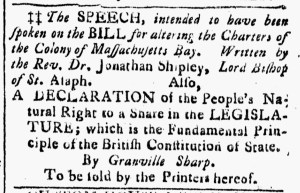
Among the other advertisements that appeared in the October 7, 1774, edition of the Connecticut Journal and New-Haven Post-Boy, Thomas Green and Samuel Green inserted a notice for two political pamphlets “To be sold by the Printers hereof.”  They stocked “The SPEECH, intended to have been spoken on the BILL for altering the Charters of the Colony of Massachusetts Bay.  Written by the Rev. Dr. Jonathan Shipley, Lord Bishop of St. Asaph” as well as “A DECLARATION of the People’s Natural Right to Share in the LEGISLATURE; which is the Fundamental Principle of the British Constitution of State.  By Granville Sharp.”

Both pamphlets supported the American cause against abuses perpetrated by Parliament.  The first critiqued the Massachusetts Government Act, legislation that revoked the colony’s charter, gave greater authority to a governor appointed by the king, and prohibited town meetings without prior approval.  As a bishop of the Church of England, Shipley was a member of Parliament.  He intended to object to the Massachusetts Government Act, one of the Coercive Acts passed in retaliation for the Boston Tea Party, but was not allowed to deliver it.  Instead, he had it published.  Although it had little effect in England, the speech circulated widely and to great acclaim in the colonies.  In addition to imported editions sold by booksellers, colonial printers produced at least eleven American editions in Salem, Boston, Newport, Hartford, New York, Philadelphia, Lancaster, and Williamsburg.  The Massachusetts Gazette and Boston Post-Boy reprinted the speech in a supplement that accompanied its September 12, 1774, edition.  In addition, Daboll’s New-England Almanack, for the Year 1775 included the “Celebrated Speech” and a portrait of Shipley on the title page.  The bishop achieved great acclaim among colonizers for his support during their plight.

The Greens advertised and sold Shipley’s speech, but they did not publish their own edition.  They were so eager to disseminate the pamphlet to their customers that they first advertised it in the outer margin of the second page of the September 30 edition of the Connecticut Journal.  A single line declared, “The celebrated SPEECH, of the Bishop of St. Asaph, on the Bill for altering the Charter of the Colony of Massachusetts-Bay.  To be sold by the Printers, and Nathan Hicok, jun. price 4d.”  Hicok was a post rider who joined the ranks of post riders who not only delivered letters and newspapers but also sold political tracts that advocated for the rights of the colonies.  It appears that the Greens may have received copies of the bishop’s speech shortly before taking the September 30 edition to press, but rather than wait an entire week to promote it in the next issue they instead opted to squeeze it into the margin.  They then converted it into a regular advertisement to continue promoting it to readers.  The advertisements do not reveal how many customers purchased and read the pamphlet, but they do indicate that printers and post riders actively worked to distribute it widely.

September 6

What was advertised in a colonial American newspaper 250 years ago today?

Connecticut Courant (September 6, 1774).

This celebrated Performance … had a wonderful Operation on the Minds of that People.”

A popular political pamphlet originally printed in London and reprinted in four towns in the colonies made another appearance among the advertisements in the September 6, 1774, edition of the Connecticut Courant.  In this instance, Ebenezer Watson, the printer of that newspaper, promoted his own edition of Considerations on the Measures Carrying On with Respect to the British Colonies in North-America produced at his printing office in Hartford.  By that time, John Holt, printer of the New-York Journal, and Benjamin Edes and John Gill, printers of the Boston-Gazette, had already advertised their own editions of the tract.  In New Haven, David Atwater advertised and sold Holt’s New York edition.

Those advertisers replicated the copy from one notice to another.  For his part, however Watson devised his own copy, though he had likely seen at least some of the other advertisements as he scoured other newspapers for content to reprint in the Connecticut Courant.  Watson even offered a variant title in his advertisement, “CONSIDERATIONS On the Measures carrying on by GREAT-BRITAIN, Against the Colonies in NORTH-AMERICA,” though the title on the title page of the pamphlet itself was consistent with the original London edition and the others reprinted in the colonies.  Although Watson did not directly borrow copy from the other advertisements circulating at the time, he seems to have been inspired by them enough to paraphrase from them.  “This celebrated performance” (rather than a “most masterly performance”), he proclaimed, “was first published in England, and had a wonderful Operation on the Minds of that People, in eradicating their Prejudices against the Inhabitants of America.”  In comparison, the other advertisements declared that the tract “had a wonderful effect in removing the prejudices and convincing the people of England.”  Other advertisers commented on the price of American editions compared to the London edition.  Watson did so more elaborately, stating that a “Book so highly admired, and so wonderfully calculated to open blind Eyes, ought to be in the hands” of colonizers throughout America.  That convinced him “to sell it as cheap as he can possibly afford it” without losing money on it.

To disseminate the pamphlet widely, Watson enlisted the aid of local agents in several towns, including Canaan, Farmington, Great Barrington, Litchfield, Middletown, Norfolk, Sheffield, Simsbury, and Torringford.  In addition, readers could acquire copies from two post riders, Joseph Knight and Amos Alden.  As printers in New England marketed a variety of books and pamphlets related to the imperial crisis in the mid 1770s, some of them integrated post riders into their distribution networks in new ways.  They made a point of naming post riders as agents who sold these publications, entrusting them with responsibilities beyond delivering items that buyers ordered from a local dignitary or directly from the printer.  This made post riders’ role in keeping colonizers informed about arguments critiquing Parliament even more visible as they became active proponents rather than mere messengers.