What was advertised in a revolutionary American newspaper 250 years ago this week?
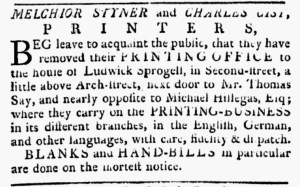
“BLANKS and HAND-BILLS in particular are done on the shortest notice.”
In the spring of 1776, Melchior Steiner and Charles (Carl) Cist ran an advertisement “to acquaint the public, that they have removed their PRINTING OFFICE to the house of Ludwick Sprogrell, in Second-street” in Philadelphia. In their new location, the partners “carry on the PRINTING-BUSINESS in its different branches, in the English, German, and other languages, with care, fidelity & dispatch.” That had been a common appeal in advertisements that they previously placed in several newspapers in December and January, emphasized in a headline that proclaimed, “PRINTING In ENGLISH, GERMAN, and other Languages.” By the time they relocated, Steiner and Cist collaborated with William Bradford and Thomas Bradford, the printers of the Pennsylvania Journal, in printing a new edition of Thomas Paine’s Common Sense approved by the author and a German translation of the popular pamphlet.
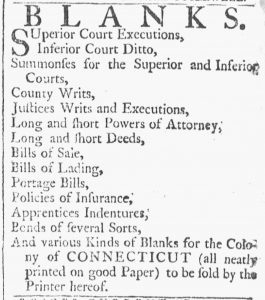
Yet the printers did not limit themselves to books and pamphlets and other major projects. They concluded their advertisement with a note that “BLANKS and HAND-BILLS in particular are done on the shortest notice.” In other words, they accepted all sorts of smaller job printing assignments, quickly producing documents useful in business. “BLANKS” referred to a variety of forms so commonly used that it saved time to print them in volume and then write the details by hand for each transaction. In an advertisement in the Providence Gazette, John Carter listed more than a dozen kinds of blanks he printed, including “long and short Powers of Attorney, long and short Deeds, Bills of Sale, Bills of Lading, Portage Bills, Policies of Insurance, Apprentices Indentures, [and] Bonds of various Sorts.” When it came to “HAND-BILLS,” customers used them to promote consumer goods and services, sometimes supplementing newspaper advertisements, and to disseminate news about politics, meetings, and other current events. That printers so often advertised that they printed handbills suggests that many more of those items circulated in early American cities and towns than have survived in research libraries, historical societies, and private collections. Steiner and Cist printed both blanks and handbills “on the shortest notice,” indicating that customers expected their orders to be filled speedily so they could get more information into circulation.