What was advertised in a revolutionary American newspaper 250 years ago today?
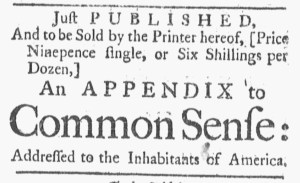
“Just PUBLISHED … An APPENDIX to Common Sense.”
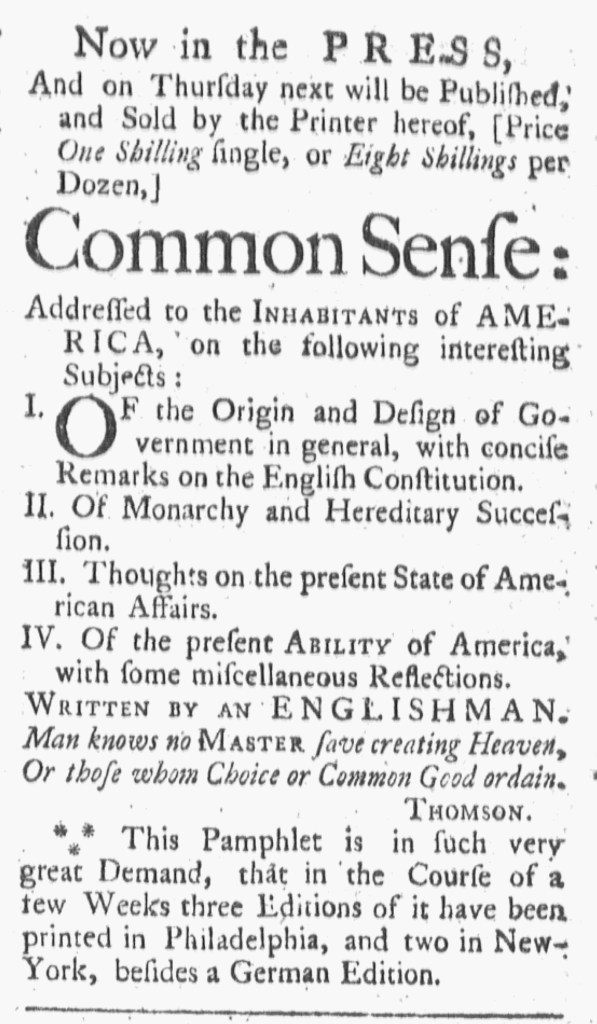
Advertisements for Thomas Paine’s Common Sense continued to proliferate in the March 9, 1776, edition of the Providence Gazette. Three weeks earlier, John Carter, the printer, announced that he had a local edition of the pamphlet “Now in the PRESS” and expected that copies would be ready for sale within a week. To stoke anticipation, he trumpeted, “This Pamphlet is in such very great Demand, that in the Course of a few Weeks three Editions of it have been printed in Philadelphia, and to in New-York, besides a German Edition.” The following week, he updated the advertisement to alert the public that he “JUST PUBLISHED” the pamphlet and sold it for “One Shilling single, or Eight Shillings per Dozen.”
Rather than continuing to run that advertisement, he once again revised it for the March 1 edition of the Providence Gazette. This version eliminated the comment about the “very great Demand” for the pamphlet. Carter also described his edition as “A NEW EDITION OF Common Sense,” replicating how William Bradford and Thomas Bradford described the edition they produced in collaboration with Thomas Paine after the author parted ways with Robert Bell, the publisher of the first edition of Common Sense. Given that the Bradfords did not announce publication of that edition until February 14, the edition that Carter had “Now in the PRESS” on February 17 must have drawn from one of Bell’s editions or from John Anderson’s New York edition (drawn from one of Bell’s editions) published on February 8. Why did Carter consider it necessary to revise his advertisement to describe his edition as “A NEW EDITION”?
He may have seen the dispute, first between Bell and Paine and later between Bell and the Bradfords, play out in advertisements in the Pennsylvania Evening Post and other newspapers published in Philadelphia. After all, printers exchanged newspapers so they could reprint news, letters, editorials, and other content. During that dispute, the Bradfords emphasized that their edition included new material written by Paine, “An APPENDIX, and an Address to the People called QUAKERS.” It did not take long for Bell to pirate those items and add them to “Large ADDITIONS to COMMON SENSE,” a collection of essays from newspapers, none of the written by Paine.
Carter acquired one of those pamphlets. On March 9, he once again ran his advertisement promoting the “NEW EDITION.” In a second advertisement, he announced publication of “An APPENDIX to Common Sense,” a separate item that sold for “Ninepence single, or Six Shillings per Dozen.” Richard Gimbel indicates that this pamphlet included the “Address to the People called Quakers.”[1] Perhaps Carter updated his advertisement in solidarity with the Bradfords. He did not, after all, publish a local edition of “Large Additions.” Carter did not explicitly wade into that controversy that gained so much attention in Philadelphia. Instead, he kept the focus on distributing Common Sense and Paine’s supplementary materials.
**********
[1] Richard Gimbel, Thomas Paine: A Bibliographical Check List of Common Sense with an Account of Its Publication (New Haven: Yale University Press, 1956), 90.