GUEST CURATOR: Trevor Delp
What was advertised in a colonial newspaper 250 year ago this week?
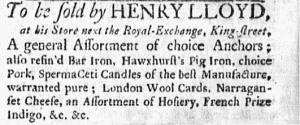
“SpermaCeti Candles of the best Manufacture, warranted pure.”
In today’s advertisement spermaceti candles were being sold. Spermaceti candles are candles made out of headmatter from sperm whales. Massachusetts history is rich with whaling culture. According to the Nantucket Historical Association, “Candles were considered a specialized element of the whale-oil trade and were priced as a luxury item.” Spermaceti candles burned brighter and also were odorless. This made them a very attractive commodity and far more expensive than the traditional tallow candles.
In the early eighteenth century colonists first started coming across pods of sperm whales, but it was not until the 1750s that spermaceti oil refining started taking place. According to the New Bedford Whaling Museum, sperm whales were difficult to hunt because they have the ability to dive upwards of three thousand feet, deeper than any other marine animal, and hold their breath for up to ninety minutes. This made hunting them with the rudimentary seafaring technology of the eighteenth century both impressive and lucrative, an endeavor that also came with great danger. These candles were pivotal to life before electricity.
Although the major boom of whaling in New England would not come until the nineteenth century, I still found it interesting that Boston newspapers were advertising spermaceti candles in the 1760s. Patty Jo Rice of the Nantucket Historical Association says, “By 1763 there were as many as twelve manufacturers in the colonies and accusations of pricing violations was commonplace.” This points to development of the whaling market that was not completely documented at the time and that can be hard trace. Today’s advertisement helps to demonstrate that whaling and whale products were becoming increasingly popular in colonial America.
**********
ADDITIONAL COMMENTARY: Carl Robert Keyes
Testaments to quality were among the most common appeals made in eighteenth-century advertisements. Henry Lloyd mobilized such an appeal more than once in today’s advertisement, first when he described the pork he sold as “choice” and again when he assured potential customers that his “SpermaCeti Candles” were both “of the best Manufacture” and “warranted pure.”
The promise that theses candles were “warranted pure” merits additional investigation. Drawing once again from the Nantucket Historical Association, we know that “headmatter, sperm oil (oil from the blubber of the sperm whale), and whale oil (from all other whales) became separate products in the marketplace with headmatter commanding an average of three times the price of standard whale oil.” When shipping these products to England, whaling merchants sometimes mixed whale oil and headmatter together to avoid the higher duties on headmatter. That being the case, colonial consumers could be justifiably suspicious when purchasing spermaceti candles. If headmatter and whale oil could be combined to lower the duties when exported, why not combine them to raise the price of candles made and sold in the colonies? In an era with far fewer regulations than the modern business environment, Henry Lloyd gave his word that customers who purchased relatively expensive spermaceti candles were not being duped or cheated.
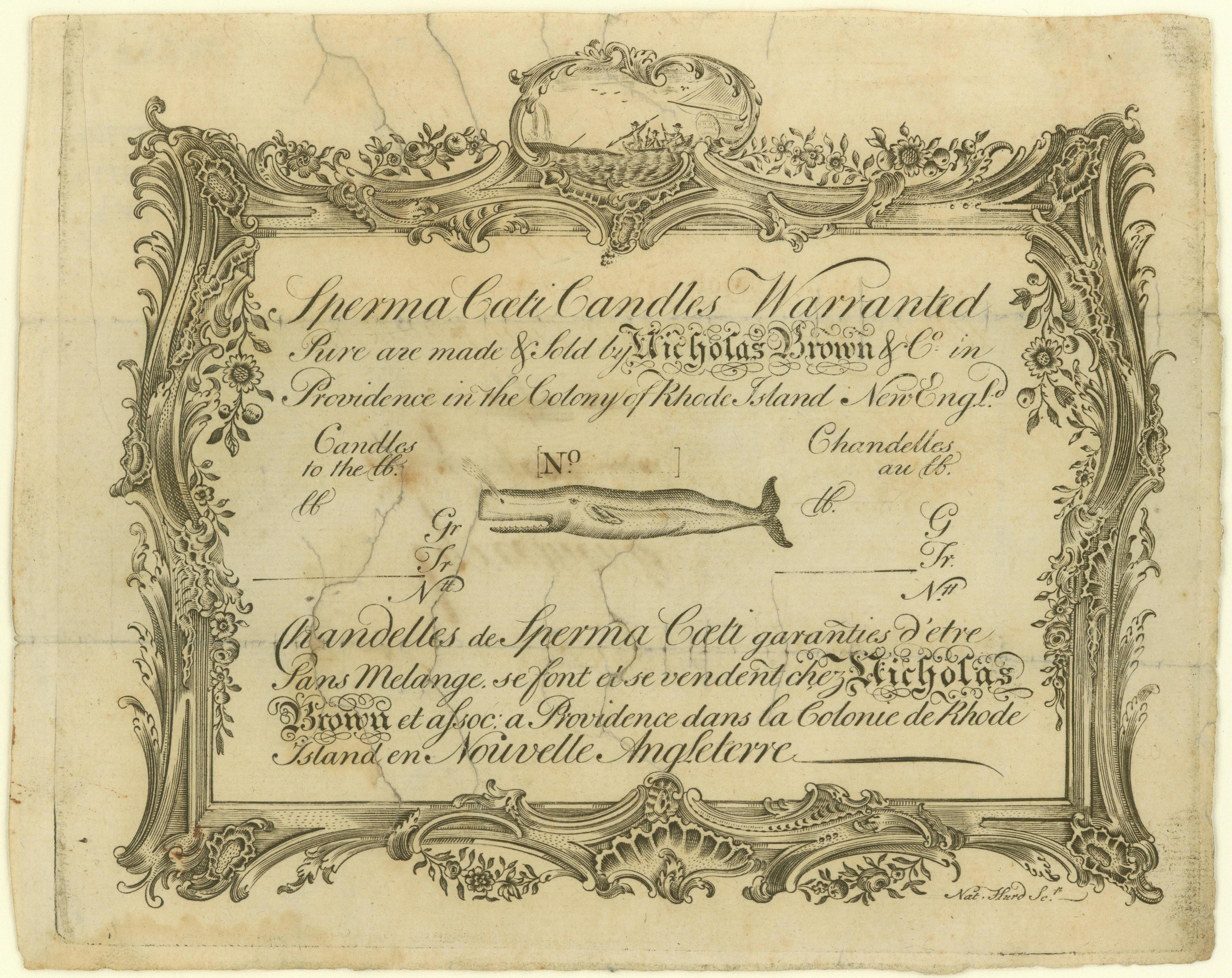
Lloyd was not alone in doing so. “Warranted Pure” was a standard assurance offered to consumers in advertisements for spermaceti candles in the decade before the American Revolution. A Boston manufactory issued a trade card circa 1770 that announced “Sperma-ceti candles warranted pure; are made by Joseph Palmer & Co.” The collections of the John Carter Brown Library include this trade card, circa 1764, from Nicholas Brown and Company in Providence. It also promised that customers could purchase spermaceti candles that were “Warranted Pure.” Note the whale in the center and the whalers in the cartouche at the top.