September 24

What was advertised in a colonial American newspaper 250 years ago today?

Sep 24 - 9:24:1767 Pennsylvania Gazette
Pennsylvania Gazette (September 21, 1767).

“Good, sound, and neat silver watches.”

Advertisements for imported goods – textiles, housewares, hardware – filled the pages of colonial newspapers. In most instances, artisans and manufacturers in England made items colonists either could not produce on their own or that surpassed the quality of similar items made by colonial crafters. As the eighteenth-century progressed, however, greater numbers of skilled artisans participated in transatlantic migrations, bringing their expertise to colonial cities and towns. They set up shop in their new places of residence; their skills and experience contributed to improving the reputation associated with domestically produced goods.

By the 1760s, residents of Philadelphia and major urban ports worried that observers in England, especially London, might look down on them as backwater provincials since they were so far distant from the center of the empire. Some advertisers in Boston, Charleston, New York, and Philadelphia attempted to allay these anxieties with assurances that they made and sold goods of the highest quality and most recent fashions. Yet concerns about cosmopolitanism were not confined to the largest and busiest port cities. In Lancaster, more than fifty miles west of Philadelphia, Thomas Skidmore opened a workshop where customers interested in purchasing expensive watches “may be here supplied as in London.”

In an advertisement in the Pennsylvania Gazette, Skidmore, a “WATCH-FINISHER, from London,” insisted that local consumers were no longer “under the necessity of importing good watches from England or Ireland.” For only £12, he made “good, sound, and neat silver watches” in the town of Lancaster. Skidmore did not work alone; instead, he employed two assistants, “the one a movement-maker, and the other a motion-maker,” both of whom had previously followed their trade in England. Working together, the three produced “good watches” that Skidmore asserted rivaled any imported from Britain. Skidmore was so certain of the quality of the work done in his shop that he offered a guarantee that his watches would not require repairs in the first three years. He made appeals that would have been familiar to residents of Philadelphia, the largest city in the American colonies in the decade before the Revolution. His location in Lancaster, however, demonstrates that desire to participate in consumer culture extended beyond urban centers, far into the hinterland.

September 2

What was advertised in a colonial American newspaper 250 years ago today?

Sep 2 - 9:2:1767 Georgia Gazette
Georgia Gazette (September 2, 1767).

“EXCEEDING GOOD OLD BARBADOS RUM, by the hogshead, quarter-cask, or small quantity.”

Horton and Moore placed a fairly simple advertisement in the September 2, 1767, issue of the Georgia Gazette. In it, they announced that they sold a small number of items: rum, sugar, vinegar, and Delftware (a popular blue and white pottery made in the Netherlands and exported to locales throughout the Atlantic world). Compared to the list-style advertisements that crowded the pages of many eighteenth-century newspapers, their notice was relatively short. Yet the simplicity and the length did not mean that Horton and Moore neglected to advance marketing messages in their advertisement. For each item, they offered some sort of commentary intended to entice potential customers to visit Horton and Moore’s wharf to make their purchases.

The partners resorted to some of the most common appeals made to consumers throughout the eighteenth century. They emphasized quality, explicitly and implicitly, to promote both rum and sugar. They described the former as “EXCEEDING GOOD” and the latter as “of an extraordinary good quality.” In noting the places of origin – “BARBADOS RUM” and “JAMAICA SUGAR” – they further testified to quality since those locations were widely recognized for producing the finest examples of their respective commodities.

When it mattered, Horton and Moore made an appeal to consumer choice: they carried a ‘COMPLETE ASSORTMENT” of Delftware. This implied a variety of (fashionable) patterns as well as an array of items, from plates and bowls to canisters and sugar dishes to tiles and tureens for household use and decoration. Horton and Moore invited customers to examine all the possibilities, promising that they would not be forced to choose from a tiny selection. A “COMPLETE ASSORTMENT” meant the freedom to express themselves by identifying their favorites and choosing items that distinguished them from their friends and relations.

Horton and Moore also marketed convenience when they offered to sell their commodities in various quantities. Customers could purchase rum “by the hogshead, quarter-cask, or small quantity,” sugar “by the hogshead, barrel, or small quantity,” and vinegar “in any quantity.” Presumably shoppers were also welcome to select as many or as few pieces of Delftware as they desired.

Finally, the partners made an appeal to price, stating they sold all of their merchandise “on the most reasonable terms.” Combined with the other appeals, this made their wares even more attractive to prospective customers.

Horton and Moore’s advertisement demonstrates that commercial notices aimed at consumers did not need to be elaborate or lengthy to incorporate marketing appeals. In the space of half a dozen lines, the merchants deployed messages about quality, choice, convenience, and price as they attempted to incite demand among customers in Savannah and its hinterland.

August 20

What was advertised in a colonial American newspaper 250 years ago today?

Aug 20 - 8:20:1767 Pennsylvania Gazette
Supplement to the Pennsylvania Gazette (August 20, 1767).

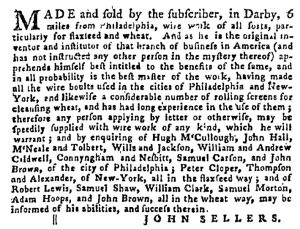
“A considerable number of rolling screens for cleansing wheat.”

John Sellers and Richard Truman both advertised their “SCREENS for cleaning all sorts of Grain” in the August 20, 1767, issue of the Pennsylvania Gazette. Truman devoted more than half of the space in his notice to a woodcut depicting a machine that used one of the screens he made. This strategy likely garnered a fair amount of attention since visual images were relatively rare in eighteenth-century newspapers; even the most humble woodcuts distinguished the advertisements they adorned from the vast majority of others.

Sellers purchased the same amount of space, but, like most advertisers, densely filled it with text. He used that space to develop two marketing strategies: an appeal to unparalleled expertise in his field and roll call of existing customers who could testify to his abilities and their experience using the screens he made.

Sellers not only “MADES and sold” screens for cleaning flaxseed and wheat, he claimed to be “the original inventor and institutor of that branch of business in America.” Furthermore, he protected his trade secrets by not sharing his techniques with anyone else. As evidence that former customers recognized the quality and utility of his “wire work of all sorts,” Sellers argued that he had made “all the wire boults used in the cities of Philadelphia and New-York” as well as a “considerable number” of rolling screens akin to those advertised by Truman. Due to his “long experience” and status as “the best master of the work,” he believed that he was “best intitled” to the patronage of those who needed to purchase such equipment.

Potential customers did not need to take Sellers’ word. Instead, he listed eight associates in Philadelphia and another eight in New York, encouraging readers to enquire of them for further endorsements. Realizing that consumers would rightfully be skeptical of what amount to nothing more than braggadocio, Sellers made it possible for them to independently verify his claims by speaking with satisfied customers.

Without a woodcut decorating his advertisement, John Sellers instead worked to convince potential customers of the superiority of his product over others marketed and sold by his competitors. Richard Truman’s advertisement was rudimentary in comparison. It included an eye-catching visual image, but did little beyond announcing that he sold fans and screens for cleaning grains. In contrast, Sellers explained why customers should prefer the products he made and sold. In addition, he directed them to satisfied customers who could speak authoritatively about his screens.

August 18

What was advertised in a colonial American newspaper 250 years ago today?

Aug 18 - 8:18:1767 South-Carolina Gazette and Country Journal Supplement
Supplement to the South-Carolina Gazette and Country Journal (August 18, 1767).

“They will be warranted to be equal, if not superior in quality, to any WINES that has been imported this season.”

Samuel Peronneau advertised “A large parcel of genuine Made[i]ra Wines” in the supplement that accompanied the August 18, 1767, edition of the South-Carolina Gazette and Country Journal. On the same page, William Hulme promoted the “MADEIRA, VIDONIA and LISBON WINES, BRANDY and GIN” he sold, along with “RUMS, from Jamaica, Barbados, and the Northward.” Elsewhere in the issue, several shopkeepers advertised other alcoholic beverages. James McCall included “bottled beer, cyder, ale, and perry” among a list of dozens of imported items in stock at his shop. Samuel Grove carried “best Taunton ale, [and] cyder,” while Greenland and Jones sold “best Bristol bottled beer, [and] Philadelphia ditto in whole and half barrels.” Other merchants and shopkeepers regularly advertised beers, wines, and liquors in the South-Carolina Gazette and Country Journal and other newspapers printed in Charleston in the late 1760s. Residents of Charleston had many options when it came to acquiring alcohol.

Amid this sea of choices, Peronneau attempted to distinguish his offerings from those presented by his competitors. He confidently stated that his wines were “Of the best London, York, and Jamaica qualities” and boldly pledged that they “will be warranted to be equal, if not superior in quality, to any WINES that has been imported this season.” Some competitors made passing comments about the quality of their beverages, but Peronneau elaborated on why potential customers could trust his assurances in that regard. He did not sell whatever happened to be shipped to him by faraway associates. Instead, he contracted “a gentleman on the spot” to examine “every pipe.” In each instance, that gentleman “spared no pains in the choice of them.” In effect, Peronneau had a quality control agent overseeing the merchandise that entered his warehouse. Ultimately, that “gentleman” worked on behalf of Peronneau’s clients, his efforts mutually benefitting the retailer and the customers rather than the suppliers.

Whether they sold wine or other imported goods, most advertisers did not provide much information about the processes through which they acquired their inventory. Peronneau, however, had a system that distinguished his wines from others on the market. This allowed him to include specific details that further developed his appeal to quality, one of the most common appeals in eighteenth-century advertisements. Rather than make vague and general statements about the quality of his merchandise, Peronneau offered potential customers specific details explaining why they should believe that he did indeed stock wine “equal, if not superior in quality” to any others they could purchase locally.

May 30

What was advertised in a colonial American newspaper 250 years ago today?

May 30 - 5:30:1767 Providence Gazette
Providence Gazette (May 30, 1767).

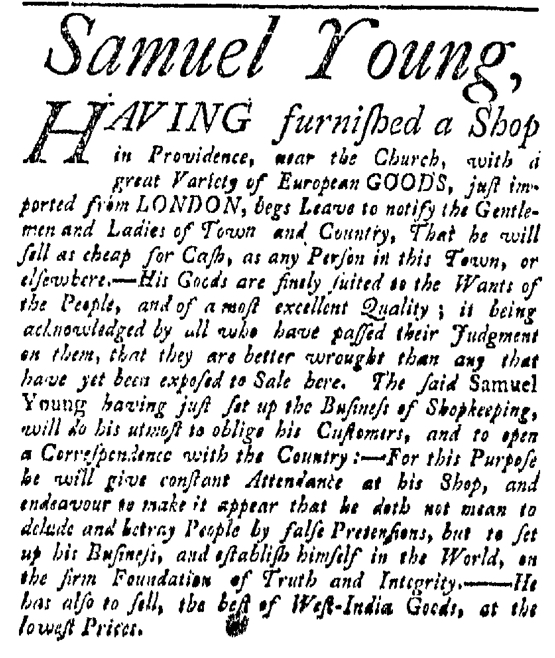
“Samuel Young … begs Leave to notify the Gentlemen and Ladies of Town and Country.”

Samuel Young of Providence was new to shopkeeping, but he demonstrated in his first advertisement that he understood the conventions of eighteenth-century advertising. He incorporated several of the most common marketing appeals of the era, including price, quality, and consumer choice. He opened his notice with a pledge to “sell as cheap for Cash, as any Person in this Town, or elsewhere” and concluded by reiterating that he offered “the lowest Prices.” He went into greater detail about the “most excellent Quality” of his “European GOODS,” claiming that “all who have passed their Judgment on them” acknowledged “that they are better wrought than any that have yet been exposed to Sale here.” Similarly, he sold “the best of West-India Goods.” Savvy consumers probably greeted these boasts with some skepticism. After all, Young sold the same imported goods as his competitors. Although he did not enumerate his wares, Young stated that they comprised “a great Variety” and were “finely suited to the Wants of the People.” Hyperbolic at times, Young did not merely place a notice that announced he opened a new shop. Instead, drew on techniques already popular in consumer advertising to market his merchandise.

As a newcomer to his occupation, Young also attempted to reassure potential customers about his own character, arguing that he possessed the personal qualities to make sure they would receive satisfactory treatment during transactions. He was not afraid of hard work, intending to “give constant Attendance at his Shop.” He also seemed sensible that some of his claims came off a bit overstated. To that end, he persuaded readers “that he doth not mean to delude and betray People by false Pretensions.” Instead, he simply wished to “establish himself in the World, on the firm Foundation of Truth and Integrity.” Young’s advertisement appeared alongside commercial notices by shopkeepers with established reputations. He realized that he needed to make bold claims to attract attention to his business while simultaneously cultivating his own standing as an honest and fair dealer.

May 28

What was advertised in a colonial American newspaper 250 years ago today?

May 28 - 5:28:1767 New-York Journal
New-York Journal (May 28, 1767).

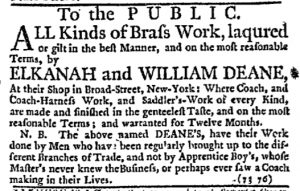
“Have their Work done by Men who have been regularly brought up to the different Branches of Trade.”

Elkanah and William Deane made coaches “At their Shop in Broad-Street, New-York.” At the same location they also did “Coach-Harness Work, and Saddler’s-Work of every Kind.” The Deanes apparently were not impressed with many of their competitors, issuing sharp words about the quality of work customers could expect from other shops. In a nota bene they asserted, “The above named DEANE’S, have their Work done by Men who have been regularly brought up to different Branches of Trade, and not be Apprentice Boy’s, whose Master’s never knew the Business, or perhaps ever saw a Coach making in their Lives.”

The quality promised by the Deanes resulted from specialized training by qualified artisans. They accused competitors of hiring workers who had supposedly been through apprenticeships, but they cast doubt on the caliber of expertise and experience possessed by some of the supposed masters who trained the next generation of coachmakers and artisans in related occupations, such as harnessmakers and saddlers. The Deanes warned that prospective customers needed to heed not only the credentials of the coachmaker who ran a shop but also those of anyone employed in that shop. After all, the owner of a shop did not undertake all the work but instead distributed it and oversaw the labor of others. The Deanes took responsibility for the work done by every employee in their shop, pledging that they only hired experienced “Men who have been regularly brought up to the different Branches of Trade.”

Assuring potential customers of the quality of the work produced in their shop was so important to the Deanes that they offered a one-year guarantee. Whether repairs to coaches or new harnesses or saddles, everything that came out of their shop was “warranted for Twelve Months.” By providing a guarantee, the Deanes underscored that their scathing comments about training and expertise were not merely idle boasts. They could afford to guarantee their work because they were so confident in their own skills and experience as well as those of everyone who worked in their shop.

March 11

What was advertised in a colonial American newspaper 250 years ago today?

Mar 11 - 3:11:1767 Georgia Gazette
Georgia Gazette (March 11, 1767).

“THOMAS LEE jun. House-Carpenter and Joiner.”

Thomas Lee, Jr. most likely placed this advertisement to introduce himself to residents of Savannah. As far as introductions went, it was brief but covered a lot of ground. In a single sentence, Lee assured “gentlemen who will be pleased to employ him, that they may depend upon having their work done in the best manner and at the most reasonable rates, with the utmost dispatch.” In so doing, Lee incorporated two of the most common appeals made in advertisements for consumer goods in the eighteenth century. Artisans and others who offered services often adapted those appeals to their own purposes. An appeal to price (“at the most reasonable rates”) required little shift in the meaning, but an appeal to quality (“”having their work done in the best manner”) moved the focus away from merchandise to the skills possessed by the advertiser offering the service. Lee added another appeal sometimes advanced by shopkeepers but more often deployed by artisans. When he pledged to complete work “with the utmost dispatch,” he promised attentiveness and efficiency. Then and now, customers hiring artisans (or contractors) to work on their homes value jobs completed in a timely manner. Similarly, Lee provided “estimations and plans” so customers could hold him accountable for the work he was hired to do.

In describing himself as a “House-Carpenter and Joiner,” Lee informed potential clients that he was a versatile craftsman. Like carpenters, joiners worked with wood, but they specialized in lighter and more ornamental work. Lee was qualified to work on the structure of a building or make and repair any of the fittings that adorned it. Those fittings might include simple doors and windows or they could include intricate pediments and mantels. That being the case, he addressed his introduction “to all gentlemen” in Savannah because affluent merchants and other members of the local gentry would have been most likely to hire (and afford) his services for more ornate work. As the consumer revolution placed an increasing number of goods in the hands of all sorts of colonists, the elite used architectural adornment to express their tastes and attempt to assert distinctions between themselves and others who sometimes mimicked their fashions.

At first glance, Lee’s advertisement looks like a simple notice, but the savvy “House-Carpenter and Joiner” actually incorporated several types of appeals to make a good first impression when introducing himself and his services to residents of Savannah.

October 21

GUEST CURATOR: Lindsay Hajjar

What was advertised in a colonial American newspaper 250 years ago this week?

oct-21-10201766-south-carolina-gazette
South Carolina Gazette (October 20, 1766).

“RUM … superior in quality to what is usually imported.”

This advertisement is interesting because it closely resembles advertisements we would see today, playing on people’s emotions that this rum was better than what they usually drank. I learned about types of persuasion in my Social Psychology class taught by Professor Maria Parmley. I think the type of persuasion the seller used is peripheral route to persuasion. The advertisement called for consumers to make the decision based on emotion, not facts (like how the rum was made or why it was better quality). Potential customers were told that the rum they were used to drinking was lesser quality than this rum “FROM the Island of Grenada.” This type of precaution tactic is commonly seen in advertisements today; when many people see a commercial with a beautiful model using the product they are more likely to buy it because the product then becomes associated with the model’s beauty. It’s interesting that the way of inciting people to buy one product over another has changed very little in 250 years.

John J. McCusker shows the importance of rum in the colonial American economy.[1] Rum, which was made from sugar that was being produced in the Caribbean colonies, was an important part of the import and export trade. Drinking alcohol, like rum, became an essential part of life for many of the colonists, providing an escape from the pressures of everyday life. Social drinking was something that the colonists have in common with people today. Even though we may not always realize it we have more in common with the people who lived in colonial America than we might assume. Through this advertisement you can see two things that the colonists and people of the twenty-first century had in common, the way consumers can be persuaded to buy goods and how both people today and people then care about the quality of the alcohol they drink.

 **********

ADDITIONAL COMMENTARY: Carl Robert Keyes

Lindsay’s analysis of the sophisticated tactics Anthony Lamotte used to market his rum made me wonder how it compared to other advertisements for rum in the same issue of the South Carolina Gazette. Two other notices featured rum prominently.

oct-21-10201766-rum-in-south-carolina-gazette
South Carolina Gazette (October 20, 1766).

One brief advertisement announced that William Gibbes(?) had “CHOICE JAMAICA RUM, best MUSCOVADO SUGAR, and COFFEE, to be sold cheap.” This advertisement included two of the most common appeals from eighteenth-century advertising: price (“to be sold cheap”) and quality (“CHOICE”). However, Gibbes did not compare the quality of his Jamaican rum to any other rum, whether from the same island, the Windward Islands, or any other place. (The “3M.” in brackets may have been a printer’s note indicating that the advertisement was to run for three months. Perhaps Gibbes relied on repetition of his advertisement, rather than other means of persuasion, to attract customers.)

oct-21-10201766-rum-2-in-south-carolina-gazette
South Carolina Gazette (October 20, 1766).

Thomas Shirley advertised a hodgepodge of imported commodities, from flour to iron to Windsor chairs. “A few Puncheons of Jamaica Rum” appeared in the middle of Shirley’s list. Like Gibbes (“to be sold cheap”) and Lamotte (“TO BE SOLD, reasonably”), Shirley made an appeal to price (“to be sold reasonably”), but he made no other effort to distinguish the rum he sold. Some modern readers may be tempted to think that listing Jamaica in italics was intended to highlight the origins of his rum for consumers that considered production in some places superior to others. However, listing place names in italics was common practice throughout eighteenth-century advertisements. In addition, printers – not the advertisers themselves – usually made the decisions about typography.

As Lindsay notes, rum was an extremely popular commodity in colonial America. Amid already high demand, advertisers like Anthony Lamotte worked to direct that demand in their favor. To do so, Lamotte used a marketing strategy that emphasized more than just price and quality. He promised potential customers that his rum was “superior in quality” to others, playing on their emotions in the absence of providing evidence to explain why it was a better product.

**********

[1] John J. McCusker, “The Rum Trade and the Balance of Payments of the Thirteen Continental Colonies, 1650-1775,” Journal of Economic History 30, no. 1 (March 1970): 244-246.

July 5

What was advertised in a colonial newspaper 250 years ago this week?

Jul 5 - 7:4:1766 Virginia Gazette
Virginia Gazette (July 4, 1766).

“I have settled … in Henrico county, where I purpose to carry on the FULLING business.”

Mathew Dick, a fuller, used an advertisement in the Virginia Gazette to announce that he had just set up shop in Henrico county. Dated July 1, his notice appeared in the next issue of the Virginia Gazette. Although his “FULLING business” was a new establishment, Dick relied on many of the advertising appeals that were commonly deployed in the eighteenth century, reassuring potential customers that he knew his craft and could provide quality service.

He opened with appeals to quality and price, promising that he did his work “in the best and cheapest manner ever done in this colony.” That last bit – “ever done in this colony” – was a bit of hyperbole that underscored his confidence and dared potential customers to give him a chance and see for themselves if his work lived up to the advertisement. In addition, all the equipment and supplies were prepared “in the best order.”

He also offered some words of wisdom specific to his occupation, again reassuring potential customers of his expertise even though he operated a new establishment. “[T]he wool from the neck and shoulders is the best for the finest cloth,” he lectured. Furthermore, “all woolen cloth should be wove at least 5 quarters wide.” Dick knew his business and used his advertisement to testify to the fact.

Finally, Dick promised excellent customer service. He offered two different locations where customers could drop off the fabric they wanted him to process. He would see to it that their orders were fulfilled “in the neatest manner” and as quickly as possible, but not at the expense of deviating from their instructions. Dick fulled cloth to his customers’ specifications and satisfaction: “their directions most punctually observed and followed.”

Dick’s fulling mill may have been new, but he leveraged multiple appeals in his advertisement to demonstrate that he knew his craft and potential customers could depend on him.

May 8

What was advertised in a colonial newspaper 250 years ago today?

May 8 - Wharton 5:8:1766 Pennsylvania Journal
Pennsylvania Journal (May 8, 1766).

“ANCHORS manufactured in America.”

“I have for some time carried on the business here.”

Daniel Offley and Charles Wharton were competitors when it came to selling anchors in Philadelphia. Both of these advertisements appeared in the May 8, 1766, issue of the Pennsylvania Journal, but the dates affixed to each suggest the course of conversations that took place, certainly in the public prints but possibly face-to-face with potential customers as well. Wharton’s advertisement had been running since late March, but Offley’s appeared for the first time in the May 8 issue. (Guest curator Maia Campbell previously featured the same advertisement from Wharton, which also appeared in the Pennsylvania Gazette.)

May 8 - 5:8:1766 Pennsylvania Journal
Pennsylvania Journal (May 8, 1766).

Wharton incorporated two powerful appeals into his short advertisement. He pledged to sell anchors “at a half penny per lb. cheaper than any other person can or will sell at in this city.” Considering that anchors weighed hundreds or even thousands of pounds, this presented significant savings. Wharton also announced that he his anchors were “manufactured in America.” Like a good number of other merchants, retailers, and artisans in the mid 1760s, he embarked on the first “Buy American” campaign in response to the Stamp Act. (Keep in mind that in March, when the advertisement first appeared, the colonists were not yet aware that the Stamp Act had been repealed – just two days before the date on the advertisement.)

Wharton, a wealthy merchant from a prominent family, sold anchors, but Offley, a smith, “MADE and SOLD” anchors as a significant part of his livelihood. His advertisement suggests that he found it difficult to compete with the well-connected Wharton (though he never named his competitor), but he offered extensive explanations and justifications in order to convince potential customers to purchase his anchors even though they cost more.

Offley stated that he did not have access to the same resources as the manufacturer of anchors “sent to this place” from elsewhere in the colonies. If he could get “shanks, made out of the loop directly from the pig-iron at the forges” he could afford to sell his anchors at the lower price. However, Offley asserted that he made anchors of a higher quality, emphasizing “the care I always take to have them made well.” He also stated that he had “for some time carried on the business here” and practiced it “to the greatest perfection that it has been brought to here.” In addition, he promised that “one of my anchors of four hundred weight, will hold as much as one of the others of five hundred.” In other words, he sold a superior product that made it unnecessary to buy heavier anchors, thus more than covering the half penny per pound discount offered by his competitor.

In addition, Offley repaired anchors, a service not offered by Wharton. He doubled down on his skills as an artisan when he threatened that he would not “mend nor repair any of those that is advertised American made.” Offley warned that if potential customers bought their anchors from Wharton that he had no intention of making repairs at some later time. Instead, he would turn them away.

Wharton advanced a “Buy American” appeal that likely resonated with many readers, but Offley thought about production and commerce on an even more local scale. He had established himself as a smith in Philadelphia, as had others. He did not appreciate a merchant like Wharton infringing on business that he felt should go to local artisans, no matter if Wharton sold products “manufactured in America.” Offley pleaded that “if this branch of manufactory be taken away from this place, it may be a long time before it may be regained.” This would be a loss for “the number of hands that may be employed in it.” In addition, Offley was interested in “keeping the cash in our own province, circulating amongst the laborious part of mankind.”

That final sentence suggests that status played a role in these competing advertisements. Wharton and Offley both saw value in products “manufactured in America,” but the merchant and the artisan ultimately had different goals. Offley suggested that Wharton sought merely to line his own pockets, but purchasing anchors made locally by “the laborious part of mankind” would serve the greater good.