May 23

What was advertised in a revolutionary American newspaper 250 years ago today?
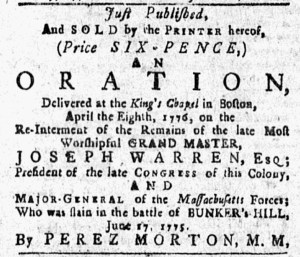
New-York Journal (May 23, 1776).

“AN ORATION, Delivered … on the Re-Interment of the Remains of … JOSEPH WARREN.”

Joseph Warren was an American hero, not just a hero in Massachusetts.  That was part of the point of the proliferation of local editions of the oration that Perez Morton delivered “on the Re-Interment of the Remains of the late Most Worshipful GRAND MASTER, … President of the late CONGRESS of this Colony, AND MAJOR-GENERAL of the Massachusetts Forces; Who was slain in the battle of BUNKER’s HILL, [on] June 17, 1775.”  When the siege of Boston ended with the departure of British forces on March 17, 1776, Warren’s brothers searched for his body.  After identifying it by an artificial tooth, they arranged for a Masonic funeral and burial in the Granary Burial Ground.  A few weeks later, John Gill advertised Morton’s oration from the occasion.  It met with such demand that he issued a second edition.

Yet Gill was not the only printer to publish, advertise, and distribute the oration in memory of Warren.  John Dunlap, the printer of Dunlap’s Pennsylvania Packet, produced an edition in Philadelphia.  Simultaneously, John Holt, the printer of the New-York Journal, published yet another edition.  Advertisements for the various local editions featured nearly identical copy drawn from the extensive title of the oration.  Not only did that relieve the printers of composing their own advertisements, but it also provided readers in New England, New York, and Pennsylvania with a succinct overview of Warren’s most significant achievements, his commitment as a Patriot, and the sacrifice he made for the American cause.  As the war entered its second year and more colonizers advocating for declaring independence rather than seeking redress of grievances within the imperial system, newspapers throughout the colonies regularly carried letters, resolutions, and other items that made John Hancock, the president of the Second Continental Congress, and George Washington, the commander of the Continental Army, known far and wide.  Yet the movement benefited from having even more heroes for Patriots to venerate.  The local editions of Morton’s oration in memory of Warren and the advertisements for in newspapers that circulated far beyond Boston, New York, and Philadelphia played a part in constructing a pantheon of American heroes.
April 25

What was advertised in a revolutionary American newspaper 250 years ago today?

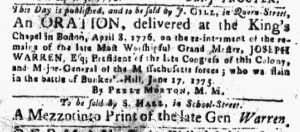
New-England Chronicle (April 25, 1776).

“An ORATION … on the re-interment of the remains of … JOSEPH WARREN.”

Samuel Hall, the printer of the New-England Chronicle, published the last issue of that newspaper “at his Printing-Office in Stoughton-Hall, HARVARD-COLLEGE,” in Cambridge on April 4, 1776.  Three weeks later, he resumed publication “at his Office next to the OLIVER CROMWELL Tavern, in SCHOOL-STREET,” in Boston.  The newspaper continued with the same volume and issue numbering.  The evacuation of the British and the end of the siege of Boston on March 17 presented an opportunity for Hall to enter the city, making the New-England Chronicle the only newspaper printed in Boston at the time.  Benjamin Edes continued publishing the Boston-Gazette in Watertown until late October and returned the newspaper to Boston in early November.

The end of the British occupation also allowed for events and rituals that could not be undertaken while they remained.  For example, the annual commemoration of the Boston Massacre occurred in Watertown rather than in Boston.  A month later, however, the British had departed and patriots gathered “at the King’s Chapel in Boston [for] the re-interment of the remains of the late Most Worshipful Grand Master, JOSEPH WARREN, Esq; President of the late Congress of this Colony, and Major-General of the Massachusetts forces; who was slain in the battle of Bunker’s-Hill, June 17, 1775.”  On that solemn occasion, Perez Morton delivered an oration, yet colonizers did not have to attend the reinterment on April 8 to learn about the minister’s message.  John Gill, Edes’s former partner in printing the Boston-Gazette, advertised that he published and sold Morton’s Oration in the April 25 edition of the New-England Chronicle, that first issue published in Boston.  It was simultaneously an act of commemoration and an act of commodification of the events of the revolutionary era, not unlike the publication and dissemination of the annual oration delivered on the anniversary of the Boston Massacre.  Putting copies of Morton’s Oration into circulation in Boston and beyond contributed to the veneration of Warren as a hero who made the ultimate sacrifice on behalf of his country.  The pamphlet met with such demand that Gill published a second edition.  In addition, John Holt published a local edition in New York and John Dunlap did the same in Philadelphia, disseminating Morton’s oration in memory of Warren beyond New England.

Hall, a savvy entrepreneur, piggybacked on Gill’s advertisement for Morton’s Oration.  Immediately below, he inserted his own advertisement for a “Mezzotinto Print of the late Gen. Warren.”  He apparently expected that demand for one would enhance demand for the other, providing consumers with another opportunity to demonstrate their patriotism through their decision to purchase commemorative items.