June 24

What was advertised in a revolutionary American newspaper 250 years ago today?
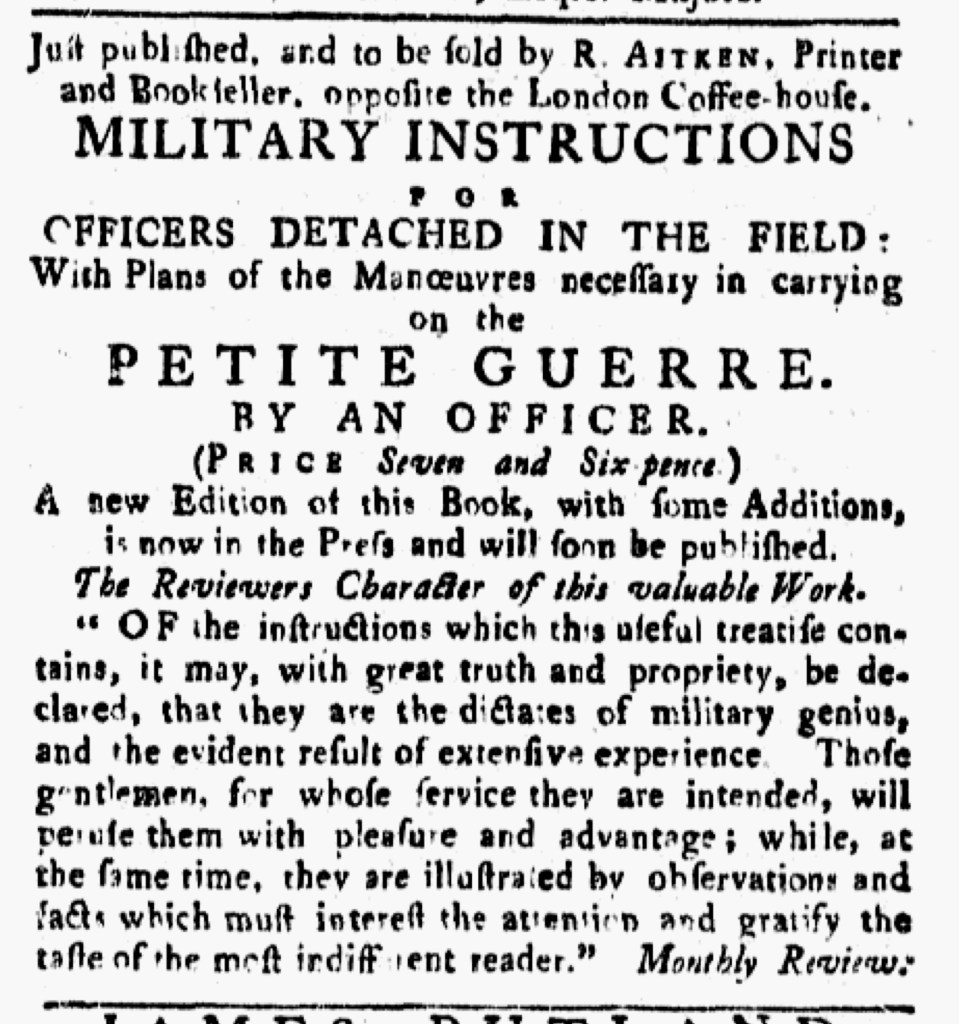
Pennsylvania Ledger (June 24, 1775).

“MILITARY INSTRUCTIONS FOR OFFICERS DETACHED IN THE FIELD.”

It was a timely volume for the summer of 1775.  The June 24 edition of the Pennsylvania Ledger carried an advertisement for Military Instructions for Officers Detached in the Field: With Plans of the Manoeuvres Necessary in Carrying on the Petite Guerre.  Robert Aitken, a printer and bookseller in Philadelphia, published and sold an American edition of a book that had been successful enough in England to go to a second edition the previous year.

Aitken marketed it at a time that readers of the Pennsylvania Ledger already knew about the battles at Concord and Lexington and the siege of Boston.  They were just learning about the Battle of Bunker Hill a week earlier.  In the column to the left of the advertisement for Military Instructions, the Pennsylvania Ledger reprinted a portion of a letter that reported “our people attempting to take possession of Bunker’s Hill and Dorchester Point … were attacked by the regulars.”  The correspondent did not have all the details, but did know that “three Colonels in our service were wounded, Col. Gardner, mortally; how many are slain on either side, is uncertain.”  The letter did not mention the death of Joseph Warren, a noted Patriot and the president of the Massachusetts Provincial Congress, nor did it reveal the outcome of the battle.  “When the post came away,” the letter stated, “our people kept their ground and made a stand; how they have fared at Dorchester, we do not hear.”  Incomplete, it was the most recent update available in Philadelphia at the time the June 24 edition of the Pennsylvania Ledger went to press.

Still, it likely primed some readers to take greater interest in Military Instructions written “BY AN OFFICER.”  To help in stimulating demand, Aitken inserted an excerpt of a review that appeared in the Monthly Review, a magazine published in London.  “OF the instructions which this useful treatise contains,” the reviewer asserted, “it may, with great truth and propriety, be declared, that they are the dictates of military genius, and the evident result of extensive experience.”  That made the book required reading for colonizers serving as officers.  “Those gentlemen, for whose service they are intended,” the reviewer pronounced, “will peruse them with pleasure and advantage.”  Yet that was not the only prospective audience for Military Instructions.  The reviewer insisted that “they are illustrated by observations and facts which must interest the attention and gratify the taste of the most indifferent reader.”  With battles being fought in New England and George Washington “appointed commander in chief of all the North-American forces by the Honourable Continental CONGRESS” (according to an update that appeared just below the initial report from Bunker Hill), could any prospective reader have been “indifferent” when they saw Aitken’s advertisement?
June 7

What was advertised in a revolutionary American newspaper 250 years ago today?

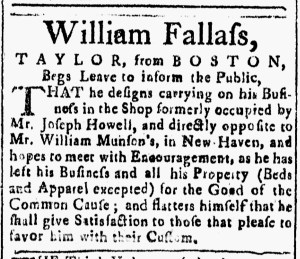
Connecticut Journal (June 7, 1775).

“He has left his Business and all his Property … for the Good of the Common Cause.”

In the summer of 1775, William Fallass, a “TAYLOR, from BOSTON,” relocated to New Haven, Connecticut.  Upon arriving in town, he placed a newspaper advertisement to introduce himself to his new neighbors and prospective customers.  Fallass announced that he “designs carrying on his Business in the Shop formerly occupied by Mr. Joseph Howell … and hopes to meet with Encouragement.”  The locals did not yet know him or his work by reputation, prompting him to declare that he “flatters himself that he shall give Satisfaction to those that please to favor him with their Custom.”  The newcomer pledged his best efforts for his clients.

He also offered another reason that residents of New Haven should hire his services.  He had not planned to relocate to another town but instead “left his Business and all his Property (Beds and Apparel excepted) for the Good of the Common Cause.”  The battles at Lexington and Concord and the ensuing siege of Boston upended Fallass’s life and livelihood.  In late April, the Massachusetts Provincial Congress, meeting in Watertown, negotiated with General Thomas Gage, the governor, for safe passage in or out of Boston.  Loyalists could move into the city; Patriots and others could depart.  In each instance, they could take their “Effects” with them, “excepting their Fire-Arms and Ammunition.”  The unfortunate Fallass did not manage to move most of his “Effects,” just his clothing and bedding.  He hoped that sacrifice “for the Good of the Common Cause” would endear him to prospective clients and entice them to do business with him, a refugee.

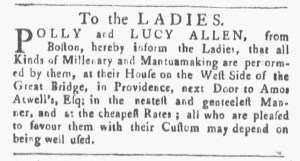
In that regard, Fallass made a more explicit appeal than Polly Allen and Lucy Allen, milliners and mantuamakers from Boston, did when they ran a newspaper advertisement in Providence earlier in the week.  In both cases, however, advertisements help in tracing the movement of men and women who departed Boston during the siege.  They did not merely leave the city for the countryside; many relocated to other colonies and attempted to revive their businesses in new places as the Revolutionary War began.  Articles and “letters of intelligence” relayed some accounts of current events, yet advertisements played another role in revealing the effects of the war on some colonizers.

June 3

What was advertised in a revolutionary American newspaper 250 years ago today?

Providence Gazette (June 3, 1775).

“POLLY and LUCY ALLEN, from Boston.”

On June 3, 1775, Polly Allen and Lucy Allen published an advertisement addressed “To the LADIES” in the Providence Gazette.  That notice served as an introduction upon their arrival in the city, informing prospective customers and the community that “all Kinds of Millenary and Mantuamaking are performed by them, at their House on the West Side of the Great Bridge.”  Since the Allens were new to town, they gave further directions that stated their location relative to a resident familiar to readers, stating that they could be found “next door to Amos Atwell’s, Esq.”  New on the scene, they could not rely on their reputation among an established clientele to generate business.  Instead, they assured prospective customers that they made hats and garments “in the neatest and genteelest Manner, and at the cheapest Rates.”  In addition to skillful work on fashionable clothing at the lowest prices, the Allens also pledged exemplary customer service, stating that “all who are pleased to favour them with their Custom may depend on being well used.”

As part of their introduction, the Allens described themselves as “from Boston.”  That made them refugees, of sorts, who had been displaced during the first weeks of the Revolutionary War.  Following the battles at Lexington and Concord on April 19, militias from throughout Massachusetts, joined by companies from other colonies, besieged Boston.  The Massachusetts Provincial Congress, meeting in Watertown, negotiated with General Thomas Gage, the governor, to allow Loyalists who wished to enter the city to do so.  In return, Patriots and other “Inhabitants of the Town of Boston” could leave.  In each case, they could take their effects with them, “excepting their Fire-Arms and Ammunition.”  The Allens apparently took advantage of safe passage out of the city, along with between 12.000 and 13,000 other residents.  When they introduced themselves in the Providence Gazette as “POLLY and LUCY ALLEN, from Boston,” they did not need to say more for readers to piece together why they chose to relocate at that moment.  The Allens may have hoped that their situation would evoke some sympathy among prospective customers or even some curiosity among those who wanted to hear for themselves what conditions had been like since the Boston Port Act closed the harbor a year earlier and, especially, during the siege in recent weeks.  Some clients may have headed to the Allens’ shop in hope of stories as well as new hats and dresses.

April 24

What was advertised in a revolutionary American newspaper 250 years ago today?

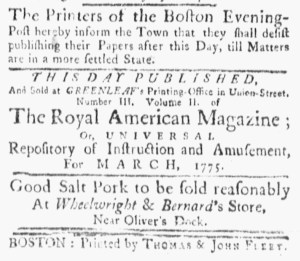
Boston Evening-Post (April 24, 1775).

“They shall desist publishing their Papers after this Day, till Matters are in a more settled State.”

The printers and the public did not know it yet, but the April 24, 1775, edition of the Boston Evening-Post would be the last issue of that newspaper.  Thomas Fleet established the newspaper in August 1735.  His sons, Thomas and John, continued publishing the Boston Evening-Post after their father’s death in 1758.  They even disseminated issues while the Stamp Act was in effect from November 1765 through May 1766, though they did not include their names in the colophon.  The events at Lexington and Concord, however, were too much of a disruption to continue.  The Fleets initially intended to suspend the newspaper and continue publication at some point in the future.  The April 24 issue included only three advertisements, the first one from the printers to “inform the Town that they shall desist publishing their Papers after this Day, till Matters are in a more settled State.”  A newspaper that had served Boston for just shy of forty years ended with “NUMB. 2065.”

By that time, Isaiah Thomas, the printer of the Massachusetts Spy, had already published the final issue of that newspaper in Boston on April 6 and headed to Worcester.  He revived it as the Massachusetts Spy: Or, American Oracle of Liberty in early May.  Nathaniel Mills and John Hicks distributed the last known issue of the Massachusetts Gazette and Boston Post-Boy on April 17.  The April 20 edition of the Massachusetts Gazette and Boston Weekly News-Letter was the last for a month.  Margaret Draper and John Boyle resumed publication of that newspaper on May 19, though they published issues sporadically for the next several months before turning the newspaper over to John Howe.  The February 29, 1776, edition may have been the last; it is the last known issue.  Benjamin Edes and John Gill suspended the Boston-Gazette with the April 17, 1775, edition.  Edes went to Watertown and resumed publication there on June 5.  He remained in Watertown until the end of October 1776.  At that time, he returned to Boston and continued publication in November. His sons became partners in 1779.  The Boston-Gazette did not close until September 1798.

At the beginning of April 1775, five newspapers served Boston, yet the beginning of the Revolutionary War in nearby Lexington and Concord on April 19 had a dramatic impact on those newspapers.  Two folded immediately, even though they hoped to resume when “Matters are in a more settled state.”  One suspended publication for a month and then limped along for less than a year.  Another relocated to Worcester and experienced success there.  Only the Boston-Gazette survived the war and resumed publication in that city.  Other newspapers eventually filled the void, commencing publication during the war, but for some time the town that long had more newspapers than any other in the colonies adapted to new circumstances that limited publication of news (and advertisements).

April 6

What was advertised in a colonial American newspaper 250 years ago today?

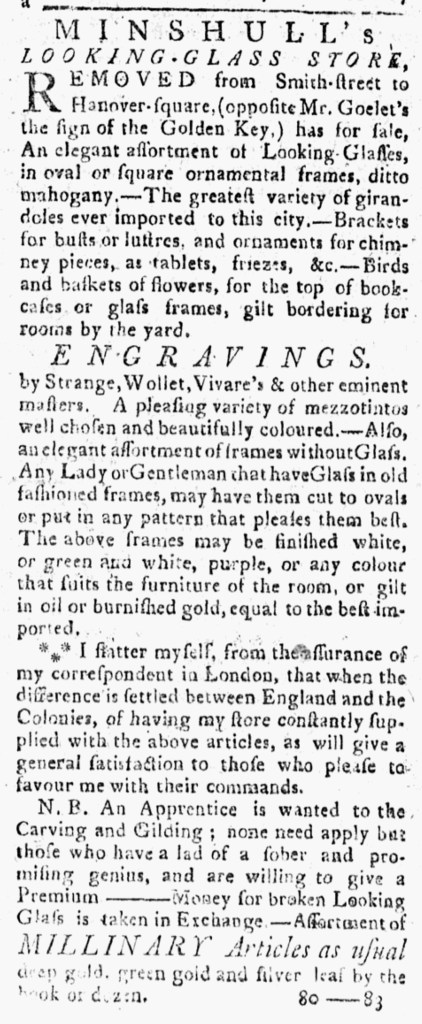
Supplement to the New-York Journal (April 6, 1775).

“Assurance … that when the difference is settled between England and the colonies, of having my store constantly supplied.”

In the spring of 1775, the proprietor of “MINSHULL’s LOOKING-GLASS STORE” ran a newspaper advertisement to announce that he had “REMOVED” from Smith Street to a new location “opposite Mr. Goelet’s [at] the sign of the Golden Key” on Hanover Square in New York.  In addition to an “elegant assortment” of looking glasses, he stocked other items for decorating homes and offices, including brackets for displaying busts, arrangements of flowers and birds “for the top of bookcases,” and the “greatest variety of girandoles” or candleholders “ever imported to the city.”  He also devoted a separate paragraph, with its own headline, to a “pleasing variety” of mezzotint “ENGRAVINGS” and the choices for frames.

John Minshull confided that he had “assurances of my correspondent in London, that when the difference is settled between England and the Colonies, of having my store constantly supplied with the above articles, as will give a general satisfaction” to his customers.  Readers realized that he referred to the imperial crisis and the effects of the Continental Association, the nonimportation agreement devised by the First Continental Congress in response to the Coercive Acts.  Minshull did not state that he imported his inventory before that pact went into effect on December 1, 1774.  Instead, he allowed readers to make that assumption, especially when he noted that he would not receive any new merchandise from England until the colonies and Parliament reached an accord.

That did not happen.  Within weeks of Minshull placing his advertisement, the Revolutionary War began with the Battles of Lexington and Concord in Massachusetts.  A little over a year later, the British occupied New York and remained in the city until 1783.  Yet Minshull persevered, continued operating his shop, and, according to an advertisement in the November 8, 1780, edition of the Royal Gazette, “imported in the Fleet from England, A large Assortment of LOOKING GLASSES, adapted to the present mode of Town and Country.”  He apparently managed to maintain his connections with his correspondents and suppliers in London.

Perhaps Minshull abided by the Continental Association in 1775 as a matter of political principle.  Perhaps he did so merely to stay in the good graces of his customers and the community.  The latter seems more likely since, according to Luke Beckerdite, “a ‘John Michalsal’ was included in a list of Loyalists” in 1775 and “a ‘John Minchull’ subsequently fled to Shelburne, Nova Scotia,” a haven for Loyalists during and immediately after the war.  From August 1782 through February 1783, ran an advertisement in the Royal Gazette for his “remaining Stock” that he sold “Cheap! Cheap! Cheap!”  It appears that Minshull had a going-out-of-business sale before evacuating from New York when the war ended.  Before that, he resumed business as usual when circumstances changed under the British occupation, weathering the storm and attempting to earn his livelihood during uncertain times.  When the “difference [was] settled between England and the Colonies,” he no longer sold looking glasses or anything else in New York.