August 12

What was advertised in a revolutionary American newspaper 250 years ago today?

Pennsylvania Ledger (August 12, 1775).

“MILITARY INSTRUCTIONS FOR OFFICERS DETACHED IN THE FIELD.”

On August 12, 1775, Robert Aitken, a printer in Philadelphia, launched a new advertising campaign to promote his American edition of Military Instructions for Office Detached in the Field by Roger Stevenson.  He began with advertisements in the Pennsylvania Evening Post and the Pennsylvania Ledger.  Two days later, he placed the same advertisement in Dunlap’s Pennsylvania Packet and then in the Pennsylvania Gazette another two days after that. Aitken’s new advertisement significantly expanded on the notice that he had published in June.

This time, for example, the printer announced that his American edition was “Dedicated to His Excellency GEORGE WASHINGTON, Esq; General and Commander in Chief of the Army of the United Colonies of North-America.”  The book itself featured a short dedication essay that extended four pages.  In the new advertisement, Aitken promoted some of the usual qualities that printers, publishers, and booksellers often highlighted, noting that the book was printed “On fine Paper, [with] a beautiful new Type” and the “twelve useful Plates” or illustrations “of the Manœuvres” supplemented the text.  Each bound copy cost six shillings and six pence, though Aitken also marketed a “few copies on a superfine paper” for one dollar to those who desired even higher quality.  The price was a bargain, the printer noted, with a bound copy of the London edition selling for ten shillings.

Beyond those details, Aitken incorporated an address “TO THE PUBLIC” into this advertisement, though he did not generate the copy himself.  Instead, he borrowed liberally from the preface of the book, making minor revisions here and there.  In effect, he gave prospective customers a preview of what they would read once they purchased Military Instructions for Officers Detached in the Field.  In the preface, Stevenson lamented that “inferior officers have had no source from whence they could derive instruction on the duties of their sphere in the field,” but he aimed to remedy that with this volume.  He almost certainly had not intended, however, that it would be used by officers in the “Army of the United Colonies of North-America” as they defended their liberties in what would eventually become a war for independence.  Aitken saw an opportunity to generate revenues in the wake of the battles at Lexington and Concord.

In a nota bene, the printer added that he stocked “A complete and elegant MAP of the country, shewing the Seat of the present unhappy Civil War in North-America.”  Bernard Romans, a prominent cartographer, distributed broadside subscription proposals a month earlier, listing Aitken among the many local agents who collected names of subscribers who ordered copies in advance.   The printer gave details about the map not included in the broadside subscription proposal and that had not appeared in newspaper notices.  The map featured a “beautiful Draught of the Provincial CAMP: Likewise, A perspective View of BOSTON, and Gen. Gage’s LINE.”  Current events certainly shaped which items Aitken produced, advertised, and sold at his printing office in Philadelphia.
August 11

What was advertised in a revolutionary American newspaper 250 years ago today?

Essex Journal (August 11, 1775).

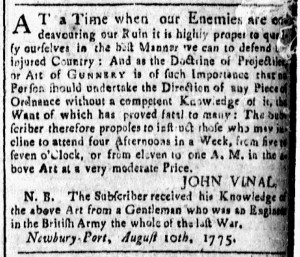
“The Doctrine of Projectiles, or Art of GUNNERY.”

In the spring of 1775, John Vinal advertised a “private School for the Youth of both Sexes” to open in Newburyport, Massachusetts, on April 3.  His notice in the March 29 edition of the Essex Journal specified two locations, “the room he improved last Summer, nearly opposite Mr. Davenport’s Tavern,” with lessons commencing “at 11 o’Clock, A.M.” and “the Town School-House” from “5 to 7 o’Clock, P.M.” for “those who can best attend in the Afternoon.”  The term began just two weeks before the battles at Lexington and Concord.  Four months later, Vinal advertised a very different kind of instruction: “the Doctrine of Projectiles, or Art of GUNNERY.”

Circumstances had certainly changed in Newburyport, in Massachusetts, and throughout the colonies since Vinal announced the opening of his school.  The siege of Boston and the Battle of Bunker Hill followed the skirmishes at Lexington and Concord.  The Second Continental Congress convened in Philadelphia and appointed George Washington to command the Continental Army.  Colonizers from New England to Georgia held local and provincial meetings to determine their own responses.  “AT a Time when our Enemies are endeavouring our Ruin,” Vinal proclaimed, “it is highly proper to qualify ourselves in the best Manner we can to defend out injured Country.”  To that end, some colonizers advertised military manuals and others recruited men to join artillery companies or other regiments to defend their liberties.  Making his own contribution to those efforts, Vinal offered to “instruct those who may incline” to learn about the “Art of GUNNERY.”  He explained that “no Person should undertake the Direction of any Piece of Ordnance without a competent Knowledge of it,” warning that “the Want of which has proved fatal to many.”  What qualifications did the schoolmaster possess to teach “the Doctrine of Projectiles” rather than reading, writing, and arithmetic?  He asserted that he “received his Knowledge … from a Gentleman who was an Engineer in the British Army the whole of the last War,” meaning the Seven Years War.  Britain and the American colonies had worked together to defeat the French and their Indigenous allies in pursuit of imperial interests, but now the expertise of that “Engineer in the British Army” would support the American cause at a time when Parliament and British regulars had become “Enemies … endeavouring our Ruin.”

As had been the case with his “School for Youth of both Sexes,” Vinal provided lessons at two times.  Students could “attend four Afternoons in a Week, from five to seven o’Clock.”  Either the term for his school concluded or this endeavor displaced the lessons he otherwise would have offered.  He also stated that he taught about ordnance “from eleven to one A.M.”  Given the schedule for his school, he likely meant “eleven A.M. to one P.M.” rather than suggesting that he taught the class in the middle of the night.  Hopefully his lessons emphasized greater precision!

July 27

What was advertised in a revolutionary American newspaper 250 years ago today?

New-England Chronicle (July 27, 1775).

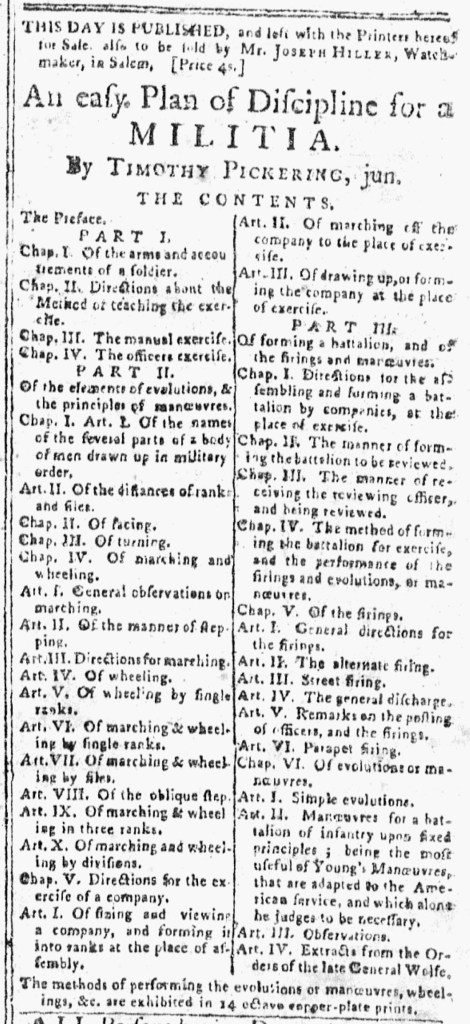
“An easy Plan of Discipline for a MILITIA. By TIMOTHY PICKERING.”

As the imperial crisis intensified when the Coercive Acts went into effect in 1774, the Massachusetts Provincial Congress recommended publication of a manual for training militia throughout the colony, The Manual Exercise as Ordered by His Majesty in 1764: Together with Plans and Explanations of the Method Generally Practis’d at Reviews and Field-Days.  Over the next several months, several printers in New England published their own editions.  Advertisements for The Manual Exercise appeared frequently in newspapers throughout the region.  Printers beyond New England followed their lead.  After the battles at Lexington and Concord, advertisements for other military manuals proliferated, including advertisements for Thomas Hanson’s Prussian Evolutions in Actual Engagements published by subscription in Philadelphia.

Samuel Hall and Ebenezer Hall, printers of the New-England Chronicle, published and advertised yet another military manual, An Easy Plan of Discipline for a Militia by Timothy Pickering, Jr.  An advertisement for the work appeared in the July 27, 1775, edition of their newspaper.  The Halls indicated that they had copies available at their printing office in Cambridge, where they had only recently moved from Salem and renamed and continued publishing the Essex Gazette. In addition, Joseph Hiller, a watchmaker in Salem, also sold the manual.  The advertisement consisted primarily of an extensive list of the contents, demonstrating to prospective customers what they could expect to find in the volume, followed by a short note that the “methods of performing the evolutions or manœuvres, wheelings, &c. are exhibited in 14 octavo copper-plate prints.”  The illustrations were an important addition that would aid readers in understanding the various maneuvers described in the book.

In addition to the advertisement the Halls inserted in the New-England Chronicle, Pickering pursued another means of marketing the book.  He sent a copy directly to George Washington with a request that he consider “recommending or permitting its use among the officers & soldiers under your command.”  Pickering flattered the commander of the Continental Army following his appointment to the post by the Second Continental Congress, declaring that the army had been “committed to your excellency’s care & direction” “to the joy of every American.”  Pickering asserted his own “duty & inclination” inspired him to compose the manual and present it to the general for his consideration.  He deemed it a “service [to] my country” that he hoped “may well prove advantageous in an army hastily assembled.”  Washington did indeed take note.  According to the American Revolution Institute, “Washington promoted the use of several published works, including Timothy Pickering’s An Easy Plan of Discipline for a Militia and Thomas Hanson’s The Prussian Evolutions” during the early years of the Revolutionary War.  In 1779, Baron von Steuben’s Regulations for the Order and Discipline of the Troops of the United States became the first official manual of the Continental Army.  Until then, Pickering’s manual was a popular choice for training American soldiers.

July 25

What was advertised in a revolutionary American newspaper 250 years ago today?

New-Hampshire Gazette (July 25, 1775).

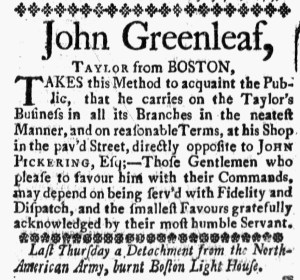
“John Greenleaf, TAYLOR from BOSTON.”

Even though Daniel Fowle sometimes had to reduce the size of the New-Hampshire Gazette to two pages instead of four in the months following the battles at Lexington and Concord, he found space to include advertisements alongside the news of the momentous events taking place in Massachusetts where the siege of Boston continued and General George Washington took command of the Continental Army, in Philadelphia where the Second Continental Congress met to address the crisis, and throughout the colonies as everyone took stock of what occurred and made preparations for what they believed might come next.  The July 25, 1775, edition of the New-Hampshire Gazette, for instance, consisted of six columns spread over two pages.  Several advertisements filled just over half of the final column.

Those advertisements included one from John Greenleaf, “TAYLOR from BOSTON,” who wished “to acquaint the Public, that he carries on the Taylor’s Business in all its Branches in the neatest Manner, and on reasonable Terms, at his Shop” in Portsmouth.  After rehearsing common appeals about his skill and the quality of his work (“neatest Manner”) and the price (“reasonable Terms”), Greenleaf emphasized the sort of service that customers expected from tailors: “Those Gentlemen who please to favour him with their Commands, may depend on being serv’d with Fidelity and Dispatch, and the smallest Favours gratefully acknowledged.”  The tailor’s advertisement followed a familiar formula, one used by members of his trade from New England to Georgia.

Even listing his occupation and the place he formerly lived and worked (“TAYLOR from BOSTON”) as a secondary headline was part of that formula, yet in this instance doing so had new significance.  Greenleaf did not merely communicate that he brought his experience from one of the largest urban ports in the colonies to the smaller town of Portsmouth.  He also made a statement about how his life had been disrupted when hostilities commenced in April 1775.  He took advantage of negotiations between General Thomas Gage, the governor and king’s representative, and the Massachusetts Provincial Congress that allowed Loyalists to enter Boston and Patriots and others to depart.  In describing himself as a “TAYLOR from BOSTON,” Greenleaf declared that he was a refugee, one of many who placed advertisements when they settled in new towns.  He likely hoped that would influence prospective customers to avail themselves of his services.  The scrap of news that Fowle, the printer, inserted immediately below the tailor’s advertisement underscored Greenleaf’s status as a refugee.  “Last Thursday,” Fowle reported, “a Detachment from the North-American Army, burnt Boston Light House.”  Greenleaf did not need to elaborate on the dangers he escaped and the challenges he faced in establishing his business in a new town.  Readers already knew all about it.

July 23

What was advertised in a revolutionary American newspaper 250 years ago this week?

South-Carolina and American General Gazette (July 21, 1775).

“A SERMON on the present Situation of American Affairs.”

Robert Wells, the printer of the South-Carolina and American General Gazette, often inserted advertisements that promoted the merchandise available at his “GREAT STATIONARY & BOOK STORE” in Charleston.  On July 21, 1775, he devoted a notice to “A SERMON on the present Situation of American Affairs.  Preached in Christ Church, Philadelphia, June 23, 1775, at the Request of the Officers of the Third Battalion of the City of Philadelphia and District of Southwark.  By WILLIAM SMITH, D.D. Provost of the College in that City.”  Like many other advertisements for books, the copy replicated the title page.  Wells added the verse from the Book of Joshua that Smith cited as inspiration for the sermon.

The headline for the advertisement declared, “Just published, and to be sold BY ROBERT WELLS.”  Did “Just published” and “to be sold” both describe Wells’s role in disseminating Smith’s sermon?  When printers and booksellers linked those phrases together, they often meant that a work had been “Just published” by someone else and made available “to be sold” by other printers and booksellers.  Wells may have acquired copies of the sermon printed by James Humphreys, Jr., in Philadelphia and retailed them at his own shop.  Another advertisement in the same issue used the headline, “This Day are Published, BY ROBERT WELLS,” to introduce two books, “OBSERVATIONS on the RAISING and TRAINING of RECRUITS. By CAMPBELL DALRYMPLE, Esq; Lieutenant Colonel to the King’s Own Regiment of Dragoons,” and “THE MANUAL EXERCISE, with EXPLANATIONS, as now practised by The CHARLESTOWN ARTILLERY COMPANY.”  In contrast to “This Day are Published,” other items certainly not printed by Wells appeared beneath a header that stated, “At the same STORE may be had.”  On the other hand, Wells could have published a local edition of Smith’s sermon.  James Adams printed and sold a local edition in Wilmington, Delaware.

Christopher Gould includes Smith’s Sermon on the Present Situation of American Affairs (entry 103) in his roster of imprints from Wells’s printing office, along with The Manual Exercise (entry 92) and Observations on the Raising and Training of Recruits (entry 93).  For each of them, he indicates that he did not examine an extant copy but instead drew the information from newspaper advertisements.  Gould explains that “many of the entries for 1774 and 1775 must be regarded as suspect.  Wells advertises them as his publications, but in the absence of extant copies bearing his imprint, the likelihood is strong that they are in fact London editions of popular works bound in Charleston by Wells.”[1]  As I have noted, Wells used a headline to introduce Smith’s Sermon that both contemporary printers and readers understood did not necessarily attribute publication to the advertiser.  Even if he sold copies of the sermon printed elsewhere, they did not come from London.  Smith delivered the sermon on June 23 and Wells advertised it just four weeks later, not nearly enough time for London printers to be involved.  Wells advertised an American edition, even if he did not publish it.

Whatever the case, the sermon supplemented the news.  Readers of the South-Carolina and American General Gazettefollowed all sorts of “AMERICAN INTELLIGENCE” from New England to Georgia, but the pages of any newspaper could present only so much content.  Wells presented readers an opportunity to learn more about the discussions about current events taking place in Philadelphia by experiencing Smith’s sermon themselves.  As consumers, they could become better informed and join with others who heard or read the sermon.

**********

[1] Chrisopher Gould, “Robert Wells, Colonial Charleston Printer,” South Carolina Historical Magazine 79, no. 1 (January 1978): 42.

July 20

What was advertised in a revolutionary American newspaper 250 years ago today?

New-York Journal (July 20, 1775).

“SMALL SWORDS.”

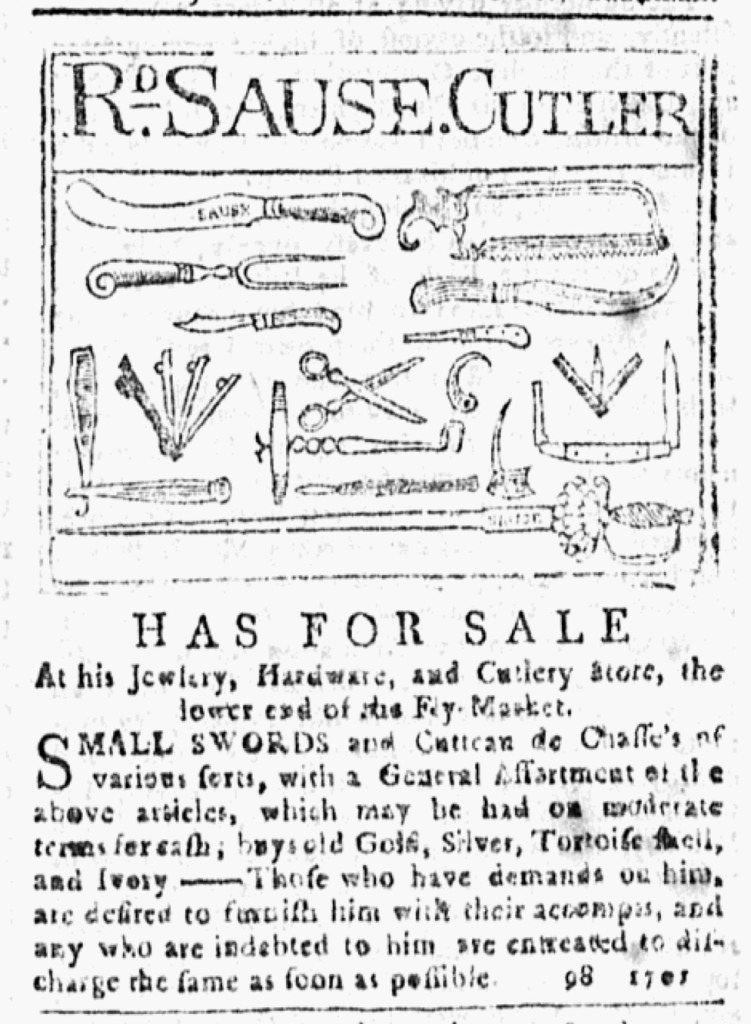
Richard Sause resorted to a familiar image to adorn his advertisement in the July 20, 1775, edition of the New-York Journal.  It included his name and occupation, “RD. SAUSE. CUTLER,” and depictions of more than a dozen kinds of knives and other blades available at his “Jewlery, Hardware, and Cutlery Store.”  Some of the items, a table knife and a sword, even had his name on the blade, suggesting that Sause marked the items he made.  The image had periodically appeared in various newspapers published in New York since the early 1770s.  Personalized woodcuts, commissioned by advertisers, belonged to those advertisers to submit to printing offices as they saw fit.

In Sause’s previous advertisements, the woodcut accounted for a relatively small amount of space compared to the copy that Sause composed to promote his business.  This time, however, the image and the copy took up the same amount of space.  Sause noted that he sold “a General Assortment of the above articles,” perhaps referring to the “Jewelry, Hardware, and Cutlery” listed in the name of his store or perhaps referring to the many items in the woodcut.  In the copy, he highlighted only one sort of item: “SMALL SWORDS and Cutteau de Chasse’s of various sorts.”  (See Steve Rayner and Jim Mullins’s extensively researched “Cuttoe Knives: A Material Culture Study” for more on “a variety of short swords known as cutteau de Chasse.”  It includes an engraved trade card from 1739 for John Cargill, “Instrument Maker, at ye Saw & Crown in Lombard Street, London,” that featured an image of various blades and other instruments similar to Sause’s woodcut.)  It made sense that Sause emphasized swords in an advertisement placed in the summer of 1775.  Men in New York and other places prepared for the possibility that the fighting that began at Lexington and Concord in April and continued with the siege of Boston and the Battle of Bunkers Hill could occur in their own colonies.  They formed new companies to defend their liberties.  Merchants, shopkeepers, and artisans marketed military equipment while printers and booksellers published and sold military manuals.  Under those circumstances, Sause made a savvy decision to promote “SMALL SWORDS” in his advertisement.

July 13

Who was the subject of an advertisement in a revolutionary American newspaper 250 years ago today?

Maryland Gazette (July 13, 1775).

“An English servant man … intended to Boston to general Gage, who he understood would protect all servants who came to him.”

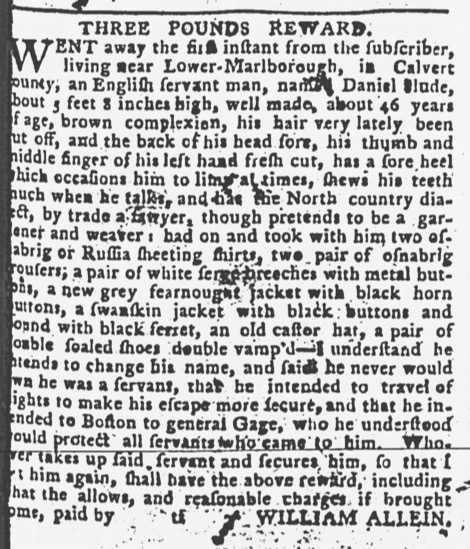
William Allein of Lower Marlborough in Calvert County turned to the Maryland Gazette to seek assistance in recovering an enslaved man and an indentured servant in the summer of 1775.  He ran two advertisements in the July 13 edition, one concerning Mial, an enslaved man who became a fugitive for freedom at the beginning of May, and Slude, an “English servant man” who “WENT away” in early July.  Allein expected newspaper readers to observe strangers to assess whether they matched the descriptions he published, offering rewards to those who participated in securing Mial and Slude and returning them to him.

Allein gave a physical description of Slude, including recent injuries (“his thumb and middle finger on his left hand fresh cut” and “a sore heel which occasions him to limp at times”) that could make him easier to recognize, and detailed the clothing that Slude wore or took with him.  His “North country dialect” also distinguished the indentured servant.  According to Allein, Slude was “by trade a sawyer, though he pretends to be a gardener and weaver.”  He would engage in other subterfuge as well, changing his name and traveling by night to avoid detection.

Compared to many of his counterparts who placed other advertisements for runaway indentured servants, apprentices, and convict servants and enslaved people who liberated themselves, Allein was well informed about where Mial and Slude were likely headed.  “I have heard that [Mial] proposed going towards Alexandria in Virginia,” Allein declared.  As for Slude, “I understand that … he intended to Boston to general Gage, who he understood would protect all servants who came to him.”  Current events influenced Slude when he planned the route for making his escape; he apparently relied on rumors, hoping for their veracity.  Word of the battles at Lexington and Concord and the ensuing siege of Boston quickly spread throughout the colonies, as did news of the Battle of Bunker Hill.

Yet not all the news was always accurate, not even the accounts printed in newspapers.  The confusion created openings for men like Slude to embrace the reports that they wanted to believe.  In the end, however, Mial may have been more successful in eluding Allein than Slude was.  The advertisement describing Mial ran for many weeks, but the notice about Slude appeared only once.  The indentured servant heading to Boston may have been recognized and captured shortly after it appeared, prompting Allein to discontinue the advertisement.  If Mial made it to Virginia and managed to avoid capture until November, he might have joined Lord Dunmore, the royal governor, when he issued a proclamation that offered freedom to enslaved people and indentured servants “appertaining to Rebels” if they joined “His MAJESTY’s Troops” in “reducing this Colony to a proper Sense of their Duty.”

July 12

What was advertised in a revolutionary American newspaper 250 years ago today?

Pennsylvania Gazette (July 12, 1775).

“All Sorts of Military Articles.”

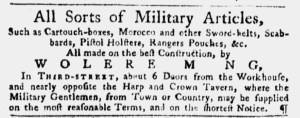
It was a sign of the times.  The headline for Wolere Ming’s advertisement in the July 12, 1775, edition of the Pennsylvania Gazette proclaimed, “All Sorts of Military Articles.”  The brief notice listed some of the items the merchant stocked, such as “Cartouch-boxes [for carrying cartridges], Morocco and other Sword-belts, Scabbards, Pistol Holsters, [and] Rangers Pouches.”  Hostilities had commenced with the battles of Lexington and Concord less than three months earlier, followed by the siege of Boston and the Battle of Bunker Hill.  The Second Continental Congress convened in Philadelphia, appointed George Washington of Virginia as commander of the Continent Army, and dispatched him to Massachusetts.  Colonizers in New England, New York, Pennsylvania, and elsewhere mobilized as they followed the news, some of them heading to Massachusetts to lend their support and others preparing to defend their communities.

Responding to current events meant new opportunities for colonial entrepreneurs.  For instance, Charles Oliver Bruff, a goldsmith and jeweler in New York, advised “gentlemen who are forming themselves into companies in defence of their liberties” that they could purchase swords of various sorts at this shop in May 1775.  In Philadelphia, those seeking to outfit themselves for military service could do so very well at Ming’s shop “nearly opposite the Harp and Crown Tavern” where they selected among items “made on the best Construction” available “on the shortest Notice.”  Ming addressed a particular kind of consumer, the “Military Gentlemen, from Town or Country,” as he sought to leverage current events to establish revenue streams.  The headline for his advertisement played an important role in attracting the attention of prospective customers, especially considering that most newspaper advertisements did not have headlines of any sort.  Only one other in the issue of the Pennsylvania Gazette that carried Ming’s advertisement featured a headline that mentioned goods offered for sale, Thomas McGlathry’s notice for “IRISH LINENS, of various Prices.”  Merchants and shopkeepers who had been restrained by the Continental Association, a nonimportation agreement, since December 1774 now faced new circumstances that they could make work to their benefit if they shifted their marketing strategies accordingly.

July 7

What was advertised in a revolutionary American newspaper 250 years ago today?

North-Carolina Gazette (July 7, 1775).

“EXTRACTS from the Votes and Proceedings of the AMERICAN CONTINENTAL CONGRESS.”

When they perused the July 7, 1775, edition of the North-Carolina Gazette, readers encountered an advertisement that proclaimed, “JUST PUBLISHED, And to be sold at the Printing Office … EXTRACTS from the Votes and Proceedings of the AMERICAN CONTINENTAL CONGRESS, held at Philadelphia, on the Fifth Day of September, 1774.”  The Extracts, however, were not “JUST PUBLISHED,” though James Davis certainly had them for sale at the printing office in New Bern.  The Adverts 250 Project previously featured this advertisement’s appearance in the April 7, 1775, edition of the North-Carolina Gazette.  Few issues of that newspaper survive, preventing a complete reconstruction of when the advertisement ran.  Only seven issues, all from 1775, are available via America’s Historical Newspapers, the most comprehensive database of digitized eighteenth-century newspaper.  Davis’s advertisement for the Extracts did not run on March 24, but appeared on April 7, May 5, and May 12.  It was not in the June 30 issue, yet it returned for the July 7 and July 14 issues.

It is not clear how often the advertisement ran between May 12 and June 30, but Davis did not insert it in the issue immediately before the one that delivered several important updates that might have influenced him to believe that readers who had not yet purchased the Extracts would have increased interest in the “Bill of Rights, a List of Grievance, Occasional Resolves,” and “General Gage’s Answer to the Letter sent him by the General Congress.”  The Extractsdocumented the meeting of the First Continental Congress in the fall of 1774.  When the advertisement ran on July 7, 1775, the Second Continental Congress had been meeting for nearly two months.  That issue included an update that “By Letters from the Congress of the 19th of June, we are informed, that Col. Washington, of Virginia, is appointed General and Commander in Chief of all the American Forces.”  It also delivered news of the Battle of Bunker Hill, acknowledging that the account received in the printing office was “very imperfect, and must leave us in Suspence till a further Account of this most momentous Affair arrives.”  Indeed, that “imperfect” account inaccurately claimed that “General Burgoyne fell … and was interred in Boston with great Funeral Pomp.”  As he sorted through newspapers and letters arriving from the north, Davis apparently believed that the news he selected for publication would spark new interest in his remaining copies of the Extracts from the First Continental Congress.

As had been the case in the April 7 edition, that advertisement ran alongside another that described an enslaved man who liberated himself by running away from his enslaver.  In this instance, “a Negro Slave … named JEM,” was a fugitive from slavery who might have been “harboured or kept out by his Wife, named Rachel.”  James Biggleston, Jem’s enslaver, suspected that Jem was “lurking in the Neighborhood” of the plantation where Rachel was enslaved. Biggleston offered a reward for the capture and return of Jem in a nota bene at the end of the advertisement, though the main body of the notice consisted of a warrant signed by “Two of his Majesty’s Justices of the Peace” that authorized that “if the said Jem doth not surrender himself, and return home immediately … that any Person or Persons may kill and destroy the said Slave … without Impeachment or Accusation of any Crime or Offence … or without incurring any Penalty.”  Most readers of the North-Carolina Gazette and other newspapers compartmentalized the contents of those publications.  They did so to such an extent that the juxtaposition of colonizers demanding freedom from oppression and enslaved people seeking liberty did not register as a contradiction.

July 5

What was advertised in a revolutionary American newspaper 250 years ago today?

Massachusetts Spy (July 5, 1775).

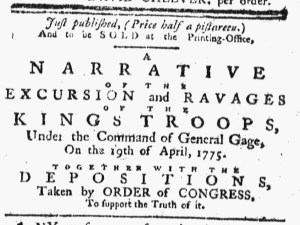
“A NARRATIVE OF THE EXCURSION and RAVAGES OF THE KINGS TROOPS, Under the Command of General Gage.”

I am fortunate to live just a few miles from the American Antiquarian Society in Worcester, Massachusetts.  I pass the AAS on my way to campus, take students there to examine primary sources from the era of the American Revolution, and use its collections in my own research.  Over the years that I have been in Worcester, I have become familiar with the stories that scholars and staff affiliated with the AAS most often tell about its founder, Isaiah Thomas.  In recent months, I have used newspaper advertisements to retell some of those stories … and today I want to draw attention to an important detail that I have not heard highlighted nearly as often as the most treasured and repeated parts of the Thomas narrative.

This is a brief version of the story most often told: Thomas was an ardent Patriot whose editorial perspective in the Massachusetts Spy, the newspaper he printed in Boston so angered British officials that for his own safety he left Boston in April 1775, getting out just before the battles at Lexington and Concord and the siege of the city that followed.  Thomas headed to Worcester, taking his press there and continuing to print the Massachusetts Spy in that town.  It took a few weeks for him to acquire the paper necessary to print his newspaper, but when the first Worcester edition appeared on May 3, 1775, it included an account of the events at Lexington and Concord.  Thomas famously signed the bottom of one copy: “This News-paper is the first Thing ever printed in Worcester – Isaiah Thomas.”  (This story does not mention that Thomas previously announced plans to establish a printing office in Worcester and install a junior partner to print the town’s first newspaper or that when he left Boston he advertised that he would publish the next issue of the Massachusetts Spy in Worcester on May 3.)  Thomas settled in Worcester.  He collected as many books, pamphlets, newspapers, broadsides, and other items printed in America as he could to research and publish his History of Printing in America in 1810.  Those items became the initial collections of the American Antiquarian Society, founded in Worcester in 1812.  Thomas did not establish the library and learned society in Boston because he felt Worcester provided greater security as the new nation went to war with Great Britain for a second time.

That’s a great story, one that engages students, scholars, and visitors to the American Antiquarian Society … but there’s even more that, from my perspective, makes it an even better story about this Patriot printer and his contributions to the American cause.  Two months after Thomas printed the first issue of the Massachusetts Spy in Worcester, the newspaper carried an advertisement for “A NARRATIVE OF THE EXCURSION and RAVAGES OF THE KINGS TROOPS, Under the Command of General Gage, On the 19th of April, 1775.”  The book also included “DEPOSITIONS, Taken by ORDER of CONGRESS, To support the Truth of it.”  Just as the first newspaper printed in the town featured an account of Lexington and Concord, so did the first book published there.  Once again, Thomas made a notation on the product of his press: “First Book printed in Worcester.”[1]  The imprint at the bottom of the title page stated, “WORCESTER, Printed by ISAIAH THOMAS, by order of the PROVINCIAL CONGRESS.”  To underscore the point, Thomas printed the corresponding resolution on the verso of that page.[2]  Thomas served as printer, even though other printers had offices closer to where the Massachusetts Provincial Congress met in Watertown.  For instance, Samuel Hall and Ebenezer Hall relocated the Essex Gazette from Salem to Cambridge and renamed it the New-England Chronicle.  Benjamin Edes, another prominent Patriot printer, moved to Watertown and printed the Boston-Gazette there.

When Thomas printed A Narrative of the Excursion and Ravages of the King’s Troops and marketed it in the Massachusetts Spy, Patriots fought a war on many fronts.  In addition to the battles at Lexington, Concord, and Bunker Hill, they waged a war of information.  Thomas worked to establish and expand a communications infrastructure to collect and disseminate news from Boston and its environs, the Continental Congress meeting in Philadelphia, and throughout the colonies and beyond.  Yet he competed with misinformation and British officials and Tories who had different perspectives and relayed different versions of recent events and their causes.  That made it even more important to supplement newspaper coverage of the outbreak of hostilities at Lexington and Concord, sometimes confused and contradictory, with “the Truth of it,” not just as presented by a Patriot printer but supported by “DEPOSITIONS, Taken by ORDER of CONGRESS.”  Thomas played an important role in establishing the narrative of what occurred on April 19, 1775.

**********

[1] See the first image on the page linked here.

[2] Advance to the fifth image on the page linked here.