November 23

What was advertised in a revolutionary American newspaper 250 years ago today?
Rivington’s New-York Gazetteer (November 23, 1775).

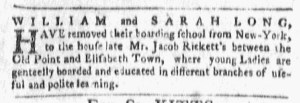
“WILLIAM and SARAH LONG, HAVE removed their boarding school from New-York.”

Late in November 1775, William and Sarah Long placed an advertisement for their boarding school “where young Ladies are genteelly boarded and educated in different branches of useful and polite learning” in the final edition of Rivington’s New-York Gazetteer, though they did not know that it would be the last issue.  They advised prospective students and their parents that they “removed … from New-York, to the house late Mr. Jacob Rickett’s between the Old Point and Elisabeth Town” in New Jersey.  What prompted the Longs to relocate outside the city?  With the siege of Boston continuing, the uncertainty of where and when British soldiers would attempt to assert their authority likely played a role in their decision.  A few months earlier, Andrew Wilson ran an advertisement for his grammar school in Morristown, New Jersey, emphasizing its distance from the coast.  He invoked the “dangerous and alarming times [for] the inhabitants of large cities” and suggested that they “may wish to have their children educated in the interior parts of the country, at a distance from probable, sudden danger and confusion.”  Similar thoughts may have inspired the Longs when they “removed” their school from New York.

On November 27, “sudden danger and confusion” did indeed occur at James Rivington’s printing office on Hanover Square.  Angry with the Tory perspective that Rivington often expressed in his newspaper, the Sons of Liberty attacked his printing office.  It was not the first time, but the damage was much more significant than the previous attack.  The Sons of Liberty destroyed Rivington’s press and type, preventing him from continuing to publish his newspaper or anything else.  The printer decided to leave the city, sailing for London.  He returned in 1777, during the British occupation of New York, and established Rivington’s New-York Gazette.  It continued the numbering of Rivington’s New-York Gazetteer.  That tile lasted for only two issues before he updated it to Rivington’s New York Loyal Gazette for several weeks and then the Royal Gazette throughout the remainder of the war.  Rivington’s newspaper changed names one more time, becoming Rivington’s New-York Gazette for just over a month before ceasing publication with the December 31, 1783, edition.  In his History of Printing in America (1810), patriot printer Isaiah Thomas noted that “for some time Rivington conducted his paper with as much impartiality as most of the editors of that period.”[1]  Adhering to that impartiality longer than other printers contributed to the perception that Rivington favored Tory sentiments when he claimed that he merely exercised freedom of the press.  Earlier in 1775, he advertised “Pamphlets published on both sides, in the unhappy dispute with Great-Britain.”  In addition to the Longs’ advertisement about their boarding school, the final issue of Rivington’s New-York Gazetteer also carried an advertisement for the Constitutional Post Office in New York.  The Second Continental Congress authorized the Constitutional Post as an alternative to the imperial system.

William and Sarah Long and their students “removed” from New York before “sudden danger and confusion” found them.  James Rivington, on the other hand, fled the city after repeated attacks on his printing office made it impossible for him to continue printing his newspaper.

**********

[1] Isaiah Thomas, The History of Printing in America: With a Biography of Printers and an Account of Newspapers (1810; New York: Weathervane Books, 1970), 511.
November 19

What was advertised in a revolutionary American newspaper 250 years ago this week?

Rivington’s New-York Gazetteer (November 16, 1775).

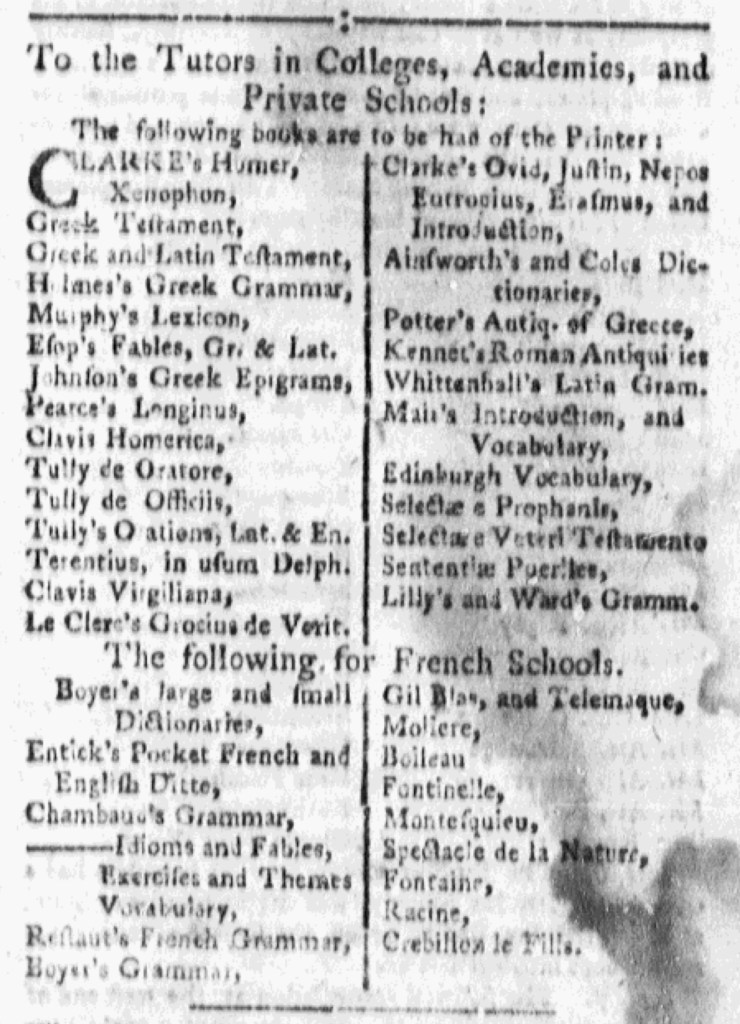
“To the Tutors in Colleges, Academies, and Private Schools.”

James Rivington, the printer of Rivington’s New-York Gazetteer, sold books as an additional revenue stream rather than relying solely on subscriptions and advertisements.  Such was the case with other printers throughout the colonies, their printing offices doubling as bookstores.  Rivington’s newspaper often carried advertisements for books, pamphlets, and almanacs that he stocked.  He printed some of them, acquired others from other colonial printers, and imported most of them from England.  Some advertisements featured a single title.  The November 16, 1775, edition, for instance, featured an advertisement for “A DICTIONARY OF THE Holy Bible” that included the prints, size, and number of volumes along with a description of the contents.  Other advertisements listed multiple titles without providing additional information.

On occasion, Rivington ran advertisements that promoted books and pamphlets with a common theme.  With a headline proclaiming, “The American Controversy,” an advertisement published in February 1775 listed ten pamphlets “published on both sides, in the unhappy dispute with Great-Britain.”  He deployed the same strategy in another notice that ran on November 16, this time addressing “the Tutors in Colleges, Academies, and Private Schools.”  He then gave the titles of more than two dozen books he considered suitable for classrooms, such as “CLARKE’s Homer,” “Greek and Latin Testament,” “Esop’s Fable, Gr[eek] & Lat[in],” “Tully’s Orations, Lat[in] & En[glish],” “Ainsworth’s and Coles Dictionaries,” “Whittenhall’s Latin Gram[mar],” and “Lilly’s and Wards Gramm[ar].”  Rivington implied that those books should have been familiar to tutors.  In addition to those titles, he devoted the final third of the advertisement to books “for French Schools,” including “Boyer’s large and small Dictionaries,” “Entick’s Pocket French and English [Dictionary],” “Chambaud’s Grammar,” “[Chambaud’s] Exercises and Themes,” “Moliere,” and “Montesquieu.”  While Rivington usually marketed most books and pamphlets to general audiences and prospective customers of all backgrounds, especially when his advertisements consisted of catalogs of books available at his printing office, he occasionally attempted to boost sales by directing particular kinds of readers to carefully curated lists of titles.  In this case, tutors and schoolmasters did not need to pore over lengthy lists of books and pamphlets not relevant or not appropriate to their lessons when Rivington presented a specialized catalog for their convenience.

October 29

What was advertised in a revolutionary American newspaper 250 years ago this week?

Rivington’s New-York Gazetteer (October 26, 1775).

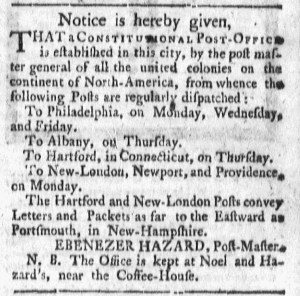
“A CONSTITUTIONAL POST-OFFICE is established in this city.”

Yet another advertisement for a “CONSTITUTIONAL POST-OFFICE,” an alternative to the British postal system, appeared in the public prints at the end of October 1775.  It ran in Rivington’s New-York Gazetteer, despite the reputation of that newspaper and its printer, James Rivington, for expressing Loyalist sentiments.  William Goddard originally envisioned the Constitutional Post and set about establishing local offices before the battles at Lexington and Concord, but after hostilities commenced the Second Continental Congress assumed responsibility for maintaining and expanding its services.  That included appointing Benjamin Franklin as the postmaster general, much to the chagrin of Goddard.  Ebenezer Hazard, a bookseller, became the postmaster in New York, though John Holt, the printer of the New-York Journal, lobbied for the position.  According to the nota bene in the advertisement, “The Office is kept at Noel and Hazard’s, near the Coffee-House,” the same location where the new postmaster and his partner, Garrat Noel, stocked the “JOURNAL OF THE PROCEEDINGS” of the First Continental Congress.

The notice in Rivington’s New-York Gazetteer, signed by Hazard as the “Post-master,” informed the public that a “CONSTITUTIONAL POST-OFFICE” is established in this city, by the post master general of all the united colonies on the continent of North-America.”  Hazard offered the most complete schedule of any that yet appeared in newspaper advertisements, stating that the “Posts are regularly dispatched” to Philadelphia on Mondays, Wednesdays, and Fridays, to Albany on Thursdays, to Hartford on Thursdays, and to New London, Newport, and Providence on Mondays.  The routes to both Hartford and New London extended “as far to the Eastward” as Portsmouth, New Hampshire.  Unlike some other postmasters, Hazard did not mention that service continued as far south as Georgia.  He focused primarily on the network that connected New York to New England and Pennsylvania.  As new advertisements for the Constitutional Post appeared in newspapers in multiple towns and cities, the public became more aware of an enterprise that competed with the imperial postal system to carry “Letters and Packets,” delivering news and information without interference from British authorities.

October 26

What was advertised in a revolutionary American newspaper 250 years ago today?

Rivington’s New-York Gazetteer (October 26, 1775).

“We think proper to notify the public, that the charge against us is wholly and totally false.”

Rumors and misrepresentations spread in conversation and in print when the imperial crisis intensified and hostilities between the colonies and Britain commenced.  Upon finding themselves the subjects of gossip that damaged their reputations, Abraham Hatfield and William Lounsbery published a newspaper advertisement to set the record straight.  It started with an entry in the October 5, 1775, edition of the New-York Journal.  Among the news received from correspondents in the city,  John Holt, the printer, inserted this report: “We understand from North Castle, that on last Saturday night, Abraham Hatfield, Esq; of the White Plains, and Lieutenant William Lownsburry, of Mamaroneck, were discovered in the very act of endeavouring to cut down a Liberty Pole, which was so well fortified with iron that it occasioned their being found out, and for that time disappointed in their loyal attempt.”

Whether or not they held Tory sentiments, Hatfield and Lounsbery vigorously denied that they had acted on them by attempting to cut down the liberty pole.  In the next issue of Rivington’s New-York Gazetteer, published on October 12, they inserted an advertisement that identified the allegations and dismissed them as fabrications.  “WE the subscribers” (or undersigned) “having understood that Mr. Holt has inserted in his last week’s paper, a piece charging us with being concerned, and of even being detected in the fact of attempting to cut down a Liberty-pole – we think proper to notify the public, that the charge against us is wholly and totally false.”  It ran twice more, on October 19 and 26.  Hatfield and Lounsbery disseminated their denial that they had anything to do with the incident multiple times in their effort to combat an accusation made in the public prints just once.

Why didn’t they submit a correction to Holt or place a similar advertisement in the New-York Journal since that newspaper carried the piece that spread what they claimed was misinformation?  Perhaps they did, but Holt, a Patriot printer, felt confident enough in the source of the report that he declined to publish anything submitted by Hatfield and Lounsbery.  Alternately, they may have been so upset with Holt that they did not wish to give him the satisfaction of acknowledging the allegations in his newspapers (or contributing to his advertising revenue) that they instead opted for another newspaper, one with a circulation that rivaled or exceeded the New-York Journal.  Whatever the case, they did not allow the accusation that they were Loyalists who had attempted to cut down a liberty pole go unanswered.

The same issue of the New-York Journal that featured the report that identified Hatfield and Lounsbery as the culprits involved in the liberty tree incident in New Castle also carried letters addressed to Holt concerning rumors that colonizers had scalped a British soldier and cut off his ears after the battles at Lexington and Concord.  The correspondents believed that Holt could “serve the cause of truth and liberty” by publishing their accounts of the actual events, stating that they “buried the dead bodies of the king’s troops that were killed at the north bridge in Concord, on the 19th day of April, 1775,” and none of them “were scalped, not their ears cut off, as has been represented” by those who sought to “dishonour the Massachusetts people, and to make them appear to be savage and barbarous.”  In articles, letters, and advertisements, accusations and rebuttals about the misbehavior and even depravity of Patriots and Loyalists circulated in the public prints during the Revolutionary War.

October 5

What was advertised in a revolutionary American newspaper 250 years ago today?

Rivington’s New-York Gazetteer (October 5, 1775).

“THE Speeches of EDMUND BURKE, Esq; on American Taxation.”

James Rivington did not know it when he published the October 5, 1775, edition, nor did readers and the rest of the community, but he would soon discontinue printing Rivington’s New-York Gazetteer.  With hindsight, we know that less than two months later, on November 27, the Sons of Liberty would attack his printing office and destroy his press and type “because of his pronounced Tory sentiments.”[1]  It was not the first time.  His home and printing office had been attacked the previous May.  For a few weeks, he had sought refuge on a British ship in the harbor.  He had been hung in effigy.  After all that, the November 23, 1775, edition would be the last issue of Rivington’s New-York Gazetteer that he would print before departing for London.  The printer returned to New York in 1777, during the British occupation, and established Rivington’s New-York Loyal Gazette.  Today, historians consider it possible that Rivington spied on behalf of the American cause, but that would not have been public knowledge in the 1770s.

What was public knowledge was that the masthead of Rivington’s New-York Gazetteer featured the seal of Great Britain at a time when the mastheads for other newspapers did not have an image or chose some other device.  The “UNITE OR DIE” political cartoon depicting a severed snake, each segment representing a colony, even appeared in the masthead of the Pennsylvania Journal.  A few other newspapers did continue to include the seal of Great Britain in their masthead, but the printers did not have the same history of expressing positions that supported the officials considered enemies of American liberties.  Even with the seal of Great Britain in the masthead, the October 5, 1775, edition of Rivington’s New-York Gazetteer included an advertisement for “THE Speeches of EDMUND BURKE, Esq; on American Taxation, delivered April 19, 1774” and “His Speech on Moving his Resolutions of Conciliation with the Colonies, March 22d, 1775.”  Rivington printed and sold both speeches by a member of Parliament considered a friend to America.  The printer had a history of marketing “pamphlets on the Whig and Tory side” of “The American Controversy” and arguing for freedom of the press when it came to the contents of his newspaper and other items he printed and sold.  After the battles at Lexington and Concord, however, he discontinued advertising pamphlets that expressed the Tory perspective.  The advertisement for Burke’s speeches, pamphlets that he printed as well as promoted, starkly presented only one side of “THE AMERICAN CONTEST.”  Rivington seemingly changed his advertising strategy as the political situation in the colonies intensified once hostilities commenced in Massachusetts.

**********

[1] Clarence S. Brigham, History and Bibliography of American Newspapers, 1690-1820 (Worcester: American Antiquarian Society, 1947), 686.

August 3

What was advertised in a revolutionary American newspaper 250 years ago today?

Rivington’s New-York Gazetteer (August 3, 1775)

“MAP … Shewing the SEAT of the present unhappy CIVIL WAR in NORTH-AMERICA.”

On August 3, 1775, Rivington’s New-York Gazetteer carried a subscription proposal for a “COMPLETE and ELEGANT MAP” that extended from Boston to Worcester to the west, Providence to the south, and Salem to the north, “Shewing the SEAT of the present unhappy CIVIL WAR in NORTH-AMERICA.”  The “AUTHOR,” Bernard Romans, realized that colonizers who read and discussed news about the battles at Lexington and Concord in April, the siege of Boston that followed, and the Battle of Bunker Hill would likely be interested in learning more about the geography of New England.  Among the conditions, he specified that “all places where any remarkable event has hitherto occurred, and the provincial lines, &c. shall be particularly pointed out.”  The map itself featured an inset that depicted “BOSTON and itsENVIRONS” that did indeed have its own legend identifying important places, “Provincial Lines,” and “Enemy Lines” as well as an illustration that provided “A View of the Lines thrown upon BOSTON NECK: by the Ministerial Army.”

Romans made support for the American cause an integral part of his marketing effort.  He followed the list of conditions for subscribing (that included the price and descriptions of “good paper and large scale”) with a reflection on the imperial crisis: “Hail, O Liberty! thou glorious, thou inestimable blessing: Banished from almost every part of the old world, America, thy darling, received thee as her beloved: Her arms shall protect thee, – her sons will cherish thee!”  When Romans published the map, it included a dedication “To the Hone. Jno. Hancock Esqre. President of ye Continental Congress … By his Most Obedient Humble Servant.”  As Patriots purchased, collected, and consulted political pamphlets, journals of the proceedings of the First Continental Congress, orations about the Boston Massacre, and sermons about the present state of affairs, Romans presented them with yet another piece of memorabilia that helped them in better understanding current events.  The map was a commemorative item produced and sold even before the colonies declared independence.

**********

The Massachusetts Historical Society has digitized Romans’s map, accompanied by a brief overview of its significance and a short essay about Romans and other cartographers active during the era of the American Revolution.

July 30

What was advertised in a revolutionary American newspaper 250 years ago this week?

Rivington’s New-York Gazetteer (July 27, 1775).

“Iron utensils, so much recommended by physicians for their safety.”

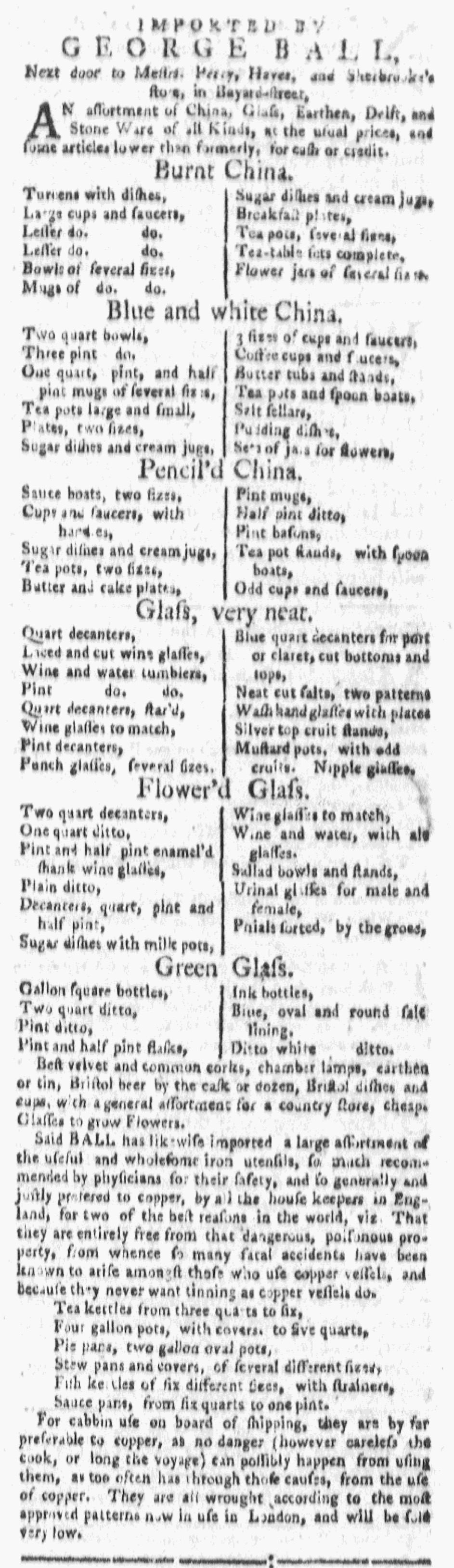
As July 1775 came to a close, George Ball advertised an “assortment of China, Glass, Earthen, Delft, and Stone Ware of all Kinds” in Rivington’s New-York Gazetteer.  He conveniently did not mention when he acquired his merchandise, whether it arrived in the colonies before the Continental Association went into effect, though the headline did proclaim “IMPORTED BY GEORGE BALL” rather than “JUST IMPORTED BY GEORGE BALL.”

Most of Ball’s advertisement consisted of a list of the various items he stocked, divided into categories that included “Burnt China,” “Blue and white China,” “Pencil’d China,” “Glass, very neat,” “Flower’d Glass,” and “Green Glass.”  In the final third of the advertisement, however, Ball highlighted “iron utensils” and made a pitch to convince consumers to demand iron tea kettles, iron pots, iron saucepans, iron pie pans, and iron stew pans with iron covers instead of copper ones.  Those “useful and wholesome iron utensils,” Ball asserted, were “so much recommended by physicians for their safety” and, accordingly, “so generally and justly prefered to copper, by all the house keepers in England.”  Ball made health and safety the centerpiece of his marketing, citing “the best reasons in the world.”  He emphasized that cookware made of iron was “entirely free from that dangerous, poisonous property, from whence so many fatal accidents have been known to arise amongst those who use copper vessels.”  As a bonus, consumers could save money over time since “iron utensils” did not need the same maintenance: “they never want tinning as copper vessels do.”  In addition to the “house keepers” of New York, Ball promoted his wares to readers responsible for outfitting ships.  “For cabbin use on board shipping,” he declared, iron items “are by far preferable to copper, as no danger (however careless the cook, or long the voyage) can possibly happen from using them, as too often has through those causes, from the use of copper.”  Ball concluded by noting that his “iron utensils” were “all wrought according to the most approved patterns now in use in London,” but that nod to fashion and taste merely supplemented his primary marketing strategy.  For consumers concerned about health and safety in the kitchen, he carried the cookware that they needed to use instead of taking chances with copper kettles, pots, and pans.

June 25

What was advertised in a revolutionary American newspaper 250 years ago this week?

Rivington’s New-York Gazetteer (June 22, 1775).

“The doctors family medicines, which are well known in most parts of the continent.”

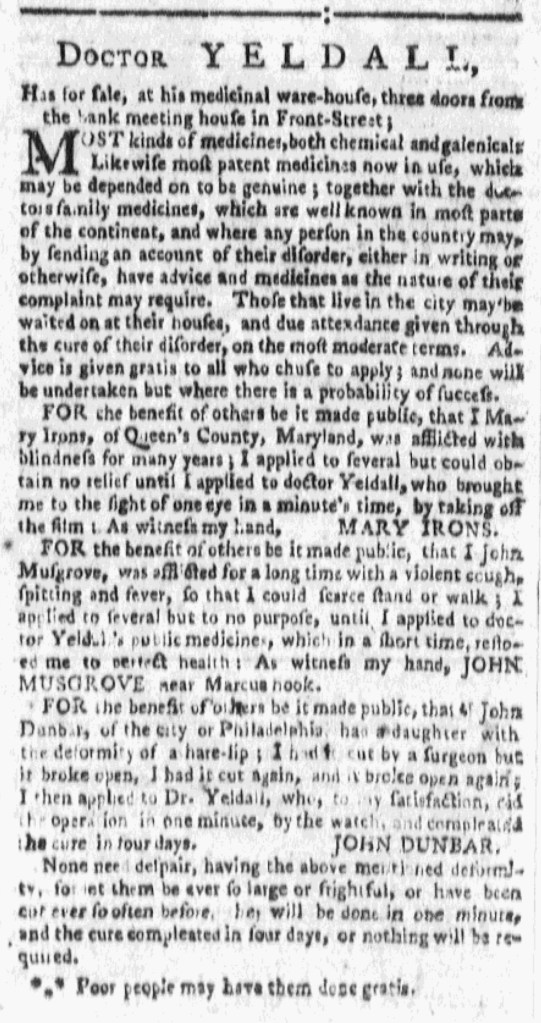
Doctor Yeldall ran his advertisement for remedies available “at his medicinal ware-house” on Front Street in Philadelphia in Rivington’s New-York Gazetteer at the same time that it appeared in the Pennsylvania Ledger.  He did, after all, claim that the “doctors family medicines” that he produced as an alternative to other patent medicines were “well known in most parts of the continent” and advised that “any person in the country may, be sending an account of their disorder … have advice and medicines as the nature of their complaint may require.”  Yeldall operated the eighteenth-century version of a mail order pharmacy.  Advertising in Rivington’s New-York Gazetteer: Or, the Connecticut, Hudson’s River, New-Jersey, and Quebec Weekly Advertiser placed his notice before the eyes of many more prospective patients.  In addition to selling medicines, Yeldall also performed medical procedures.  Two of the four testimonials in the original advertisement described restoring sight “by taking off the film” from a patient’s eye and repairing “the deformity of a Hare-Lip.”  New York was close enough to Philadelphia that Yeldall may have expected that some prospective patients who exhausted their options in one place would travel to Philadelphia in hopes that he would successfully treat them.

The advertisements in the two newspapers were nearly identical.  The use of capital letters and italics varied, likely the result the decisions made by compositors in the two printing offices.  That was usually the case when advertisers submitted the same copy to multiple newspapers.  The version in Rivington’s New-York Gazetteer lacked the longest of the four testimonials that ran in the Pennsylvania Ledger.  The compositor might have removed Alexander Martin’s description of how Yeldall “recovered me to my perfect health” after being “afflicted with a consumptive disorder for upwards of three years” in the interest of space.  Yeldall’s advertisement ran at the bottom of the final column on the third page of the June 22, 1775, edition of Rivington’s New-York Gazetteer, making it one of the last items inserted during the production of that issue.  The compositor, lacking space for the entire advertisement, may have simply removed one of the testimonials.  The notice still made the point that Yeldall supposedly cured several patients who “could obtain no relief” until they sought medical care from him.

May 11

What was advertised in a revolutionary American newspaper 250 years ago today?

Rivington’s New-York Gazetteer (May 11, 1775).

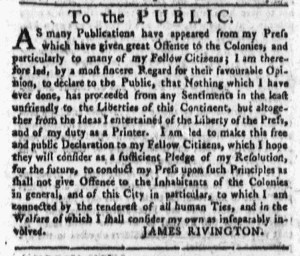
“Many Publications have appeared from my Press which have given great Offence to the Colonies.”

James Rivington seemed to change his tune about what he printed and sold at his printing office on Hanover Square in New York.  On April 20, the day after the battles at Lexington and Concord, the printer of Rivington’s New-York Gazetteer once again advertised “several pamphlets on the Whig and Tory side” of “THE AMERICAN CONTEST.”  Word of what had occurred in Massachusetts the previous day had not yet arrived in New York, but Rivington had other news concerning the imperial crisis to report.  That included residents of New Brunswick, New Jersey, hanging “an effigy, representing the person of Mr. Rivington … merely for acting consistent with his profession as a free printer.”  A rare woodcut depicting the scene accompanied the combination article and editorial about his “OPEN and UNINFLUENCED PRESS.”

A week later, Rivington’s New-York Gazetteer carried news of Lexington and Concord.  The printer chose not to insert his advertisement hawking pamphlets representing both Whig and Tory perspectives in that issue.  In the next issue, two weeks after the battles in Massachusetts, Rivington ran a new advertisement, one that took a different tone than his coverage of the effigy.  “AS many Publications have appeared from Press which have given great Offence to the Colonies, and particularly to many of my Fellow Citizens,” the printer declared, “I am therefore led, be a most sincere Regard for their favourable Opinion, to declare to the Public, that Nothing which I have ever done, has proceeded from any Sentiments in the least unfriendly to the Liberties of this Continent, but altogether from the Ideas I entertained of the Liberty of the Press, and of my duty as a Printer.”  That being the case, “I am led to make this free and public Declaration to my Fellow Citizens, which I hope they will consider as a sufficient Pledge of my Resolution, for the future, to conduct my Press upon such Principles as shall not give Offence to the Inhabitants of the Colonies in general, and of this City in particular, to which I am connected by the tenderest of all human Ties, and in the Welfare of which I shall consider my own as inseparably involved.”  Rivington stopped short of offering an apology or stating that he regretted printing and selling newspapers and pamphlets that advanced Tory views, but he did take a less defiant tone in his effort to explain his editorial decisions.  He suggested that he would adopt a new approach, though he did not go into detail about that.  Perhaps he hoped that critics would notice that he did not advertise the problematic pamphlets.  Even if they did not, Rivington refrained from publishing an advertisement that ran counter to the message he delivered in his notice clarifying his prior actions.

That notice appeared in three consecutive issues of Rivington’s New-York Gazetteer, none of which carried advertisements for political pamphlets.  The events unfolding in Massachusetts may have encouraged the printer to take greater caution, though the masthead of his newspaper continued to proclaim that he operated an “OPEN and UNINFLUENCED PRESS.”  As far as the Sons of Liberty were concerned, however, the printer could not redeem himself.  On May 10, a week after Rivington first published his notice assuring the public that he would “conduct [his] Press upon such Principles as shall not give Offence to the Inhabitants of the Colonies,” the Sons of Liberty attacked his home and printing office.  Rivington fled to a British ship in the harbor.  Assistants maintained uninterrupted publication of the newspaper, continuing to run Rivington’s notice, while the printer petitioned the Second Continental Congress for pardon.  As Todd Andrlik documents, Rivington explained that “however wrong and mistaken he may have been in his opinions, he has always meant honestly and openly to do his duty.”  The Continental Congress forwarded the petition to the New York Provincial Congress.  Rivington received his pardon, but his reformation was not so complete as to avoid further notice from the Sons of Liberty.  In November 1775, Sons of Liberty from New Haven destroyed his press and reportedly melted down his types to make shot, bringing an end to Rivington’s New-York Gazetteer.

May 7

What was advertised in a revolutionary American newspaper 250 years ago this week?

Rivington’s New-York Gazetteer (May 4, 1775).

“Repairing or cleaning WATCHES … entirely free from the old Fleecing Method.”

John Simnet’s notices became a fixture among the advertisements that appeared in New York’s newspapers in the first half of the 1770s.  The watchmaker migrated from England to Portsmouth, New Hampshire, in the late 1760s.  He spent about eighteen months there before moving to New York.  During his time in New England, he published a series of cranky notices that more often than not engaged in a feud with a competitor, Nathaniel Sheaff Griffith.  When Sinnet arrived in New York, he continued with the cantankerous advertisements, sometimes commenting on rival watchmakers in general and occasionally singling out a new competitor for the same sort of abuse he previously heaped on Griffith. Such behavior certainly made Simnet fun for the Adverts 250 Project to cover a couple of centuries later!

As the imperial crisis intensified in 1774, Simnet refrained from doing anything too outrageous in the public prints, but after fighting began at Lexington and Concord he demonstrated that he still had that spark.  Most advertisers, including his fellow watchmakers, usually promoted their own goods and services without mentioning their competitors.  Even when they proclaimed that they offered the best quality or the lowest prices, they did not intentionally denigrate their competitors.  Simnet, on the other hand, relished doing so.  In an advertisement in the May 4, 1775, edition of Rivington’s New-York Gazetteer, he mocked “what others think moderate or reasonable Terms,” suggesting that his peers who repaired and cleaned watches charged exorbitant rates for services poorly rendered.  Such work required yearly maintenance.  Simnet offered a superior alternative, cleaning and repairing watches such that they “perform much truer” and “retain their original Beauty much longer.”  Clients who availed themselves of his services liberated themselves from “the old Fleecing Method of paying by the Year.”  The watchmaker made clear that he believed his competitors cheated their customers, either by design or through a lack of competence.  When it came to having their watches repaired or cleaned, prospective customers did not “need be at an considerable Expence” if they entrusted the work to Simnet, watchmaker “From Clerkenwell, London,” rather than any of his inept competitors whose training and experience all took place in the colonies.