July 1

What was advertised in a colonial American newspaper 250 years ago today?

Supplement to the New-York Journal (July 1, 1773).

“Advice to the cautious, who are about to buy, swop, and little jobs to the wise for nothing.”

On July 1, 1773, watchmaker John Simnet placed a new advertisement in Rivington’s New-York Gazetteer.  On that day, another of his advertisements appeared in the New-York Journal for the tenth time.  While not uncommon for merchants, shopkeepers, and artisans to advertise in more than one newspaper simultaneously, they usually submitted identical notices to each printing office.  Prospective customers usually encountered the same advertisement no matter which publication they happened to read.

Simnet’s advertisements in the two newspapers were not that much different.  In each, he informed the public that he recently “removed” to a new location.  He also proclaimed that he charged “half the price” of his competitors when it came to cleaning and repairing watches, in addition to offering a service plan in which he would “keep them in order at his own trouble, without expence (except abused).”  In other words, as long as clients treated their watches well, Simnet provided small repairs free of charge.  The watchmaker, a frequent advertiser, had been promoting these aspects of his business for quite some time, even before one of his current advertisements first ran in the New-York Journal on April 29.

Rivington’s New-York Gazetteer (July 1, 1773).

He made additional appeals in his new advertisement in Rivington’s New-York Gazetteer.  In particular, he offered “advice to the cautious, who are about to buy, swop, and little jobs to the wise for nothing.”  With the exception of small jobs undertaken gratis, these services had not previously been part of Simnet’s marketing efforts in the public prints.  The description he deployed closely replicated the language that Thomas Hilldrup, a watchmaker in Hartford, used in advertisements that ran in all three newspapers published in Connecticut.  In those notices, Hilldrup declared that he offered “advice to those who are about to buy, sell or exchange, and any other jobbs that take up but little time gratis.” Simnet almost certainly saw those advertisements, especially considering that he advertised in the Connecticut Courant for the first time in January 1773.  He had been active in the greater New York market for more than two years, after relocating from Portsmouth, New Hampshire, but had not considered it necessary to advertise in any of the newspapers published in Connecticut until Hilldrup arrived in the colony in the fall of 1772 and then devised an extensive advertising campaign over the next several months.

One other aspect of Simnet’s new notice merits attention, especially considering that he placed it in a newspaper that served Connecticut, New Jersey, the Hudson River, and Quebec.  Simnet asserted that he was the “ONLY regular Watchmaker here, of the London Company,” a claim that he frequently made in other advertisements as a means of denigrating his competitors.  In addition, he had a long history of picking fights and engaging in public feuds in his newspaper advertisements, first in Portsmouth and then in New York.  It comes as little surprise that he would appropriate the marketing strategies of a competitor while simultaneously contending that he possessed superior skill and training, especially in a newspaper that he anticipated that competitor was likely to read.  The cantankerous watchmaker often seemed as interested in taunting his competitors as attracting clients to his shop.

June 17

What was advertised in a colonial American newspaper 250 years ago today?

Rivington’s New-York Gazetteer (June 17, 1773).

“A Rogue!  A Rogue!  A Rogue!”

The headline set one advertisement apart from others that appeared in the June 17, 1773, edition of Rivington’s New-York Gazetteer.  Some of those others had headlines like “TO BE SOLD,” “IMPORTED,” “TO BE LETT,” or “WANTED.”  Many deployed the name of the advertiser as the headline, including “ABRAHAM DURYEE,” “ENNIS GRAHAM,” “THOMAS HAZARD,” and “JOSEPH PEARSALL.”  Even the printer used his own name, “JAMES RIVINGTON,” as the headline for his advertisement.  A few headlines provided more specific details, such as “DELAWARE LOTTERY,” “HORSEMANSHIP,” “INDIGO,” “THEATRE,” and “WATCHES.”

One distinctive advertisement paired two headlines, “FIVE POUNDS REWARD” and “A Rogue!  A Rogue!  A Rogue!” The first frequently appeared in advertisements describing and offering rewards for the capture and return of apprentices and indentured servants who ran away from their masters and enslaved people who liberated themselves from their enslavers.  In contrast, the repetition of “A Rogue!  A Rogue!  A Rogue!” set the advertisement apart from any of the others and likely demanded the attention of readers, inciting curiosity about what kind of offenses merited such a headline.

When they set about learning more, readers discovered that the rogue was an “atrocious villain, known by the name of Isaac Vanden Velden” who had recently “imposed on several persons in this city, with bills of exchange, which he has forged in the name of Mr. Paul Hogstraffer, of Albany.”  Even before those incidents, Vanden Velden had a reputation for misconduct in both Philadelphia and Albany, according to the advertisement, and sometimes “pretends to have large rights in land on the Mississippi.  The con artist “talks fast, and affects a good deal of propriety in his conversation,” so much so that he “has a very good address, and appears capable of executing any artful piece of fraud.”  Readers might detect Vander Velden, “a German,” from his speech; although he “speak good English,” he retained “a little of his own country accent.”

A nota bene indicated that the rogue was headed in the direction of Philadelphia.  Given the circulation of Rivington’s New-York Gazetteer well beyond the city, the advertiser hoped that readers put on alert about Vanden Velden would capture and “secure the above impostor in any of his Majesty’s jails, so that he may be brought to justice.”  In this instance, the advertisement with its extraordinary headline served as a public service announcement and a supplement to the news that ran elsewhere in the newspaper.

May 23

What was advertised in a colonial American newspaper 250 years ago this week?

Rivington’s New-York Gazetteer (May 20, 1773).

“The Sign of the Tea-Cannister and two Sugar Loaves.”

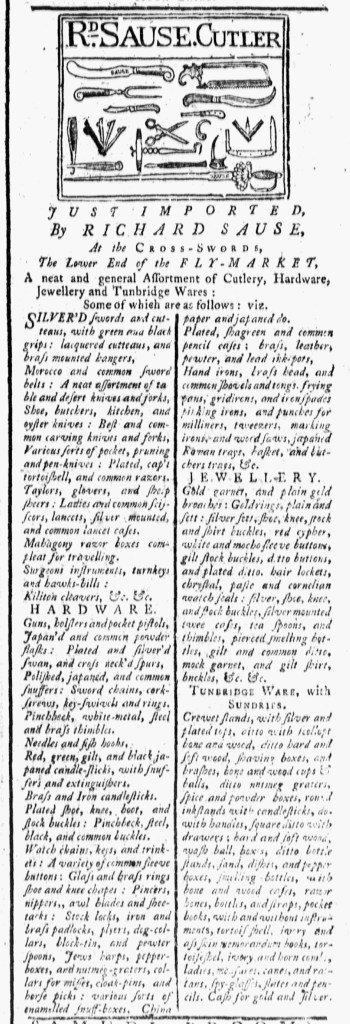
When James Rivington launched Rivington’s New-York Gazetteer in the spring of 1773, he had a significant number of advertisers lined up for the first several issues.  Those advertisers included entrepreneurs who previously invested in woodcuts that depicted some aspect of their business.  Such visual images distinguished their advertisements from others that consisted entirely of text.  Nesbitt Deane, a hatmaker, ran an advertisement featuring the familiar image of a tricorne hat with his name in a ribbon below it in the first issue.  Richard Sause, a cutler, included his woodcut depicting items made and sold at his shop in the second issue of Rivington’s New-York Gazetteer.

A couple of weeks later, Smith Richards, a “GROCER and CONFECTIONER, At the Sign of the Tea-Cannister and two Sugar Loaves,” ran an advertisement with an image that replicated his shop sign.  Within a thick border, sugar loaves flanked a tea canister embellished with the names of popular varieties of tea, “HYSON,” “SOUCHONG,” and “CONGO.”  Unlike the woodcuts that adorned advertisements placed by Deane and Sause, this one had not previously appeared in the New-York Gazette and Weekly Mercury or the New-York Journal.  (It may have run in the New-York Gazette or Weekly Post-Boy.  Issues from January 1771 through the last known issue of July 12, 1773, have not yet been digitized for greater accessibility.)  The image of the “Sign of the Tea-Cannister and two Sugar Loaves” very well may have been the first woodcut commissioned for an advertisement in Rivington’s New-York Gazetteer.

Richards had not previously advertised in the New-York Gazette and Weekly Mercury or the New-York Journal, but he apparently believed that the new Rivington’s New-York Gazetteer offered a good opportunity and a sound investment when it came to advertising his wares.  Even though most advertisers did not commission woodcuts to accompany their notices, many other entrepreneurs, some who previously advertised in other newspapers and some who had not, shared Richards’s confidence in the effectiveness of disseminating their advertisements via New York’s newest newspaper. Rivington had successfully convinced prospective advertisers that his newspaper enjoyed a wide circulation for even its earliest issues.

May 6

Who was the subject of an advertisement in a colonial American newspaper 250 years ago today?

Rivington’s New-York Gazetteer (May 6, 1773).

TO BE SOLD, A Very fine Negro Boy.”

Three issues.  That was how long it took James Rivington to become a broker in the slave trade when he launched Rivington’s New-York Gazetteer or the Connecticut, New-Jersey, Hudson’s-River and Quebec Weekly Advertiser in the spring of 1773.  The Adverts 250 Project has examined some of the advertisements that appeared in the first and second issues of that newspaper.  With the third issue, the Slavery Adverts 250 Project begins chronicling advertisements about enslaved men, women, and children that appeared in Rivington’s New-York Gazetteer.

Rivington, like other colonial printers, generated revenues by publishing and disseminating such advertisements, yet their complicity in perpetuating slavery and the slave trade did not end there.  When they published advertisements that provided descriptions of enslaved people who liberated themselves by running away from their enslavers and offered rewards for their capture and return, colonial printers encouraged and facilitated the widespread surveillance of Black men and women, including by colonizers who did not purport to own enslaved people themselves.  When colonial printers instructed readers to “Enquire of the Printer” for more information about enslaved people for sale, they became brokers in the transactions.

Such was the case with an advertisement in the May 6, 1773, edition of Rivington’s New-York Gazetteer.  In just five short lines, Rivington implicated himself in perpetuating slavery and the slave trade: “TO BE SOLD, A Very fine Negro Boy, about seventeen years old, capable of waiting on a gentleman, and in a family extremly useful, he is strong, well built, and remarkably sober, and well worth £. 100.  Enquire of the Printer.”  In his examination of “Enquire of the Printer” advertisements, Jordan E. Taylor notes, “Printers had several reasons to traffic enslaved people.  Many probably viewed this work as a way of encouraging advertisers.  To refuse to perform this service may have led an advertiser to taker his or her business to competitors.”[1]

Rivington’s competitors certainly did not refuse such business.  On the same day that Rivington’s New-York Gazetteer ran its first “Enquire of the Printer” advertisement, an advertisement describing and offering a reward for Cush, an enslaved man who liberated himself from John Foster of Southampton on Long Island, ran in John Holt’s New-York Journal.  Earlier in the week, Hugh Gaine published three advertisements concerning enslaved people in his New-York Gazette and Weekly Mercury, one seeking a “NEGROE man-servant,” another offering an enslaved woman for sale, and the third describing and offering a reward for Sam, an enslaved man who could speak English and Dutch.  Gaine acted as the broker in the first advertisement, instructing anyone willing to hire out an enslaved “NEGROE man-servant” to learn more “by applying to the printer.”

Still, Rivington made a choice about whether to participate in this aspect of the printing business, just as Nathaniel Mills and John Hicks did when they became proprietors of the Massachusetts Gazette and Boston Post-Boy.  Three days before Rivington published his first advertisement concerning an enslaved person, Mills and Hicks published theirs, joining with other printers in Boston who carried the same notice in their newspapers.  The following week, the fourth issue of Rivington’s New-York Gazetteer carried its first advertisement about an enslaved man, Pompey, who liberated himself.  Rivington had made his editorial decision about what he was willing to publish among the advertisements in his newspaper.  He did not seem to hesitate in doing so.

**********

[1] Jordan E. Taylor, “Enquire of the Printer: Newspaper Advertising and the Moral Economy of the North American Slave Trade, 1704-1807,” Early American Studies 18, no. 3 (Summer 2020): 296.

April 29

What was advertised in a colonial American newspaper 250 years ago today?

Rivington’s New-York Gazetteer (April 29, 1773).

“RD. SAUSE. CUTLER.”

In the second issue of Rivington’s New-York Gazetteer, the printer continued publishing a significant number of advertisements to supplement the revenue earned from subscriptions.  Advertising accounted for six of the twelve columns in the April 29, 1773, edition.  Many of those advertisers also placed notices in other newspapers.

Richard Sause, a cutler, ran an advertisement that filled more than half a column.  He listed a variety of goods from among the “neat and general Assortment of Cutlery, Hardware, Jewellery and Tunbridge Wares” that he recently imported, clustering the various categories of merchandise together with headings to help readers locate items of interest.  A woodcut that depicted more than a dozen forms of cutlery, including knives, scissors, a saw, and a sword, adorned the advertisement.  That image may have replicated the sign that marked the location of Sause’s shop.  It likely looked familiar to readers who regularly perused the New-York Gazette and Weekly Mercury since it had previously accompanied the cutler’s advertisements in that newspaper.

Nesbitt Deane, a hatmaker who frequently advertised in the city’s newspapers, placed a notice that featured a woodcut of a tricorne hat with his name enclosed in a banner beneath it in the first issue of Rivington’s New-York Gazetteer, but it did not appear in the second issue.  Like Sause’s woodcut, that image would have been familiar to readers who regularly read other newspapers since it had been appearing in the New-York Journal for more than a year.  Deane apparently wished to increase the visibility of his business among curious colonizers who examined the first issue of Rivington’s newspaper, but returned to advertising in a publication that he had greater confidence would yield customers.  His advertisement, complete with the woodcut, ran in the New-York Journal rather than Rivington’s New-York Gazetteer on April 29.  Deane either collected the woodcut from one printing office and delivered it to the other or made arrangements for the transfer.

In both instances, the advertisers benefitted from visual images that prominently displayed their names and distinguished their notices from others that consisted solely of text.  To gain those advantages, they made additional investments in commissioning woodcuts and then carefully coordinated when and where they appeared in the public prints.  Like other advertisers who incorporated images into their notices, Deane and Sause each commissioned a single woodcut rather than multiple woodcuts that would have allowed them to enhance their advertisements in more than one newspaper simultaneously.

April 22

What was advertised in a colonial American newspaper 250 years ago today?

Rivington’s New-York Gazetteer (April 22, 1773).

“He will endeavour, to discharge himself in his Function, with Faithfulness to all Mankind.”

After several months of promoting the endeavor, including placing subscription proposals in newspapers in New England, New York, and Pennsylvania, James Rivington published the first issue of Rivington’s New-York Gazetteer; or the Connecticut, New-Jersey, Hudson’s River, and Quebec Weekly Advertiser on April 22, 1773.  In addition to subscribers, the printer sought advertisers for his newspaper … and promised “Gentlemen in Business” in neighboring Connecticut that they would have access to advertisements placed by the “Merchants and Traders of New-York” if they subscribed.

Rivington delivered on that promise, filling five of the twelve columns in the first issue with advertisements.  The revenue from those notices complemented what subscribers paid for their newspapers, an important alternate stream of revenue for the printer.  In the colophon at the bottom of the final page, he solicited more advertisements as well as job printing of blanks, broadsides, handbills, and other items.  Rivington’s roster of advertisers included many entrepreneurs who already placed notices in other newspapers.  They hoped to maintain or increase their share of the market by disseminating advertisements via New York’s newest newspaper.  Among those advertisers who supplemented their marketing efforts in other newspapers, Maxwell and Williams, tobacconists from Bristol, advertised a variety of snuff, John Simnet (in an uncharacteristically subdued notice) informed readers that he repaired watches “VERY cheap and VERY well,” John C. Knapp offered his services as an attorney, broker, and conveyancer at his “Scrivener’s Office,” and William Bayley hawked a “neat and general assortment” of merchandise he recently imported.  Bayley even pledged to insert a more extensive advertisement, encouraging prospective customers to look for it.  He planned to catalog his inventory of hardware, “a full Advertisement of which will be published in a future Paper.”   Nesbitt Deane, the hatmaker, retrieved the woodcut that depicted a tricorne hat with his name in a banner beneath it, from another printing office in order to include it in his advertisement in the first issue of Rivington’s New-York Gazetteer.

Rivington’s New-York Gazetteer (April 22, 1773).

Rivington also published notices from advertisers in other towns.  Rensselaer Williams inserted an advertisement for the Royal Oak Inn adjacent to the Trenton Ferry similar to the one he previously published in the Pennsylvania Gazette.  Given the anticipated circulation of Rivington’s New-York Gazetteer, that certainly made sense, a savvy investment by an innkeeper hoping to serve travelers from many colonies as they passed through New Jersey and Pennsylvania.  Edward Pole, who frequently advertised in newspapers printed in Philadelphia, placed a lengthy notice that listed “Fishing Tackle of all sorts.”  In a note at the end, he declared that “All Orders from Town and Country will be thankfully received, duly attended to, and carefully executed as though the Persons were themselves personally present.”  That signaled his eagerness to serve prospective customers in New York who wished to send orders, yet Pole likely believed that prospective customers in Philadelphia and nearby towns would encounter his advertisement in Rivington’s New-York Gazetteer.  After all, the printer ran subscription notices in the Pennsylvania Chronicle, the Pennsylvania Gazette, the Pennsylvania Journal, and the Pennsylvania Packet.  Pole apparently believed that the newspaper achieved sufficient circulation in his area to make it worth placing an advertisement to supplement those that ran in newspapers printed in his own city.

Advertising accounted for a significant portion of the content of the first issue of Rivington’s New-York Gazetteer … and likely accounted for a significant amount of revenue that helped to defray the costs of printing the newspaper. Although Rivington had presented the presence of advertisements as beneficial to some prospective subscribers, especially merchants in Connecticut, his marketing campaign much more extensively highlighted the news, essays, and speeches that he intended to print.  Still, when he published the first issue, advertising comprised nearly half of the content that subscribers received in Rivington’s New-York Gazetteer … and Weekly Advertiser.

April 12

What was advertised in a colonial American newspaper 250 years ago today?

Supplement to the New-York Gazette and Weekly Mercury (April 12, 1773).

“He intreats those who are so obliging as to intend advertising in the first Number of the New-York Gazetteer, to favour him with their Advertisements as soon as convenient.”

As he prepared to launch his New-York Gazetteer, James Rivington placed a notice in the April 12, 1773, edition of the New-York Gazette and Weekly Mercury to announce that he published and distributed “AN ADDRESS TO THE SUBSCRIBERS” for his newspaper.  He worried, however, that not every subscriber actually received their copy.  He arranged for each of them to “have the Address left at their Houses,” but discovered that “thro’ Inadvertency, [some] may have been hitherto neglected.”  To remedy the situation, he offered that they “may be furnished sans Expence with as many Copies of it as may be required for themselves or for their Friends” upon sending a request to the printing office.

Why might subscribers have been interested in obtaining multiple free copies of this address and sharing them with others?  It was not an extended subscription proposal.  Instead, Rivington explained that it “contains the Speeches in Parliament, subsequent to that from the Throne at the opening of the present Session,” made by nearly twenty politicians and other dignitaries, including “the truly eloquent Mr. Edmund Burke, Agent for our Colony.”  Those speeches elaborated on “the most important Subjects, in which the Inhabitants of this Continent are very materially interested.”  Rivington devised a premium or gift that he gave to subscribers before the first issue of his newspaper went to press.  He likely hoped that any of the additional copies that subscribers ordered to share with their friends might also induce others to subscribe as well.

The printer had another purpose, however, in placing this notice in the New-York Gazette and Weekly Mercury.  Between his offer to distribute additional copies of the “ADDRESS TO THE SUBSCRIBERS” and his explanation of the contents, he made a pitch to prospective advertisers.  Rivington “intreats those who are so obliging as to intend advertising in the first Number of the New-York Gazetteer, to favour him with their Advertisements as soon as convenient.”  He explained that advertisements “will be inserted on the usual terms,” though he did not specify the rates, and promised that the newspaper “will have a very extensive Circulation.”  Colonizers familiar with the full name of the newspaper, Rivington’s New-York Gazetteer; or the Connecticut, New-Jersey, Hudson’s-River, and Quebec Weekly Advertiser, already anticipated that would be the case.  Furthermore, Rivington previously disseminated subscription proposals in New York, Pennsylvania, and New England.  Merchants, shopkeepers, artisans, and others could depend on prospective customers near and far glimpsing their advertisements as they perused Rivington’s newspaper.

This notice appeared in the New-York Gazette and Weekly Mercury ten days before Rivington published the first issue of his new newspaper on April 22, 1773.  He presented a gift to his subscribers and offered additional free copies of speeches delivered in Parliament in hopes of inciting more interest among prospective subscribers.  At the same time, he positioned a call for advertisers in the middle of his description of the premium his subscribers and their friends received.  When the first issue went to press, advertising filled five of the twelve columns.  Through his various efforts, Rivington convinced advertisers to take a chance on placing notices in his new publication.

March 23

What was advertised in a colonial American newspaper 250 years ago today?

Connecticut Courant (March 23, 1773).

“A motive to Gentlemen in Business to give orders for the Papers.”

As he prepared to launch a new newspaper, “RIVINGTON’s NEW-YORK GAZETTEER; OR THE CONNECTICUT, NEW-JERSEY, HUDSON’s-RIVER, AND QUEBEC WEEKLY ADVERTISER,” James Rivington continued to expand his advertising campaign in newspapers in New York, New England, and Pennsylvania.  He placed a notice in the Connecticut Courant on March 23, 1773, a full month after his first notices appeared in the Newport Mercury and the Pennsylvania Chronicle on February 22.  Except for the brief advertisement in the Newport Mercury, the much more extensive subscription proposals in the other newspapers all provided an overview about how Rivington envisioned that his newspaper would include content that distinguished it from others.  In many ways, he proposed a hybrid of a newspaper and a magazine, a publication that “will communicate the most important Events, Foreign and Domestic” as well as the “State of Learning” with the “best modern Essays,” a “Review of New Books,” and coverage of “new Inventions in Arts and Sciences, Mechanics and Manufactories.”

For readers of the Connecticut Journal and New-Haven Post-Boy, Rivington also attempted to incite interest through noting that “the Merchants and Traders of New-York, have universally patronized this Design, and their Advertisements will constantly appear in the Gazetteer.”  Given New Haven’s proximity to New York, Rivington apparently believed that consumers and retailers there would find such advertisements by merchants and shopkeepers in the bustling port as interesting and as useful as the rest of the content.  He made a similar pitch to residents of Hartford in his notice in the Connecticut Courant.  Following the paragraph describing the news and essays he planned to include in the newspaper, the printer expressed his hope that the “general support and promise of Mr. Rivington’s Friends, to Advertise in his Gazetteer … may be a motive to Gentlemen in Business to give orders for the Papers, which will be very regularly sent to the Subscribers.”  Rivington envisioned that advertising, in addition to coverage of “the Mercantile Interest in America, Departures and Prices Current, at Home and Abroad,” would facilitate commerce between New York and smaller towns in neighboring Connecticut.  He suggested to prospective subscribers in Hartford and New Haven that they consider advertisements placed by “Merchants and Traders” in New York as valuable sources of information, as newsworthy and practical in their own right as reports about current events.

March 21

What was advertised in a colonial American newspaper 250 years ago this week?

Massachusetts Gazette and Boston Weekly News-Letter (March 18, 1773).

“PROPOSES to publish a Weekly NEWS-PAPER.”

James Rivington continued to expand his marketing campaign to gain subscribers for his new newspaper, “RIVINGTON’s NEW-YORK GAZETTEER; OR THE CONNECTICUT, NEW-JERSEY, HUDSON’s-RIVER, AND QUEBEC WEEKLY ADVERTISER,” with an advertisement in the March 18, 1773, edition of the Massachusetts Gazette and Boston Weekly Mercury.  Nearly a month earlier, he commenced advertising in newspapers with a brief notice in the Newport Mercury on February 22.  That same day, he placed a longer notice in the Pennsylvania Chronicle.  That version became the standard that Rivington published, with minor variations, in other newspapers, including the Pennsylvania Gazette and the Pennsylvania Journal on February 24, the Connecticut Journal on February 26, and the Pennsylvania Packet on March 1.  On March 8, he informed readers of the New-York Gazette and Weekly Mercury that the “first Number” of Rivington’s New-York Gazetteer “shall make its Appearance in the month of April” and requested that “Gentlemen who may be inclined to promote the Establishment of this Undertaking” send their names “as soon as convenient, which will determine the Number he shall print of the first Paper.”

For prospective subscribers in Massachusetts, Rivington provided directions for contacting local agents.  “Subscriptions taken,” he declared, “by Messrs. Cox and Berry and Dr. M.B. Goldthwait, at Boston.”  Otherwise, the proposal in the Massachusetts Gazette and Boston Weekly Mercury replicated those that ran in the newspapers published in Philadelphia.  For some reason, that initial notice in the Newport Mercury differed significantly from those that ran in half a dozen other newspapers in New England, New York, and Pennsylvania.  The overall consistency of those subscription proposals amounted to a regional advertising campaign that delivered the same content to prospective subscribers in several colonies.  Members of the book trade – printers, booksellers, and publishers – devised the vast majority of advertising campaigns that extended beyond a single town in the eighteenth century.  Merchants and shopkeepers frequently placed advertisements in multiple newspapers published in their town; the purveyors of goods, rather than the products they sold, defined the geographic scope of their markets since most producers did not advertise the items they made.  Even when merchants and shopkeepers in several towns sold the same items, such as patent medicines, they did not participate in centralized advertising campaigns coordinated by the producers of those items.  Markets confined to colonial cities and their hinterlands, however, often could not support printed items, such as books and pamphlets, so printers, booksellers, and publishers developed advertising campaigns that placed the same notices in newspapers throughout a region or even throughout the colonies.  Rivington adopted that model in marketing a newspaper that he also intended would serve readers far beyond his printing office in New York.

March 1

What was advertised in a colonial American newspaper 250 years ago today?

Pennsylvania Packet (March 1, 1773).

“Every particular that may contribute to the improvement, information, and entertainment of the public, shall be constantly conveyed through the channel of the NEW-YORK GAZETTEER.”

A week after James Rivington’s proposal for publishing a newspaper, Rivington’s New-York Gazetteer; or the Connecticut, New-Jersey, Hudson’s River, and Quebec Weekly Advertiser, first appeared in the Newport Mercury and the Pennsylvania Chronicle, it ran in the Pennsylvania Packet.  During that week, Rivington also inserted the proposal, with variations, in the Connecticut Journal, the Pennsylvania Gazette, and the Pennsylvania Journal.  In advance of publishing a newspaper intended to serve an expansive region, the bookseller, printer, and stationer launched an advertising campaign in multiple newspapers throughout that region.  Once his notice appeared in the Pennsylvania Packet on March 1, 1773, all four English-language newspapers in Philadelphia carried it to readers dispersed far beyond that busy urban port.

These advertisements likely helped Rivington attract subscribers.  In his History of Printing in America (1810), Isaiah Thomas notes that Rivington’s New-York Gazetteer “was patronized in all the principal towns by the advocates of the British administration who approved the measures adopted toward the colonies” and “obtained an extensive circulation.”  Furthermore, the newspaper “undoubtedly had some support from ‘his Majesty’s government.’”  Patriots found Rivington’s New-York Gazetteer “obnoxious.”  On November 27, 1775, “a number of armed men from Connecticut entered the city, on horseback, and beset his habitation, broke into his printing house, destroyed his press, threw his types into heaps, and carried away a large quantity of them, which they melted and formed into bullets.”  Rivington departed for England soon after that encounter, but he returned to New York once the British occupied the city.  In October 1777, he began publishing Rivington’s New-York Gazette; or the Connecticut, Hudson’s River, New-Jersey, and Quebec Weekly Advertiser once again.  That title lasted for two issues before he changed it to Rivington’s New-York Loyal Gazette and, not long after that, the Royal Gazette.[1]

Although Thomas did not care for Rivington’s politics, he did give him credit for his skills as an editor, a printer, and an entrepreneur who disseminated his newspaper widely.  Thomas acknowledged that “for some time Rivington conducted his paper with as much impartiality as most of the editors of that period; and it may be added, that no newspaper in the colonies was better printed, or was more copiously furnished with foreign intelligence.”  In addition, Thomas reported that Rivington claimed that “each impression of his week Gazetteer, amounted to 3,600 copies” in October 1773.[2]  For the period, that was an extensive circulation indeed.

**********

[1] Isaiah Thomas, History of Printing in America: With a Biography of Printers and an Account of Newspapers (1810; New York: Weathervane Books, 1970), 508-9.

[2] Thomas, History of Printing, 511.