November 4

What was advertised in a colonial American newspaper 250 years ago today?

Rivington’s New-York Gazetteer (November 4, 1773).

“A large assortment of goods.”

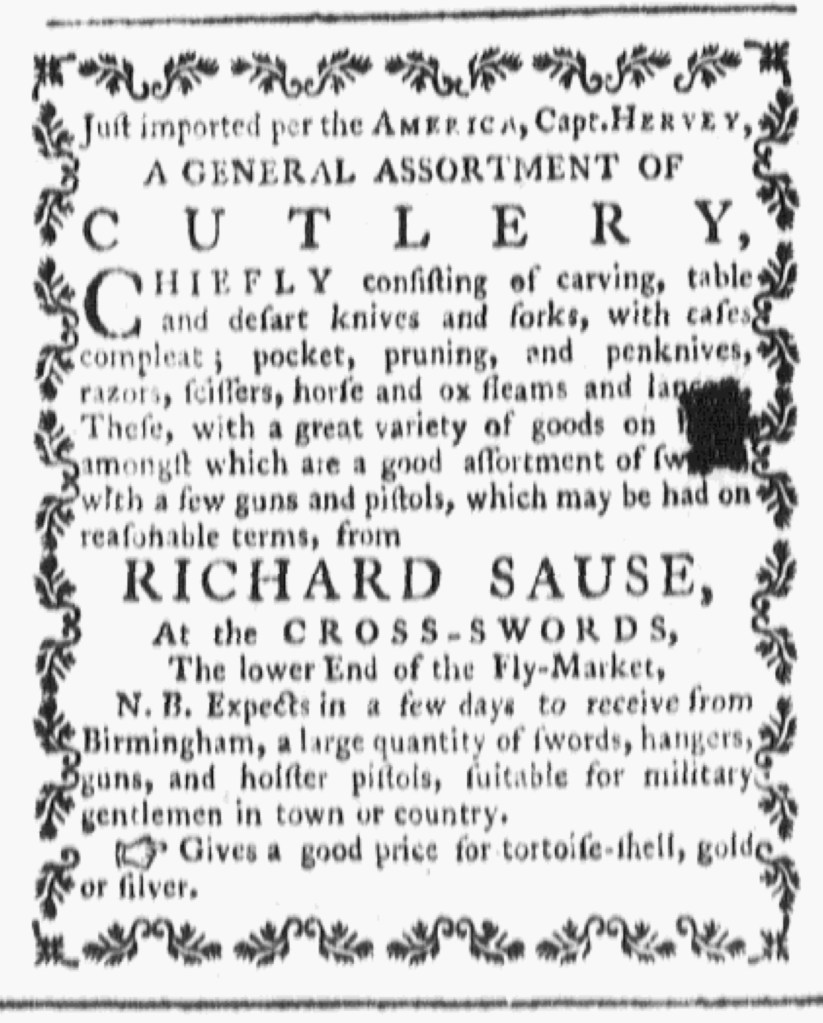
In its first six months of publication, Rivington’s New-York Gazetteer developed a signature style for many of its advertisements.  They featured the same copy that appeared in other newspapers published in the city, yet surrounded by borders made of decorative type.  James Rivington and the compositors who worked in his printing office certainly were not the first to devise borders for newspaper notices.  After all, borders enclosed Jolley Allen’s advertisements in several Boston newspapers going back years and the shopkeeper continued to incorporate that design element into his advertisements in the early 1770s (in every newspaper except the Massachusetts Spy, which seemed hesitant to accommodate that request).  Borders occasionally surrounded advertisements in other newspapers as well, but in no newspaper did they appear as frequently as in Rivington’s New-York Gazetteer.

In the fall of 1773, Richard Sause, a cutler “At the CROSS SWORDS,” joined the ranks of advertisers with borders around their advertisements.  Several notices in the November 4 edition had borders, including those places buy John Arthur, a shopkeeper, John Laboyteaux, a tailor, John J. Roosevelt, a merchant, and John Siemon, a furrier.  Borders also enclosed advertisements for “SHIP BREAD” sold by Crommelin and Horsfield and Rivington’s own notice for “Dr. KEYSER’s PILLS.”  The compositor selected different printing ornaments for each advertisement, making them distinctive even though they shared a common feature.

The copy for Sause’s advertisement matched his notice on the front page of the November 1 edition of the New-York Gazette and Weekly Mercury.  An extensive list of merchandise, divided into two columns with one or two items per line, appeared below a headline and brief introduction that promised a “large assortment of goods, which he will sell cheap for cash or short credit.”  Sause’s advertisement filled three-quarters of a column in Rivington’s New-York Gazetteer, making it the longest advertisement with a border in that issue.  Yet Sause did not need to experiment with a border as a means of drawing attention to his advertisement.  Like Siemon, he previously ran advertisements with a woodcut depicting some aspect of his business.  For the furrier, it was a muff.  For Sause, it was a sign that showed many of the items that he made and sold, including a table knife with “SAUSE” at the base of the blade and a sword with “SAUSE” in the same position.”  The sign depicted on the woodcut even included his name and occupation, “RD. SAUSE CUTLER,” making it one of the few woodcuts personalized in such a manner.  That image appeared in Sause’s advertisement in Rivington’s New-York Gazetteer on April 29, only the second issue of that newspaper.  Six months later, however, Rivington opted for the decorative border rather than the woodcut.  The increasingly popular style apparently made an impact on the advertiser, convincing him to give it a try in his own marketing in hopes that it would have a similar effect on prospective customers.

October 28

What was advertised in a colonial American newspaper 250 years ago today?

New-York Journal (October 28, 1773).

“Gentlemen’s caps, and gloves, lined with fur, very useful for travelling, and sleighing.”

During the final week of October 1773, John Siemon, a furrier, inserted advertisements in three newspapers published in New York, placing his notices before the eyes of as many readers in and near the city as possible.  He hawked a “General and complete assortment, of new fashion’d muffs & tippets, ermine, cloak linings, … gentlemen’s caps, and gloves, lined with fur,” and other items.  In addition, he “trims Ladies robes and riding dresses” and “faces and lapels Gentlemen’s waistcoats.”  As an ancillary service, Siemon provided directions “to rub the furs in summer” to keep them in good condition when not being worn.

Although Siemon submitted nearly identical copy to the three printing offices, his advertisements had very different formats when they appeared in the newspapers.  Arguably the one that best represented Siemon’s brand, the notice in the New-York Journal featured a woodcut depicting a muff, an image that regularly accompanied the furrier’s advertisements.  Siemon apparently considered it worth the investment to commission a single woodcut for the exclusive use of his business, but did not realize the potential of purchasing multiple woodcuts with the same image in order to achieve visual consistency and product recognition across several publications.

Rivington’s New-York Gazetteer (October 28, 1773).

Siemon’s advertisement in Rivington’s New-York Gazetteer had a different kind of visual appeal.  The furrier joined the ranks of advertisers who enclosed their notices within borders comprised of decorative type, including Crommelin and Horsfield, bakers, John J. Roosevelt, a merchant, Richard Sause, a cutler.  James Rivington and the compositors in his printing office made such borders a regular part of advertisements for consumer goods and services.  Those borders helped to draw attention to certain advertisements while also giving the pages of Rivington’s newspaper a distinctive look.  In contrast, no images or decorative type adorned Siemon’s advertisement in the New-York Gazette and Weekly Mercury.  It consisted solely of text with the typography determined by the compositor to match other advertisements in that publication.

New-York Gazette and Weekly Mercury (October 25, 1773).

In most instances, advertisers submitted copy to printing offices and then compositors determined the format of the advertisements.  Siemon’s advertisements suggest that was indeed the case when advertising in the New-York Gazette and Weekly Mercury, yet he offered specific directions, in the form of the familiar woodcut, for his advertisement in the New-York Journal.  His advertisement in Rivington’s New-York Gazetteer demonstrates the greatest level of collaboration between advertiser and compositor.  Siemon either requested or agreed to include a distinctive visual element associated with notices in that newspaper.  The furrier took graphic design into account to varying degrees in his efforts to disseminate his advertisements in multiple newspapers.

October 24

What was advertised in a colonial American newspaper 250 years ago this week?

Rivington’s New-York Gazette (October 21, 1773).

“In a short time JAMES RIVINGTON will publish some other particulars of the efficacy of Dr. KEYSER’s PILLS.”

Like many other colonial printers, James Rivington supplemented revenues from the usual operations of his printing office by peddling patent medicines.  In particular, Rivington hawked Dr. Keyser’s Pills, one of the most popular treatments for venereal disease in eighteenth-century America.  This remedy was so popular that often name recognition alone marketed the pills to prospective customers.  For many weeks in the fall of 1773, Rivington ran a short advertisement that proclaimed, “EVERY ONE THEIR OWN PHYSICIAN, BY THE USE OF Dr, KEYSER’s PILLS.”  A border comprised of decorative type enclosed the bold headline and a promise that the medicine would “infallibly cure a DISEASE, not to be mentioned in a News-Paper, without the Knowledge of the most intimate Friends.”  For those still too embarrassed to purchase the pills, Rivington noted that they “are also wonderfully efficacious in curing the RHEUMATISM,” providing a cover story for prospective customers who wished to make use of it.

On occasion, Rivington enhanced that candid advertisement with descriptions of “CURES Performed by KEYSER’s PILLS,” giving examples to readers who still needed more convincing about whether they should invest in the medicine.  In the October 24 edition of Rivington’s New-York Gazetteer, for instance, the printer included three stories of patients who had been cured of “a fashionable disease.”  The most remarkable concerned a pregnant woman whose child “was born with the distemper.”  When the mother’s symptoms “grew very alarming,” she took the pills and recovered.  The infant’s wet nurse also took the pills and “the child, from the effect of the pills taken by the nurse, was perfectly restored to health.”  According to this story, Dr. Keyser’s Pills were so effective that they even cured a baby breastfeeding from a woman directed to take them!  The other two stories told of patients who had long suffered “with the same disease” and the “severest courses prescribed” by physicians, yet “restored” or “relieved” when they resorted to Dr. Keyser’s Pills.  Once again, Rivington avoided associating the pills exclusively with venereal disease.  To that end, he inserted other examples: “In the RHEUMATISM,” “In APOPLEXIES,” “In the ASTHMA,” and “A WHITE SWELLING.”  That swelling almost resulted in “the amputation of an arm,” but the patient experienced “a radical cure” upon taking Dr. Keyser’s Pills.”

That did not exhaust the stories of successful treatments, just the amount of space that Rivington devoted to advertising the pills in that issue of his newspaper.  He concluded his advertisement with a note that “In a short time [he] will publish some other particulars of the efficacy of Dr. KEYSER’s PILLS,” though he did not indicate if he intended to do so with newspaper advertisements, handbills, broadsides, or pamphlets.  The media mattered less than alerting prospective customers that the printer had access to similar stories.  They could wait to examine those or consider that sufficient enough justification to acquire the pills to start down their own road to recovery.

October 10

What was advertised in a colonial American newspaper 250 years ago this week?

Rivington’ New-York Gazetteer (October 7, 1773).

“The usual genteel accommodation for set CLUBS, and other private companies large or small.”

Samuel Fraunces (or Samuel Francis) was one of the most prominent American tavernkeepers and restaurateurs in the late eighteenth century.  He remains famous today, in part because Fraunces Tavern at 54 Pearl Street in New York City continues to welcome visitors in a building listed on the National Register of Historic Places.  A tavern and restaurant occupy the first floor and the Sons of the Revolution in the State of New York operate a museum on the second and third floors.

Fraunces frequently advertised during the era of the American Revolution.  In the fall of 1773, for instance, he inserted a notice in Rivington’s New-York Gazetteer to promote the “QUEEN’s HEAD TAVERN, Near the Exchange in Broad-street.”  The industrious entrepreneur presented a visit to the tavern as an experience that incorporated food, drink, entertainment, service, and atmosphere.  He invited “the respectable inhabitants of this city” to dine and socialize in the “large commodious room” that he outfitted for “the reception and entertainment” of his guests.  He encouraged them “to regale themselves with fine ALE of this country produce, equal to any imported,” though he also had on hand “draft, or bottled porter from London, of the first quality” as well as an assortment of wines, punch, and spirits.  Fraunces wanted his patrons to eat as well as drink, serving “beef stakes, mutton or pork chops, veal stakes or cutlets, fry’d oysters,” and other fare throughout the day and evening.

New-York Gazette and Weekly Mercury (June 13, 1772).

The tavernkeeper placed a premium on service.  In addition to his staff preparing and serving the food “in the neatest manner,” Fraunces undertook “every other necessary requisite to give general satisfaction” to his customers, “particularly, the best attendance, the most respectful behaviour, and a hearty acknowledgment of those favours” from his patrons.  Fraunces depicted the Queen’s Head Tavern as an exceptional venue, not only for “one or more persons” who wished to drink and dine together but also for “CLUBS, and other private companies large or small” who wished to hold their gatherings within the “genteel accommodation” he worked so hard to cultivate.  As an additional inducement to visit the tavern, Fraunces moved the “elegant WAX-FIGURES” (that he described in newspaper advertisements than ran a year earlier) from Vaux-Hall Garden to the tavern.  His staff included “proper attendants to shew” the wax figures at “any hour of the day or evening.”  The Queen’s Head Tavern was not just any watering hole.  Fraunces exerted great effort in marketing it as a destination.

New-York Gazette and Weekly Mercury (August 17, 1772).

October 3

What was advertised in as colonial American newspaper 250 years ago this week?

Rivington’s New-York Gazetteer (September 30, 1773).

“A GENERAL ASSORTMENT OF CUTLERY.”

Richard Sause joined other entrepreneurs who experimented with decorative borders enclosing their advertisements when he promoted a “GENERAL ASSORTMENT OF CUTLERY” in Rivington’s New-York Gazetteer.  The cutler had previous experience incorporating visual images into his advertisements in both the New-York Gazette and Weekly Mercury and Rivington’s New-York Gazetteer.  By the fall of 1773, many advertisements in New York’s newest newspaper featured borders, a popular means of enhancing notices.  Similar borders sometimes adorned advertisements in other newspapers, but not in the numbers and frequency that they appeared in Rivington’s New-York Gazetteer.

The September 30, 1773, edition of that newspaper, for instance, included eight advertisements with ornate borders.  Most of those notices were relatively short, a single square of text.  Among them, Dennis McReady, a tobacconist, hawked his wares and Aspinwall and Smith announced that they sold “CHOICE OLD JAMAICA SPIRIT.”  Another of these shorter announcements advised that “the Delaware Lottery for the Sale of Lands, belonging to the Earl of Stirling, will commence on Monday the first Day of November next.”  James Rivington, the printer, also enclosed his advertisement for Keyser’s Pills within a decorative border.  George Webster, “At the THREE SUGAR LOAVES,” listed a couple of items “just received from LONDON” and promised “many other Articles which will be inserted next week.”  That advertisement, however, never materialized.  Given that advertisers paid by the amount of space their notices occupied rather than the number of words, borders made advertisements more expensive.  Rivington may have also charged additional fees for the borders, making them especially attractive to entrepreneurs running shorter advertisements.

Still, some advertisers enclosed longer notices within borders.  Thomas Hazard, one of Sause’s competitors, did so with an advertisement for “Ironmongery and Cutlery,” as did Francis Lewis and Sons in their advertisement that listed dozens of items for sale at their store on Queen Street.  Among these three longer advertisements, Sause’s notice was the shortest.  He apparently appreciated the visual appeal of the border and considered it worth the investment.  Four weeks later he placed a much more extensive advertisement that extended approximately three-quarters of a column.  A decorative border enclosed the lengthy list of merchandise that Sause “JUST IMPORTED.”  Along with several other advertisers, the cutler sought to generate interest in his newspaper notices by making them more visually appealing than text alone.  The printing office seems to have encouraged this innovation.

September 16

What was advertised in a colonial American newspaper 250 years ago today?

Rivington’s New-York Gazetteer (September 16, 1773).

“EVERY ONE THEIR OWN PHYSICIAN, BY THE USE OF Dr. KEYSER’s PILLS.”

Dr. Keyser’s Pills may have been the most widely advertised patent medicine in colonial American newspapers.  Apothecaries included the remedy among the lists of patent medicines that they stocked, as did merchants and shopkeepers who did not specialize in drugs and medicines.  Printers also frequently advertised a variety of patent medicines, especially Dr. Keyser’s Pills, in their efforts to supplement revenues earned from job printing, newspaper subscriptions, advertising fees, and selling books and stationery.  In the summer of 1772, printers in Charleston, South Carolina, even engaged in a feud over which of them sold genuine Dr. Keyser’s Pills and accusing the other of peddling counterfeit medicines.

James Rivington, printer of Rivington’s New-York Gazetteer, managed to avoid such controversy in the fall of 1773, though he competed with Hugh Gaine, printer of the New-York Gazette and Weekly Mercury, in selling Dr. Keyser’s Pills.  Neither of them placed the kind of extensive notice, complete with descriptions of the symptoms that the medicine alleviated and testimonials to the effectiveness of the pills, that sometimes appeared in colonial newspapers.  Gaine did briefly note that he “has now by him many Proofs of their Utility in curing Inflamations, Rheumatism, [and] White Swellings,” an invitation to readers to examine testimonials on hand in his printing office.  For his part, Rivington deployed a headline that proclaimed “EVERY ONE THEIR OWN PHYSICIAN” when they used Dr. Keyser’s Pills to treat a “DISEASE, not to be mentioned in a News-Paper.”  Consumers knew that patients afflicted with venereal disease commonly turned to Dr. Keyser’s Pills, not just those who suffered from rheumatism (though Rivington did join Gaine in stating the pills “are also wonderfully efficacious” in alleviating those symptoms).  For prospective customers seeking to protect their privacy and avoid embarrassment by acting as “THEIR OWN PHYSICIAN,” Rivington asserted that Dr. Keyser’s Pills “infallibly cure” the unnamed disease “without the Knowledge of the most intimate Friend” (or perhaps even spouses or other partners).  Like other purveyors, Rivington sold the pills in boxes of different quantities so customers could select how many pills they thought they needed to treat themselves.

In the eighteenth century, Dr. Keyser’s Pills were as widely known to consumers as many over-the-counter brands are to customers today.  Accordingly, advertisers did not always need to publish lengthy advertisements to market the pills.  Instead, Rivington and others believed that short notices with bold proclamations, like “EVERY ONE THEIR OWN PHYSICIAN” effectively marketed the popular patent medicine.

September 2

What was advertised in a colonial American newspaper 250 years ago today?

Rivington’s New-York Gazetteer (September 2, 1773).

“An assortment of goods suitable to the season.”

A little more than four months after James Rivington commenced publication of Rivington’s New-York Gazetteer, many of the advertisements in that newspaper had a notable feature intended to attract readers’ attention.  Borders composed of decorative type enclosed five of the advertisements in the September 2, 1773, edition.  That gave the section devoted to advertising a distinctive look compared to the New-York Gazette and Weekly Mercury and the New-York Journal.  During that week, the latter did not carry any advertisements with borders.  The former carried one with a border, a short notice about “KEYSER’s PILLS” placed by Hugh Gaine.

Rivington’s New-York Gazetteer (September 2, 1773).

Gaine happened to be the printer of the New-York Gazette and Weekly Mercury.  Although he adorned one of his own advertisements with a border, he also appeared to reserve that format for his exclusive use.  S. Sp. Skinner, a distiller, ran advertisements for “the best of RUM” with identical copy in both publications, with a border in Rivington’s newspaper and without a border in Gaine’s newspaper.  The distiller also advertised, without a border, in the New-York Journal.  Rivington or a compositor in his printing office experimented with a format that enhanced the visual appeal of advertisements.  They either offered borders to advertisers or some advertisers learned that Rivington’s New-York Gazetteer would accommodate such requests.

Rivington’s New-York Gazetteer (September 2, 1773).

Other advertisements with identical copy in multiple newspapers demonstrate that Rivington incorporated a visual element not available in other printing offices in New York.  Robert Murray and John Murray ran an announcement that they dissolved their partnership and requested that “Persons Indebted to them” settle their accounts or face legal action.  Their advertisement had a border in Rivington’s New-York Gazetteer, but not in the New-York Gazette or Weekly Mercury or the New-York Journal.  Similarly, T.B. Atwood placed an advertisement for his “Medicinal Store” in all three newspapers.  It featured side-by-side columns listing patent medicines and other merchandise in each of them, apparently a format specified by the advertiser, but only Rivington’s newspaper enclosed Atwood’s notice within a decorative border.  Not only did the advertisement have a border, that border consisted of decorative type different from any that surrounded other advertisements or separated news accounts in that issue.  Taking the service to a higher level, the compositor chose printing ornaments that made the borders for each advertisement unique.

Rivington’s New-York Gazetteer (September 2, 1773).

Vincent Pearse Ashfield’s advertisement for coffee, tea, wine, and spirits also appeared in two newspapers, the New-York Gazette and Weekly Mercury and Rivington’s New-York Gazetteer, but embellished with a border in only one.  All of the advertisers whose notices had borders in Rivington’s newspaper – Ashfield, Atwood, the Murrays, and Skinner – simultaneously placed the same advertisement in at least one other newspaper.  Despite the identical copy, only the notices in Rivington’s New-York Gazetteer incorporated borders, suggesting that Rivington’s printing office worked with advertisers to offer an option not available in other newspapers.  In addition to drawing attention to those advertisements, that made the pages of Rivington’s new newspaper easy to recognize and perhaps more interesting for readers.

August 5

What was advertised in a colonial American newspaper 250 years ago today?

Rivington’s New-York Gazetteer (August 5, 1773).

“It was intirely the Printer’s mistake in advertising last week that Mr. BATES would perform only once more.”

On Thursday, July 22, 1773, Mr. Bates ran an advertisement in the New-York Journal to promote his next performance showcasing feats of horsemanship, informing the public that it would take place on Tuesday, July 27.  In the same notice, he announced that he “proposes, but twice more, before he leaves this City, to exhibit his Performances in Horsemanship.”  He did not indicate the date of his final performance, but the same day he inserted a much shorter advertisement in Rivington’s New-York Gazetteer.  “MR. BATES,” that notice proclaimed, “PROPOSES to perform on Tuesday next, and on Friday the 30th instant, and no more, before he leaves this City.”  The performer placed a longer advertisement, with nearly identical copy to the one in the New-York Journal, in the New-York Gazette and Weekly Mercury on July 26, the day before one of those final performances.  In it, he stated that “Mr. Bates’s stay in town will be very short, as he intends performing only twice.”  In each advertisement, Bates made it clear that he would remain in New York for a limited time only.  Audiences interested in attending his show needed to purchase tickets before it was too late.

The next advertisement that appeared in Rivington’s New-York Gazetteer was consistent with Bates’s marketing over the prior week.  On Thursday, July 29, that notice encouraged readers to attend his final performance in the city: “MR. BATES PROPOSES to perform tomorrow at the usual place, for the last time.”  The New-York Journal did not happen to carry an advertisement from Bates on the day before that final performance.  On Monday, August 2, the New-York Gazette and Weekly Mercury once again ran the advertisement from July 26, with one update.  It now stated, “TO-MORROW, being TUESDAY the 3d August, he will perform on One, Two, Three and Four HORSES, at the Bull’s-Head, in Bowery-Lane.”  Only the date changed, from “27th of July” to “3d August.”  A note at the end still asserted that “Mr. Bates’s stay on town will be very short, as he intends performing only twice.”  On August 5, he once again advertised in the New-York Journal.  The opening paragraph remained the same as what appeared in the previous two issues, but he updated information about his final performance and departure from New York.  “On TUESDAY next, the 10th of August, if the weather permits, if not on the Friday following, which positively will be the last time, as Mr. Bates intends to set out on a tour for Boston the next day,” the advertisement explained, “He will perform on one, two, three and four Horses, at the Bull’s-Head, in the Bowery Lane.”

That same day, August 5, Bates placed a new advertisement in Rivington’s New-York Gazetteer, the publication that announced a week earlier that he would give his final performance on Friday, July 30.  In this notice, Bates stated that he would perform the following Tuesday and allowed for the next Friday as the rain date.  He once again underscored that this was the last chance to attend his who, that audiences had a limited time to witness the spectacle for themselves before he left town.  He underscored that “the public may be assured this will be his last exhibition, and that he will leave this town on his way to Boston, the day after his finishing performance.”  He added that it “was intirely the Printer’s mistake in advertising last week that Mr. BATES would perform only once more.”  Was it?  The advertisement in the July 29 edition of Rivington’s New-York Gazette accurately reflected the dates from the advertisement that appeared in the previous issue as well as the appeals that Bates made in notices in other newspapers.  A savvy marketer like Bates may have intended all along to announce his imminent departure, creating demand for the final shows, and then “extend” his time in New York by a week in order to give two more performances.  Alternately, his plans might have changed and that allowed him to sell tickets for two more shows.

The discrepancy in the advertisements and the supposed “Printer’s mistake” in Rivington’s New-York Gazetteer raises questions about how closely Bates coordinated his marketing efforts with each of the printing offices.  Given the revisions to the advertisements in the New-York Gazette and Weekly Mercury and the New-York Journal, he apparently submitted new instructions.  Did he also send updated information to the other printing office only to have it inadvertently overlooked?  Or did Bates plan for that newspaper to carry the “Printer’s mistake” as a means of creating confusion to amplify the sense of urgency for purchasing tickets that he wanted audiences to experience?  The relief they felt after learning that they had another chance following the “Printer’s mistake” might have convinced some readers to buy tickets for what would actually be Bates’s final performance in New York … but that was not a ploy that the performer could use in more than one newspaper.  Bates carefully managed his marketing efforts while in New York.  He certainly sought to manipulate audiences into attending his shows after announcing they he would soon leave the city.  Was the “Printer’s mistake” an actual mistake or another manipulation intended to incite interest?

July 25

What was advertised in a colonial American newspaper 250 years ago this week?

Rivington’s New-York Gazetteer (July 22, 1773).

“HORSEMANSHIP.”

“MR. BATES PROPOSES to perform on Tuesday next, and on Friday the 30th instant, and no more, before he leaves this City.”  That brief advertisement in the July 22 edition of Rivington’s New-York Gazetteer put readers on notice that only limited opportunities remained to see Bates’s show.  From both his frequent advertisements in New York’s newspapers and the reputation that he cultivated in the city, most readers probably knew that Bates performed feats of horsemanship for the entertainment of his audiences.

New-York Journal (July 22, 1773).

A much longer advertisement in the New-York Journal on the same day deployed the usual headline, “HORSEMANSHIP,” and described him as “The ORIGINAL PERFORMER.”  Bates offered a spectacle of the “MANLY ARTS” that he previously performed for dignitaries that included “the Emperor of Germany, the Empress of Russia, the King of Great-Britain, the French King, the Kings of Prussia, Portugal, Sweden, Denmark, and Poland, and the Prince of Orange.”  Bates confided that he “received the greatest applause” for those performances, “as can be made manifest by the CERTIFICATES from the several courts now in his possession.”  Readers did not have to take his word for it that he presented his feats of horsemanship to monarchs and aristocrats.  For a mere four shillings, colonizers in New York could gain access to the same exhibition enjoyed by royals and nobles, but they had to purchase tickets in advance because “No money will be taken at the Doors, nor Admittance without Tickets.”  Bates welcomed “Ladies and Gentlemen” and provided “proper” seating for their comfort, but requested that “Gentlemen will not suffer any dogs to come with them” for fear of scaring or distracting the horses.

A manicule drew attention to the same appeal that appeared in the other newspaper, though stated differently.  “Mr. Bates proposes, but twice more, before he leaves this City, to exhibit his Performances in Horsemanship,” the equestrian daredevil stated.  That being the case, he intended to sell “the Boards, Scantling, &c. at his riding Inclosure, together with the Benches, Rails, &c.”  Dismantling the venue underscored that audiences had only a limited time to witness Bates performing “on one, two, three and four Horses, at the Bulls-Head, in Bowery-Lane.”  They risked missing a performance that would “excel any Horseman that ever attempted any thing of the kind” if they hesitated and did not buy their tickets as soon as possible.

July 8

What was advertised in a colonial American newspaper 250 years ago today?

Rivington’s New-York Gazetteer (July 8, 1773).

“He has obtained a certificate from the Queen’s Stay-Maker in London.”

Readers of Rivington’s New-York Gazetteer likely noticed the image that adorned John Burchett’s advertisement in the July 8, 1773, edition.  After all, it was the only image featured throughout the issue, with the exception of a woodcut depicting a ship at sea that appeared in the masthead.  Burchett, a “STAY and RIDING HABIT-MAKER” who kept shop “at the Sign of the Crown and Stays,” led his advertisement with a woodcut that replicated that sign.

Yet Burchett did not rely on the image alone to market his goods and services.  Instead, he incorporated other appeals in his efforts to convince prospective customers to purchase stays from him.  For instance, he invoked his origins and previous experience, describing himself as “From LONDON and PARIS.”  Like others in the garment trades, Burchett suggested to consumers that they would derive additional cachet from hiring someone with connections to such cosmopolitan cities.  Most tailors, milliners, and staymakers who migrated across the Atlantic could claim roots in only one of those capitals of fashion and gentility, yet Burchett asserted ties to both.  He especially emphasized the recognition he gained in London, informing prospective customers that “he has obtained a certificate form the Queen’s Stay-Maker in London.”

That testified to the taste and quality associated with stays made by Burchett.  For those concerned about price, he declared that he “has also a good number of ready made stays of the best quality, cheaper than can be imported.”  He even gave prices so prospective customers could assess the bargains for themselves without having to visit his shop.  In addition, he proposed a payment plan meant to encourage consumers to select him over his competitors.  The staymaker pledged that “any lady who shall employ him” could pay “half cash … and the rest in dry goods.”  That put him in a position to barter with female shopkeepers and the wives and daughters of merchants and shopkeepers.

Burchett did not merely announce that he made and sold stays and then hope that customers would visit his shop at the Sign of the Crown and Stays.  Instead, he deployed an image that corresponded to the sign associated with his business as an invitation to peruse a lively narrative that included a variety of marketing strategies.  He commented on fashion and price while emphasizing his experience working in London and Paris and alternatives to paying with cash or credit.  As a result of such attention to so many aspects of his business, prospective customers could trust that the staymaker would indeed “use all possible endeavours to merit their interest.”