July 23

What was advertised in a revolutionary American newspaper 250 years ago this week?

South-Carolina and American General Gazette (July 21, 1775).

“A SERMON on the present Situation of American Affairs.”

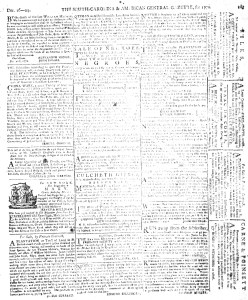
Robert Wells, the printer of the South-Carolina and American General Gazette, often inserted advertisements that promoted the merchandise available at his “GREAT STATIONARY & BOOK STORE” in Charleston.  On July 21, 1775, he devoted a notice to “A SERMON on the present Situation of American Affairs.  Preached in Christ Church, Philadelphia, June 23, 1775, at the Request of the Officers of the Third Battalion of the City of Philadelphia and District of Southwark.  By WILLIAM SMITH, D.D. Provost of the College in that City.”  Like many other advertisements for books, the copy replicated the title page.  Wells added the verse from the Book of Joshua that Smith cited as inspiration for the sermon.

The headline for the advertisement declared, “Just published, and to be sold BY ROBERT WELLS.”  Did “Just published” and “to be sold” both describe Wells’s role in disseminating Smith’s sermon?  When printers and booksellers linked those phrases together, they often meant that a work had been “Just published” by someone else and made available “to be sold” by other printers and booksellers.  Wells may have acquired copies of the sermon printed by James Humphreys, Jr., in Philadelphia and retailed them at his own shop.  Another advertisement in the same issue used the headline, “This Day are Published, BY ROBERT WELLS,” to introduce two books, “OBSERVATIONS on the RAISING and TRAINING of RECRUITS. By CAMPBELL DALRYMPLE, Esq; Lieutenant Colonel to the King’s Own Regiment of Dragoons,” and “THE MANUAL EXERCISE, with EXPLANATIONS, as now practised by The CHARLESTOWN ARTILLERY COMPANY.”  In contrast to “This Day are Published,” other items certainly not printed by Wells appeared beneath a header that stated, “At the same STORE may be had.”  On the other hand, Wells could have published a local edition of Smith’s sermon.  James Adams printed and sold a local edition in Wilmington, Delaware.

Christopher Gould includes Smith’s Sermon on the Present Situation of American Affairs (entry 103) in his roster of imprints from Wells’s printing office, along with The Manual Exercise (entry 92) and Observations on the Raising and Training of Recruits (entry 93).  For each of them, he indicates that he did not examine an extant copy but instead drew the information from newspaper advertisements.  Gould explains that “many of the entries for 1774 and 1775 must be regarded as suspect.  Wells advertises them as his publications, but in the absence of extant copies bearing his imprint, the likelihood is strong that they are in fact London editions of popular works bound in Charleston by Wells.”[1]  As I have noted, Wells used a headline to introduce Smith’s Sermon that both contemporary printers and readers understood did not necessarily attribute publication to the advertiser.  Even if he sold copies of the sermon printed elsewhere, they did not come from London.  Smith delivered the sermon on June 23 and Wells advertised it just four weeks later, not nearly enough time for London printers to be involved.  Wells advertised an American edition, even if he did not publish it.

Whatever the case, the sermon supplemented the news.  Readers of the South-Carolina and American General Gazettefollowed all sorts of “AMERICAN INTELLIGENCE” from New England to Georgia, but the pages of any newspaper could present only so much content.  Wells presented readers an opportunity to learn more about the discussions about current events taking place in Philadelphia by experiencing Smith’s sermon themselves.  As consumers, they could become better informed and join with others who heard or read the sermon.

**********

[1] Chrisopher Gould, “Robert Wells, Colonial Charleston Printer,” South Carolina Historical Magazine 79, no. 1 (January 1978): 42.
November 25

What was advertised in a colonial American newspaper 250 years ago today?

South-Carolina and American General Gazette (November 25, 1774).

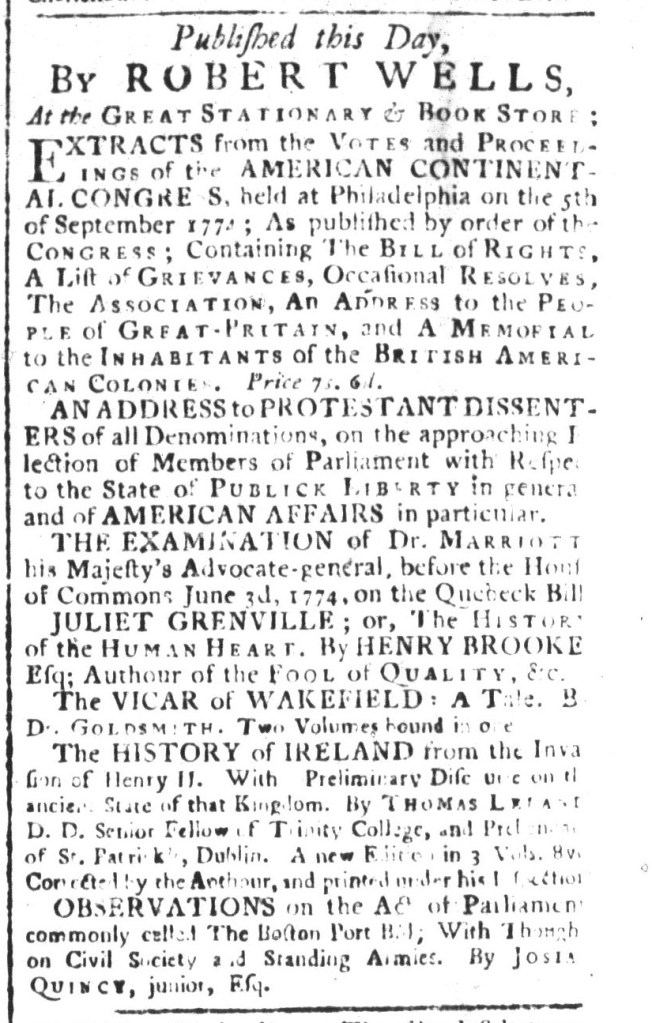
“EXTRACTS from the VOTES and PROCEEDINGS of the AMERICAN CONTINENTAL CONGRESS.”

As soon as the First Continental Congress adjourned near the end of October 1774, printers set about publishing, advertising, and selling “EXTRACTS from the VOTES and PROCEEDINGS of the AMERICAN CONTINENTAL CONGRESS, held at Philadelphia.”  William Bradford and Thomas Bradford, printers of the Pennsylvania Journal, were the first to advertise this political pamphlet, but other printers soon advertised that they produced local editions in their own towns, helping to disseminate the news far and wide.  Conveniently packaging “The BILL of RIGHTS, A List of GRIEVANCES, Occasional RESOLVES, The ASSOCIATION, An ADDRESS to the PEOPLE of GREAT-BRITAIN, and A MEMORIAL to the INHABITANTS of the BRITISH AMERICAN COLONIES” in one volume, this pamphlet supplemented coverage in newspapers.  Its format allowed for easier reference than saving and scouring issue after issue of newspapers that relayed some but not all the contents of the Extracts.  The pamphlet met with such demand that some printers quickly printed second editions.  In the November 24 edition of the Norwich Packet, for instance, Alexander Robertson, James Robertson, and John Trumbull advertised the “second Norwich EDITION” of the Extracts.

The Adverts 250 Project has examined the publication and dissemination of the Extracts in Pennsylvania, the neighboring colonies of Maryland and New York, and multiple towns in New England.  It took a little longer for printers in southern colonies to publish the pamphlet, but within a month of the First Continental Congress finishing its business Robert Wells, the printer of the South-Carolina and American General Gazette, advised readers that they could purchase the Extracts at his “GREAT STATIONARY & BOOK STORE.”  Unlike other printers who ran separate advertisements for the pamphlet, Wells included it among a list of half a dozen titles he sold.  He gave it a privileged place, first on the list, acknowledging its importance and likely interest among readers.  The other items included a couple of novels and a history of Ireland, but Wells concluded the list with “OBSERVATIONS on the Act of Parliament commonly called The Boston Port Bill, With Thoughts on Civil Society and Standing Armies.  By JOSIAH QUINCY, junior, Esq.”  Among the many volumes available at his bookstore, Wells chose to emphasize two concerning current events as the imperial crisis intensified.  Like so many other printers, he marketed items that supplemented the news he published in his newspaper.

August 5

What was advertised in a colonial American newspaper 250 years ago today?

South-Carolina and American General Gazette (August 5, 1774).

“*Extract from Dr. RUSH’s Oration.”

Robert Wells had sufficient content to fill a four-page supplement (though printed on a smaller sheet) as well as the standard four-page issue when he took the August 5, 1774, edition of the South-Carolina and American General Gazetteto press.  With so much space to fill, he devoted the entire final page of the standard issue to a book catalog, listing dozens and dozens of titles in four columns.  His inventory represented an array of subjects, though he did not classify or categorize his offerings under headings like other booksellers sometimes did.  Instead, he left it to readers to discover the variety as they perused the catalog.  Among the many titles, he hawked “THE VISIONS of THOMAS SAY of the City of Philadelphia, which he saw in a Trance.”  Wells was either unaware that Say had disavowed that publication in an advertisement in the Pennsylvania Gazette several months earlier or he disregarded it in favor of generating revenue from selling the curious work.

The printer and bookseller also stocked “AN ORATION delivered … before the American Philosophical Society at Philadelphia, containing an Enquiry into the NATURAL HISTORY of MEDICINE among the INDIANS in NORTH-AMERICA … By BENJAMIN RUSH, M.D. Professor of Chemistry in the College of Philadelphia*.”  The asterisk directed readers to an “*Extract from Dr. RUSH’s Oration” that filled the bottom third of the column.  Despite the title, the excerpt (starting on page 67) warned against “luxury and effeminacy” among colonizers, stating that the damage was not so extensive that it could not be remedied.  He offered a series of recommendations, including improved education for children and temperance for adults, while some of them reflected the imperial crisis.  Politics and medicine intertwined when Rush commented on “the ravages which Tea is making upon the health and populousness of our country.  Had I a double portion of all that eloquence which has been employed in describing the political evils which lately accompanied this East-India herb, it would be too little to set forth the numerous and complicated diseases which it has introduced among us.”  The doctor described tea as a hydra, asserting that colonizers needed the strength of Hercules “to vanquish monsters.”  Parliament, the East India Company, and colonizers’ own desire for tea were presumably among the many heads of that monstrous hydra.  The excerpt concluded with an argument that “America is a theatre where human nature will probably receive her last and principal literary, civil and military honours.”

Wells almost certainly selected passages intended to pique the curiosity of readers and leave them wanting more.  They could examine Rush’s entire argument and learn what his comments about education, temperance, and tea had to do with “MEDICINE among the INDIANS” by purchasing the book.  Just as modern publishers provide excerpts to entice prospective customers, Wells published an “Extract” to help boost sales.

South-Carolina and American General Gazette (August 5, 1774).

July 22

What was advertised in a colonial American newspaper 250 years ago today?

South-Carolina and American General Gazette (July 22, 1774).

“Orders for Books, Stationary Wares, Book-binding & Printing Work.”

Like many other printers, Robert Wells, printer of the South-Carolina and American General Gazette used the colophon of his newspaper as an advertisement for that newspaper and a variety of goods and services available at his printing office.  His colophon, however, appeared in a different place than most others that ran either at the bottom of the final page or, less often, within the masthead at the top of the first page.  Wells placed his colophon at the bottom of the first page, extending across all four columns.  He sometimes devoted each of those columns to news, as was the case for the July 22, 1774, edition, yet other times included paid notices on the first page.  No matter what other content appeared, readers encountered an advertisement on the front page in the form of the colophon.  They did so repeatedly if they perused all four columns before examining the rest of the newspaper.

In that colophon, Wells gave a grand name to the site where he conducted business, calling it the “OLD PRINTING-HOUSE, GREAT STATIONARY and BOOK STORE.”  That name testified to his experience as a printer (“OLD”) and the quality and array of merchandise he stocked (“GREAT”).  He advised that he received “SUBSCRIPTIONS andADVERTISEMENTS for this Paper, which is circulated through all the SOUTHERN COLONIES, &c.”  That included Georgia and North Carolina in addition to South Carolina with “&c.” (et cetera) suggesting Virginia and Maryland as well.  The South-Carolina and American Gazette directly competed with the South-Carolina Gazette, printed by Peter Timothy, and the South-Carolina Gazette and Country Journal, printed by Charles Crouch, both published in Charleston.  In emphasizing the vast reach of his newspaper’s circulation, Wells sought to encourage advertisers who wished to disseminate information as widely as possible, whether they aimed to sell consumer goods, enslaved people, or real estate, or called on colonizers to settle accounts with businesses or the executors of estates or described enslaved people who had liberated themselves by running away from their enslavers.  The printer also accepted “Orders for Books, Stationary Wares, Book-binding & Printing Work,” a variety of goods and services enmeshed within the book trades.  “Printing Work” included broadsides, handbills, trade cards, catalogs, and other advertising ephemera for customers to distribute on their own, contributing to the culture of marketing in the colonies and disseminating information in print via means other than newspapers.  Wells wished to generate greater demand for printed materials, including advertisements, that would benefit both his customers and his business.  In doing so, he devised a colophon that did more than identify the location and printer of the South-Carolina and American General Gazette.

May 13

What might have been advertised in a colonial American newspaper 250 years ago today?

Handbill (recto) perhaps distributed with the South-Carolina and American General Gazette (May 13, 1774).

“WELLS’S REGISTER: TOGETHER WITH AN ALMANACK … For the Year of our LORD, 1774.”

Most colonial newspapers consisted of four pages created by printing two pages on each side of a broadsheet and folding it in half.  On occasion, printers issued supplements, postscripts, or extraordinaries, sometimes just two pages on a half sheet and other times another four pages.  Robert Wells, the printer of the South-Carolina and American General Gazette, took a different approach when he distributed additional content.  He printed additional pages without a masthead that designated them as part of a supplement.  Instead, they featured continuous numbering with the other pages in the issue, which continued the numbering from the previous edition, and no indication that they were not part of the standard issue for that week.  The May 13, 1774, edition of the South-Carolina and American General Gazetteincluded two extra pages, numbered 129 and 130.  When delivering the newspaper to subscribers, that additional half sheet would have been tucked inside the broadsheet portion, between pages 126 and 127.  Eighteenth-century readers understood the system for navigating such issues.

A broadsheet or handbill, likely printed on a smaller sheet, may have also accompanied that edition of the newspaper.  Accessible Archives, the database that provides the most complete coverage of newspapers from colonial South Carolina, includes an advertisement for “WELLS’S REGISTER: TOGETHER WITH AN ALMANACK … For the Year of our LORD, 1774.”  What seems certain is that the archive with the run of the South-Carolina and American General Gazette originally photographed for greater accessibility and eventually digitized by Accessible Archives has that handbill in its collection.  If the newspaper had been bound into a volume with other newspapers, by Wells or a subscriber or a collector, then the handbill was bound between the May 13 and May 20 issues.  Sometimes the binding is so tight that it distorts the image of the newspaper, especially the column nearest the binding.  While the images of the South-Carolina and American General Gazette in Accessible Archives suggest that the individual issues were part of a bound volume, they have been cropped in such a way as to hide the binding.  If the pages are indeed in a bound volume, the binding is not so tight that it resulted in distorted images when photographing the newspaper.  If the pages are not in a bound volume, then the handbill may have been tucked into the four-page broadsheet portion of the newspaper along with the additional half sheet of news.

Handbill (verso) perhaps distributed with the South-Carolina and American General Gazette (May 13, 1774).

That these items ended up together in an archive, however, does not necessarily mean that they were distributed together in 1774.  The middle of May seems rather late for Wells to distribute a handbill promoting an almanac and register for that year.  More than a third of the material in the almanac would not have much utility for readers, the months of January, February, March, and April having passed.  The register, on the other hand, with its lists of officials in Great Britain, Ireland, North America, Virginia, North Carolina, South Carolina, and Georgia and other information about local governance in the southern colonies, retained its full value.  Printers sometimes continued advertising almanacs well into the year, hoping to find buyers for surplus copies.  If Wells did happen to distribute this handbill in May 1774, then the handbill itself, proclaiming that “THIS DAY IS PUBLISHED … WELLS’S REGISTER,” was likely left over from previous marketing efforts.  The printer may have been trying to get both the handbill and remaining copies of the Register out of his shop.

The inclusion of this handbill as part of the May 13, 1774, edition of the South-Carolina and American General Gazetteraises questions about its production, distribution, and preservation.  While those questions do not have ready answers, that the handbill is part of the newspaper collection, regardless of how it ended up there, testifies to Wells’s use of media beyond newspaper notices to promote the Register.  Handbills and other advertising media, like broadsides and trade cards, were much more ephemeral than newspapers and, in turn, less likely to become part of collections that historians can examine.  They sometimes survived in quirky ways, such as a handbill tucked inside a newspaper.  Those instances suggest a much more vibrant culture of advertising than the scattered examples in research libraries, historical societies, and private collections.

August 16

What was advertised in a colonial American newspaper 250 years ago this week?

South-Carolina Gazette Extraordinary (August 10, 1772).

“The Public may be assured that THEIRS are the GENUINE.”

When Thomas Powell and Company published a midweek supplement, the South-Carolina Gazette Extraordinary on August 10, 1772, they proclaimed their intention to print both news and advertising as quickly as possible for the “ENTERTAINMENT” and “EMOLUMENT” of the public.  Headers identifying “New Advertisements” appeared on three of the four pages of the supplement.  Powell and Company placed one of their own advertisements immediately below one of those headers.

That advertisement continued a feud with Charles Crouch, printer of the South-Carolina Gazette and Country Journal, that the rivals pursued in advertisements in their newspapers throughout July.  Powell and Company temporarily ceased participating at the time that Edward Hughes, one of the partners, died on July 30, but launched a new volley a short time later.  Their desire to engage Crouch once again may have played a part in their decision to print a midweek supplement in early August.

The feud did not concern the printing trade or editorial policy.  Instead, Crouch and Powell and Company squabbled over how best to market a patent medicine for venereal disease and which of them carried an authentic remedy.  In a new advertisement in the midweek supplement, Powell and Company declared that they “lately received a Quantity of Dr. KEYSER’S GENUINE PILLS,” echoing the description most recently used by Crouch, “from Mr. James Rivington, Bookseller, in New-York, who is the ONLY Person that is appointed (by the Proprietor) for vending them in America.”  That being the case, Powell and Company implied that Crouch sold counterfeit pills.  “Therefore,” they proclaimed, “as the above T. POWELL, & Co. have always received the Pills sold by them from Mr. Rivington, the Public may be assured that THEIRS are the GENUINE.”

In a nota bene, Powell and Company referred readers to the third newspaper published in Charleston at the time, the South-Carolina and American General Gazette printed by Robert Wells.  “For a surprising Cure performed by the Pills sold by Mr. Rivington,” Powell and Company instructed, “see Mr. WELLS’s Gazette, of August 3, 1772.”  In what capacity did such an account appear in that newspaper?  Was it part of an advertisement?  If so, who placed it?  Was it a puff piece that masqueraded as a news item?  Did it direct readers to purchase the pills from a particular vender?  Did Wells also sell the pills while managing to avoid a confrontation with Powell and Company?  Or did Powell and Company intend for this advertisement to undermine both Crouch and Wells?  Unfortunately, only scattered issues of the South-Carolina and American General Gazette from 1772 survive.  Those issues have not been digitized for greater access.  The combination of those factors prevent exploring what role Wells and his newspaper played in this controversy over marketing and selling patent medicines in Charleston in the summer of 1772.

December 24

What was advertised in a colonial American newspaper 250 years ago today?

South-Carolina and American General Gazette (December 24, 1771).

The other NEW ADVERTISEMENTS are in the additional Sheet.”

Robert Wells, printer of the South-Carolina and American General Gazette, did a brisk business in advertising in the early 1770s.  He often had to distribute supplemental pages devoted exclusively to advertising when he did not have sufficient space to publish all the paid notices in the standard edition.  Such was the case on December 24, 1771.  Wells inserted a note at the bottom of the final column on the third page, complete with a manicule to draw attention to it, to inform readers (and advertisers looking for their notices) that “The other NEW ADVERTISEMENTS are in the additional Sheet.”

Wells was savvy in the production of that supplement, refusing to commit more resources than necessary.  The “additional Sheet” differed in size from the standard issue.  Unfortunately, digitized copies of eighteenth-century newspapers usually do not include dimensions; without examining the original, I cannot say with certainty that Wells adopted a particular strategy, but I can describe what seems likely based on both the visual evidence and common practices among eighteenth-century printers.

Let’s start with a description of the standard issue.  Like other newspapers of the era, it consisted of four pages created by printing two on each side of a broadsheet and then folding it in half.  Most newspapers published in the early 1770s had three columns per page, for a total of twelve columns in an issue, but the South-Carolina and American General Gazettehad four columns per page, bringing the total to sixteen per issue.  In this instance, the “additional Sheet” also consisted of four pages, two on each side of a folded broadsheet, but the format differed from the standard issue.  Three shorter columns filled most of the page, but a fourth column featured advertisements rotated perpendicular to the rest of the text in order to for on the page.  Printers often deployed this technique to maximize the amount of space they filled while still using the same column width to prevent breaking down and resetting type multiple times for advertisements that ran for several weeks.  The “additional Sheet” had four columns in each of the perpendicular columns.  It appears that the “additional Sheet” was actually a half sheet that Wells turned on its side.

Why did he do that?  On the same day, Charles Crouch distributed an advertising supplement with the South-Carolina Gazette and Country Journal.  He also used a half sheet, though he did not adjust the format.  As a result, that supplement consisted of only two pages rather than the four that Wells created by folding a half sheet in half once again.  Compared to Crouch’s approach, the most common one throughout the colonies, Well’s method did not reduce the amount of paper required to print the supplement.  It did, however, yield a greater number of pages and gave the impression that advertisements overflowed into the margins.  This may have been Wells’s intention, a visual suggestion to both subscribers and prospective advertisers concerning the popularity of the South-Carolina and American General Gazette.

South-Carolina and American General Gazette (December 24, 1771).

September 17

What was advertised in a colonial American newspaper 250 years ago today?

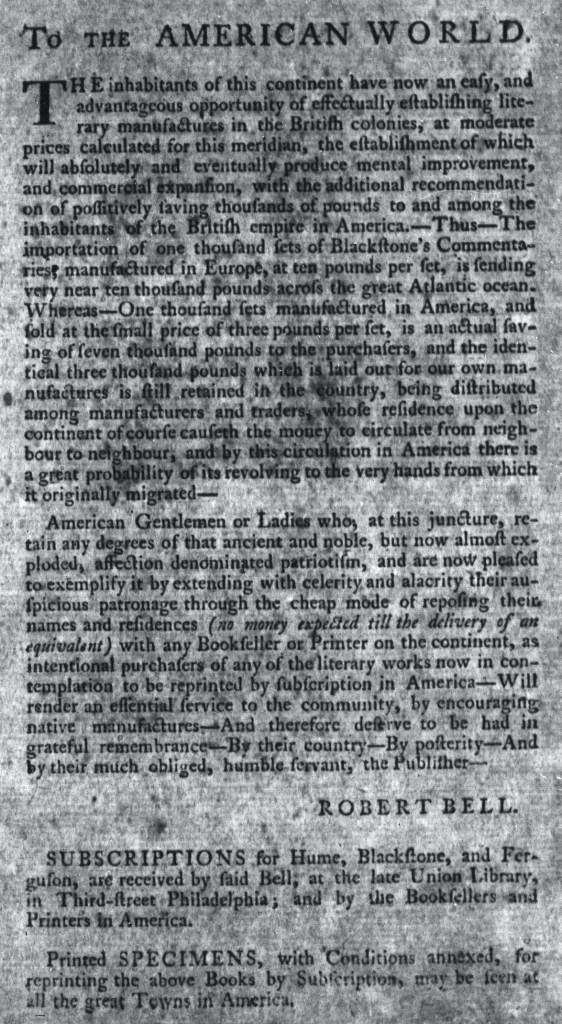
First page of Robert Bell’s subscription notice for Blackstone’s Commentaries that may (or may not) have been distributed with the September 17, 1771, edition of the South-Carolina and American General Gazette.

“SUBSCRIPTIONS for Hume, Blackstone, and Ferguson, are received by said Bell … and by the Booksellers and Printers in America.”

Digitization makes primary sources more widely available, but digital surrogates sometimes introduce questions about those sources that might be more easily answered by examining the originals.  Consider the September 17, 1771, edition of the South-Carolina and American General Gazette made available by Accessible Archives.  That company provides nine pages associated with that issue.  The first four comprise the standard issue, two pages printed on each side of a broadsheet then folded in half.

Another page filled entirely with advertising lacks a masthead, but does have the title, “THE SOUTH CAROLINA & AMERICAN GENERAL GAZETTE, for 1771,” and date “Sept. 10-17” running across the top.  It also features a page number, 192, in the upper left corner as well as a colophon at the bottom of the last column.  This may have been a one-page supplement, but paper was such a precious commodity that printers tended to fill both sides when they distributed supplements.  The page numbering for the standard issue went from 187 to 190.  Did the printer skip 191 in order to have the next issue begin, as usual, with an odd number?  Or, is the first page of a two-page supplement missing from the digital edition?  It is impossible to simply flip over the page with a digital edition, making it difficult to answer a question that likely would not even have been an issue when examining the original.

The final four pages associated with that issue of the South-Carolina and American General Gazette look like a subscription notice distributed by Robert Bell, a bookseller and publisher in Philadelphia.  The digital images suggest they were on a sheet of a much smaller size than either the standard issue or the supplement, but specific information about the relative sizes of these pages disappeared when remediating them to photographs and digital files.  How did this subscription notice become associated with that issue of the newspaper?  Bell incorporated Robert Wells, printer of the South-Carolina and American General Gazette, into his network of local agents who advertised and received subscriptions for Blackstone’s Commentaries on the Laws of England on his behalf.  An advertisement for that volume appeared on the final page of the standard issue as well as the first page of the subscription notice.  Perhaps Wells distributed Bell’s subscription notice with his newspaper.  On the other hand, the subscription notice may have been added to the collection of newspapers at a later time by the printer, a contemporary reader, a later collector, or an archivist.  Modern readers could ask a librarian or cataloger about the provenance when working with the original.  Even though that might or might not reveal an answer, it is an opportunity that readers consulting digital sources may not pursue, at least not easily.

On the whole, digitization has revolutionized access to primary sources, making them more widely available rather than confined to research libraries and historical societies.  Yet digital copies are not replacements for originals.  They sometimes introduce questions that either would not have been part of working with original copies or would have been more easily answered.  Even the most enthusiastic proponents of digitization readily recognize that digital surrogates are best considered complements to, rather than replacements for, original primary sources.

May 7

What was advertised in a colonial American newspaper 250 years ago today?

Supplement to the South-Carolina Gazette and Country Journal (May 7, 1771).

“Booksellers in Boston, New-York, Philadelphia, or … Charles-Town.”

Like many other colonial printers, Charles Crouch also sold books, pamphlets, and broadsides.  In the pages of the South-Carolina Gazette and Country Journal, he advertised titles available at his “Great Stationary and Book Shop.”  He also acted as a local agent for printers and booksellers in other cities, publishing subscription notices and handling local sales.  He did so on behalf of Robert Bell, the flamboyant bookseller responsible for publishing a three-volume American edition of “ROBERTSON’s celebrated History of CHARLES the Fifth.”  Bell coordinated an advertising campaign that extended from New England to South Carolina.  Local agents simultaneously published his subscription notice inviting readers to participate in an “elegant XENOPHONTICK BANQUET” through purchasing his American edition.

When Wells inserted that advertisement in the South-Carolina Gazette and Country Journal and listed himself as a local agent, he contributed to the creation of a community that extended far beyond Charleston.  Yet settling in for the “XENOPHONTICK BANQUET” was not the only means of joining a larger community that Wells offered to readers and prospective customers.  He appended to Bell’s subscription notice a brief note that he also sold “The Trial of the Soldiers of the 29th Regiment, for the Murders committed at Boston,” printed by John Fleeming in Boston, and “A Funeral Sermon on the Death of the Rev. Mr. Whitefield, by the Rev. Mr. Zubly,” printed by James Johnston in Savannah.  Those two items commemorated two of the most significant events of 1770, the Boston Massacre on March 5 and the death of George Whitefield on September 30.  Both events received extensive coverage in the colonial press.  Both of them also generated commemorative items ranging from broadsides and prints to sermons and orations.

In a single advertisement, Wells linked consumers in South Carolina to geographically dispersed communities that shared common interests not defined by the places individual members resided.  Colonists from New England to Georgia mourned Whitefield, just as they expressed outrage over British soldiers firing into a crowd and killing several people in Boston.  Many colonists also sought to participate in genteel communities defined in part by the books they read, joining in the “grand Feast of historical Entertainment” that booksellers in Boston, New York, Philadelphia, Charleston, and other towns offered to them.  Wells did not merely advertise three titles available at his shop; he marketed a sense of community.

April 24

What was advertised in a colonial American newspaper 250 years ago today?

Detail of supplemental page from the South-Carolina and American General Gazette (April 24, 1771).

“His STOCK of GOODS.”

Robert Wells, printer of the South-Carolina and American General Gazette, had more content than would fit in the standard issue on April 24, 1771.  Wells devoted more than a fifth of the issue to “EUROPEAN INTELLIGENCE,” spread over two columns on the front page and continuing on the second page.  The remainder of the second page consisted of “AMERICAN INTELLIGENCE,” news drawn primarily from Boston and Newport, Rhode Island, as well as limited coverage of local events.  The shipping news from the customs house spilled over, occupying a portion of the first column of the third page.  Paid notices constituted the rest of that edition, filling just shy of ten of the sixteen columns.  Even as he gave more space to advertising than to news, Wells did not have room for all of the paid notices submitted to his printing office.

To address that problem, Wells did what many other early American printers did in similar circumstances.  He distributed an additional sheet that consisted entirely of advertisements, more than two dozen of them.  One in four of those advertisements described enslaved men and women for sale or offered rewards for the capture ad return of those who liberated themselves.  While digital images of the standard issue and the supplementary pages do not indicate precise dimensions, they do reveal that Wells used a smaller sheet (and fewer columns per page) for the additional notices.  Wells depended on revenue generated from advertising to continue publication of the South-Carolina and American General Gazette, but he also carefully budgeted how much paper he used in printing advertisements.  Rather than distribute an additional half sheet that would have allowed him to print more news reprinted from other newspapers Wells instead selected a smaller sheet with room for the paid notices and nothing else.  He carefully balanced the proportion of news and advertising as well as the revenues garnered from adverting and the costs of publishing those notices.