July 27

What was advertised in a revolutionary American newspaper 250 years ago today?
New-England Chronicle (July 27, 1775).

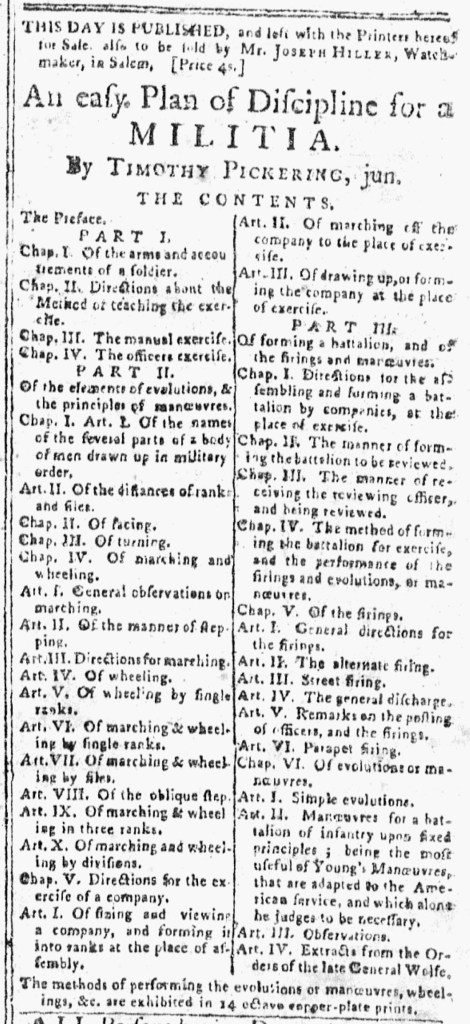
“An easy Plan of Discipline for a MILITIA. By TIMOTHY PICKERING.”

As the imperial crisis intensified when the Coercive Acts went into effect in 1774, the Massachusetts Provincial Congress recommended publication of a manual for training militia throughout the colony, The Manual Exercise as Ordered by His Majesty in 1764: Together with Plans and Explanations of the Method Generally Practis’d at Reviews and Field-Days.  Over the next several months, several printers in New England published their own editions.  Advertisements for The Manual Exercise appeared frequently in newspapers throughout the region.  Printers beyond New England followed their lead.  After the battles at Lexington and Concord, advertisements for other military manuals proliferated, including advertisements for Thomas Hanson’s Prussian Evolutions in Actual Engagements published by subscription in Philadelphia.

Samuel Hall and Ebenezer Hall, printers of the New-England Chronicle, published and advertised yet another military manual, An Easy Plan of Discipline for a Militia by Timothy Pickering, Jr.  An advertisement for the work appeared in the July 27, 1775, edition of their newspaper.  The Halls indicated that they had copies available at their printing office in Cambridge, where they had only recently moved from Salem and renamed and continued publishing the Essex Gazette. In addition, Joseph Hiller, a watchmaker in Salem, also sold the manual.  The advertisement consisted primarily of an extensive list of the contents, demonstrating to prospective customers what they could expect to find in the volume, followed by a short note that the “methods of performing the evolutions or manœuvres, wheelings, &c. are exhibited in 14 octavo copper-plate prints.”  The illustrations were an important addition that would aid readers in understanding the various maneuvers described in the book.

In addition to the advertisement the Halls inserted in the New-England Chronicle, Pickering pursued another means of marketing the book.  He sent a copy directly to George Washington with a request that he consider “recommending or permitting its use among the officers & soldiers under your command.”  Pickering flattered the commander of the Continental Army following his appointment to the post by the Second Continental Congress, declaring that the army had been “committed to your excellency’s care & direction” “to the joy of every American.”  Pickering asserted his own “duty & inclination” inspired him to compose the manual and present it to the general for his consideration.  He deemed it a “service [to] my country” that he hoped “may well prove advantageous in an army hastily assembled.”  Washington did indeed take note.  According to the American Revolution Institute, “Washington promoted the use of several published works, including Timothy Pickering’s An Easy Plan of Discipline for a Militia and Thomas Hanson’s The Prussian Evolutions” during the early years of the Revolutionary War.  In 1779, Baron von Steuben’s Regulations for the Order and Discipline of the Troops of the United States became the first official manual of the Continental Army.  Until then, Pickering’s manual was a popular choice for training American soldiers.

May 12

What was advertised in a revolutionary American newspaper 250 years ago today?

New-England Chronicle (May 12, 1775).

“We have removed our Printing-Office from Salem to this Place.”

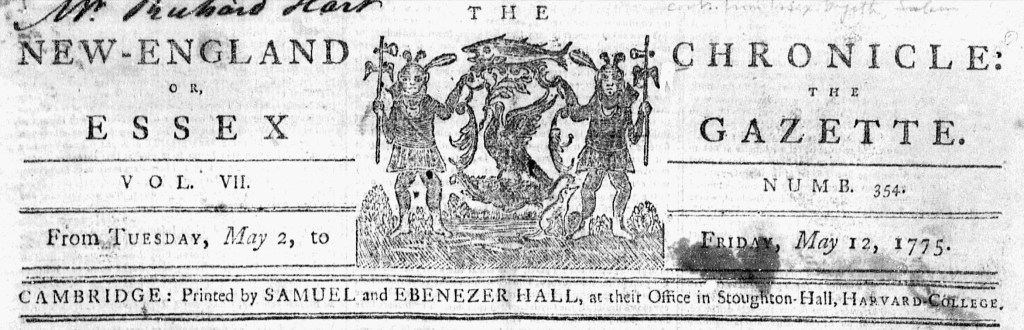
Sameul Hall and Ebenezer Hall printed the first issue of the New-England Chronicle: Or, the Essex Gazette “at their Office in Stoughton-Hall, HARVARD COLLEGE,” on May 12, 1775.  As they explained in a notice to readers, “we have removed our Printing-Office from Salem to this Place” after receiving encouragement from “many respectable Gentlemen, Members of the Honourable Provincial Congress, and others.”  They did so during the siege of Boston that followed the battles at Lexington and Concord on April 19.  The several newspapers previously published in Boston either ceased or suspended publication, leaving Salem’s Essex Gazette as one of the only newspapers in the colony.  The Provincial Congress, recognizing the value of having ready access to a press and a weekly newspaper, invited the Halls, already known as vigorous advocates of the patriot cause, to join them in Cambridge.  When the Halls commenced printing the New-England Chronicle, they continued the volume and numbering of the Essex Gazette.

Still, circumstances made the New-England Chronicle a new newspaper in the eyes of many readers and renewed the commitment of the printers “to conduct the Business [of printing] in general, and this Paper in particular, in such a Manner as will best promote the public Good.”  The Halls proclaimed that it was imperative that they do so “at this important Crisis — when the Property, the LIVES, and (what is infinitely more valuable) the LIBERTY, of the good People of this Country, are in Danger of being torn from them by the cruel Hands of arbitrary Power.”  The printers made their editorial perspective clear as they introduced the new New-England Chronicle to the public and solicited subscribers.  They hoped to continue providing subscriptions to residents of Salem who had previously supported them, yet they also had an opportunity to expand circulation to new subscribers interested in keeping up with current events, including those who previously read newspapers published in Boston.  The Halls published the New-England Chronicle in Cambridge for eleven months, Samuel maintaining the newspaper on his own following Ebenezer’s death in February 1776.  The last issue printed in Cambridge appeared on April 4, 1776.  Soon after the British evacuated Boston on March 17, 1776, Samuel Hall moved the New-England Chronicle to Boston, dropped the reference to the Essex Gazette in the extended title, and continued the volume and numbering.

New-England Chronicle (May 12, 1775).

January 17

What was advertised in a colonial American newspaper 250 years ago today?

Essex Gazette (January 17, 1774).

“ALL Persons who have … Subscription Papers … are desired immediately to return the same.”

Samuel Hall and Ebenezer Hall, the printers of the Essex Gazette, inserted a brief notice in the January 17, 1775, edition to request that “ALL Persons who have in their Hands any Subscription Papers for printing the Independent Whig … to return the same to the Printers hereof.”  They referred to a project that they had first announced more than fifteen months earlier on September 23, 1773, with another advertisement in their newspaper.  On that occasion, they confided that “A Number of the principal Gentlemen in this Town … encouraged the Publication” of the work that Thomas Gordon and John Trenchard first distributed as a weekly magazine in London in 1720.  For those not as familiar with that “celebrated Performance,” the printers gave the full title: “THE Independent Whig, Or, A Defence of primitive Christianity, and of our Ecclesiastical Establishment, against the extravagant Claims of fanatical and disaffected Clergymen.”

The Halls informed the public that they could subscribe to the work at their printing office in Salem.  Those not yet certain that they wished to reserve copies could examine the “Proposals.”  The printers eventually published subscription notices in the Massachusetts Spy in February 1774, hoping to reach even more prospective customers in Boston and other towns throughout the colony.  Yet the Halls apparently did not limit their marketing efforts to newspaper advertisements, choosing to circulate “Subscription Papers” that likely described the purpose of the book and the conditions for ordering copies.  They may have requested that friends and associates post the subscription proposals in their shops and offices, recruiting the assistance of local agents in other towns.  Such items often featured space for subscribers to sign their names, making their support of the project visible to others, though local agents sometimes compiled separate lists.  No copies of the “Subscription Papers” that the Halls mention in their newspaper advertisement survive, at least not any that have been identified and cataloged yet.  Their newspaper notice testifies to a more extensive culture of marketing media in early America than the collections in research libraries, historical societies, and private collections reveal.  How much advertising ephemera circulated that has been lost without any mention in the public prints?

September 13

What was advertised in a colonial American newspaper 250 years ago today?

Essex Gazette (September 13, 1774).

“This GAZETTE may be had for 6s. 8d. per Annum, exclusive of Postage.”

The printers of the Essex Gazette incorporated the colophon into the masthead of that newspaper.  Within that masthead, they declared that the publication “Contain[ed] the freshest Advices, both foreign and domestic” and gave the date and volume and issue numbers.  Next came the publication information that more often appeared at the bottom of the final page in other newspapers: “SALEM: Printed by Samuel and Ebenezer Hall, at their Printing-Office in King-Street.”  That made it easy for prospective subscriber and advertisers as well as others with business for the printers to contact or visit them.

Even with that choice about where to place the colophon, the Halls still recognized the bottom of the final page as valuable space for promoting their newspaper, publishing a perpetual advertisement that ran across all three columns in each issue.  A single line advised, “This GAZETTE may be had for 6s. 8d. per Annum, exclusive of Postage – 3s. 4d. (or 4s. 6d. if sent by the Eastern Post) to be paid at Entrance.”  Throughout the colonies, printers generously extended credit to subscribers, recognizing that if they increased their circulation then they could attract more advertisers.  In turn, printers often published notices calling on subscribers to pay for subscriptions going back months and even years.

For their part, the Halls refused to assume the risk of allowing readers to subscribe completely on credit.  They required payment of three shilling and four pence, half of the annual price of six shillings and eight pence, at the time that subscriptions commenced.  Even if they had difficulty collecting the balance from subscribers, those initial payments covered some of the expenses and limited their losses.  In addition, subscribers who ordered their newspapers delivered by a post rider were expected to pay an additional shilling at the start, though the notice did not indicate if that covered the entire year or, like the entrance fee, was only half of what subscribers were expected to pay.  Either way, the Halls intended that service would further expand their circulation.

No matter what kinds of news or paid notices the printers placed on the final page of the Essex Gazette from week to week, readers always encountered an advertisement for the newspaper as the final item.  Colonial newspapers often passed from hand to hand, reaching readers beyond the original subscribers.  This strategy encouraged those additional readers to consider purchasing their own subscriptions for consistent access to the news rather than rely on the possibility that others would share their newspapers.

April 5

What advertised in a colonial American newspaper 250 years ago today?

Essex Gazette (April 5, 1774).

To be sold by the Printers hereof, Mr. Hancock’s ORATION, On the Fifth of March.”

Immediately above the record of ships “Entered-In,” “Outward-Bound,” and “Cleared-Out” from the customs house in Boston in the April 5, 1774, edition of the Essex Gazette, Samuel Hall and Ebenezer Hall, the printers, inserted a brief notice, just three lines, alerting readers that they sold “Mr. Hancock’s ORATION, On the Fifth of March.”  The Halls did not need to provide further elaboration for readers to understand the announcement.  For colonizers in New England in the 1770s, the phrase “Fifth of March” conjured images like the phrase “Boston Massacre” evokes today.  They needed no explanation that the advertisement referred to John Hancock delivering the annual address to commemorate the event, to honor those killed when British soldiers from the 29th Regiment under the command of Captain Thomas Preston fired into a crowd of protesters, to condemn quartering troops in colonial cities during times of peace, and to advocate for American liberties.

As had become customary by the fourth anniversary of the Boston Massacre, the town voted to have the oration published and advertisements appeared in newspapers printed in Boston.  Yet they did not appear solely in newspapers in that town.  Other newspapers in New England sometimes carried them as well, none more often that the Essex Gazette, published in nearby Salem.  Samuel Hall had a long history of publishing news and opinion that favored sentiments expressed by Patriots.  On the first anniversary of the Boston Massacre, for instance, he included thick black mourning borders on the first page of his newspaper and published “a solemn and perpetual MEMORIAL Of the Tyranny of the British Administration of Government in the Years 1768, 1769, and 1770,” especially “THE FIFTH OF MARCH, … the Anniversary of Preston’s Massacre–in King-Street–Boston, N. England–1770.”  When Benjamin Edes and John Gill, among the most ardent of Patriots among the printers in Boston, published Hancock’s oration in 1774, the Halls acquired copies to disseminate in Salem and beyond.  In so doing, they participated in the commodification of the Boston Massacre while simultaneously commemorating it and encouraging others to side with the Patriots as relations with Parliament further deteriorated following the Boston Tea Party the previous December.

June 29

What was advertised in a colonial American newspaper 250 years ago today?

Essex Gazette (June 29, 1773).

“Our Customers are very willing their Papers should be read … by any Person who will be so kind as to forward them.”

Newspapers stolen before subscribers read them: the problem dates back to the eighteenth century … and probably even earlier.  It became such an issue in Massachusetts in the summer of 1773 that Samuel Hall and Ebenezer Hall, the printers of the Essex Gazette, inserted a notice addressing the situation.  The printers recognized that many subscribers who lived outside Salem “depend upon receiving their Papers by transient Conveyance” or by indirect means as postriders and others delivered bundles of letters and newspapers to designated locations, such as taverns or shops, with the expectation that members of those communities would then distribute the items to the intended recipients.

The Halls expressed their appreciation to “any Persons for their Favours in forwarding any Bundles to the respective Persons and Places that they are directed to.”  They also acknowledged that their “our Customers are very willing their Papers should be read, after the Bundles are opened, by any Person who will be so kind as to forward them to their Owners in due Season.”  However, all too often that did not happen.  Those who should have felt obliged to see that the newspapers reached the subscribers, especially after they read someone else’s newspaper for free, waited too long to do so or set them aside and forgot about them completely.  That being the case, the printers “earnestly” requested that “those who have heretofore taken up Paper only for their own Perusal, and afterwards thrown them by, or not taken any Care to send them to those who pay for them, would be so kind as not to take up any more.”  Instead, they should “leave them to the Care of those who are more kindly disposed” to see them delivered to the subscribers.

To make the point to those most in the need of reading it, the Halls declared that they “had the Names of some (living in Andover) … who, after having taken up and perused the Papers, and kept them several Days, were at last ashamed to deliver them to the Owners.”  The printers, as well the subscribers, considered this practice “very ungenerous.”  The Halls made a point of advising the culprits that they were aware of who read the newspapers without forwarding them to the subscribers.  They hoped that an intervention that did not involve naming names or directly contacting the perpetrators would be sufficient in altering such behavior.  They did not scold the offenders for reading the newspapers without subscribing.  Indeed, they framed that practice as something printers expected, but they did remind those readers that such generosity did not deserve the “very ungenerous” habit of hoarding and disposing of newspapers instead of forwarding them to the subscribers in a timely manner.  This was one of many challenges that colonial printers encountered in maintaining an infrastructure for disseminating information.

February 2

What was advertised in a colonial American newspaper 250 years ago today?

Essex Gazette (February 2, 1773).

“An ORATION on the Beauties of LIBERTY.”

For the third consecutive week, an advertisement for “An ORATION on the Beauties of LIBERTY, from Mic. vii. 3. Delivered at the Second Baptist Church in Boston, on the last Thanksgiving Day” ran in the February 2, 1773, edition of the Essex Gazette.  That notice also informed readers that the printers of the newspaper, Samuel Hall and Ebenezer Hall, also sold “Fleeming’s REGISTER for New-England and Nova-Scotia, with an Almanack for 1773.”  Some of the contents of the almanac became obsolete with each passing day, but the principles expressed in the Oration endured long after John Allen, known as a “British Bostonian,” gave the address in December 1772.

John M. Bumsted and Charles E. Clark described the Oration as “one of the best-selling pamphlets of the pre-Revolutionary crisis, passing through seven editions in four cities between 1773 and 1775.”[1]  In addition to printers producing the pamphlet in Boston, Hartford and New London in Connecticut, and Wilmington in Delaware, printers and booksellers advertised the Oration in other cities and towns.  The Halls encouraged the popularity and dissemination of the pamphlet by advertising it in Salem as soon David Kneeland and Nathaniel Davis, the printers, took it to press and made it available for purchase.  On January 14, Kneeland and Davis placed notices in the Massachusetts Gazette and Boston Weekly News-Letter and the Massachusetts Spy to announce that the pamphlet was “Now in the press, and will be published in a few days.”  Just five days later, the Halls advertised that they sold the pamphlet.

The Halls almost certainly stocked and sold other books that they did not advertise in their newspaper.  They chose to devote space to promoting two items they considered timely, an almanac for 1773 and a pamphlet that critiqued the appointment of Commissioners of Inquiry concerning the Gaspee incident.  Advertisements in multiple newspapers published in multiple cities and distributed to even more cities and towns likely helped Allen’s Oration become such a popular pamphlet during the era of the American Revolution.

**********

[1] John M. Bumsted and Charles E. Clark, “New England’s Tom Paine: John Allen and the Spirit of Liberty,” William and Mary Quarterly, 3rd ser., 21, no. 4 (October 1964): 561.

March 24

What was advertised in a colonial American newspaper 250 years ago today?

Essex Gazette (March 24, 1772).

“Yesterday was published in Boston … An ORATION … to commemorate the BLOODY TRAGEDY.”

As soon as Benjamin Edes and John Gill informed readers of the Boston-Gazette that they published an oration that Joseph Warren delivered to commemorate the second anniversary of the “BLOODY TRAGEDY Of the FIFTH of March, 1770,” the printers of the Essex Gazette ran their own advertisement.  “Yesterday was published in Boston, and now to be sold by Samuel Hall, in Salem,” the notice announced, “An ORATION, delivered March 5th, 1772, at the Request of the Inhabitants of the Town of Boston, to commemorate the BLOODY TRAGEDY of the Fifth of March, 1770.  By Dr. JOSEPH WARREN.”  That advertisement did not include the lengthy excerpt from the address that Edes and Gill included in their notice, but it did encourage consumers to participate in commemorating the Boston Massacre by purchasing their own copy of Warren’s remarks.

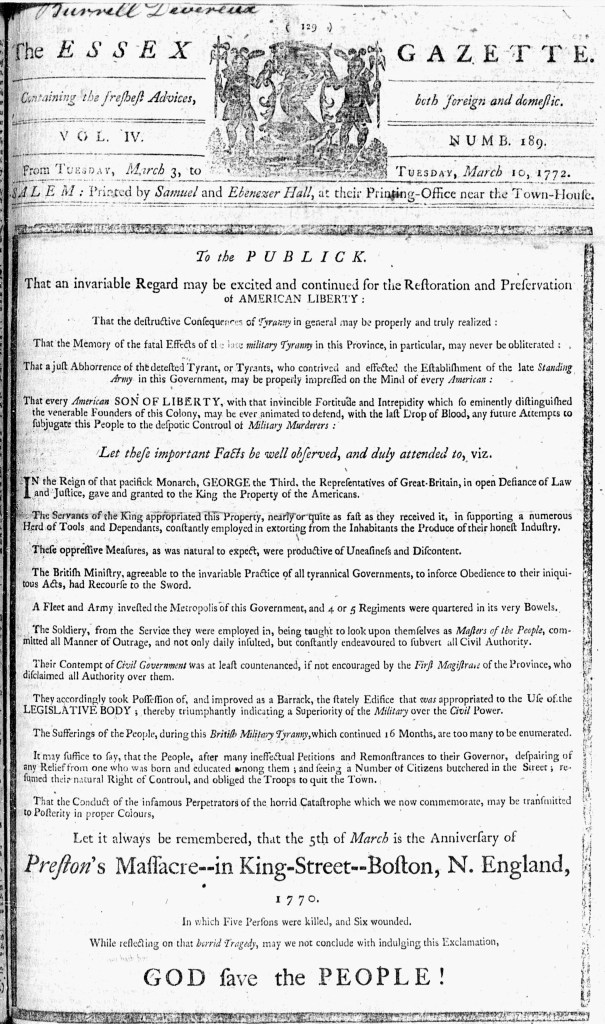
Not surprisingly, given its location, the Essex Gazette engaged in the most extensive remembrances of “Preston’s Massacre–in King-Street … In which Five Persons were killed, and Six wounded” of any newspaper published outside of Boston.  On the occasion of the second anniversary, the Halls devoted the entire first page of their newspaper to a memorial that honored the patriots who gave their lives and listed grievances against the “British Ministry” that “contrived and effected the Establishment of the late Standing Army” in Massachusetts.  In addition to such memorials, the Essex Gazette carried advertisements for commemorative items connected to the Boston Massacre.  Nearly a year before promoting Warren’s address, the Essex Gazette carried an advertisement for “A few of Mr. Lovell’s ORATIONS on the Massacre in Boston, to be sold by the Printer hereof.”  Residents of Salem and surrounding towns had an opportunity to purchase the same commemorative pamphlet printed and sold in Boston.  The commodification and marketing of the Boston Massacre helped to create a culture of commemoration of the Boston Massacre throughout the colony.  Colonizers who did not live in the busy port and could not witness Warren’s oration themselves read the Essex Gazette and the various newspapers printed in Boston.  When they did so, they read coverage of the commemorative events and encountered invitations to purchase their own copies of orations and other items related to the Boston Massacre, opportunities to partake in civic participation through consumption even if they could not attend in person.

March 10

What was advertised in a colonial American newspaper 250 years ago today?

Essex Gazette (March 10, 1772).

“The Preservation of these Papers for the Benefit of Posterity.”

A subscription notice for a “second Volume of Collection of Papers relative to the History of Massachusetts-Bay” ran in several newspapers in New England in 1772.  The version that appeared in the March 10 edition of the Essex Gazette carried a familiar appeal, asserting that “most of these Papers will, probably, be irrevocably lost in a few Years, unless preserved by Printing” so many copies that “the Public” would always have access to important documents about the history of the colony.  Prospective subscribers, the advertisement argued, had a duty to assist in “the Preservation of these Papers for the Benefit of Posterity.”

Readers of the Essex Gazette encountered this subscription notice in the context of commemorating recent history, “Preston’s Massacre–in King-Street–Boston” on March 5, 1770.  Samuel Hall and Ebenezer Hall, printers of the Essex Gazette, devoted the entire first page of the March 10 edition to commemorations marking the second anniversary of the Boston Massacre.  They enclosed a lengthy memorial within thick mourning borders, a convention usually reserved for death notices but frequently deployed for political purposes during the imperial crisis that culminated in the American Revolution.

In the memorial, the Halls called on the public to seek “the Restoration and Preservation of AMERICAN LIBERTY,” advocating that “the destructive Consequences of Tyranny in general may be properly and truly realized” and that “the Memory of the fatal Effects of the late military Tyranny in this Province, in Particular, may never be obliterated.”  They invoked “that invincible Fortitude and Intrepidity which so eminently distinguished the venerable Founders of this Colony” as they encouraged “every American SON OF LIBERTY … to defend, with the last Drop of Blood, any future Attempts to subjugate this people to the despotic Controul of Military Murderers.”  As they commemorated the second anniversary of the Boston Massacre, the Halls encouraged colonizers to consider 150 years of history and their role in shaping events.  They rehearsed recent events in a list of grievances against “Servants of the King,” the “British Ministry,” and the “Soldiery … taught to look upon themselves as Masters of the People.”  Those grievances had greater impact when considered in relation to the founding of the colony and subsequent events chronicled in the proposed volume of “Papers relative to the History of Massachusetts-Bay” advertised on another page.  The advertisement listed the Halls as local agents who accepted subscriptions for the project.  Between the memorial on the first page and the subscription notice on the final page, they tended to the recent and distant past by presenting readers with opportunities to prevent “the Memory” of significant events from being “obliterated” but instead “transmitted to Posterity.”

Essex Gazette (March 10, 1772).

February 18

What was advertised in a colonial American newspaper 250 years ago today?

Essex Gazette (February 18, 1772).

“ADVERTISEMENTS not exceeding eight or ten Lines are inserted for Three Shillings.”

How much did advertising cost?  How much did advertising cost compared to subscriptions?  These are some of the most common questions I encounter when discussing eighteenth-century advertising at conferences and public presentations.  The answer is complicated, in part because most eighteenth-century printers did not list advertising rates or subscription fees in their newspapers.  A significant minority, however, did regularly publish that information in the colophon that ran at the bottom of the final page.

Such was the case with Samuel Hall and Ebenezer Hall, printers of the Essex Gazette in Salem, Massachusetts, in the early 1770s.  Over the course of two lines, the colophon in their newspaper announced, “THIS GAZETTE may be had for Six Shillings and Eight Pence per Annum (exclusive of Postage) 3s. 4d. (or 4s. 6d. if sent by the Post) to be paid at Entrance.  ADVERTISEMENTS not exceeding eight or ten Lines are inserted for Three Shillings.”  The colophon revealed how much the Halls charged for subscriptions and advertising as well as other business practices.

Subscribers paid six shillings and eight pence per year, but that did not include postage for delivering the newspapers.  The printers expected subscribers to pay half, three shillings and four pence, in advance.  Like many other eighteenth-century entrepreneurs, the Halls extended credit to their customers.  Newspaper subscribers were notorious for not paying for their subscriptions, as demonstrated in the frequent notices calling on subscribers to settle accounts placed in newspapers throughout the colonies, prompting the Halls to require half from the start.  They asked for even more, four shillings and six pence, from subscribers who lived far enough away that they received their newspapers via the post, though the colophon does make clear if the additional shilling covered postage.  The Halls may have charged a higher deposit because they considered it more difficult to collect from subscribers at a distance.

Short advertisements, those “not exceeding eight or ten Lines,” cost three shillings or nearly half what an annual subscription cost.  Other printers specified that they adjusted advertising rates “in proportion” to length.  The Halls likely did so as well, making the cost of an advertisement that extended twenty lines about the same as a subscription.  They did not specify in the colophon that they required payment before running advertisements.  Some printers made that their policy but apparently made exceptions.  When they inserted notices calling on subscribers to send payment, they sometimes addressed advertisers.  For many eighteenth-century printers, advertising generated significant revenue. Considering that a single advertisement could cost as much or more as an annual subscription in the Essex Gazette, the Halls had good reason to cultivate advertisers as well as subscribers.