January 23

What was advertised in a colonial American newspaper 250 years ago this week?

Dunlap’s Pennsylvania Packet (January 17, 1774).

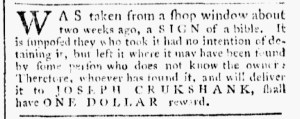
“WAS taken from a shop window … a SIGN of a bible.”

Joseph Crukshank ran a printing office and sold books at the “SIGN of a bible” in Philadelphia … some of the time.  According to an advertisement that he placed in the January 17, 1774, edition of Dunlap’s Pennsylvania Packet, his sign went missing sometime around the beginning of the year.  When he started in the trade, Crukshank did an apprenticeship with Andrew Steuart “at the Bible-in-Heart.”[1]  Perhaps he chose a similar device to mark his location as a means of encouraging an association in the minds of prospective customers familiar with his former master’s work.

“WAS taken from a shop window about two weeks ago,” Crukshank stated, “a SIGN of a bible.”  In that notice, the printer and bookseller provided information that testified to the visual culture of advertising that colonizers encountered when they traversed the streets of Philadelphia.  Although some eighteenth-century trade cards depict shop signs hanging from poles, presumably outside and perhaps perpendicular to the building so pedestrians could see them from a distance, Crukshank apparently positioned his sign in a window, facing into the street.  That gave it less visibility, but likely required less maintenance by protecting it from the weather.  Unfortunately, Crukshank did not indicate the size of the sign, though it must have been small enough for whoever took it to carry away without attracting notice.

The printer and bookseller did not believe that the culprit kept the sign but instead played a trick by abandoning it somewhere.  “It is supposed they who took it had no intention of detaining it,” he declared, “but left it where it may have been found by some person who does not know the owner.”  With that statement, Crukshank confessed the limits of deploying an image to represent his business.  Colonizers who lived in his neighborhood almost certainly recognized the “SIGN of a bible” that identified his shop, as did many others who had resided in the city for some time.  Yet he did not consider the image universally known among the denizens of the busy port.  His advertisement may have aided to establish a connection between Crukshank’s shop and his sign in the minds of those readers, a helpful bit of branding if he managed to recover the sign or replaced it.

**********

[1] Isaiah Thomas, The History of Printing in America: With a Bibliography of Printers and an Account of Newspapers (1810; New York: Weathervane Books, 1970), 386.

October 5

What was advertised in a colonial American newspaper 250 years ago today?
Connecticut Courant (October 5, 1773).

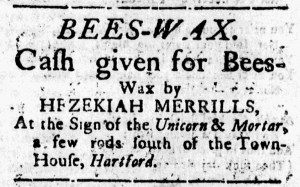
“At the Sign of the Unicorn & Mortar.”

Hezekiah Merrill ran an apothecary shop in Hartford in the early 1770s.  In October 1773, he placed advertisements in the Connecticut Courant to promote the variety of patent medicines that he sold, including Bateman’s Drops and Cordials, Turlington’s Balsam of Life, and Hooper’s Female Pills.  Each of those remedies would have been as familiar to eighteenth-century readers as popular over-the-counter medications are to modern consumers.  Merrill, like others who sold the same patent medicines, did not believe that they required descriptions when advertising them.  The apothecary also stocked books at his shop.

Merrill marked the location of his shop with “the Sign of the Unicorn & Mortar,” an appropriate image for an apothecary, and further advised prospective customers that they could find it “a few rods south of the Town-House.” Residents of Hartford regularly passed the shop and its sign, making it a familiar sight in their daily routines.  For visitors from the countryside, the sign made Merrill’s location unmistakable as they navigated town.  The apothecary encouraged consumers to associate the image of the Unicorn and Mortar with his business, treating it as a logo of sorts.  He inserted two advertisements in the October 5, 1773, edition of the Connecticut Courant, both of them invoking his shop sign.  A longer one on the first page listed the patent medicines and other merchandise, while a shorter one on the third page solicited beeswax in exchange for cash.  Just as residents of Hartford frequently glimpsed the sign, readers of the Connecticut Courant encountered “the Sign of the Unicorn & Mortar” more than once when they perused that issue.

Today, those advertisements testify to some of the sights that colonizers saw as they traversed the streets of colonial Hartford.  According to Thomas Hilldrup’s advertisement in the same issue of the Connecticut Courant, “the sign of the Dial” adorned the shop where he cleaned and repaired watches near the court house.  Other purveyors of goods and services in Hartford almost certainly displayed signs, contributing to the visual landscape of commercial activity in the town.  Few of those signs survive today, except for the descriptions of them in newspaper advertisements.

May 23

What was advertised in a colonial American newspaper 250 years ago this week?

Rivington’s New-York Gazetteer (May 20, 1773).

“The Sign of the Tea-Cannister and two Sugar Loaves.”

When James Rivington launched Rivington’s New-York Gazetteer in the spring of 1773, he had a significant number of advertisers lined up for the first several issues.  Those advertisers included entrepreneurs who previously invested in woodcuts that depicted some aspect of their business.  Such visual images distinguished their advertisements from others that consisted entirely of text.  Nesbitt Deane, a hatmaker, ran an advertisement featuring the familiar image of a tricorne hat with his name in a ribbon below it in the first issue.  Richard Sause, a cutler, included his woodcut depicting items made and sold at his shop in the second issue of Rivington’s New-York Gazetteer.

A couple of weeks later, Smith Richards, a “GROCER and CONFECTIONER, At the Sign of the Tea-Cannister and two Sugar Loaves,” ran an advertisement with an image that replicated his shop sign.  Within a thick border, sugar loaves flanked a tea canister embellished with the names of popular varieties of tea, “HYSON,” “SOUCHONG,” and “CONGO.”  Unlike the woodcuts that adorned advertisements placed by Deane and Sause, this one had not previously appeared in the New-York Gazette and Weekly Mercury or the New-York Journal.  (It may have run in the New-York Gazette or Weekly Post-Boy.  Issues from January 1771 through the last known issue of July 12, 1773, have not yet been digitized for greater accessibility.)  The image of the “Sign of the Tea-Cannister and two Sugar Loaves” very well may have been the first woodcut commissioned for an advertisement in Rivington’s New-York Gazetteer.

Richards had not previously advertised in the New-York Gazette and Weekly Mercury or the New-York Journal, but he apparently believed that the new Rivington’s New-York Gazetteer offered a good opportunity and a sound investment when it came to advertising his wares.  Even though most advertisers did not commission woodcuts to accompany their notices, many other entrepreneurs, some who previously advertised in other newspapers and some who had not, shared Richards’s confidence in the effectiveness of disseminating their advertisements via New York’s newest newspaper. Rivington had successfully convinced prospective advertisers that his newspaper enjoyed a wide circulation for even its earliest issues.

May 8

What was advertised in a colonial American newspaper 250 years ago today?

Providence Gazette (May 8, 1773).

“At the Sign of the GREYHOUND.”

Some of the advertisers who placed notices in the May 8, 1773, edition of the Providence Gazette described the shop signs that marked the locations of their businesses.  Thurber and Cahoon, for instance, informed readers that they stocked an “Assortment as compleat as in any Shop or Store in New-England” at the “Sign of the Bunch of Grapes.”  Samuel Young once again declared that he sold a “fine ASSORTMENT of Spring and Summer GOODS … cheaper than he has ever done” at his store at the “Sign of the Black Boy.”  Nathaniel Wheaton also offered low prices for a “new supply of Spring and Summer GOODS,” proclaiming that he “sells cheaper than any one, after all is said and done” at his shop at the “Sign of the GREYHOUND.”  Even the printer, John Carter, noted in the colophon that he operated a printing office at “Shakespear’s Head, … where all manner of Printing-Work is performed with Care and Expedition.”

No advertisers adorned their notices with visual images.  Thurber and Cahoon, Young, and Wheaton did not enhance their advertisements with depictions of their shop signs, but one of them had previously done so.  Within the past year, Wheaton had twice published advertisements that featured a profile view of a greyhound sitting on its hind legs with its tongue sticking out of its mouth, first for several weeks in May 1772 and again for several weeks in November 1772.  He presumably still had access to the woodcut, yet chose not to incorporate it into his new round of advertising in the Providence Gazette.  He already invested in commissioning the woodcut for his exclusive use, but perhaps he did not wish to purchase the additional space required to include an image in his advertisements in the spring of 1773.  After all, the woodcut would have doubled the amount of space occupied by Wheaton’s advertisement, doubling the price as well.  Perhaps Wheaton believed that residents of Providence glimpsed his sign often enough as they went about their daily business that merely mentioning his sign would be enough to evoke images of it for many readers of the Providence Gazette.  It served as a brand or trademark that consumers did not need to see in order to imagine it for themselves.

May 5

What was advertised in a colonial American newspaper 250 years ago today?

Pennsylvania Gazette (May 5, 1773).

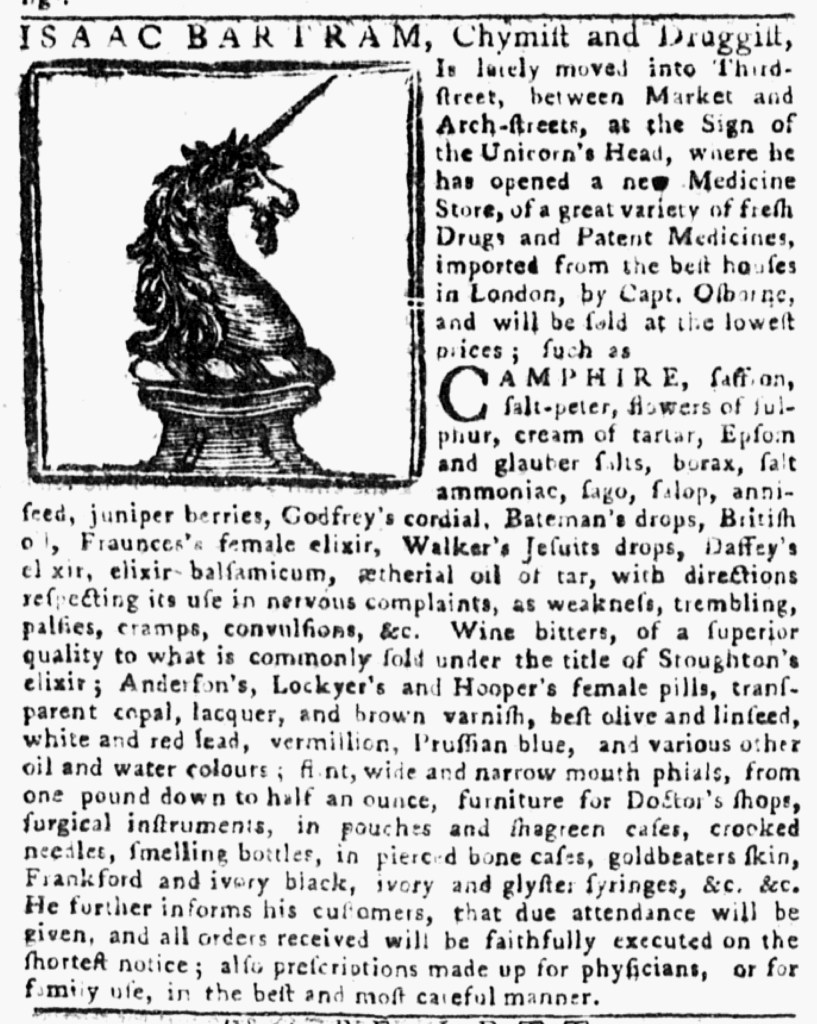
“Chymist and Druggist … at the Sign of the Unicorn’s Head.”

Isaac Bartram, “Chymist and Druggist,” offered a variety of goods and services at his “new Medicine Store” in Philadelphia in the spring of 1773.  According to his advertisement in the May 5 edition of the Pennsylvania Gazette, he sold a “great variety of fresh Drugs and Patent Medicines, imported from the best houses in London.”  Prospective customers would have been familiar with the patent medicines that Bartram listed in his notice, just as modern consumers recognize various brands of over-the-counter medications.  Among other nostrums, the apothecary carried “Godfrey’s cordial, Bateman’s drops, … Walker’s Jesuits drops, Daffey’s elixir, [and] Anderson’s Lockyer’s and Hooper’s female pills.”  For those willing to try equivalent products, like modern consumers who purchase generics, Bartram marketed “Wine bitters, of a superior quality to what is commonly sold under the title of Stoughton’s elixir.”  He also stocked medical equipment, including syringes, vials, and surgical instruments, and prepared prescriptions “for physicians, or for family use.”

In addition to the copy, Bartram deployed an image to draw more attention to his advertisement.  He indicated that he kept shop “at the Sign of the Unicorn’s Head.”  Appropriately, a woodcut depicting a unicorn’s head enclosed within a border adorned the upper left corner of his notice, accounting for nearly one-quarter of the space occupied by his advertisement.  This certainly increased Bartram’s advertising costs since he had to commission the unique image associated with his business and then pay for the additional space.  Most advertisers did not invest in images for their notices, though a growing number adopted the practice in the early 1770s.  Elsewhere in the same issue of the Pennsylvania Gazette, Stephen Paschall and son Stephen Paschall, as they styled themselves, included an image of a scythe, a sickle, and other sort of iron work available at their workshop “at the Sign of the Scythe and Sickle.”  The initials “SP” marked one of the items.  The Paschalls first published the image a year earlier.  These images may have replicated the signs displayed by Bartram and the Paschalls, the only surviving visual representations of signs that colonizers glimpsed as they traversed the streets of Philadelphia.

Most advertisers relied solely on the text of their notices to encourage readers to visit their shops.  Such was the case for Robert Bass, an apothecary whose advertisement for a “new and fresh Assortment of DRUGS and PATENT MEDICINES” appeared on the same page as Bartram’s advertisement.  The woodcut depicting the Sign of the Unicorn’s Head certainly made Bartram’s notice much more visible to readers, prompting them to read about his wares and, in the process, quite possibly justifying the investment.

March 16

What was advertised in a colonial American newspaper 250 years ago today?

Essex Gazette (March 16, 1773).

“At his APOTHECARY SHOP, at the Sign of the LION and MORTAR, in SALEM.”

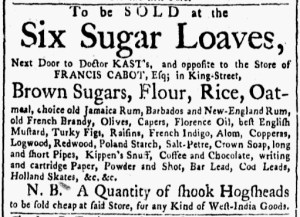
Several advertisements in the March 16, 1773, edition of the Essex Gazette included references to visual devices that aided customers in identifying businesses as well as residents and visitors in navigating the streets of Salem.  Abraham Safford, for instance, advised readers that he recently opened a tavern “rendered conspicuous by an elegant Sign of KING GEORGE THE THIRD.”  Philip Godfrid Kast promoted medicines available at his apothecary shop “at the Sign of the LION and MORTAR.”  An advertisement for Jacob Hemet’s Essence of Peral and Pearl Dentifrice listed Nathaniel Dabney’s apothecary shop “at the Head of Hippocrates” as the local vendor for those products.  Even entrepreneurs who did not have their own signs made reference to well-known devices, as Stephen Higginson did when he directed prospective customers to his shop “opposite the King’s Arms Tavern.”  Newspapers published in other towns also carried advertisements that incorporated signs for the purposes of both marketing businesses and marking locations.

Most such visual markers disappeared long ago.  In many instances, newspaper advertisements provide the sole testimony to their presence in eighteenth-century cityscapes.  Some of those advertisements, however, also included depictions of the signs and other devices that marked the locations of shops and stores.  Dabney, for example, ran several advertisements that featured the Head of Hippocrates, a bust of the ancient Greek physician atop a column, that identified his shop.  Kast distributed another kind of advertisement, a trade card engraved by Nathaniel Hurd, that prominently displayed his shop sign, a lion grasping a large mortar, hanging from an ornate signpost.  Those images hint at some of the sights seen in Salem in the eighteenth century.  Given the number of signs and other devices mentioned in newspapers and depicted on trade cards, billheads, handbills, and other marketing materials, colonizers encountered a rich environment of visual images as they traversed the streets of their towns, especially in busy ports.

December 5

What was advertised in a colonial American newspaper 250 years ago today?

Providence Gazette (December 5, 1772).

“The PRINTING and POST-OFFICES are removed to Meeting-Street.”

John Carter’s printing office had a new location.  In early December 1772, the printer of the Providence Gazette moved from his location “in King-Street, opposite the Court-House” to a new location “in Meeting-Street, near the Court-House.”  The colophon in the November 28 edition listed the former address.  Carter updated the colophon in the December 5 edition.

That was not his only means for letting readers know that the printing office moved.  He also inserted a notice that stated, “The PRINTING and POST-OFFICES are removed to Meeting-Street, nearly opposite the Friends Meeting-House.”  To draw attention to it, Carter enclosed the notice within a border made of decorative type and gave it a prominent spot on the front page.  It was the first item in the first column, making it difficult for readers to miss it, even if they only skimmed other content in that issue.  That strategy was not new to Carter.  The printing office previously “removed to a new Building on the main Street” in October 1771.  At that time, Carter published an announcement enclosed within on a border as the first item on the first page of the October 12 edition.  He also revised the colophon to reflect the new location.

Other elements remained the same.  Carter continued to use a sign depicting “Shakespear’s Head” to identify the printing office.  Colonizers still encountered it as they traversed the streets of Providence, a familiar sight in the commercial landscape of the city.  The printer also continued to promote other services in the colophon, advising that “all Manner of Printing-Work is performed with Care and Expedition” at his office.  In particular, “Hand-Bills … done in a neat and correct Manner, at a very short Notice, and on reasonable Terms.”

Carter placed a subscription proposal for an edition of “ENGLISH LIBERTIES, OR The free-born Subject’s INHERITANCE” below the notice about the new location.  In the previous issue, that subscription proposal and an advertisement for the “NEW-ENGLAND ALMANACK” that Carter published and sold appeared on the front page.  As usual, all other advertisements ran on the final pages.  Carter exercised his prerogative as printer to give his own notices prime spots in the newspaper.

November 21

What was advertised in a colonial American newspaper 250 years ago today?

Providence Gazette (November 21, 1772).

“At the Sign of the Greyhound.”

Nathaniel Wheaton sold a “new Assortment of English and India GOODS, of almost every Kind,” as well as “West-India Goods” at his shop on Williams Street in Providence.  In an advertisement that ran in the Providence Gazette for several weeks in November 1772, he thanked his current customers and invited new ones to examine his merchandise, pledging that all of “their Favours will be gratefully acknowledged.”

To help readers find his shop, Wheaton noted that “the Sign of the Greyhound” marked his location.  A woodcut depicting a greyhound, sitting on its haunches and its town hanging out, adorned the advertisement.  The image may have replicated the shop sign.  Even if Wheaton had not been that precise, he still resorted to some sort of depiction of a greyhound to encourage consumers to associate that emblem with his shop.  Like other eighteenth-century newspaper advertisers who published images that correlated to their shop signs, Wheaton devised a marketing strategy that could be considered a precursor to branding his business.  The woodcut encouraged readers to associate the greyhound with Wheaton’s shop, especially when considered in combination with the sign displayed on Williams Street.

The image also directed attention to Wheaton’s advertisement.  Except for the image of a lion and a unicorn flanking a crown and shield in the masthead, the greyhound was the only image in the November 21 edition of the Providence Gazette.  Readers could not have missed it!  Wheaton incurred additional expense to achieve that.  He paid for the woodcut and he paid for the space it occupied.  Newspaper advertisers paid for the amount of space required to publish their notices, not by the number of words, so both larger fonts and images increased the costs of running advertisements.  Wheaton devoted as much space to the image of the greyhound as he did to advertising copy, doubling the price of his notice compared to what he would have paid if he published solely text.  He likely considered the additional expense a good investment to distinguish his advertisement from those of his competitors.  After all, it was not the first time he incorporated the image into his newspaper advertisements.

An imperfection in the copy of the November 21 edition available in the database of digitized images of eighteenth-century newspapers mars the image of the greyhound in Wheaton’s advertisement. This image shows the woodcut without flaws. (Providence Gazette, November 14, 1772).

November 5

What was advertised in a colonial American newspaper 250 years ago today?

New-York Journal (November 5, 1772).

At the Sign of the Three Sugar Loaves.”

In the fall of 1772, George Webster joined the ranks of advertisers who attempted to draw more attention to their newspaper notices by adorning them with images related to their businesses.  Webster, a grocer, kept shop “at the Sign of the Three Sugar Loaves” on Leary Street in New York.  A woodcut at the top of his advertisement depicted three sugar loaves, a tall one flanked by two shorter ones.  The border that surrounded the sugar loaves suggested that the image replicated the sign that marked Webster’s location.

Throughout the colonies, entrepreneurs who placed notices in the public prints sometimes incorporated such images, but the use of images in advertising was not a standard practice in the eighteenth century.  When Webster first used his woodcut in the October 22, 1772, edition of the New-York Journal, it was one of only three images in the entire issue.  As usual, the lion and unicorn appeared on either side of a crown and shield in the masthead on the front page.  Elsewhere in the issue, Nesbitt Deane’s image of a tricorn hat and a banner bearing his name once again took up as much space as the copy it introduced.  The remainder of the advertisements, dozens of them filling fourteen of the eighteen columns in the six-page edition, did not have images.  That made Webster’s new woodcut depicting the Sign of the Three Sugar Loaves all the more noteworthy.  The following week, his image appeared once again, this time alongside two advertisements that featured stock images provided by the printer, a ship and a horse.  Neither of those familiar images had been crested for the exclusive use of any particular advertisers.  Webster, like Deane, made an additional investment in commissioning a woodcut so closely associated with some aspect of his own business.

By the time that the image appeared in Webster’s advertisement on November 5, regular readers would have recognized it, but that does not necessarily mean that the novelty had dissipated.  The woodcut continued to distinguish the grocer’s notice from the dozens of others in that issue.  Its mere presence demanded attention on a page that lacked other images in a newspaper with only four other images distributed across all six pages.  It likely also helped to encourage brand recognition as both image and text in Webster’s newspaper advertisement corresponded to the sign that colonizers glimpsed when they visited or passed his shop.

June 10

What was advertised in a colonial American newspaper 250 years ago this week?

Supplement to the New-York Gazette and Weekly Mercury (June 8, 1772).

“The Post of Mr. SIMNETT’s Dial is white, to distinguish it.”

John Simnet, a watchmaker, ran several advertisements in the New-York Gazette and Weekly Mercury and the New-York Journal in the spring of 1772.  In several of them, he pursued a feud with another watchmaker, James Yeoman, but he did not make any new insinuations about his competitor in a notice that appeared in the Gazette on June 8.  In the most aggressive portion of the advertisement, Simnet declared that it was “beneath the Character of a qualified Workman, to extract an Annuity by repairing Watches over and over again.”  Such commentary did not apply exclusively to Yeoman or any other rival.  Simnet had a long history of accusing most watchmakers of creating work for themselves by making repairs intended to last for only a short time.

Simnet devoted most of this advertisement to promoting various aspects of his own business rather than denigrating Yeoman or other watchmakers.  He boasted about his credentials, noting that “during the Term of Apprenticeship” he served as “Finisher to Mr. Webster, Exchange Alley, London.”  He also underscored his availability to greet customers “from Five in the Morning till Six in the Evening.”  In addition, he listed prices for several common services, such as “Joining a broken Spring or Chain Two Shillings” and a “new Main Spring either Six or Eight Shillings,” so prospective customers could assess the bargains for themselves.  To guide them in doing so, Simnet asserted that he set rates “at HALF the Price charg’d by any other” and explained that his customers did not have to worry about “future Expence,” those annual repairs.

The watchmaker did insert one clarification that did not previously appear in other variations of his advertisement that spring.  Apparently, another watchmaker set up shop in the vicinity, prompting Simnet to give more explicit directions to his own location.  “As there is now another of the Trade adjoining,” he explained, “please with Care to observe the Place; the Post of Mr. SIMNETT’s Dial is white, to distinguish it, and his Shop is low, aside the Coffee-House Bridge, but not the Corner.”  In a previous advertisement, he described the device that marked his shop as “the Black Dial, with a White Post.”  A competitor may have marked his own shop with a similar device, causing Simnet to focus on the color of the post.  Readers familiar with the usual tone in Simnet’s advertisements may have wondered how much time would elapse before he published more colorful commentary about “another of the Trade” with a shop so close to his own.