November 14

GUEST CURATOR: Mary Williams

What was advertised in a colonial American newspaper 250 years ago today?
nov-14-11141766-new-hampshire-gazette
New-Hampshire Gazette (November 14, 1766).

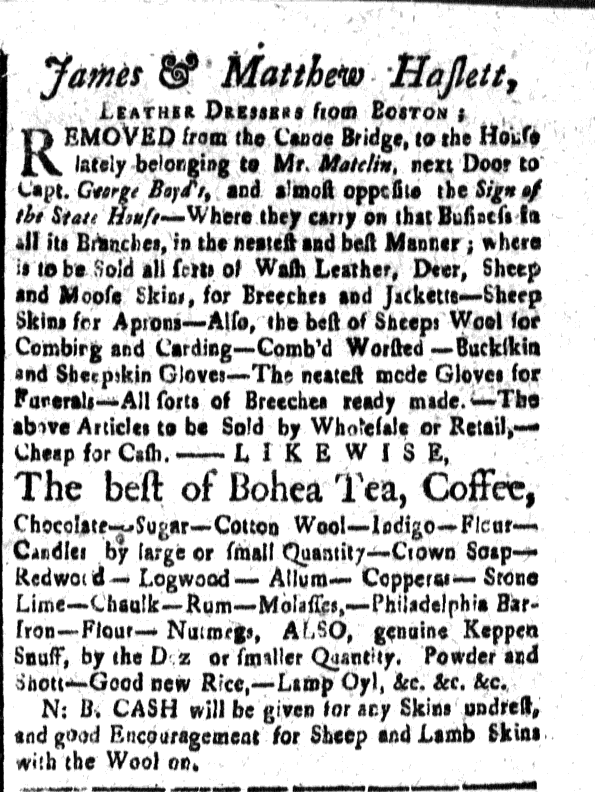
“Buckskin and Sheepskin Gloves – The neatest made Gloves for Funerals.”

In this advertisement from the New-Hampshire Gazette, James and Matthew Haslett offered several leather goods. The first thing I noticed was the description of gloves that were specifically made for funerals.

For my research, I found “The Handsome Tokens of a Funeral: Glove-Giving and the Large Funeral in Eighteenth-Century New England” by Steven Bullock and Sheila McIntyre. Bullock and McIntyre explain that the family of the deceased distributed leather gloves to funeral attendees. They write that this tradition was short-lived, but when it was popular it was a very important funeral custom in British North America. “Well-to-do families distributed them to everyone, often using far more than twelve dozen pairs. A particularly substantial ceremony might require a thousand – or more.”[1] This tells us that a wide variety of people might have responded to this advertisement for funeral gloves: both common people and the elite. The difference between the groups would most likely be that the elite would purchase a large amount of gloves that would be more widely distributed, while common people would purchase a smaller number of gloves that would be reserved for specific funeral attendees.

**********

ADDITIONAL COMMENTARY: Carl Robert Keyes

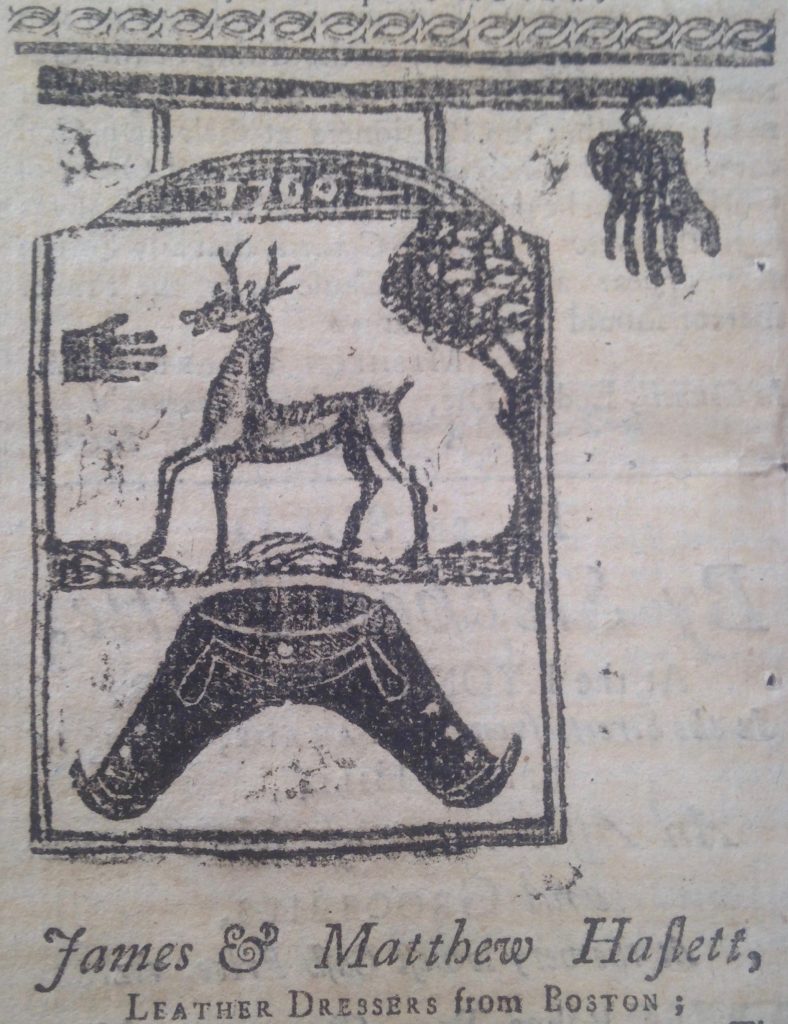
James and Matthew Haslett advertised regularly in the New-Hampshire Gazette. The Adverts 250 Project featured one of their advertisements just two months ago, selecting that advertisement because of the woodcut depicting the “Sign of the Buck and Glove” that accompanied it. Over a period of several weeks the Hasletts published three advertisements that included two different woodcuts depicting the sign that marked their place of business. Considering that very few newspaper advertisements included visual images (and that those that did usually relied on stock images of houses or ships that belonged to the printer), it was quite exceptional that the Hasletts commissioned not only one but two woodcuts.

Just two months later, however, neither woodcut was anywhere in evidence in their advertisement in the New-Hampshire Gazette. The image was missing and so was any mention of the sign. The Hasletts previously announced that “they have set up their Factory at the Sign of the Buck and Glove, adjoining Canoe Bridge.” Now they reported that they had REMOVED from the Canoe Bridge, to the House lately belonging to Mr. Matelin, next Door to Capt. George Boyd’s, and almost opposite the Sign of the State House.” These new directions were extensive, which would have allowed new and returning customers to find the Hasletts.

What happened to the “Sign of the Buck and Glove” that marked their previous location? Presumably it moved with them. After all, other colonial artisans and shopkeepers were known to have operated under the same shop sign for years or decades. For some, it became a brand of sorts, especially when they commissioned woodcuts that consistently appeared in their newspapers advertisements and on their trade cards and billheads. The Hasletts were in a position to create their own brand with their shop sign. Considering the verbiage involved in the directions they provided in today’s advertisement, it would not have been any more complex to include the name of their shop sign as a means of encouraging readers to always associate their products with the Sign of the Buck and Glove. This appears to have been a missed opportunity.

It may have also been a pragmatic decision. Although this advertisement did not include a woodcut, very little else changed from the previous iteration. The headline was identical. The text was identical from the fifth line of the body of the advertisement until the conclusion of the nota bene, although an additional call for ashes was eliminated. If the Hasletts paid for a certain amount of space or to have type reset, then it made sense to leave out a reference to their shop sign in favor of inserting sufficient information to direct customers to their new location.

**********

[1] Steven Bullock and Sheila McIntyre, “The Handsome Tokens of a Funeral: Glove-Giving and the Large Funeral in Eighteenth-Century New England,” William and Mary Quarterly, 3rd ser., 68, no. 2 (April 2012): 336.

September 12

What was advertised in a colonial American newspaper 250 years ago today?

Sep 12 - 9:12:1766 New-Hampshire Gazette
New-Hampshire Gazette (September 12, 1766).

“James & Mathew Haslett … have set up their Factory at the Sign of the Buck and Glove.”

Relatively few artisans or shopkeepers included images in their newspaper advertisement during the eighteenth century. Although printers already possessed the type, advertisers were responsible for providing any woodcuts beyond the stock printers ornaments. As a result, most advertisements placed by artisans and shopkeepers lacked images. In contrast, advertisements for runaway slaves, real estate, and vessels clearing port often sported woodcuts of slaves, houses, or ships, respectively. Each type of those stock ornaments could be used interchangeably for advertisements from the associated genre.

On the other hand, when advertisements placed by artisans and shopkeepers included woodcuts, those images were specific to a particular advertiser. In most cases, the text of the advertisement suggested that the image illustrated the shop sign that marked the advertiser’s establishment. The woodcut in James and Matthew Haslett’s advertisement even depicted a shop sign!

Sep 12 - Haslett 8:29
Detail of James and Matthew Haslett’s advertisement in the New-Hampshire Gazette (August 29, 1766). American Antiquarian Society.

The visual culture of the newspaper corresponded to the scenes readers saw on the street. But how closely did these woodcuts replicate the shop signs they were intended to portray? It’s tempting to assume that they were designed to reproduce the original as much as possible, yet the woodcut in the Hasletts’ advertisement throws that supposition to question. The image that appeared in the September 12 issue was the second one used by the Hasletts. Just two weeks earlier they published the same advertisement with a different (but similar) woodcut, before replacing it in the September 4 and September 12 issues. (The woodcut did not appear in the New-Hampshire Gazette again after that throughout the rest of 1766.)

Sep 12 - Haslett 9:4
Detail of James and Matthew Haslett’s advertisement in the New-Hampshire Gazette (September 4, 1766). American Antiquarian Society.

Why did the Hasletts switch from one woodcut to another? What kind of expenses were involved in that decision? Was including a woodcut in their advertisement worth the investment? Did the Hasletts distribute any handbills or billheads that incorporated the same woodcut? Did the new woodcut more closely replicate their actual shop sign?

Today’s advertisement offers some refreshing visual culture among eighteenth-century advertisements usually comprised exclusively of text. However, it also raises questions about the decisions made by advertisers and how closely the crude proto-logos that appeared in newspaper advertisement portrayed the shop signs they were supposed to reference.

Sept 12 - Haslett 9:12
Detail of James and Matthew Haslett’s advertisement in the New-Hampshire Gazette (September 12, 1766). American Antiquarian Society.

While researching this entry, I consulted the original newspapers in the collections of the American Antiquarian Society in addition to the digital surrogates in Readex’s Early American Newspapers.

July 24

What was advertised in a colonial newspaper 250 years ago today?

Jul 24 - 7:24:1766 Pennsylvania Journal
Pennsylvania Journal (July 24, 1766).

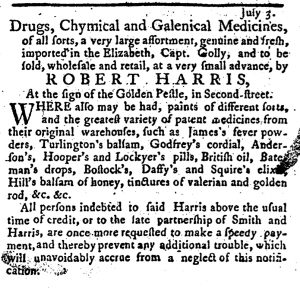
“ROBERT HARRIS, At the sign of the Golden Pestle, in Second-street.”

Not only did a variety of shop signs announce where entrepreneurs operated their businesses, those signs also aided colonists in navigating the streets of cities and towns in an era before street numbers and addresses were either common or standardized. Some shopkeepers and artisans had signs that were memorable and imaginative but did not necessarily correspond to their occupation in any way other than their decision to adopt them as their own logo. For instance, shopkeeper William Murray could be found at the Sign of General Wolfe in Marlborough Street in Boston. Murray’s sign celebrated the British general, a hero of the empire, but in depicting Wolfe it did not reveal what kind of business operated at that location.

Robert Harris, on the other hand, chose a device directly connected to the merchandise he sold. He advertised “Drugs, Chymical and Galenical Medicines, of all sorts,” including an extensive list of popular patent medicines familiar on both sides of the Atlantic. He sold them “At the sign of the Golden Pestle, in Second-street” in Philadelphia. The mortar and pestle were perhaps the equipment most frequently associated with apothecaries in the colonial era, just as they continue to be a recognized symbol and emblem for pharmacists today.

During the second half of the eighteenth century, some colonists used their shop signs in ways that transformed them into what we would today consider a logo that branded their goods and services. They commissioned woodcuts that replicated their shop signs to accompany newspaper advertisements. They distributed trade cards and billheads that also made use of the same images. Robert Harris may not have been quite that innovative when it came to using multiple media and visual images to promote his business, but he was savvy in choosing a sign that unambiguously announced his occupation. This may have been especially imperative in Philadelphia, the largest city in the colonies and an extremely busy port with large numbers of people unfamiliar with the city and its vendors arriving regularly.