September 21

What was advertised in a colonial American newspaper 250 years ago today?
Sep 21 - 9:21:1767 Pennsylvania Chronicle
Pennsylvania Chronicle (September 21, 1767).

“New Shop at the Sign of the Naked Boy.”

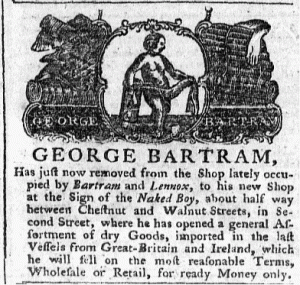
George Bartram launched a new venture in 1767, opening his own shop “at the Sign of the Naked Boy” on Second Street in Philadelphia. To let both former and potential new customers know about his new location, he published an advertisement in the Pennsylvania Chronicle. Bartram promoted the “general Assortment of dry Goods, imported in the last Vessels from Great-Britain and Ireland,” but he did not confine himself to merely describing the goods he stocked. Instead, he included a woodcut that featured some of the textiles he imported and hoped to sell to consumers in the port city. A cartouche in the center depicted a naked boy examining a length of cloth, encouraging potential customers to imagine themselves inspecting Bartram’s merchandise. That the boy held the fabric close to his naked body suggested quality and softness, enticing readers to anticipate the luxurious pleasures that awaited them at Bartram’s shop. Many rolls of fabric flanked the central cartouche, testifying to the “general Assortment” of merchandise. What kinds of tactile sensations might shoppers experience when they compared the weave of one fabric to another? The naked boy surrounded by textiles of all sorts invited colonists to visit Bartram’s shop, where they did not need to confine themselves merely to window shopping but could indulge their sense of touch as well as sight.

The woodcut also included the proprietor’s name on either side of the cartouche, an unnecessary flourish in an advertisement that featured Bartram’s name as a headline. Its inclusion may have been necessary, however, if the woodcut doubled as an accurate representation of the “Sign of the Naked Boy” that marked Bartram’s shop. The shopkeeper had previously conducted business at a “Shop lately occupied by Bartram and Lennox.” To mark his new shop as exclusively his own, Bartram may have instructed the painter or carver who made his sign to include his name as well as the device he intended to serve as his brand. Eighteenth-century advertisements regularly indicate which shop signs marked which businesses, but few of those signs have survived. Woodcuts like the naked boy in Bartram’s advertisement suggest what colonists may have seen as they traversed the streets and visited retailers and artisans who used signs to mark their businesses.

September 14

What was advertised in a colonial American newspaper 250 years ago today?

Sep 14 - 9:14:1767 Boston Evening-Post
Boston Evening-Post (September 14, 1767).

“Just opened and now read for Sale, by Jolley Allen.”

A week ago I examined Jolley Allen’s extraordinary full-page advertisement in the September 7, 1767, edition of the Boston-Gazette. Given that Allen was prone to inserting the same advertisement in all four Boston newspapers, I noted that he had not placed that particular advertisement in the other two local newspapers distributed on the same day, nor the other one printed later in the week. The expense may have explained Allen’s decision, but space constraints may have played a role as well. The printers may not have been able to accommodate him at that time; after all, other advertisers had also contracted their services. It very well could have been a combination of the two factors, expense and limited space.

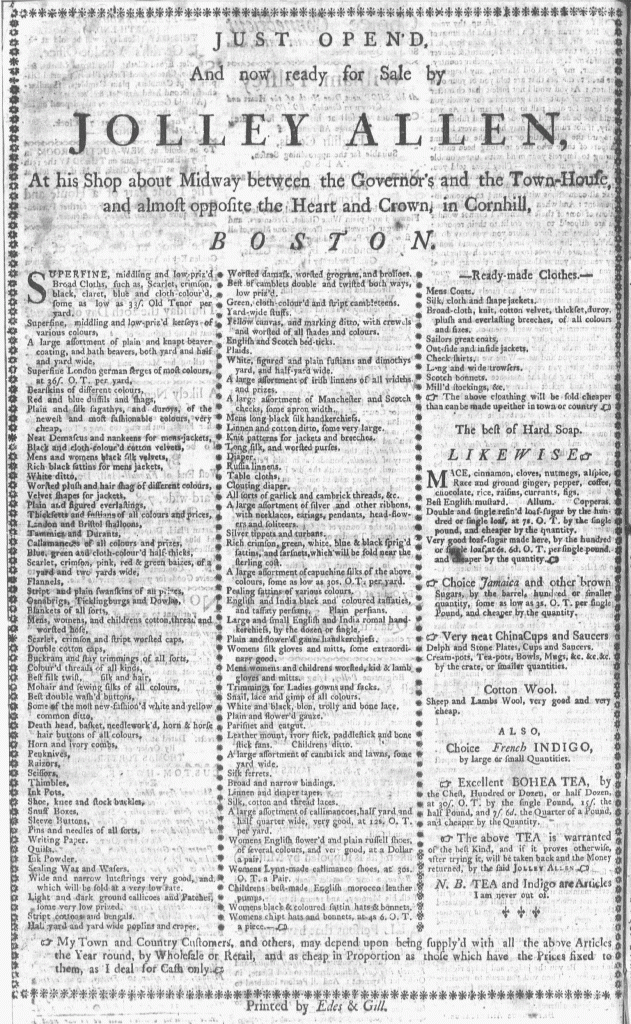
Allen’s full-page advertisement did not run a second time in the Boston-Gazette, but the following week a similar advertisement appeared in both the Boston Evening-Post and the Boston Post-Boy on September 14. In each case, the notice contained the same content, the same extensive list of merchandise, but had been condensed to two columns instead of three. Allen shared the page with other advertisers, reducing both expense and space. While the revised format may not have had the same impact as a full-page advertisement, taking up two columns was still an impressive feat that deviated from the vast majority of newspaper advertisements published in eighteenth-century America. Allen’s advertisement eventually ran in the Massachusetts Gazette, again condensed to two columns, on September 24, two and a half weeks after the full-page advertisement occupied the entire final page of the Boston-Gazette. It continued to appear sporadically in some, but not all, of Boston’s newspapers in October.

The two-column version lacked Allen’s signature decorative border in all three newspapers, but it did add an ornate printing device that flanked Allen’s name (itself printed in larger font than anything else in any of those newspapers, with the exception of the mastheads). In the absence of a border, Allen still managed to achieve visual consistency in his advertisements across three of Boston’s four newspapers.

Jolley Allen, a prolific advertiser, did not merely place notices in newspapers. Instead, he developed marketing campaigns that included advertising in multiple newspapers and consistent use of graphic design elements across those publications. He usually launched new advertisements through simultaneous publication in all of Boston’s newspapers, but the ability to do so with a full-page advertisement in September 1767 eluded him. Various factors may have been at play, yet Allen still managed to devise an advertising campaign of much greater magnitude than anything attempted by his competitors in Boston or his counterparts elsewhere in the colonies.

September 7

What was advertised in a colonial American newspaper 250 years ago today?

Sep 7 - 9:7:1767 Boston-Gazette
Boston-Gazette (September 7, 1767).

“Now ready for Sale by JOLLEY ALLEN, At his Shop.”

Jolley Allen regularly placed advertisements in the Boston-Gazette and other newspapers published in the port city. On most occasions, readers could readily identify his notices, even at just a glance, because Allen made arrangements with printers to have them enclosed in decorative borders. This was a consistent feature from one newspaper to another, a relatively rare example of an advertiser exerting influence over typographical decisions in the eighteenth century. In most cases, advertisers generated copy but compositors made determinations about format and layout. Realizing the value of making his commercial notices easy to distinguish from others on the page, Allen insisted on retaining control over some of the visual aspects. Distinctive borders created with printing ornaments became his brand in multiple newspapers.

Allen neglected to utilize a border in some of his advertising during the summer of 1767, a decision he reversed in the September 7 edition of the Boston-Gazette. The border around his advertisement in that issue, however, was not its most distinctive element. Except for the colophon, Allen’s advertisement filled the entire final page. Spread over three columns, the merchant listed an assortment of imported goods – from textiles to groceries – that he sold “Wholesale and Retail” to customers in both town and country. Even without the decorative border, the size of the advertisement alone demanded attention. Eighteenth-century newspapers featured few full-page advertisements, each of them all the more noteworthy considering that a standard issue consisted of only four pages. The printers gave over a significant amount of space that might otherwise contain additional advertisements or news items.

Experimenting with a full-page advertisement must have been an expensive investment for Allen. He usually placed identical advertisements in all four of Boston’s newspapers, but not during the week that his full-page advertisement ran in the Boston-Gazette. None of the other local newspapers carried any advertising by Allen. He may have exhausted the money he budgeted for marketing in a single advertisement. He might also have wished to see what kind of response it garnered, waiting to place full-page advertisements in other publications only if he determined doing so was worth the investment.

Historians of advertising and print culture usually describe full-page advertisements as nineteenth-century innovations, but colonial merchants and shopkeepers had already experimented with the format. Though uncommon, such advertisements were not unknown in eighteenth-century America.

August 29

What was advertised in a colonial American newspaper 250 years ago today?

Aug 29 - 8:29:1767 Providence Gazette
Providence Gazette (August 29, 1767).

“He desires all Persons who want to lay their Money out to Advantage, to come and see for Love.”

John Mathewson opened a new shop “on the West Side of the Great Bridge” in Providence during the summer of 1767. To attract customers, he regularly inserted advertisements in the Providence Gazette in July and throughout August, deploying some of the most common marketing appeals yet also giving some of them his own twist in an effort to distinguish him form his competitors.

Prospective customers would have recognized Mathewson’s appeals to current styles and consumer choice within a transatlantic marketplace centered in Britain. To that end, he included formulaic language that could have been drawn from advertisements that appeared in any newspaper throughout the colonies: “a very fashionable and neat Assortment of English Goods.” He also made a standard appeal to price, following a recent trend among shopkeepers who advertised in the Providence Gazette to compare their own prices to others in the port city, colony, or region. Many local shopkeepers had moved away from merely stating that customers could acquire their merchandise at low costs in favor of making bolder pronouncements. Mathewson, for instance, asserted that he would “sell as cheap as are sold in New-England,” suggesting that prospective customers did not need to do any comparison shopping because he already offered the best bargains.

Yet Mathewson did not simply reiterate the language of standard marketing appeals or recent trendy updates. He infused his advertisement with some of his own personality as well. He extended a special invitation to potential customers: “He desires all Persons who want to lay their Money out to Advantage to come and see for Love, and buy for Money.” Mathewson did not depict just a commercial transaction, an exchange of money for goods. Instead, he encouraged readers to imagine the pleasures of shopping, the joys of sorting through the “neat Assortment” he made available to them. More explicitly than most of his competitors, Mathewson depicted a visit to his shop as an experience in and of itself, a pleasant outing that included being “genteely served” while selecting among the many options presented for their consideration. That they would “come and see for love” suggested the delights of window shopping even if customers did not ultimately purchase every item that caught their fancy. In addition, an invitation to “come and see for love” addressed critiques of excessive luxury that accompanied the consumer revolution. Mathewson signaled to potential customers that it was acceptable to entertain their desires without being deemed frivolous or irresponsible, especially since his low prices meant they could “lay their Money out to Advantage.”

August 2

What was advertised in a colonial American newspaper 250 years ago this week?

Aug 2 - 7:30:1767 Pennsylvania Gazette
Pennsylvania Gazette (July 30, 1767).

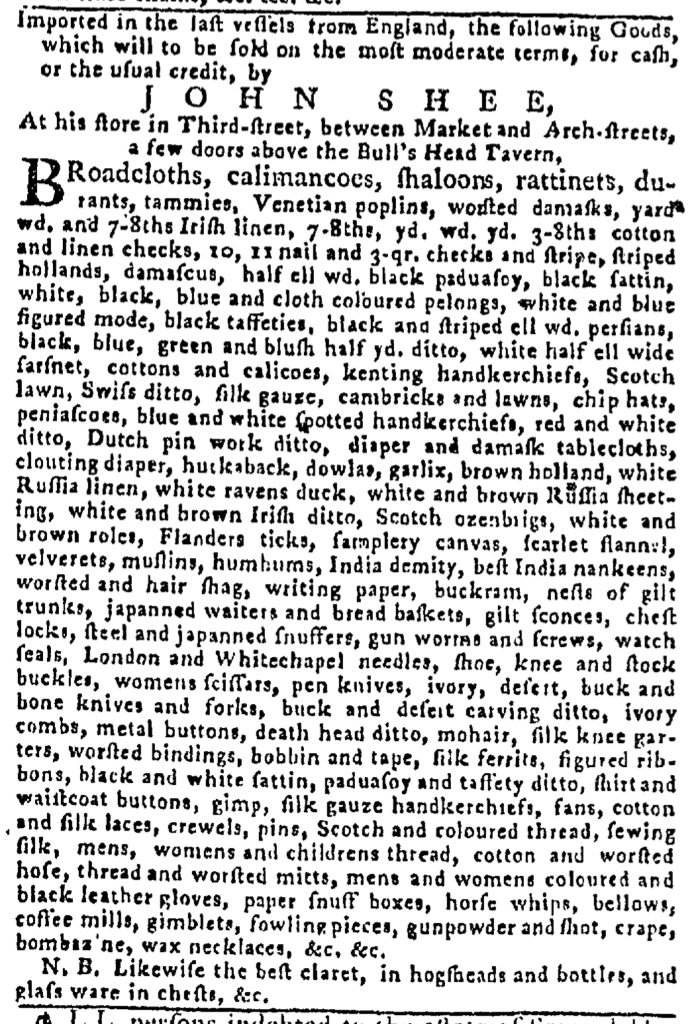
“The following Goods, which will to be sold … by JOHN SHEE.”

Consisting of a block of densely formatted text with little white space and almost no variation in font size, John Shee’s advertisement certainly would not have been considered flashy, but that did not necessarily mean that it was ineffective by eighteenth-century standards.

Shee observed many of the conventions of the day. He made an appeal to price (“sold on the most moderate terms”) and offered more than one option for payment (“cash, or the usual credit”). In noting that his merchandise had been “Imported in the last vessels from England,” he reminded potential customers that they were participating in transatlantic consumer culture that linked them to their counterparts in London and the English provinces. That these goods arrived via the “last vessels” also suggested that they were the most current fashions available.

Shee expended the most effort in detailing the assortment of items he stocked, everything from textiles and adornments (comprising more than half the advertisement) to coffee mills to pen knives to gunpowder and shot. Even then, he had not exhausted his inventory. Eighteenth-century readers knew that the “&c. &c.” that concluded his list meant “etc. etc.,” a promise that potential customers could examine an even greater array of goods upon visiting Shee’s shop. By listing dozens and dozens of items, Shee made an appeal to consumer choice. He invited potential customers to imagine acquiring, wearing, admiring, using, displaying, and possessing the goods he sold. He also offered them independence, the ability to make their own decisions about which items to purchase to fit their own tastes or to distinguish themselves from friends and neighbors. Such a lengthy list meant that customers did not have to content themselves with whatever happened to be on the shelves. A nota bene appended to the conclusion even suggested that the shopkeeper was constantly adding new merchandise to the selection he offered for sale.

In terms of the graphic design elements, Shee’s advertisement replicated others in the Pennsylvania Gazette. Short of paying extra for a woodcut to accompany his advertisement, he likely had little control over the layout. Instead, he accepted the standard format adopted by a compositor who squeezed as much content as possible onto the pages of the Pennsylvania Gazette. It was not the visual appeal of their advertisements that Shee and many of his counterparts were convinced would sell their goods. Instead, they relied on careful attention to a set of appeals they believed resonated with consumers. In the absence of varied graphic elements, Shee and other shopkeepers expected potential customers to approach their advertisements as active readers.

July 2

What was advertised in a colonial American newspaper 250 years ago today?

Jul 2 - 7:2:1767 Pennsylvania Gazette
Pennsylvania Gazette (July 2, 1767).

“A Variety of other Articles (advertised in the May Papers).”

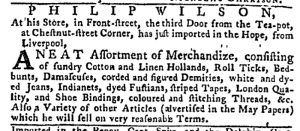
In an advertisement in the July 2, 1767, issue of the Pennsylvania Gazette, Philip Wilson announced that he sold “A NEAT assortment of Merchandize” at his store on Front Street, just three doors down from “the Tea-pot, at Chestnut-street Corner.” He listed more than a dozen specific items, but also indicated that he carried “a Variety of other Articles (advertised in the May Papers).”

This note near the end of the Wilson’s advertisement suggests how he imagined colonial consumers interacted with advertisement in their local newspapers. Most likely he did not expect readers to remember the particulars of his advertisements published two months earlier, not given that during that time the Pennsylvania Gazette regularly included a four-page supplement devoted exclusively to advertising in addition to all of the advertising in each standard issue. In addition, residents of Philadelphia were also exposed to advertisements in the Pennsylvania Chronicle and the Pennsylvania Journal. The proliferation of newspaper advertising that occurred in Philadelphia by the 1760s made it unlikely that readers would remember Wilson’s original notice unless it included especially noteworthy or innovative appeals to distinguish it from others. (It did not.)

Jul 2 - 5:14:1767 Pennsylvania Gazette.jpg
Pennsylvania Gazette (May 14, 1767).

Instead, Wilson assumed that his potential customers were active readers – very active readers – who had access to issues of the Pennsylvania Gazette published and distributed weeks earlier. In mentioning that he had previously advertised and listed a greater assortment of merchandise, he offered directions for locating a more complete accounting of his wares, anticipating that at least some readers would take the time and make the effort to do so. In turn, Wilson’s reference to his advertisements in previous issues suggests that some subscribers held onto their newspapers for some time before discarding them. Some of those subscribers may have included proprietors of coffeehouses, establishments known for providing newspapers among the many amenities offered to patrons.

Wilson was not alone in making assumptions that readers would look for advertisement inserted in previous issues.  Samuel Nightingale, Jr., deployed a similar technique in the Providence Gazette the previous November, though he directed readers to specific issues by number.

The masthead of the Pennsylvania Gazette proclaimed that it “Contain[ed] the Freshest Advices, Foreign and Domestic,” but some subscribers and coffeehouses likely created small archives of what was becoming old news (and advertisements), at least going back a few months, for perusal and reference. Philip Wilson assumed potential customers had some way to access a list of the “Variety of other Articles (advertised in the May Papers).”

June 13

What was advertised in a colonial American newspaper 250 years ago today?

Jun 13 - 6:13:1767 Providence Gazette
Providence Gazette (June 13, 1767).

“The assortment being too large for an advertisement, the particulars are omitted.”

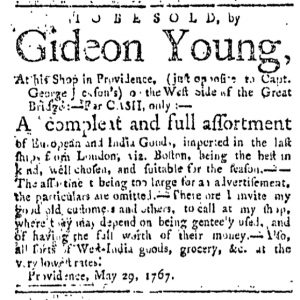
Shopkeepers, including Gideon Young of Providence, frequently promoted the “compleat and full assortment of European and India Goods” they imported, stocked, and sold to colonial consumers. Most emphasized consumer choice, enticing potential customers with visions of selecting textiles and housewares that appealed to their own tastes and fit their budgets. A “compleat and full assortment” of merchandise meant that customers experienced significant independence when they went shopping, rather than being expected to accept whatever happened to be on the shelves. Such freedom empowered colonial consumers; advertisers hoped this would encourage them to make more purchases as they explored and considered all the possibilities before determining which goods to buy.

Many advertisers set that process in motion by inserting lengthy lists of their inventory in their commercial notices, prompting potential customers to imagine possessing their merchandise – wearing particular fabrics and adornments or using and displaying specific housewares – even if they had not yet considered visiting any shops. Advertisers sought to stimulate demand by introducing readers to items that they might not have previously even realized that they desired. Eighteenth-century shopkeepers considered enumerating dozens or even hundreds of items in a list-style advertisement one effective way of achieving that goal.

Gideon Young, however, took a different approach as he encouraged potential customers to think about his “compleat and full assortment of European and India Goods.” He did not list any specific items, but instead stated, “The assortment being too large for an advertisement, the particulars are omitted.—Therefore I invite my good old customers and others, to call at my shop.” Such an invitation may have been just as powerful as a list of specific goods. It created a sense of mystery and anticipation by prompting readers to imagine the size of Young’s inventory and the variety of his goods that prevented him from offering a preview in the newspaper. It evoked curiosity and encouraged window shopping that might lead to actual purchases when readers came to investigate the “complete and full assortment” of merchandise on their own.

Young may have been making a virtue of a necessity when he adopted this sort of appeal. While this marketing strategy occupied less space on the page and presumably incurred lower costs, this did not necessarily make it less effective than posting a list-style advertisement. Instead, Young’s description of his merchandise – “the best of its kind, well chosen, and suitable for the season” – was designed to convince potential customers to visit his examine his wares rather than visit shops where the proprietors had not exercised so much care in selecting which goods to stock.

May 30

What was advertised in a colonial American newspaper 250 years ago today?

May 30 - 5:30:1767 Providence Gazette
Providence Gazette (May 30, 1767).

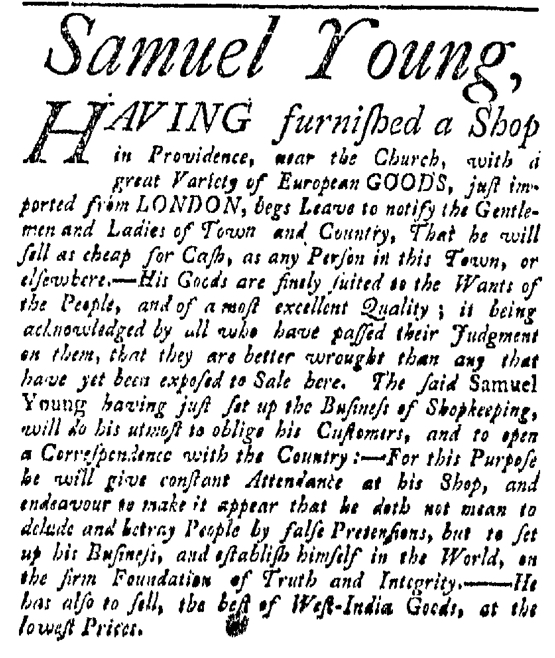
“Samuel Young … begs Leave to notify the Gentlemen and Ladies of Town and Country.”

Samuel Young of Providence was new to shopkeeping, but he demonstrated in his first advertisement that he understood the conventions of eighteenth-century advertising. He incorporated several of the most common marketing appeals of the era, including price, quality, and consumer choice. He opened his notice with a pledge to “sell as cheap for Cash, as any Person in this Town, or elsewhere” and concluded by reiterating that he offered “the lowest Prices.” He went into greater detail about the “most excellent Quality” of his “European GOODS,” claiming that “all who have passed their Judgment on them” acknowledged “that they are better wrought than any that have yet been exposed to Sale here.” Similarly, he sold “the best of West-India Goods.” Savvy consumers probably greeted these boasts with some skepticism. After all, Young sold the same imported goods as his competitors. Although he did not enumerate his wares, Young stated that they comprised “a great Variety” and were “finely suited to the Wants of the People.” Hyperbolic at times, Young did not merely place a notice that announced he opened a new shop. Instead, drew on techniques already popular in consumer advertising to market his merchandise.

As a newcomer to his occupation, Young also attempted to reassure potential customers about his own character, arguing that he possessed the personal qualities to make sure they would receive satisfactory treatment during transactions. He was not afraid of hard work, intending to “give constant Attendance at his Shop.” He also seemed sensible that some of his claims came off a bit overstated. To that end, he persuaded readers “that he doth not mean to delude and betray People by false Pretensions.” Instead, he simply wished to “establish himself in the World, on the firm Foundation of Truth and Integrity.” Young’s advertisement appeared alongside commercial notices by shopkeepers with established reputations. He realized that he needed to make bold claims to attract attention to his business while simultaneously cultivating his own standing as an honest and fair dealer.

May 14

What was advertised in a colonial American newspaper 250 years ago today?

May 14 - 5:14:1767 Massachusetts Gazette
Massachusetts Gazette (May 14, 1767).

“They are much the same in all the Stores.”

Many eighteenth-century shopkeepers promoted their merchandise by publishing extensive lists of their inventory. They presented potential customers with a multitude of choices amongst the “general Assortment of English and India GOODS” they imported. Three shopkeepers – Joshua Blanchard, Joshua Gardner and Company, and Clement Jackson – each inserted list-style advertisements that extended half a column or more in the May 14, 1767, issue of the Massachusetts Gazette. Each named dozens of items that readers could purchase in their shops.

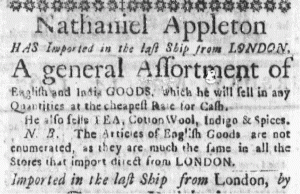
Nathaniel Appleton saw little sense in paying for such extensive advertisements, especially not when his competitors already did so. Yet he did not want to lose any prospective customers who might assume that his failure to list so many goods indicated that he had an inferior selection. To that end, he supplemented his assertion that he carried a “general Assortment” of goods with a nota bene that offered further explanation: “The Articles of English Goods are not enumerated, as they are much the same in all the Stores that import direct from LONDON.”

Appleton poked at his competitors, suggesting that one of the most popular marketing methods employed by other shopkeepers might be pointless. He carried the same goods as his competitors but had the good sense not to attempt to manipulate potential consumers with efforts to overwhelm them with extensive advertisements. He acknowledged standardization in consumer culture, noting that retailers generally depended on the same suppliers.

Appleton was not the only retailer to critique lengthy list-style advertisements. Just ten days earlier Gilbert Deblois’ advertisement in the Boston Evening-Post proclaimed that his inventory “consist[ed] of every Article that has been mentioned in the most lengthy Advertisements,” though that did not prevent him for providing an abbreviated list of his own. A couple of months earlier Benjamin Thurber and Edward Thurber inserted a notice in the Providence Gazette in which they announced that they stocked “too many [goods] … to enumerate each Particular in an Advertisement.” In addition, refusing to take on the costs of doing so allowed them to keep their prices low. At the beginning of the year, Joshua Blanchard deployed a similar argument as he lambasted the list-style advertisements published by his competitors: “The VERY LOW Price at which he sells will not afford a lengthy Advertisement, enumerating every Particular, even to Pins and Needles.” Blachard apparently had a change of heart. His lengthy advertisement “enumerating” dozens of items “Imported from LONDON” appeared immediately to the right of Appleton’s notice in the May 14 issue. Blanchard paid for his advertisement, but Appleton benefited from its proximity to his own.

Eighteenth-century advertisers like Appleton played with the conventions developing around consumer marketing, sometimes critiquing them if they thought doing so might result in some advantage or attract customers bored with the usual sorts of appeals.

May 4

What was advertised in a colonial American newspaper 250 years ago today?

May 4 - 5:4:1767 Boston Evening-Post
Boston Evening-Post (May 4, 1767).

“GOODS, consisting of every Article that has been mentioned in the most lengthy Advertisements.”

Gilbert Deblois frequently advertised in Boston’s newspapers, sometimes at great length. On May 4, 1767, he inserted the same advertisement in both the Boston Evening-Post and the Boston Post-Boy. Several days earlier the same notice appeared in the extraordinary that accompanied the current issue of the Massachusetts Gazette. Compared to some of his other marketing efforts in the public prints, this notice was considerably shorter. Still, extending over almost one-third of a column, it occupied significantly more space – about three times as much – compared to advertisements placed by some of his competitors.

Deblois seemed less concerned about those advertisements than the much lengthier list advertisements placed by other competitors, including John Appleton and John Barrett and Sons (two-thirds of a column), Clement Jackson and John Gore, Jr. (three-quarters of a column), and Frederick William Geyer (an entire column and one-fifth of another). Those advertisements listed scores of items stocked by local shopkeepers.

Deblois devised a way to make those lengthy list advertisements (paid for by his competitors) work to his own advantage. After inserting the standard language about “A complete fashionable Assortment of English & India Piece GOODS,” he proclaimed that he carried “every Article that has been mentioned in the most lengthy Advertisements and many others not usually imported.” (The italics appeared in the advertisements in all three newspapers that carried this advertisement, indicating that Deblois gave specific instructions to the printers rather than leaving it to their discretion to make decisions about that particular aspect of formatting the notice. On the other hand, the three advertisements had other variations in format, but not copy.)

Considering the variety of consumer goods imported and advertised by Boston’s merchants and shopkeepers, readers probably greeted this pronouncement with some skepticism. As a frequent advertiser who sometimes placed lengthy list notices, however, Deblois may have previously amassed some credibility. He did not need to enumerate all of his wares in every advertisement. Invoking his competitors’ advertisements provided a means of listing his merchandise without actually listing it – or paying to do so. This also initiated a challenge to potential customers to visit his shop and assess for themselves the validity of his claim, generating foot traffic that could result in additional sales.