July 31

What was advertised in a colonial American newspaper 250 years ago this week?

Jul 31 - 7:25:1768 Boston-Gazette
Boston-Gazette (July 25, 1768).

“A large Assortment of … GOODS.”

Frederick William Geyer advertised regularly in several of Boston’s newspapers in the late 1760s. The shopkeeper deployed a variety of strategies to promote his wares, including appeals to price and consumer choice. Both appeared in a notice he placed in the July 25, 1768, edition of the Boston-Gazette. In it, he announced that he had just imported a “large Assortment of English, India and Scotch Peice [sic] GOODS.” Not only did he proclaim that he offered low prices, he also asserted that he was “determined to sell … as cheap as can be bought in Parts of America.”

Geyer devoted more effort – and space – to developing an appeal to consumer choice. In addition to introducing his merchandise as a “large Assortment,” he reiterated the word “assortment” several times to describe particular kinds of items he sold: “A large assortment of Irish linens,” “An assortment of superfine, middling and low pric’d Broad Cloths,” “An assortment of Ribbons,” “A large assortment of plain and painted Ebony Fans,” “a very pretty assortment of black and coloured paddlestick Fans,” “A pretty assortment of plain & flower’d Lawns,” “A large assortment of white Threads,” “a large and neat Assortment of Mettle Buttons immediately from the Makers,” and “a large Assortment of Glass Necklaces.” These descriptions appeared among an extensive list that included hundreds of items in his inventory, indicating to prospective customers that he carried wares to suit practically any taste or budget.

The space that Geyer’s advertisement occupied on the page also played a role in communicating that message to consumers. It more than filled an entire column on the front page of the July 25 issue, spilling over into a second column. A competitor, William Gale, advertised his own “General Assortment of ENGLISH and INDIA GOODS” in a notice that appeared on the same page, but it looked paltry printed next to Geyer’s advertisement. Indeed, Gale’s entire notice was similar in length to the portion of Geyer’s advertisement that required an additional column. They may have carried similar merchandise, but the space on the page consumed by Geyer’s notice suggested that customers would encounter so much more when they visited his shop on Union Street. Twice the length of any other advertisement in the same issue, Geyer’s notice dominated the page, part of a strategy of overwhelming his competitors by vividly presenting prospective customers with the many choices he made available to them.

June 19

What was advertised in a colonial American newspaper 250 years ago this week?

Jun 19 - 6:16:1768 Boston Weekly News-Letter
Boston Weekly News-Letter (June 16, 1768).

“A great Variety of Callicoes.”

Even though he advertised many of the same goods as other merchants and shopkeepers who placed notices in Boston’s newspapers in June 1768, Samuel Fletcher attempted to attract attention to his wares via the visual design of his advertisement in the Boston Weekly News-Letter. Eighteenth-century advertisers often listed an assortment of goods that comprised their inventory, informing potential customers of a vast array of choices to suit their tastes and budgets. Most merchants and shopkeepers who published such advertisements simply listed their merchandise in dense paragraphs. Others experimented, perhaps with the encouragement of printers and compositors who better understood the possibilities, with arranging their goods in columns, listing only one or two items per line, in order to make the entire advertisement easier for readers to peruse.

Usually list-style advertisements broken into columns featured only two columns, but Fletcher’s advertisement in the June 16, 1768, edition of the Boston Weekly News-Letter had three, distinguishing it from others that appeared in the same publication that week. (Fletcher’s advertisement was the only one divided into columns in the Boston Weekly News-Letter, but two others in Richard Draper’s Massachusetts Gazette used columns to organize “A great Variety of English and India Goods.” For the purposes of this examination of these advertisements, I have classified Draper’s Massachusetts Gazette and the Boston Weekly News-Letter as only one publication because they were printed on a single broadsheet folded in half to create four pages, two of which comprised Draper’s Massachusetts Gazette and the other two the Boston Weekly News-Letter. Whether the boundaries between the two were permeable when it came to inserting advertisements requires further investigation, but Draper printed both and the same compositors presumably set type for both.) Caleb Blanchard and Samuel Eliot inserted lengthy advertisements that extensively listed scores of items, each advertisement divided down the middle to create two columns. Other newspapers published in Boston in the late 1760s often included advertisements that used this format, making it familiar to readers in the city and its hinterlands. Very rarely, however, did advertisements feature three columns.

As a result, the visual aspects of Fletcher’s advertisement made it stand out from others, even if nothing else about the list of goods distinguished it from the notices placed by his competitors. Fletcher made a brief appeal to price, noting that he “Sells cheap for Cash,” but primarily relied on the graphic design of his advertisement to direct readers to his advertisement as part of his effort to convince potential customers to visit his shop “Near the Draw-Bridge, BOSTON.”

May 27

What was advertised in a colonial American newspaper 250 years ago today?

May 27 - 5:27:1768 Connecticut Journal
Connecticut Journal (May 27, 1768).

“A few of the so much esteem’d FARMER’s Letters.”

Isaac Beers and Elias Beers sold a variety of goods at their shop in New Haven. In the spring of 1768 they enumerated many of their wares in an advertisement in the Connecticut Journal, listing textiles and adornments that ranged from “blue, bluegrey, and blossom colour’d German Serges” to “A very large Assortment of Buttons, Bindings, and all kind of Trimmings for Mens Cloathes” to “A genteel Assortment of the newest fashion’d Ribbons.” They stocked grocery items, including tea, cofeem and sugar, as well as “Pigtail Tobacco” and snuff.

Although they were not booksellers or stationers, the Beers included writing supplies and books among their inventory. Like other shopkeepers, they carried “Writing Paper” and wax wafers for making seals. They also sold bibles and spelling books as well as “A few of the so much esteem’d FARMER’s Letters.” (Although that portion of the advertisement has been damaged in the copy of the May 27, 1768, edition of the Connecticut Journal seen above, the same advertisement appeared the next week in an issue that has not been damaged.)

The Beers did not need to provide any further explanation for prospective customers to identify the pamphlet that contained all twelve of John Dickinson’s “Letters from a Farmer in Pennsylvania” previously printed and reprinted in newspapers throughout the colonies, starting in December 1767 and continuing into the spring of 1768. In these “Letters,” Dickinson, under the pseudonym of “A Farmer,” presented a dozen essays that explained how Parliament overstepped its authority in passing the Townshend Act and other measures that usurped the authority of colonial legislatures. He encouraged colonists to resist Parliament’s designs or risk even greater abuses.

Upon completion of the series, industrious printers in Boston, New York, and Philadelphia collected all twelve “Letters” in pamphlets. Printers and booksellers in several colonies advertised that they sold the “Letters,” but supplying the public with that pamphlet was not the province of the book trade alone. Shopkeepers like the Beers purchased “A few” copies to retail alongside general merchandise in their own shops, considering the “Letters” significant enough to merit particular mention in their advertisements. In so doing, they assisted in disseminating some of the arguments that eventually transformed resistance into a revolution. The choices they made as retailers and advertisers helped to shape the rhetoric of the Revolution.

May 23

What was advertised in a colonial American newspaper 250 years ago today?

May 23 - 5:23:1768 Boston Evening-Post
Boston Evening-Post (May 23, 1768).

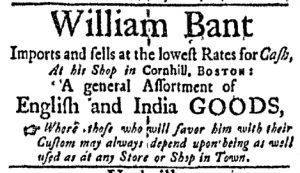
Those who will favor him with their Custom may always depend upon being as well used as at any Store or Shop in Town.”

Shopkeeper William Bant advertised in a very crowded marketplace. Residents of Boston encountered shops and stores practically everywhere they went as they traversed the city in the late 1760s. They also experienced a vibrant culture of advertising for consumer goods and services in the pages of the several newspapers published in the city. Some of those newspapers so overflowed with advertisements that the publishers regularly distributed supplements to accompany the regular issues. As the consumer revolution of the eighteenth century continued in Boston, Bant was just one of countless merchandisers attempting to entice prospective customers to patronize his shop.

As part of that effort, he inserted a relatively brief advertisement in the May 23, 1768, edition of the Boston Evening-Post. In it, he announced that he stocked “A general Assortment of English and India GOODS.” Unlike many other shopkeepers, however, Bant did not provide a list of his inventory. On the following page, Thomas Lee’s advertisement extended one-third of a column and listed dozens of imported goods he offered for sale. Jonathan and John Amory’s advertisement was twice as long and listed even more merchandise. John Gore, Jr., inserted an advertisement of a similar length, though its list of goods appeared even more crowded due to graphic design choices made by the compositor.

How did Bant attempt to compete with merchants and shopkeepers who invested in so much more space for promoting their wares in the public prints? He left the details of his “general Assortment” of goods to the imagination, instead opting to emphasize customer service. He pledged that “those who will favor him with their Custom may always depend upon being as well used as at any Store or Shop in Town.” Bant did not promise merely satisfactory service; he proclaimed that the service he provided was unsurpassed in the busy marketplace of Boston. He did not need to overwhelm prospective customers with dense and extensive lists of all the items they could purchase in his shop. Instead, he invited them to imagine the experience of shopping and interacting with the purveyors of the goods they desired. Just as merchandisers competed with each other for customers, consumers sometimes competed with each other for the attention of merchants and shopkeepers. Bant presumed that shoppers sometimes experienced frustration when they dealt with retailers. In turn, he assured prospective customers that they would not be disappointed in the service they received at his shop.

March 5

What was advertised in a colonial American newspaper 250 years ago today?

Mar 5 - 3:5:1768 Providence Gazette
Providence Gazette (March 5, 1768).

“All persons … will not repent coming so far down town.”

Location! Location!! Location!!! Today many businesses promote the convenience associated with their location, but an awareness of the potential effect of location on the success of a business goes back to the colonial era. James Brown and Benoni Pearce, for instance, promoted their shops “On the West Side of the Great-Bridge” in Providence by advising that “their Customers coming from the Westward, may save both Time and Shoe-Leather” by visiting their establishments rather than crossing to the other side of the river to browse the wares sold by merchants and shopkeepers there.

Other entrepreneurs, however, admitted that their location might present certain disadvantages if potential customers considered them too far out of the way. In his advertisement in the March 5, 1768, edition of the Providence Gazette, Nicholas Cooke announced that he sold “a Quantity of Dry Goods” at his shop “At the lower End of the Town.” Cooke realized that being situated at the outskirts of town was not an ideal location. Attracting customers required making alternate marketing appeals, such as emphasizing consumer choice. In addition to highlighting his “Quantity of Dry Goods,” Cooke also deployed the word “assortment” to describe certain categories of merchandise: “An assortment of Irish linen, checks and stripes” and “a large and neat assortment of glass, stone and earthen ware.” He had so many of those housewares that he proclaimed his inventory was “too large to enumerate.” In addition, he also stocked “many other articles” sure to delight shoppers.

To further justify making the trip to “the lower End of the Town,” Cooke also explained that he offered prices that his competitors could not beat. He stated that because he “imported the above goods directly from England” that he “can afford them as cheap as can be sold by any in this place.” He promised customers a bargain, assuring them that they “will not repent coming so far down town.” Brown and Pearce also attempted to convince certain prospective customers to venture beyond the nearest shops. Those who resided “on the other Side” of the Great Bridge would not “save both Time and Shoe-Leather” by visiting their shops, but they would be “well paid for crossing the Pavements, and be kindly received and well used.”

Eighteenth-century shopkeepers sometimes promoted their location when doing so worked to their advantage, but they did not neglect to acknowledge when they were located in a spot that consumers might not consider ideal. In such instances, they attempted to convince prospective customers that a variety of other benefits outweighed the inconvenience of traveling farther to their shops.

January 19

What was advertised in a colonial American newspaper 250 years ago today?

Jan 19 - 1:19:1768 South-Carolina Gazette and Country Journal
South-Carolina Gazette and Country Journal (January 19, 1768).

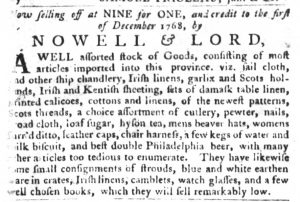
“A WELL assorted stock of Goods, consisting of most articles imported into this province.”

In their advertisement in the January 19, 1768, edition of the South-Carolina Gazette and Country Journal, Nowell and Lord incorporated many of the most common marketing strategies deployed by merchants and shopkeepers in eighteenth-century America. The format of their advertisement, like the appeals, would have been familiar to readers. Like many of their competitors in Charleston and throughout the colonies, Nowell and Lord composed a list-style advertisement that revealed the range of goods they stocked, from “Irish and Kentish sheeting” to “leather caps” to “blue and white earthen ware.”

In and of itself, this format demonstrated the veracity of one of their appeals to potential customers: consumer choice. The partners reiterated that their patrons could choose the items that matched their needs, desires, tastes, and budgets throughout their advertisement. First, they described their inventory as “A WELL assorted stock of Goods,” proclaiming that it included “most articles imported into this province.” In other words, customers were unlikely to find merchandise in other shops that Nowell and Lord did not also carry. To underscore the variety they offered, the partners promoted their “choice assortment of cutlery” midway through the advertisement. They also made a point of noting that the list they printed in the newspaper was not exhaustive; instead, they also carried “many other articles too tedious to enumerate.” Customers would delight in the number of choices available to them when they visited Nowell and Lord’s shop.

In addition to consumer choice, the shopkeepers also made appeals to price and fashion. For instance, they stressed that they sold their merchandise “remarkably low.” To make their wares even more affordable, they offered “credit to the first of December 1768.” When it came to textiles for making garments, they informed readers that they imported “the newest patterns,” allowing customers to impress their friends and acquaintances by keeping up with current fashions in other parts of the empire.

Nowell and Lord deployed consumer choice as the central marketing strategy in their advertisement, but they supplemented that appeal with assurances about price and fashion. To sell their merchandise, they replicated methods used by countless other advertisers throughout the colonies. That so many merchants and shopkeepers consistently relied on the same strategies testifies to the power they believed those strategies possessed to entice and influence colonial consumers.

December 24

What was advertised in a colonial American newspaper 250 years ago today?

Dec 24 - 12:24:1767 New-York Gazette Weekly Post-Boy
New-York Gazette: Or, the Weekly Post-Boy (December 24, 1767).

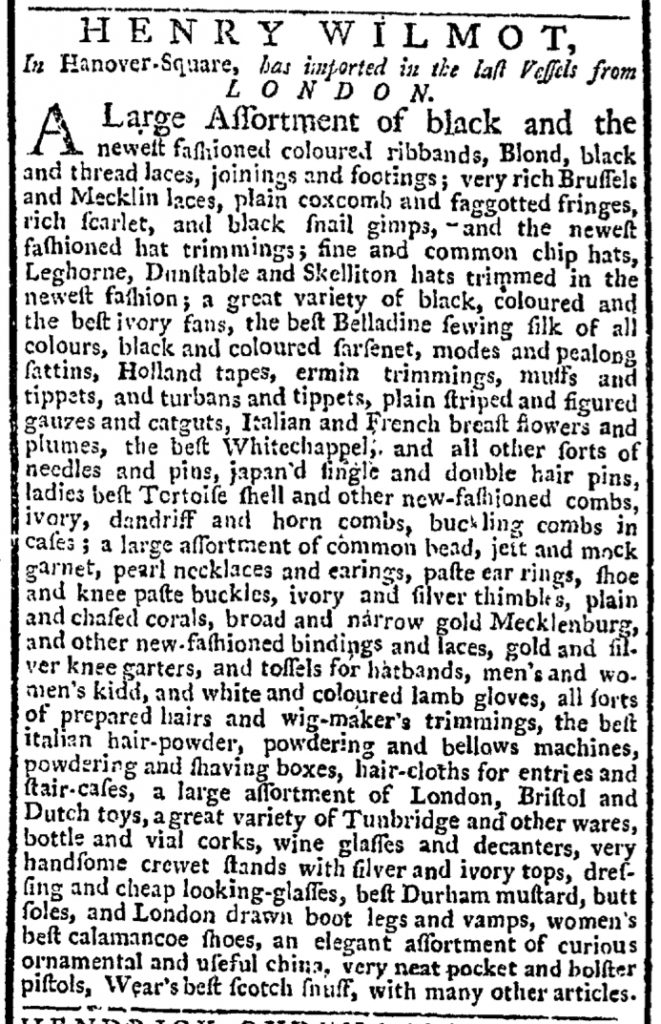
“Newest fashioned hat trimmings.”

At his shop on Hanover Street in New York, Henry Wilmot stocked an impressive array of goods “imported in the last Vessels from LONDON.” His advertisement in the December 24, 1767, edition of the New-York Gazette: Or, the Weekly Post-Boy described all kinds of personal adornments, from lace and ribbons to hairpins and combs to jewelry and gloves. To incite demand for these baubles from Britain, Wilmot deployed one of the most common marketing strategies of the period, an appeal to fashion. Many shopkeepers made general statements about the fashionable qualities of all of their wares, but Wilmot instead reiterated this point throughout his advertisement. He repeated some variation on the phrase “newest fashion” five times in the list of his inventory: “newest fashioned coloured ribbands,” “newest fashioned hat trimmings,” “Leghorne, Dunstable and Skelliton hats trimmed in the newest fashion,” “new-fashioned combs,” and “new-fashioned bindings and laces.”

This method may have been intended to convey to potential customers that Wilmot exercised careful attention to detail when it came to keeping abreast of the latest trends in London. Rather than make sweeping claims about all of his merchandise, he highlighted particular items that consumers could trust reflected tastes currently on display in the cosmopolitan center of the empire. In turn, this suggested that he could provide guidance in selecting from among his other merchandise, steering customers away from items too far out of style in favor of those that suitably complemented the “newest fashioned” garments and adornments. At the very least, repeating the phrase “newest fashion” may have induced potential customers to associate all of Wilmot’s merchandise with current styles, as did the use of adjectives like “best” and “elegant.”

Colonial consumers often worried that shopkeepers hawked whatever merchandise they could acquire, that English merchants sent castaways no longer popular in the London market. Wilmot addressed those suspicions with repeated assertions that he stocked and sold goods of the “newest fashion,” stylish items that had not been lingering in his shop but instead arrived on the vessels that most recently entered port.

December 18

What was advertised in a colonial American newspaper 250 years ago today?

Dec 18 - 12:18:1767 New-Hampshire Gazette
New-Hampshire Gazette (December 18, 1767).

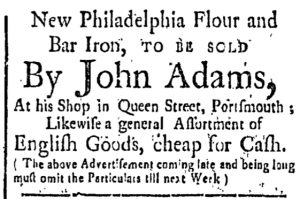
“The above Advertisement coming late and being long must omit the Particulars till next Week.”

John Adams placed an advertisement in the December 18, 1767, edition of the New-Hampshire Gazette to inform readers that he sold “Philadelphia Flour and Bar Iron” and “a general Assortment of English Goods” at his shop on Queen Street in Portsmouth. An editorial note accompanied Adams’s notice: “The above Advertisement coming late and being long must omit the Particulars till next Week.” The shopkeeper’s much lengthier advertisement did appear in the next issue, but until then readers had to imagine what it might contain. Although they would not have been able to name all the “Particulars,” colonial consumers were so steeped in the print culture of marketing via newspaper advertisements that most would have accurately predicted that the complete notice included a lengthy list of merchandise that presented a multitude of choices. Adams did not benefit from sharing that list with potential customers in the December 18 issue, but when it did appear it concluded with a general description of “a variety of other Articles.” Even when allocated space for the entire advertisement, Adams chose to publish a partial list of his inventory and prompted consumers to imagine what other treasures they might discover if they visited his shop. The editorial note explaining that the advertisement had been abbreviated achieved the same purpose.

That note had at least three audiences. The first consisted of residents of Portsmouth who could easily visit Adams’s shop as part of their usual routines at some point in the coming week. The entire advertisement notified them that Adams carried an array of goods – so many that they could not all be listed in the current edition – that he sold “cheap for Cash.” Readers of the New-Hampshire Gazette who resided in Portsmouth’s hinterland comprised the second audience. They might visit town only occasionally, limiting their access to any of the shops there. The editorial note alerted them that Adams would soon publish more “Particulars” about his inventory, information that they could eventually take into account when planning their excursions into Portsmouth or sending their orders to the shopkeeper. Adams himself was the third audience for the editorial note. It may not have been apparent at the time he submitted his advertisement that it would not appear in its entirety. Even if Adams had been aware in advance, the note provided an acknowledgment and assurances that the printers would allocate sufficient space for his advertisement the following week. It simultaneously informed readers that the shopkeeper had intended to share much more with them. While not the copy Adams intended to publish, the editorial note served to incite interest in his merchandise and anticipation for the complete advertisement.

December 6

What was advertised in a colonial American newspaper 250 years ago this week?

Dec 6 - 12:3:1767 New-York Journal
New-York Journal (December 3, 1767).

“Sundry other Goods … will be sold great Bargains.”

Throughout the eighteenth century, newspaper advertisers most commonly deployed a handful of marketing strategies: appeals to price, quality, gentility, and consumer choice. Many advertisers incorporated several of these appeals into their commercial notices, while others crafted advertisements that emphasized a particular appeal.

Benjamin Booth adopted the latter strategy in his advertisement for several goods he imported from London that appeared in the New-York Journal in the late fall of 1767. He made nods toward quality (“BEST English sail-Cloth”) and consumer choice (a list of merchandise followed with a promise of “sundry other Goods”), but he reiterated appeals to price four times in his advertisement. Like many other advertisements placed by colonial shopkeepers, Booth’s notice included a header and a conclusion with a list of goods between them. Many advertisers inserted an appeal to price in either the header or the conclusion, but Booth attempted to incite demand for his wares by underscoring price in all three segments of his advertisement. He relied on formulaic language used by shopkeepers throughout the colonies in the header, proclaiming that his merchandise “will be sold exceeding cheap.” In the list of his inventory, he singled out “Scotch Carpeting” as “very cheap,” indicating an especially good deal among his already low prices. In the course of a single sentence in the conclusion, Booth promoted his prices twice. He stated that his assortment of goods was “laid in upon very low Terms, and will be sold great Bargains.” Here Booth once again inserted formulaic language that appeared in other advertisements: “very low Terms.” However, he concluded with a relatively novel appeal: “great Bargains.” Although shopkeepers regularly marketed low prices in the 1760s, few invoked the word “bargain” to describe the benefits to consumers. In this regard, Booth took an innovative approach, even as the format and stock phrases for the rest of the advertisement replicated other commercial notices. He borrowed heavily from existing marketing methods, but also added his own modification to attract the attention of prospective customers.

September 23

What was advertised in a colonial American newspaper 250 years ago today?

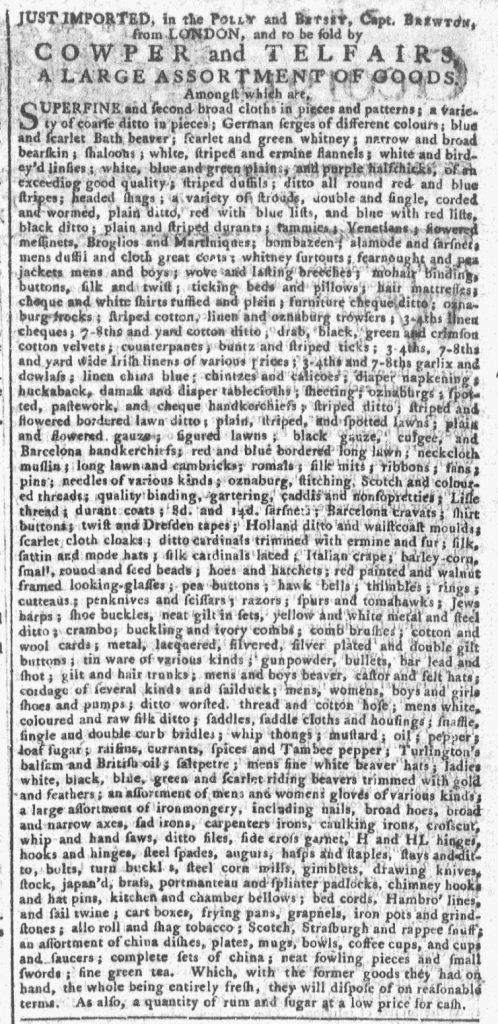
Sep 23 - 9:23:1767 Cowper and Telfairs in Georgia Gazette
Georgia Gazette (September 23, 1767).

“A LARGE ASSORTMENT OF GOODS.”

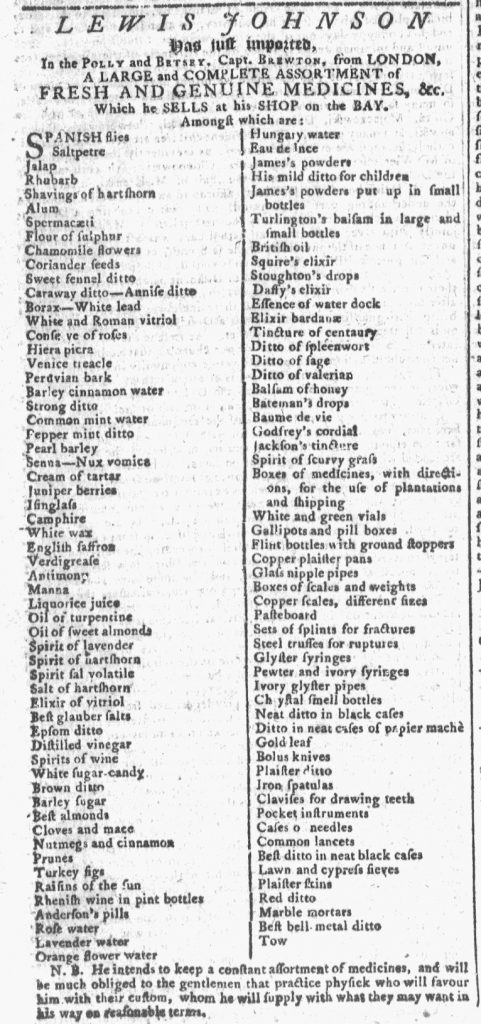
Lewis Johnson inserted an advertisement for his inventory of “A LARGE and COMPLETE ASSORTMENT of FRESH AND GENUINE MEDICINES” in the September 23, 1767, edition of the Georgia Gazette. The partnership of Cowper and Telfairs also placed an advertisement, informing potential customers of the “LARGE ASSORTMENT OF GOODS” they had imported from London. The notices, each listing an elaborate array of items, appeared side by side.

Although Lewis Johnson and Cowper and Telfairs each resorted to the common list-style advertisement to market their wares, the visual aspects of their notices distinguished them from each other. Cowper and Telfairs opted for a dense paragraph that extended two-thirds of the column, enumerating everything from “white, striped and ermine flannels” to “shirt buttons” to “broad and narrow axes” to “complete sets of china.” With some exceptions, they grouped their merchandise together by category (textiles, accouterments and accessories, hardware, and housewares). This made it somewhat easier for potential customers to locate specific items of interest (while also introducing them to others they may not have otherwise considered), even though the merchants did not include any sort of headers to indicate where one type of merchandise ended and another began. This dense list maximized the number of items Cowper and Telfairs presented to the public. While its format may have been somewhat overwhelming or difficult to read, it offered extensive choices to consumers.

Sep 23 - 9:23:1767 Johnson from Georgia Gazette
Georgia Gazette (September 23, 1767).

Johnson’s advertisement, on the other hand, occupied the same amount of space on the page, but did not list nearly as many items. Instead, it divided a single column into two narrower columns, listing only one item per line. This left much more white space on the page, making it easier for readers to navigate through the merchandise. Like Cowper and Telfairs, Johnson introduced his list with the phrase “Amongst which are,” indicating that the advertisement did not include an exhaustive inventory. Both carried additional items at their shops. Given that he carried additional medicines, Johnson made a calculated decision to truncate his list in order to make it easier to read. Compared to the dense format of everything else on the page, the layout of his list likely drew the eyes of colonial readers, increasing the likelihood that they would take note of his advertisement.

Both list-style advertisements had advantages and shortcomings inherent in their appearance on the page. Although eighteenth-century advertisements lack the dynamic graphic design elements of modern marketing efforts, advertisers and printers did experiment with different layouts in their efforts to attract attention and incite demand among potential customers.