April 30

What was advertised in a colonial American newspaper 250 years ago today?
Apr 30 - 4:30:1767 Boston News-Letter
Massachusetts Gazette (April 30, 1767).

“Genteel Assortment newest fashion Fans and Masks.”

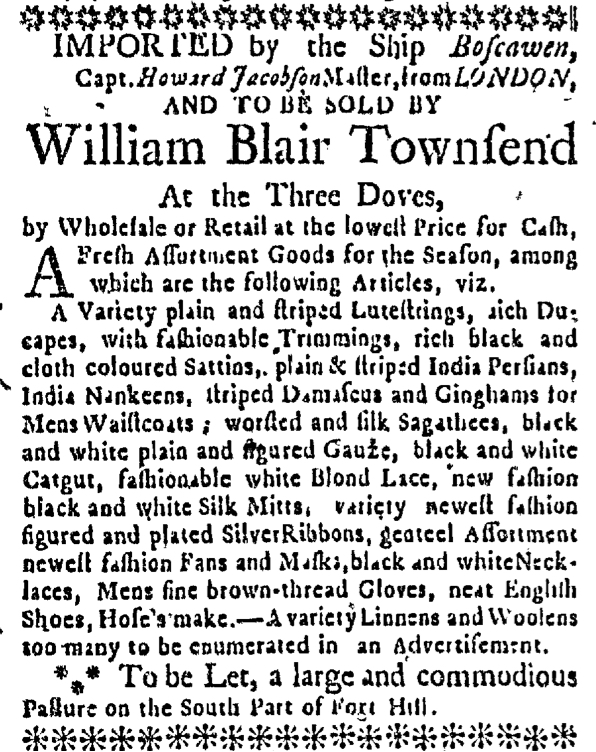
At his shop at the sign of the Three Doves in Boston, William Blair Townsend sold “A Fresh Assortment Goods for the Season” recently imported from London. Many of his competitors advised potential customers that they stocked fashionable goods, especially textiles, accessories, and adornments for garments, but most deployed some sort of blanket statement to that effect. Townsend, on the other hand, underscored that he carried dry goods à la mode, inserting the word “fashionable” five times in his list of merchandise. For instance, he carried “Ducapes, with Fashionable Trimmings” and “fashionable white Blond Lace.” For those worried that merchants in England attempted to pawn off inventory already going out of style to colonial shopkeepers to pass along to their customers far removed from the cosmopolitan center of the empire, Townsend asserted that his customers could purchase “new fashion black and white Silk Mitts” as well as a “variety newest fashion figured and plated Silver Ribbons.” Both could have been used to dress up garments that might otherwise have been already passing out of style. Townsend adopted even more expansive language as he continued describing his wares: “genteel Assortment newest fashion Fans and Masks.” Other eighteenth-century advertisers commonly made appeals to fashion, but Townsend made it the centerpiece of his marketing strategy.

Not all colonists were as keen on keeping up with current fashions as the customers Townsend sought to cultivate. The Massachusetts Gazette Extraordinary, a supplement for “other News and New-Advertisements,” included a notice that “In a few Days will be Published, AN ADDRESS TO PERSONS of FASHION.” The author did not look upon the consumer revolution, its rituals of purchasing and display, with fondness. This pamphlet was a warning “worthy the serious Attention of every Christian, especially at a Time when Vice and Immorality seem to have an Ascendancy over Religion.” This advertisement stood in stark contrast to the array of advertisements hawking all sorts of consumer goods that surrounded it. Seemingly separated from Townsend’s advertisement by several pages according to modern archival practices, the Extraordinary may have been inserted in the Massachusetts Gazette as a means of keeping the two publications for April 30 together. If that was the case, the advertisement for the “ADDRESS TO PERSONS of FASHION” appeared on the far left of the page that faced Townsend’s advertisement. Readers would have encountered the critique of fashion almost immediately before perusing the shopkeeper’s efforts to extoll his stylish merchandise.

March 29

GUEST CURATOR: Evan Sutherland

What was advertised in a colonial American newspaper 250 years ago this week?

Mar 29 - 3:27:1767 New-Hampshire Gazette
New-Hampshire Gazette (March 27, 1767).

“Best GREEN-COFFEE … Choice Bohea TEA.”

In colonial and Revolutionary America, coffee was available, but it was less accessible than tea or alcohol. Unlike tea, coffee had to be ground, which was something most colonists did not have as much time to do. So even though tea was more expensive than coffee, it took more time and labor to make coffee than tea. As a result, many colonists typically did not make coffee at home. Colonists who did make their own coffee showed their wealth when preparing or serving it, showing their privileged status.

Those who were not even able to afford tea turned to coffee substitutes. According to Christina Regelski, slaves made their own substitute coffee using ingredients from gardens such as cowpeas, sweet potatoes, and corn.

Tea also played an important role in the American Revolution. After Britain put stricter laws on imports, tea was taxed. Many colonists decided to boycott tea and give up one of the “luxuries that they had come to treasure.”

**********

ADDITIONAL COMMENTARY: Carl Robert Keyes

George Turner sold “A fine Assortment of English GOODS” as well as “Groceries of all Kinds” – including the coffee and tea examined by Evan – at his shop on Queen Street in Portsmouth, New Hampshire. To attract customers, Turner launched some of the most common appeals used by eighteenth-century advertisers, especially appeals to price and quality, but he supplemented them with several others that found their ways into advertisements less often.

For instance, he advised “Town or Country Customers” that they could “depend upon being used as well by sending their Servants, as if present themselves.” Shopkeepers in port cities regularly indicated that they received and faithfully filled orders from customers in the countryside, an eighteenth-century version of mail order shopping. Turner put a bit of a twist on that means of selling his wares. In this case, he acknowledged that customers might send others – their servants – to shop on their behalf. Doing so potentially put customers at a disadvantage in commercial transactions, but Turner assured readers that he would treat fairly with their representatives in their absence. Potential customers need not worry about being fleeced by the shopkeeper when they sent surrogates to make purchases at his store. That he listed prices for several commodities (rum, sugar, coffee, “COTTON-WOOL”), a fairly uncommon practice in eighteenth-century advertisements, left less room for haggling or surprises at the moment of purchase. In a sense, this mechanized transactions by making it irrelevant who was actually present at the exchange.

In addition, Turner also pledged to barter provisions in exchange for “any of the above mention’d ARTICLES, at a Price proportionate to the aforesaid Prices,” even though he previously announced that he sold his wares “Cheap for CASH.” Although hesitant to extend credit, the shopkeeper did not rigidly insist that every transaction required cash. Instead, he provided potential customers an alternative.

Finally, Turner put a unique spin on his appeal to price: “It is needless to say said TURNER will Sell Cheaper than others, as that would be only questioning the Judgment of the Purchaser.” Apparently it was necessary to make this statement, but in doing so Turner turned it into a self-evident statement of fact. He also absolved himself from any possible accusations of wringing inflated prices out of customers by placing the onus on them. If they bought his wares at higher prices than those charged by his competitors, that was the result of their own poor judgment. Any attempt to question Turner’s fairness became an indictment of a customer’s own competence as a savvy consumer.

George Turner created a lively advertisement that merged some standard appeals with several uncommon arguments in favor of making purchases at his shop. At a glance, his advertisement looks similar to countless others printed in eighteenth-century newspapers, but on closer examination it reveals some of the innovative playfulness possible in advertising during the colonial and Revolutionary eras.

March 26

GUEST CURATOR: Evan Sutherland

What was advertised in a colonial American newspaper 250 years ago today?

Mar 26 - 3:26:1767 Massachusetts Gazette
Massachusetts Gazette (March 26, 1767).

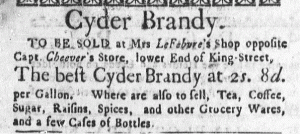
“Cyder Brandy TO BE SOLD at Mrs. LeFebure’s Shop.”

According to Patricia Cleary, the role of women as shopkeepers in the eighteenth century was an expected extension of their household duties.[1] One such example could be found in the Massachusetts Gazette, a female shopkeeper named Mrs. LeFebure. The estimated percentage of women shopkeepers during this time had varied. According to a Philadelphia tax list from 1756, thirty-eight women kept shops, which accounted for 42% of the town’s shopkeepers.[2] However, the tax list revealed that male shopkeepers were more prosperous than female shopkeepers. The evidence suggests that many of these women may have been widows, as keeping shop appeared to be a common source of income for widows in the eighteenth century.[3] Gender division was further shown when the widowed shopkeepers were labeled as widows, rather than shopkeepers. Most female shopkeepers only started trade businesses after the death of their husbands. In addition, female shopkeepers portrayed themselves as “arbiters of taste” as they attempted to increase sales and to create and meet demand during the consumer revolution.[4]

**********

ADDITIONAL COMMENTARY: Carl Robert Keyes

Yesterday Ceara Morse examined an advertisement for a dozen types of spirits produced in Savannah by Henry Snow, “Distiller from London.” Today’s advertisement featured only one kind of alcohol, “Cyder Brandy,” sold at Mrs. LeFebure’s shop on King Street in Boston. The wording makes it difficult to determine whether LeFebure produced the cider brandy herself or merely sold spirits distilled by an associate.

Even if she did not run an operation as extensive as Henry Snow’s or possess his level of experience and expertise, it likely would have been within LeFebure’s ability to distill cider brandy. After all, two recipes appeared in a cookbook for “ALL Good Housewives,” John Nott’s Cook’s and Confectioner’s Dictionary: Or, the Accomplished Housewife’s Companion, published in London in 1723. The recipes have been reproduced below. Although the recipes indicate that they required some specialized equipment (including a “Copper Body and Head” and a “refrigerator Worm”), they do not suggest that LeFebure or other “housewives” needed access to a “large Distill-House,” such as the one offered for sale or rent in the advertisement immediately below the notice that LeFebure sold “Cyder Brandy.”

While distilling may have been a predominantly masculine occupation in eighteenth-century America, today’s advertisement and Nott’s cookbook suggest that women participated as well, even if on a smaller scale than their male counterparts. Unlike Snow, LeFebure did not derive her entire livelihood from selling (and perhaps making) spirits but instead diversified her inventory. The cider brandy she sold appeared alongside various “Grocery Wares,” including coffee, tea, and sugar. Perhaps this contributed to making it more acceptable for her to peddle alcohol.

**********

From The Cook’s and Confectioner’s Dictionary: Or, the Accomplished Housewife’s Companion

  1. To make Royal Cider.

LET your Cider be fine, and past its Fermentations, but not very stale; and put to it a Pint and a half of Brandy, or Sprits drawn off of Cider, to each Gallon of Cider; and add a Quart of Cider Sweets to every four Gallons more or less, according to the Tartness or Harshness of the Cider; the Spirits and Sweets must first be mixed together, and then mix’d with an equal quantity of Cider; then put them into the Cask of Cider; and stir all together well with a Stick at the Bung-hole for a quarter of an Hour, then stop up the Bung-hole close, and roll the Cask about ten or twelve time to mix them well together. Set it by for three or four Months, then bottle it up, or you may drink it.

  1. To make Cider Brandy, or Spirits.

TAKE Eager, very hard or sowr Cider, (for that yields by much the more Spirits) twelve Gallons; distill it as other Spirits are distill’d, in a Copper Body and Head, and a refrigeratory Worm running thro’ a Cask of cold Water, under whose Beak as Receiver is placed. From which, with a gentle Fire draw off two Gallons of Cider Brandy, or Spirits, for the use mentioned in the last Receipt. You may distil on as long as any Spirits will run, for other uses.

**********

[1] Patricia Cleary, “‘She Will Be in the Shop’: Women’s Sphere of Trade in Eighteenth-Century Philadelphia and New York,” Pennsylvania Magazine and History and Biography 119, no. 3 (July 1995): 182.

[2] Cleary, “She Will Be in the Shop,” 185.

[3] Cleary, “She Will Be in the Shop,” 186.

[4] Cleary, “She Will Be in the Shop,” 200.

March 7

What was advertised in a colonial American newspaper 250 years ago today?

Mar 7 - 3:7:1767 Providence Gazette
Providence Gazette (March 7, 1767).

“A fresh Assortment of English and West-India Goods.”

The March 7, 1767, issue of the Providence Gazette included several advertisements already familiar to subscribers and other readers, including commercial notices from Joseph and William Russellat the Sign of the Golden Eagle” and Benjamin and Edward Thurber at “the Signs of the Bunch of Grapes and Brazen Lion” as well as notices inserted by the printers. One of those peddled printed blanks and another encouraged readers to provide the Providence Paper Manufactory with “Linen Rags of any Sort.”

Among these familiar notices, newer advertisements from Knight Dexter, Samuel Chace, Nathan Angel, Nathaniel Jacobs, and the Proprietors of the Providence Library appeared. Not all of these were published for the first time in that issue, but each advertiser had only recently joined the Russells and the Thurbers in turning to the Providence Gazette to inform customers and patrons of the goods and services they provided. The dearth of advertising Sarah Goddard and Company experienced during the winter of 1766 and 1767 had been disrupted, at least temporarily. Guest curators from my Revolutionary America course will examine most of these newer advertisements, but Nathaniel Jacobs’ notice receives consideration today.

In just twelve lines, Jacobs pursued two goals. The first half of his advertisement did not market goods or services at all. Instead, it called on former customers who bought on credit and had not yet paid their bills “to make speedy Payment, that he may avoid the disagreeable Necessity of troubling them.” Shopkeepers, merchants, printers, and others regularly placed such notices in eighteenth-century newspapers. Extensive and generous credit practically made them a necessity. However gently or politely stated, readers knew that “the disagreeable Necessity of troubling them” amounted to more than posting letters or knocking on doors. Jacobs, like so many of his counterparts, was prepared to sue.

It was only in the second half of the notice that the shopkeeper turned to attracting customers for the merchandise he currently stocked. Other than naming “best French Indigo” and three popular beverages (coffee, tea, and chocolate), he offered few details beyond promising “a fresh Assortment of English and West-India Goods.” Still, in making allusions to consumer choice among that “Assortment” as well as pledging to “sell as cheap for Cash as any person in Providence” Jacobs utilized some of the most common strategies for marketing his wares even though his advertisement was relatively short compared to many others.

February 21

GUEST CURATOR: Shannon Holleran

What was advertised in a colonial American newspaper 250 years ago today?

feb-21-2211767-providence-gazette
Providence Gazette (Februar 21, 1767).

“English and West-India Goods.”

Nathan Angel sold “English and West-India Goods,” which is the part of this advertisement that stood out to me when I first read it since it reminded me of T.H. Breen’s article, “Baubles of Britain.” In it, Breen discusses the consumer revolution that took place during the eighteenth century, including the Anglicization of American colonists, their culture, and their economy that resulted from buying English goods. Anglicization, I learned, means to make or become English. Breen says there was “a pervasive Anglicization of the American market” during this period.[1] Breen also asserts that advertisements, such as this one, influenced the Anglicization of American consumers: “Advertisements, merchants’ displays, news of other people’s acquisitions stoked consumer desire and thereby accelerated the spread of Anglicization.”[2]

After reading Breen’s article, I had a better understanding of this advertisement. In it, Angel did not list specific goods to be sold.   He merely stated that he was selling “an assortment of English and West India goods.” However, in 1767 colonists would have known what Angel meant by “English” goods, such as cloth, pots and pans, and nails and other hardware.

**********

ADDITIONAL COMMENTARY: Carl Robert Keyes

Compared to many other merchants and shopkeepers who placed newspaper advertisements in the eighteenth century, Nathan Angel was a man of few words. In contrast, Joseph and William Russell listed dozens of “English Goods” in their advertisement that appeared on the following page of the Providence Gazette. Despite the brevity of his notice about his “General Assortment of English and West-India Goods,” Angel managed to be repetitive, not because he was careless in choosing his words but more likely because he wanted prospective customers to notice two particular selling points.

In the space of just nine lines, Angel made and repeated two appeals concerning his merchandise, one concerning how recently he acquired his wares and the other concerning the prices customers could expect to pay.

Angel opened his advertisement by announcing, in capital letters, that he had “JUST RECEIVED” the goods he offered for sale. Midway through his advertisement he described his “General Assortment” of imported goods as “FRESH.” When it came to clothing and housewares, Angel knew that colonists worried about keeping up with current fashions in London. He countered that anxiety by implying that his inventory might be superior to what his competitors stocked solely because he had more recently acquired it. The Russells listed dozens of items, but they had been running the same advertisement since November. Were they trying to move undesirable goods that had been sitting in their shop for months? Readers did not need to worry about that if they bought Angel’s “FRESH” goods instead.

In the second line of his brief advertisement Angel promised prospective customers the “cheapest Rate” when they patronized his shop. To underscore that point, he concluded by stating that he was “determined to sell as Cheap as any Person in this or the neighbouring Colonies.” Throughout the past few months several shopkeepers in Providence had compared their prices to those of both local competitors and counterparts in Boston, New York, and elsewhere. In the advertisement printed immediately below Angel’s notice, Benjamin and Edward Thurber devoted a lengthy paragraph (longer than Angel’s entire advertisement) to explanations and assurances about their low prices. Angel, on the other hand, did not belabor the point.

Nathan Angel deployed some of the most common appeals in his advertisement, but he also devised a marketing strategy that deviated from what appeared in other notices. In the spirit of “less is more,” he quickly stated and then reiterated that he just acquired merchandise that he sold at low prices. Readers glancing through the Providence Gazette may have found his notice more memorable than the lengthy or dense advertisements that also appeared.

**********

[1] T.H. Breen, “‘Baubles of Britain’: The American and Consumer Revolutions of the Eighteenth Century,” Past and Present 119 (May 1988): 79.

[2] Breen, “Baubles of Britain,” 85.

February 17

What was advertised in a colonial American newspaper 250 years ago today?

feb-17-2171767-south-carolina-gazette-and-country-journal
South-Carolina Gazette and Country Journal (February 17, 1767).

“Men, women, boys and girls worsted, cotton, thread, and silk stockings.”

Thomas Radcliffe’s lengthy advertisement filled more than two-thirds of a column in the South-Carolina Gazette and Country Journal, but it could have been published in any of the nearly two dozen newspapers printed in colonial America in 1767. Radcliffe promoted his “large and neat Assortment of Goods” that he “sold on the most reasonable Terms.” He listed scores of specific imported items included in his inventory, yet concluded with “&c. &c.” (the eighteenth-century version of “etc. etc.”) to suggest an even more vast array of goods customers would encounter in his shop. In so doing, he emphasized that customers could make their own choices based on personal tastes and budgets. The appeals he made to consumers matched appeals other advertisers made in Virginia, Pennsylvania, Massachusetts, and throughout the colonies.

Yet it was not only Radcliffe’s marketing strategies that would have looked familiar to visitors from other colonies who read his notice in the South-Carolina Gazette and Country Journal. Shopkeepers throughout the colonies would have hawked the merchandise he stocked, a result of so much of it being imported from London and other English ports. T.H. Breen has labeled this the standardization of consumer culture in eighteenth-century America. Unique markets or regional tastes did not develop.

As a result, the letter by the pseudonymous Anthony Afterwrit published in the Providence Gazette just a few days before Radcliffe’s advertisement made its way into print hundreds of miles to the south could have appeared in any of South Carolina’s newspapers. The Afterwrit character might have expressed dismay at the bounty of goods offered to colonial shoppers, especially the “women’s fashionable hats, shades, handkerchiefs and scarfs” and “new fashionable stuffs for ladies gowns” intended the catch the attention of women, like his wife, interested in using conspicuous consumption to attest to their social status. Radcliffe’s advertisement even concluded with a “compleat set of tea china,” one of his wife’s acquisitions that Afterwrit explicitly lamented. Afterwrit conveniently ignored, however, merchandise marketed directly to men, such as “men’s silk, worsted and cotton caps” and “gentlemen’s watch chains.”

That demonstrates yet another aspect of colonial commerce common throughout the colonies: editorials that complained about feminized luxury achieved via consumption that appeared in the same newspapers that ran advertisements that marketed all sorts of goods to both female and male consumers.

February 3

What was advertised in a colonial American newspaper 250 years ago this week?

feb-3-221767-boston-gazette
Boston-Gazette (February 2, 1767).

“David Conkie Begs Leave to acquaint the Public that he is just arrived.”

Shopkeeper David Conkie placed an advertisement in the Boston-Gazette “to acquaint the Public that he is just arrived” and that he sold “a large Assortment of Winter and Spring Goods” at a store he opened near Faneuil Hall. A newcomer to the city, advertising in one of the local newspapers served a different function for Conkie than for many of his competitors who relied on inserting notices in the public prints. Conkie needed to make potential customers aware that his shop was now an alternative to others in the city, one where they could depend on the same courteous and conscientious service and low prices that other shopkeepers promised.

In contrast, many of Conkie’s competitors were well established in Boston. They operated shops already familiar to residents of the city. Even if readers of the local newspapers had not patronized Frederick William Geyer’s shop or Jolley Allen’s shop, they had certainly encountered advertisements placed by these industrious entrepreneurs. Geyer and Allen both used advertising to gain maximum market exposure.

Geyer’s advertisement appeared immediately to the left of Conkie’s advertisement in the Boston-Gazette, but on the same day it also ran in the Boston Evening-Post and the Boston Post-Boy. Four days earlier it appeared in the Massachusetts Gazette. Geyer regularly advertised in all four of Boston’s newspapers, often choosing to run shorter advertisements (as opposed to lengthy list advertisements) in order to moderate the costs of his marketing campaign. All the same, he kept his name and his goods in the minds of local consumers.

Similarly, Allen regularly advertised in multiple newspapers. His distinctive advertisement appeared two columns to the left of Conkie’s advertisement in the Boston-Gazette, as well as in the Boston Evening-Post and the Boston Post-Boy on the same day. Allen devised a brand, of sorts, for his advertising. Each notice featured a border composed of printing ornaments, making his advertisements immediately recognizable, especially for regular readers of Boston’s newspapers. Like Geyer, he established a prominent presence through continuous and widespread advertising in the local media.

David Conkie did not publish his advertisement in multiple newspapers. He may not have had the resources to do so, yet he recognized the importance of advertising in at least one if he wished to gain a foothold in the local marketplace. He deployed the same appeals concerning price, choice, and service as his competitors as he attempted to overcome the familiarity enjoyed by established shopkeepers and draw customers to his own shop.

January 26

What was advertised in a colonial American newspaper 250 years ago today?

jan-26-1261767-boston-gazette
Boston-Gazette (January 26, 1767).

“My Good Customers and others will excuse my not promising to sell CHEAPER than can be bought elsewhere.”

William Palfrey frequently advertised in the Boston-Gazette and other newspapers printed in the city. His placed notices of various lengths, such as this list advertisement that extended for an entire column. As a preamble to this extensive account of his merchandise, Palfrey inserted much of the standard language and made several of the most common appeals. His method of advertising looked familiar to potential customers because Palfrey understood all the conventions of newspaper advertising in eighteenth-century America. Among those conventions, he made an appeal to price, promising that “he will sell at the very lowest Rates by Wholesale or Retail.”

That was not Palfrey’s last word, however, when it came to the price of his goods. He concluded his advertisement with a short paragraph that advised readers that “The above Goods will be sold as CHEAP as any of the same Quality in Town. My Good Customers and others will excuse my not promising to sell CHEAPER than can be bought of elsewhere; as such promises, though frequently made, are seldom comply’d with, and are only calculated to impose on Persons who are not well acquainted with the Quality of Goods.” In so doing, Palfrey echoed a sentiment that Gilbert Deblois had recently expressed in his advertisements. That other shopkeeper explained that he did not indicate prices of specific items in his advertisements because everyone knew that goods “differ so much in Quality.”

In making these observations, Palfrey and Deblois indicated that they were aware that potential customers, at least savvy ones, did not take all of the claims made in advertisements at face value. While recognizing that readers would naturally be suspicious of the appeals advanced in their own advertisements, both shopkeepers sought to turn such skepticism to their advantage. By acknowledging that there was room for subterfuge in advertising, especially that deception might be practiced by others, they encouraged readers to have greater trust in them to deal fairly. After all, when they admitted that they could not get away with pulling the wool over customers’ eyes that put the shopkeepers in the position of only being able to transact business as honest brokers.

January 17

What was advertised in a colonial American newspaper 250 years ago today?

jan-17-1171767-providence-gazette
Providence Gazette (January 17, 1767).

“A Very large and new Assortment consisting of almost every Kind suitable for Town and Country.”

Regular readers of the Providence Gazette may have raised their eyebrows when they encountered Joseph and William Russell’s claim that “Their Assortment [of consumer goods] is too large for an Advertisement of Particulars in this Paper.” Such an assertion belied the numerous lengthy list advertisements that appeared in American newspapers throughout the eighteenth century. More significantly, it contradicted the Russells’ recent marketing strategies in the Providence Gazette itself. Less than two months earlier, the Russells had inaugurated the first full-page advertisement in that publication, a commercial notice divided into three columns that listed hundreds of items from their “large Assortment of English Goods and Braziery Ware.” The Russells placed that advertisement multiple times over the next several weeks before yielding the space to other advertisers, shopkeepers who also experimented with full-page advertising once they observed competitors initiate the practice. Almost every issue of the Providence Gazette published since late November included a full-page advertisement on the final page.

That may explain the remarkable statement that “an Advertisement of Particulars” from among the Russells’ “Very large and new Assortment” of goods was “too large” to be included “in this Paper.” That portion of the advertisement may not have been written by either of the Russells but may have instead been an editorial comment inserted by the printers. Perhaps “this Paper” referred specifically to that particular issue, already filled with other content, including a full-page list advertisement for Thompson and Arnold’s “Shop near the Great Bridge.” If the suspect claim was indeed an editorial explanation, it might also have been a promise that a more complete accounting of the Russells’ “Fresh GOODS, JUST IMPORTED FROM LONDON” would appear in a subsequent issue.

At any rate, the comment rang particularly false because the Russells’ advertisement appeared in the first column on the first page of that issue (perhaps given such a prominent place – the only advertisement that appeared on the front page of a newspaper that usually reserved paid notices for the final two pages – as a consolation for the printer not being able to accommodate a larger or lengthier advertisement). As a result, the Russells’ advertisement was printed directly to the right of Thompson and Arnold’s full-page advertisement before the broadsheet was folded in half to create a four-page issue. Although separated as the first and last pages most of the time, those two advertisements appeared next to each other any time a reader opened the newspaper. In the absence of listing their merchandise, the Russells resorted to promising that “Customers may have a fine Choice,” enough variety to compete with the hundreds of items Thompson and Arnold listed in their advertisement elsewhere in the same issue.

January 12

What was advertised in a colonial American newspaper 250 years ago today?

jan-12-1121766-boston-evening-post
Boston Evening-Post (January 12, 1767).

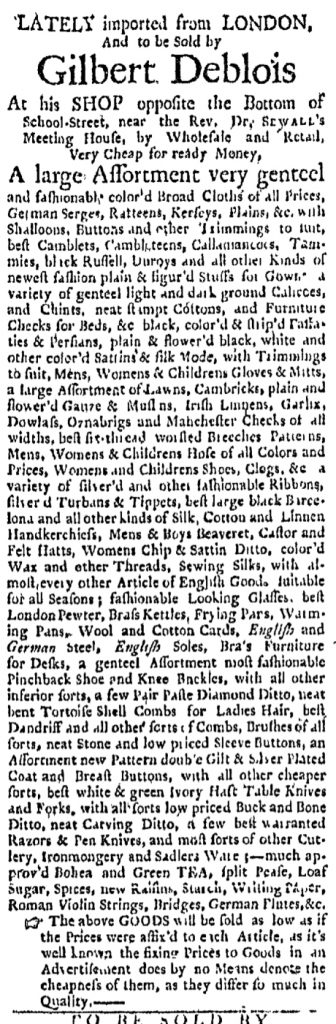
“The above GOODS will be sold as low as if the Prices were affix’d to each Article.”

Eighteenth-century advertisers rarely indicated specific prices for their merchandise, though they frequently proclaimed that they charged “reasonable rates” or offered discounts for purchasing by volume. Shopkeeper Gilbert Deblois stated that he sold the “large Assortment” of goods he stocked “Very Cheap for ready Money.” He made this promise in what might be considered the header of his advertisement that appeared before an extensive list detailing his inventory. Advertisements placed by retailers commonly featured some sort of header that included the advertiser’s name and location, announced that their wares had been recently imported, and made general appeals to price, quality, and fashion.

Deblois augmented his standard assurance that customers could expect “Very Cheap” prices with a note that explained why he did not specify any particular prices. “The above goods,” he asserted, “will be sold as low as if the Prices were affix’d to each Article.” He further explained, just in case potential customers were not already aware or needed to be reminded, that “it’s well known the fixing Prices to Goods in an Advertisement does by no Means denote the cheapness of them, as they differ so much in Quality.” Consumers would not find it useful, the shopkeeper argued, to review the prices in an advertisement before visiting his shop. They needed to examine the merchandise to assess its quality for themselves in order to determine that any price was indeed “Very Cheap.”

This clarification may help to explain why so few advertisers announced specific low prices as a means of attracting potential customers, a significant difference between eighteenth-century methods and modern marketing practices that often rely on advertising particular prices. In an era before major manufacturers mass produced products that carried brand names associated with well known reputations, both retailers and, especially, consumers may have considered listing specific prices in advertisements meaningless, ineffective, and potentially misleading.